
A single filing error triggers a $25,000 IRS penalty. This fine applies even if your entity generates no income and owes zero tax. For international owners, the complexity of us company foreign shareholder reporting creates significant financial risk. You recognize the threat of automated IRS enforcement and the inefficiency of high accounting fees for standard documentation. It's a common challenge for those managing US entities from abroad.
This guide provides a clear path to compliance for the 2026 tax year. You'll master the specific requirements for foreign-owned US corporations and disregarded entities to eliminate penalty exposure. We'll define the $25,000 penalty triggers, clarify the distinctions between IRS forms, and establish a repeatable filing process. You can manage your reporting obligations with precision and maintain a cost-efficient workflow. We examine the essential filing deadlines, the broad definition of reportable transactions, and the specific documentation needed for a successful Form 5472 submission. This approach ensures your business remains compliant while minimizing administrative overhead.
Key Takeaways
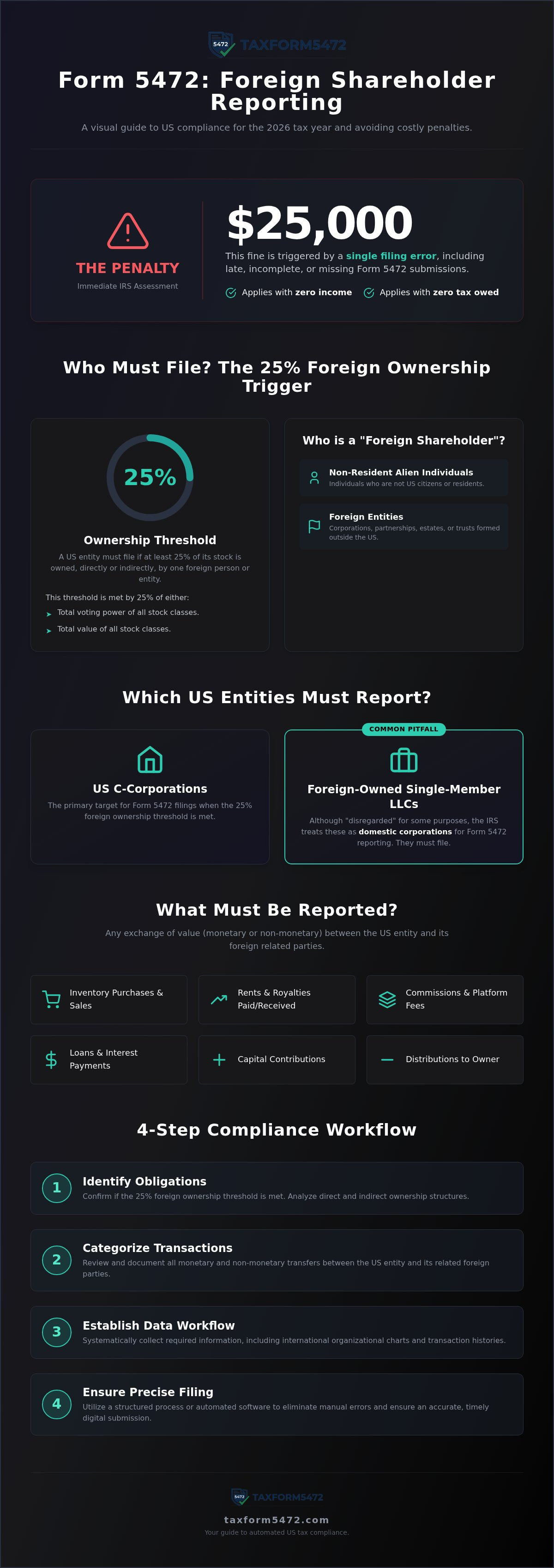
- Identify obligations for us company foreign shareholder reporting triggered by the 25% ownership threshold.
- Prevent the $25,000 IRS penalty assessed for late, incomplete, or missing Form 5472 filings.
- Categorize reportable transactions between related parties, including all monetary and non-monetary transfers.
- Establish a structured data collection workflow to verify international organizational charts and transaction history.
- Utilize automated software to eliminate manual entry errors and ensure a precise digital filing process.
Understanding US Reporting for Foreign Shareholders
IRS Section 6038A mandates us company foreign shareholder reporting. It targets entities with 25% or more international ownership. This threshold considers either total voting power or total value of all classes of stock. The IRS prioritizes this transparency to track capital flow. It's a tool to prevent profit shifting and tax base erosion. The 2026 compliance landscape requires absolute precision. Transparency is the IRS's primary objective for international tax enforcement. Failing to disclose shareholder identity triggers immediate scrutiny. The IRS uses automated systems to flag missing information. Once a failure is identified, the $25,000 penalty is assessed immediately. Non-disclosure isn't just an oversight; it's a high-cost compliance failure.
Defining the Foreign Shareholder
Identifying a foreign shareholder requires a broad lens. Foreign persons include several distinct categories:
- Non-resident alien individuals
- Foreign corporations and partnerships
- Foreign estates or trusts
Ownership analysis must include indirect and constructive rules. For example, if a foreign parent company owns a US subsidiary, the reporting obligation is clear. If ownership is split across multiple related foreign entities, the 25% aggregate still triggers the requirement. Understanding What is Form 5472? helps clarify these relationships. The identity of the reporting corporation depends on these specific ownership ties. You must look through layers of holding companies to find the ultimate foreign owner. Failure to map these relationships accurately leads to incomplete filings and subsequent penalties. The IRS requires the full identity and address of each 25% foreign shareholder to ensure complete transparency.
Applicable Entities: LLCs and Corporations
Standard US C-corporations with foreign owners are the primary targets. But the rules extend further. Single-member LLCs owned by a foreign person are "disregarded entities." For most tax purposes, they don't exist separately from the owner. For us company foreign shareholder reporting, the IRS treats them as domestic corporations. They must obtain an EIN and file Form 5472. This is a common point of failure. Many owners assume "disregarded" means "exempt." It doesn't. You can find more details in our Foreign Owned US Corporation Tax: 2026 Compliance Guide. Compliance is mandatory regardless of whether the entity generated US-source income. Even a dormant LLC must file if a reportable transaction occurred. This includes simple capital contributions, distributions, or paying administrative fees. The entity must report any transfer of property or money between the US entity and its foreign owner.
IRS Form 5472 and Section 6038A Requirements
Section 6038A governs the reporting of transactions between a US corporation and its foreign related parties. This regulation requires the submission of Form 5472 to disclose specific financial activities. Refer to the Official IRS Form 5472 guidance for technical specifications. The IRS uses this data to monitor transfer pricing and ensure arm's length transactions. Compliance involves more than reporting income. It covers any exchange of value. Precise us company foreign shareholder reporting depends on identifying every reportable event during the tax year. Automated IRS systems now flag missing data with high frequency.
Reportable Transactions Explained
Reportable events include non-cash exchanges. The IRS categorizes these into monetary and non-monetary transactions. Monetary transactions include sales of goods, rents, royalties, and interest. Non-monetary transactions include the exchange of intangible property or services without cash payment. You must report:
- Inventory purchases and sales
- Rents and royalties paid or received
- Commissions and platform fees
- Loans and interest payments
- Capital contributions and distributions
Even interest-free loans between a foreign owner and the US entity are reportable. For a detailed breakdown, see our guide on Reportable Transactions Form 5472: A 2026 Compliance Guide. Records must substantiate reported values. The IRS requires these documents to be available for inspection. Maintain clear ledgers for all related party activity to satisfy Section 6038A standards. Accurate us company foreign shareholder reporting requires a complete transaction history.
The Related Party Definition
The reporting obligation triggers when a transaction involves a related party. A related party is any 25% foreign shareholder. It also includes any person or entity related to the reporting corporation or the 25% foreign shareholder under Section 267(b) or 707(b)(1). Common control is a key factor. If the same group of individuals owns multiple international entities, those entities are related. Family attribution rules also apply. Ownership by a spouse, sibling, or ancestor can be attributed to the individual. This broad definition prevents owners from bypassing reporting through complex corporate structures. You can prepare your filing online to centralize your compliance data. Digital interfaces ensure every related party transaction is captured before submission. Use a structured workflow to identify these parties early in the tax year.
Compliance Risks and the $25,000 Penalty
The financial risk associated with us company foreign shareholder reporting is severe. Since the Tax Cuts and Jobs Act of 2017, the base penalty for failure to file Form 5472 is $25,000. This amount applies per form, per tax year. If a corporation has three foreign related parties and fails to report transactions with each, the initial assessment reaches $75,000. The IRS doesn't require tax liability to assess these fines. Even a zero-income entity faces the same exposure if it misses its filing obligations. It's a binary compliance trigger.
The IRS identifies non-compliance through automated data matching. U.S. banks report foreign-owned accounts to the Treasury under existing regulations. If these accounts show activity without a corresponding Form 5472, the system flags the entity for enforcement. International information exchange treaties also provide the IRS with data on foreign shareholders. Once the IRS issues a notice of failure, a 90-day clock starts. If you don't file within this window, the penalty increases by $25,000 for every 30-day period. There's no upper limit on these additional charges. The compounding nature of these fines can bankrupt a small enterprise within months.
Common Filing Mistakes to Avoid
Errors often stem from misunderstanding "reportable transactions." Many owners disclose cash transfers but omit non-monetary property exchanges or intercompany services. Incomplete disclosure is legally treated as a failure to file. Foreign-owned disregarded entities (LLCs) are particularly vulnerable. These owners often assume their "disregarded" status exempts them from corporate reporting. It doesn't. If you discover an error, act immediately. Review our guide on How to Amend Form 5472: Avoiding the $25,000 Late Filing Penalty. Precision in the initial filing is the only way to ensure 2026 compliance. Consult the IRS Instructions for Form 5472 to verify specific line-item requirements before submission.
Managing IRS Audits and Inquiries
IRS investigations into foreign ownership often begin with a notice of inquiry. Triggers include mismatching data between Form 1120 and Form 5472. Large capital contributions without supporting documentation also invite scrutiny. Respond to every IRS notice within the stated timeframe. Silence is interpreted as continued non-compliance and accelerates penalty assessment. Maintain professional record-keeping standards for at least seven years. Digital ledgers should track:
- Bank statements for all related party transfers
- Signed loan agreements and interest schedules
- Invoices for intercompany services and royalties
- Organizational charts showing 25% ownership tiers
Robust documentation is your primary defense during an audit. It supports a "reasonable cause" argument if you need to contest a penalty. Without records, the IRS has the authority to adjust your taxable income based on their own estimates. This leads to additional tax, interest, and secondary penalties. Precise us company foreign shareholder reporting requires a proactive, documented approach to every international transaction.
Preparation Workflow for the 2026 Tax Year
Effective us company foreign shareholder reporting begins with a comprehensive data audit. Don't wait for tax season. Gather all transaction records from the preceding year. Review international organizational charts for accuracy. Even minor ownership changes trigger new filing requirements. If a foreign stake crossed the 25% threshold mid-year, you must report their identity and all subsequent transactions. Document these changes with corporate resolutions or updated stock ledgers immediately.
Coordination with the primary corporate return is critical. Form 5472 is technically an attachment to Form 1120. For foreign-owned disregarded entities, the process is unique. You must file a pro forma Form 1120 with Form 5472 attached. This filing cannot be submitted electronically; it requires fax or certified mail. Ensure the business name and EIN match exactly across all documents. Any inconsistency leads to processing delays. You can prepare your 2026 compliance forms through our digital interface to ensure data accuracy and consistency.
Required Information Checklist
Accurate filing requires specific identifiers for all related parties. You must provide the legal name, address, and country of citizenship or organization for each foreign owner. Missing data points render the form "substantially incomplete," which the IRS treats as a failure to file. Required data includes:
- Foreign shareholder EIN, ITIN, or foreign taxpayer identification number
- Summary of all monetary exchanges, including sales, rents, and loans
- Description and estimated value of non-monetary property transfers
- Principal business activity codes for the reporting corporation
For a complete technical checklist, view our IRS Form 5472 Filing: 2026 Compliance and Automation Guide. This resource details the specific documentation needed for each transaction type to satisfy IRS auditors.
Filing Deadlines and Extensions
The 2026 filing season follows strict timelines. For calendar-year corporations, the deadline is April 15, 2026. Fiscal-year entities must file by the 15th day of the 4th month following their year-end. If you need more time, file Form 7004 before the original due date. This grants a 6-month extension to October 15, 2026. The extension is automatic upon filing. It only covers the information return and doesn't extend the time to pay any federal income tax due.
The consequences of missing the extension deadline are absolute. The IRS assesses the $25,000 penalty immediately upon processing a late return. There's no warning. The system is programmed to flag any Form 5472 received after the deadline or extension date. If the failure continues for more than 90 days after notification, the IRS assesses an additional $25,000 every 30 days. Maintain a compliance calendar with multiple internal milestones to ensure you meet us company foreign shareholder reporting requirements without fail.
Streamlining Compliance with Automated Preparation
Manual entry is the primary cause of filing errors. For us company foreign shareholder reporting, even a typo in an EIN or a missing address triggers a "substantially incomplete" status. Automated preparation eliminates these risks through structured data validation. Software-as-a-service platforms provide a precise environment for documentation. This approach ensures your 2026 filing meets every technical requirement without the overhead of manual review. Automation acts as a safeguard against the $25,000 penalty. It standardizes data entry across all related party transactions. High-volume entities benefit from bulk processing capabilities. This ensures that every foreign shareholder relationship is documented with identical precision. Don't rely on manual review for high-stakes compliance.
Automation vs. Traditional Methods
Traditional CPA firms often charge high fees for routine documentation preparation. These legacy services rely on billable hours and manual workflows. Automated tools offer a faster, more accurate alternative. Speed is essential when managing multiple international entities. You can process complex transaction data in minutes rather than days. This reduces the burden on internal accounting teams. For a deeper look at these benefits, see our Automated Form 5472 Preparation: 2026 Efficiency and Compliance Guide. Cost-efficiency is a primary driver for moving to automated preparation. Software-as-a-service models offer predictable costs. This allows for better budget management. You pay for the specific filing service rather than general consulting hours. This results-oriented approach aligns with modern business practices. It eliminates the friction of scheduling meetings and waiting for manual drafts. The software doesn't overlook technical details that human reviewers might miss. You maintain control over the timeline and the data accuracy.
Filing Through taxform5472.com
taxform5472.com provides a minimalist, utilitarian interface for international investors. It's designed for results-oriented professionals who value efficiency. The platform focuses exclusively on Form 5472 compliance. This specialization ensures a streamlined digital workflow. You submit your documentation through a secure interface. The system formats the data for direct submission to the IRS. It handles the unique requirements for both US corporations and foreign-owned disregarded entities. This is critical for entities that cannot file electronically. The platform generates IRS-ready documents for fax or certified mail. Data security is prioritized through encrypted transfers and professional-grade infrastructure. You maintain a digital record of all filings for future audit defense. This professional support ensures your us company foreign shareholder reporting remains accurate and cost-efficient for the 2026 tax year. The platform serves as a precise tool for maintaining your corporate standing without unnecessary administrative weight.
Securing 2026 Compliance Status
Compliance for the 2026 tax year requires immediate, decisive action. The IRS now utilizes sophisticated data-matching systems to identify gaps in us company foreign shareholder reporting. A single missing or incomplete form triggers an automatic $25,000 penalty. These assessments apply regardless of tax liability or income levels. You've mastered the identification of reportable transactions and the technical requirements of Section 6038A. Precision in your documentation is the only reliable defense against compounding monthly fines and federal scrutiny.
Transitioning to a digital workflow eliminates the risks inherent in manual entry. Our specialized Form 5472 automation ensures your documentation meets current IRS standards with absolute accuracy. You can secure your entity's standing while significantly reducing professional fees and administrative burdens. The professional compliance interface is designed for international business owners who value efficiency and results. Maintain your corporate standing through a streamlined, utilitarian process. Automate your Form 5472 filing now to protect your business and avoid $25,000 penalties. You're ready to manage your US reporting obligations with total confidence.
Frequently Asked Questions
Who is considered a 25% foreign shareholder for Form 5472?
A 25% foreign shareholder is any foreign person owning at least 25% of the voting power or total value of the US corporation. This includes individuals, foreign companies, and trusts. The IRS applies constructive ownership rules to identify these parties through complex holding structures. Accurately identifying these owners is the first step in us company foreign shareholder reporting. Failure to disclose a qualifying shareholder triggers the $25,000 penalty immediately.
Does a foreign-owned LLC need to file Form 5472 if it has no income?
Yes, filing is mandatory regardless of income. Foreign-owned single-member LLCs are disregarded for income tax but treated as corporations for reporting. Any reportable transaction, such as a capital contribution or payment of formation fees, triggers the requirement. This is a common point of non-compliance. The IRS requires a pro forma Form 1120 with Form 5472 attached. Missing this filing leads to the standard $25,000 penalty assessment.
What is the penalty for late filing of Form 5472 in 2026?
The initial penalty is $25,000 per required form. This fine applies even if no tax is owed by the entity. If the failure persists more than 90 days after an IRS notice, additional penalties of $25,000 are assessed every 30 days. There's no maximum limit for these continuation penalties. Automated systems now flag late submissions and issue these assessments without human intervention. Timely filing is the only way to avoid these costs.
Can I file Form 5472 electronically without a CPA?
You can file Form 5472 without a CPA by using specialized automated preparation platforms. These tools ensure data accuracy and IRS-ready formatting. Note that foreign-owned disregarded entities must file via fax or certified mail because the IRS doesn't permit electronic filing for these specific entities. Corporations filing a standard Form 1120 may submit electronically. Using a digital interface ensures your us company foreign shareholder reporting is precise and compliant.
What are reportable transactions under Section 6038A?
Reportable transactions include any transfer of money or property between the US company and its foreign owners. Common examples are sales of goods, rents, royalties, and platform fees. Financial transactions like loans, interest payments, and capital distributions are also included. Even non-monetary exchanges of intangible property must be disclosed. The IRS uses this data to monitor transfer pricing. Precise documentation for every related party exchange is required for federal compliance.
How do I identify related parties for US tax reporting?
Related parties include any 25% foreign shareholder and persons related to them under Section 267(b) or 707(b)(1). This definition extends to entities under common control. If the same group owns multiple international companies, those companies are related. Family attribution rules also apply to ownership interests. You must review your entire organizational structure to identify every related party. Transactions with these parties must be reported on separate Form 5472 submissions to the IRS.
Is there an extension available for Form 5472 filing?
Yes, an automatic 6-month extension is available by filing Form 7004. This must be submitted by the original due date of the return. For calendar-year entities, this extends the 2026 deadline from April 15 to October 15. The extension only applies to the information return and doesn't grant more time to pay taxes. Missing the extended deadline results in the immediate assessment of the $25,000 failure-to-file penalty. Plan your filing schedule accordingly.
What records must a foreign-owned US company maintain?
Foreign-owned entities must maintain records that support the values reported on Form 5472. This includes bank statements, signed loan agreements, and invoices for intercompany services. You should also keep updated organizational charts and stock ledgers. These records must be available for IRS inspection upon request. Documentation should be retained for at least seven years to mitigate audit risks. Professional record-keeping is the primary defense against IRS inquiries and penalty assessments.