

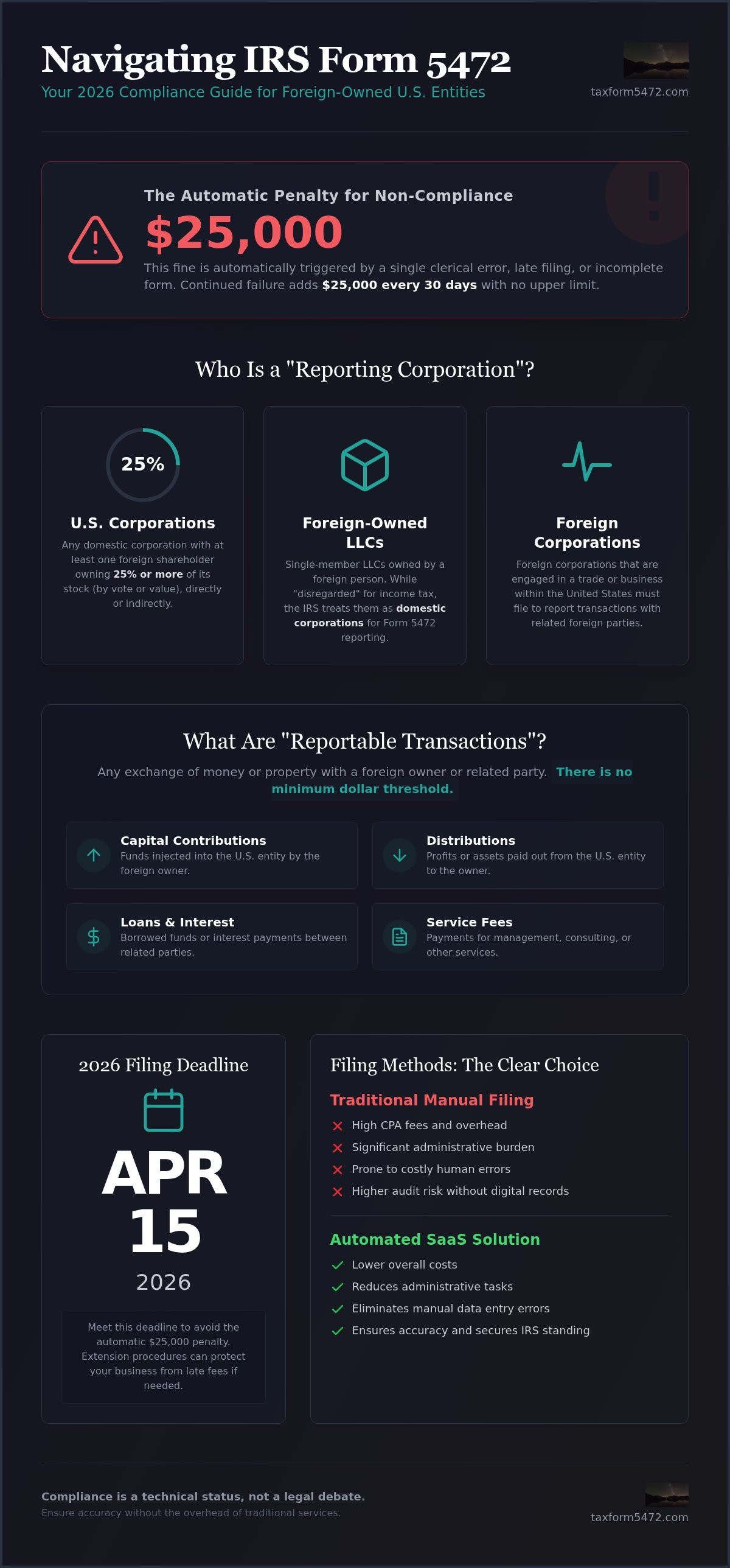
A single clerical error during your IRS Form 5472 filing now triggers an automatic $25,000 penalty. This fine is a standard IRS procedure. It's not a rare event. You're likely tired of dense IRS instructions. Traditional CPA fees are high. The administrative burden is significant. The fear of a $25,000 mistake is valid.
This guide ensures you meet IRS reporting mandates. You'll learn how to manage your 2026 compliance with speed. Automation removes human error. This process lowers costs. It secures your standing with the Treasury. Compliance is a technical status, not a legal debate. You need accuracy without the overhead of traditional services.
We'll examine the April 15, 2026, deadline. We'll detail the requirements for foreign-owned disregarded entities. You'll see how automated tools replace expensive manual work. We'll outline the exact steps to submit your forms without delay. We'll also cover extension procedures to protect your business from late fees. Let's get to work.
Key Takeaways
- Confirm filing status for U.S. entities with 25% or more foreign ownership.
- Identify all reportable transactions to ensure complete compliance with Section 6038A.
- Streamline your IRS Form 5472 filing using automated tools to remove the risk of manual errors.
- Meet the April 15, 2026, deadline to avoid the automatic $25,000 non-compliance penalty.
- Utilize professional SaaS solutions to reduce administrative burden and ensure submission accuracy.
The IRS Form 5472 Reporting Mandate
IRS Form 5472 tracks transactions between U.S. corporations and foreign owners. It serves as a primary tool for federal oversight. If a domestic corporation has at least one 25% foreign shareholder, filing is mandatory. This threshold applies to direct or indirect ownership. Foreign corporations engaged in a U.S. trade or business must also comply. It's a critical component of your annual IRS Form 5472 filing obligations.
The mandate identifies "reportable transactions" with high precision. These include any exchange of money or property. Common examples include capital contributions, loans, and payments for services. There is no minimum dollar threshold for reporting. Even small transfers require disclosure. The IRS goal is total visibility into foreign capital moving through the U.S. financial system. Failure to disclose these movements results in immediate enforcement action.
Section 6038A Compliance Standards
Internal Revenue Code Section 6038A establishes these information return requirements. It focuses on related party transaction transparency. The IRS uses this data to prevent tax avoidance and profit shifting. For the 2026 tax year, the agency is increasing its scrutiny of international entities. Refer to this IRS Form 5472 Overview to understand the foundational purpose of these regulations.
Compliance involves more than just submitting a form. You must maintain permanent books of account. Records must support every data point reported on the return. The IRS requires these documents to be available for inspection at all times. Failure to produce them upon request is a direct violation. Enforcement priorities for 2026 center on high-frequency transactions between related parties. Entities that lack digital record-keeping face higher audit risks.
- Domestic Corporations: 25% foreign-owned entities.
- Disregarded Entities: Foreign-owned single-member LLCs.
- Foreign Corporations: Those with U.S.-based business operations.
The $25,000 Non-Compliance Penalty
The IRS assesses significant penalties for non-compliance. The initial fine is $25,000. This occurs if you fail to file on time or submit an incomplete form. Accuracy is vital. A return that lacks required details is treated as unfiled. The penalty applies to each required IRS Form 5472 filing per year. If you have multiple related parties, these fines multiply quickly.
Continued failure leads to compounding costs. If the IRS notifies you of a failure and you don't respond within 90 days, additional charges begin. The agency adds $25,000 for every 30-day period. There is no ceiling on these accumulation totals. Proactive filing is the only way to mitigate this risk. Automation helps maintain this status by ensuring logic and consistency in every submission. It removes the human error that often triggers these automatic assessments.
Determining Your 2026 Filing Requirements
Identifying your status as a "Reporting Corporation" is the first step. This designation triggers the mandatory IRS Form 5472 filing process. The IRS applies this label to U.S. corporations with significant foreign ownership. It also includes foreign corporations conducting business within the United States. Accuracy at this stage prevents the $25,000 penalty mentioned previously. Requirements are strict and leave little room for interpretation.
The 25% Ownership Threshold
A corporation becomes a Reporting Corporation when at least one foreign person owns 25% or more of its stock. This ownership is measured by total combined voting power or the total value of all classes of stock. The IRS uses complex attribution rules. These rules count stock owned by family members or related entities toward your total percentage. You must look through layers of ownership to find the ultimate beneficial owner.
Direct and indirect ownership both count. If a foreign parent company owns a U.S. subsidiary, the subsidiary is a Reporting Corporation. If a foreign individual owns 25% of a foreign company that, in turn, owns a U.S. entity, the threshold is met. Detailed guidance is available in the Official IRS Instructions for Form 5472. Reviewing these instructions ensures you don't overlook "indirect" owners who trigger the filing mandate.
Foreign-Owned Disregarded Entities (LLCs)
Foreign-owned single-member LLCs face unique challenges. For income tax, these are "disregarded entities." For information reporting, the IRS treats them as domestic corporations. This means an LLC with no U.S. tax liability may still have a filing requirement. Even with zero taxable income, you must report transactions with your foreign owner. Common reportable events include:
- Capital Contributions: Funds injected by the foreign owner.
- Distributions: Profits or assets paid out to the owner.
- Loans: Borrowed funds or interest payments.
- Service Fees: Payments for management or consulting.
Compliance requires a valid Employer Identification Number (EIN). You can't file without one. Many foreign owners realize this too late. If your LLC has reportable transactions, you must file Form 5472 and a pro forma Form 1120. Exceptions to these rules are narrow. They usually apply only when a foreign corporation has no permanent establishment in the U.S. or when all transactions are already reported by another entity. Most foreign-owned U.S. structures won't qualify for these exceptions.
Managing these variables manually is time-consuming. You can simplify your IRS Form 5472 preparation through a dedicated automation platform. This ensures your entity classification and ownership percentages are handled with precision.
Reportable Transactions and Record Maintenance
Compliance hinges on accurate disclosure. Any exchange of value between the reporting corporation and a related party requires an entry in your IRS Form 5472 filing. The IRS defines these exchanges broadly. It includes both monetary and non-monetary transfers. There is no minimum dollar amount. Even a $1 transaction must be reported to maintain compliance status.
Monetary vs. Non-Monetary Exchanges
Monetary transactions are the most frequent. These involve direct cash transfers or financial obligations. Sales of inventory and tangible property fall into this category. You must also report rents paid for office space or equipment. Royalties for intellectual property and interest payments on intercompany loans are equally critical. Accuracy in these figures is essential for audit readiness.
Non-monetary exchanges are often overlooked. These involve the transfer of value without cash. Examples include in-kind transfers of assets or cost-sharing arrangements. Providing services without a fee or allowing a related party to use company property at no cost are reportable events. The IRS views these as economic benefits that must be disclosed. For a complete list of these categories, consult the Official IRS Form 5472 Information page. This ensures no transaction type is missed during your preparation.
Related Party Definitions
A "related party" extends beyond the 25% foreign shareholder. It includes any person or entity that has a direct or indirect relationship with the reporting corporation. Affiliates and subsidiaries under common control qualify. The IRS uses specific tests to determine this status. If one entity controls another, or if both are controlled by the same interest, they're related. This definition captures a wide network of global operations.
- Direct Shareholders: Any foreign person owning 25% or more.
- Affiliated Entities: Companies within the same corporate group.
- Common Control: Entities managed by the same decision-makers.
Record maintenance is a statutory requirement. You must keep documents that prove every transaction reported. This includes bank statements, contracts, and invoices. The IRS can request these records during an audit at any time. If you fail to file, the statute of limitations for the related tax return remains open indefinitely. The IRS can assess taxes and penalties years after the tax year ends. Organized digital records are the best defense against such risks. Automation ensures that your IRS Form 5472 filing data matches your internal records perfectly. It removes the guesswork from record retention.
The 2026 Filing Process and Deadlines
The 2026 filing process requires technical precision. Form 5472 isn't a standalone document. You must attach it to a corporate income tax return, typically Form 1120. For foreign-owned disregarded entities, this involves a "pro forma" Form 1120. This document includes only basic entity information with "Foreign-owned U.S. DE" written at the top. Electronic filing is the preferred IRS method for most corporations. It provides immediate receipt confirmation. This confirmation is your primary defense against claims of non-filing. Every IRS Form 5472 filing must be complete and accurate to be considered valid by the Treasury.
Foreign-owned disregarded entities face a specific hurdle. They cannot e-file Form 5472. These entities must file by mail or fax. The paper filing goes to the Internal Revenue Service in Ogden, Utah. Specifically, use the address at 1973 Rulon White Blvd, M/S 6112. You can also use the dedicated fax line at 855-887-7737. This manual requirement increases the risk of delivery failure. You must maintain proof of transmission. A fax confirmation or certified mail receipt is essential for your records. Don't rely on standard postage without tracking for these high-stakes documents.
Critical 2026 Due Dates
For calendar year corporations, the deadline is April 15, 2026. This date is firm. Fiscal year corporations have different requirements. Their deadline is the 15th day of the fourth month after their tax year ends. If your fiscal year ends June 30, your filing is due October 15. The IRS follows a timely mailing rule. A postmark on or before the due date counts as a timely submission. However, digital submission for eligible entities removes the risks associated with postal delays. Missing these dates triggers the automatic $25,000 penalty discussed in previous sections.
Extension Procedures
You can obtain more time by filing Form 7004. This request must be submitted by the original filing deadline. It provides an automatic six-month extension. For calendar year entities, the new deadline becomes October 15, 2026. This extension applies to both the corporate return and the attached Form 5472. An extension provides additional time to gather data. It doesn't grant immunity from penalties if the eventual filing is incomplete. Accuracy remains the priority. You must file the extension correctly to ensure the IRS recognizes the new date. Errors on Form 7004 can lead to a rejected extension and immediate penalty assessment.
Manual tracking of these dates is inefficient and risky. You can automate your IRS Form 5472 filing to ensure every deadline is met without administrative friction.
Automated IRS Form 5472 Filing Solutions
Manual preparation increases error and penalty risk. Human oversight often fails during complex data entry. A single missing EIN or miscalculated transaction triggers the $25,000 fine. Traditional accounting firms rely on manual processes. These are slow and expensive. Digital platforms provide a streamlined alternative. They prioritize accuracy and speed. Your IRS Form 5472 filing deserves a specialized, professional tool.
Software vs. Manual Preparation
Error-checking algorithms are the core of automated solutions. They scan reportable transactions for inconsistencies. If a distribution is entered without a corresponding capital account update, the system flags it. This level of detail is difficult to maintain manually. SaaS platforms provide a low administrative burden. You spend less time on paperwork and more on business operations. The cost-efficiency is significant. You pay for the result, not the consultant's hourly rate. Rapid turnaround is a standard feature. Even urgent deadlines are manageable with automated workflows. This ensures Section 6038A compliance without the traditional overhead of manual reviews.
Taxform5472.com Platform Features
The taxform5472.com platform is a modern utility for international entities. It bridges the gap between complex IRS mandates and user intent. The interface is intuitive for foreign owners who may not be familiar with U.S. tax jargon. It guides you through the specific requirements for disregarded entities. You can submit all necessary data through a secure portal. This ensures your IRS Form 5472 filing is logically consistent with your pro forma Form 1120.
Professional compliance management is the primary goal. The platform provides a centralized hub for all your filing records. You can access previous submissions at any time. This is vital for maintaining the record maintenance standards discussed earlier. The platform manages the technical requirements. You receive instant confirmation once your data is processed. This removes the uncertainty of traditional mail. Secure encryption protects your sensitive corporate data. It's a utilitarian approach to a high-stakes requirement.
Start Your Form 5472 Filing Now
Digital platforms streamline international data entry by standardizing inputs. They account for different currency formats and entity structures. This global scope is essential for modern businesses. Automation provides the quiet confidence that your business is protected. It's an anticipatory service that solves problems before they become penalties. Efficiency is not an option; it's a requirement for 2026 compliance. Every automated submission is a step toward total regulatory security.
Secure Your 2026 Compliance Status
Compliance is a technical status. It's not a matter of interpretation. You've seen the risks of manual oversight. The $25,000 penalty for a single error is real. It's automatic. It's avoidable. You must identify every reportable transaction with precision. Maintain your digital records. Meet the April 15, 2026, deadline without friction. Proactive management protects your U.S. operations. It ensures long-term corporate security. You've learned how to navigate these mandates efficiently.
Efficiency is the professional standard. You don't need expensive consulting fees. You don't need slow manual reviews. Automated tools provide logical consistency. They offer global accessibility. They reduce your total administrative weight. You get fast submissions. You get guaranteed accuracy. This is the most reliable way to manage your IRS Form 5472 filing requirements. It's a utilitarian solution for a complex federal mandate.
Use a specialized platform to remove human error. Automate Your IRS Form 5472 Filing now to secure your standing with the IRS. Our tool provides automated error reduction and professional results. It's built for foreign owners who value their time. Get to work on your 2026 submission today. Your business is ready for the upcoming tax season.
Frequently Asked Questions
What is the penalty for not filing Form 5472 in 2026?
The penalty for failing to file a timely and accurate Form 5472 is $25,000 per required form. This fine applies to each year the filing remains outstanding. It includes situations where the form is late, incomplete, or contains inaccurate data. If the failure continues for more than 90 days after IRS notification, additional $25,000 penalties apply every 30 days. There is no maximum limit.
Does a foreign-owned LLC with no income need to file Form 5472?
Yes, a foreign-owned disregarded entity with no U.S. taxable income must still complete an IRS Form 5472 filing if it had reportable transactions. This includes capital contributions or payments for services between the LLC and its owner. The filing mandate is based on information disclosure rather than tax liability. Failure to report these non-income transactions triggers the standard $25,000 penalty.
Can I file Form 5472 separately from my tax return?
No, Form 5472 must be filed as an attachment to your corporate tax return. For most entities, this is Form 1120. Foreign-owned disregarded entities use a "pro forma" Form 1120 to satisfy this requirement. Submitting the form on its own is considered an incomplete filing. The IRS may treat separate submissions as unfiled and assess the full penalty for non-compliance.
How far back can the IRS go for unfiled Form 5472?
The statute of limitations remains open indefinitely for any tax year where Form 5472 was not filed. This allows the IRS to assess taxes and penalties at any time in the future. The standard three-year limit does not apply to unfiled information returns. Maintaining digital records is the best way to prove compliance if the IRS audits your historical filings later.
Is there an extension for Form 5472 filing?
Yes, you can obtain an automatic six-month extension by filing Form 7004. This request must be submitted by the original April 15, 2026, deadline for calendar-year corporations. The extension moves the final due date to October 15, 2026. This additional time applies to the IRS Form 5472 filing and the attached corporate return. It does not waive penalties for previous years.
What counts as a reportable transaction for Form 5472?
A reportable transaction is any exchange of money or property between the reporting corporation and a related foreign party. This includes sales, rents, royalties, and interest payments. It also covers capital contributions and loans with no minimum dollar threshold. Even non-monetary transfers, such as the use of intangible assets or service fees, must be disclosed. Total transparency is the primary goal.
Who is considered a 25% foreign shareholder?
A 25% foreign shareholder is any foreign person who owns at least 25% of the total voting power or value of all classes of stock. This includes direct and indirect ownership through other entities or family members. The IRS uses specific attribution rules to calculate these percentages. You must identify the ultimate beneficial owner to determine if your entity meets this mandatory reporting threshold.
Can I file Form 5472 online?
Domestic corporations can file Form 5472 online when e-filing their corporate tax return. However, foreign-owned disregarded entities are currently prohibited from e-filing. These entities must submit their forms via mail or fax to the IRS center in Ogden, Utah. Automation tools can prepare the necessary paper documents for these entities to ensure accuracy before manual submission occurs.