

The IRS assesses a $25,000 penalty for a single filing error. This applies even if your company has no income. Determining who must file form 5472 is a critical task for every foreign-owned US entity. Compliance is not optional. The cost of an oversight is too high. You cannot afford a mistake. Every transaction counts toward your total liability.
IRS definitions are complex. You likely find ownership calculations and transaction reporting requirements frustrating. The fear of a $25,000 minimum penalty is a valid concern. You need certainty regarding your legal obligations. Ambiguity in these filings leads to significant financial exposure. Proper identification is the only way to mitigate this risk. Clear information is your best defense against federal audits.
This article identifies your specific 2026 filing requirements. You'll understand the exact criteria for reporting corporations and disregarded entities. We define reportable transactions and ownership thresholds clearly. This guide provides a definitive path to compliance. You can confirm your status and secure your business against IRS penalties. Use this information to meet your obligations efficiently and avoid costly administrative delays.
Key Takeaways
- Define "reporting corporation" status using the 25% foreign ownership threshold.
- Identify who must file form 5472 based on specific transactions between related parties.
- Mitigate the $25,000 minimum penalty by adhering to 2026 filing deadlines.
- Distinguish between monetary and non-monetary triggers to ensure reporting accuracy.
- Navigate filing requirements for domestic corporations and foreign-owned disregarded entities.
Reporting Corporation Criteria and Definitions
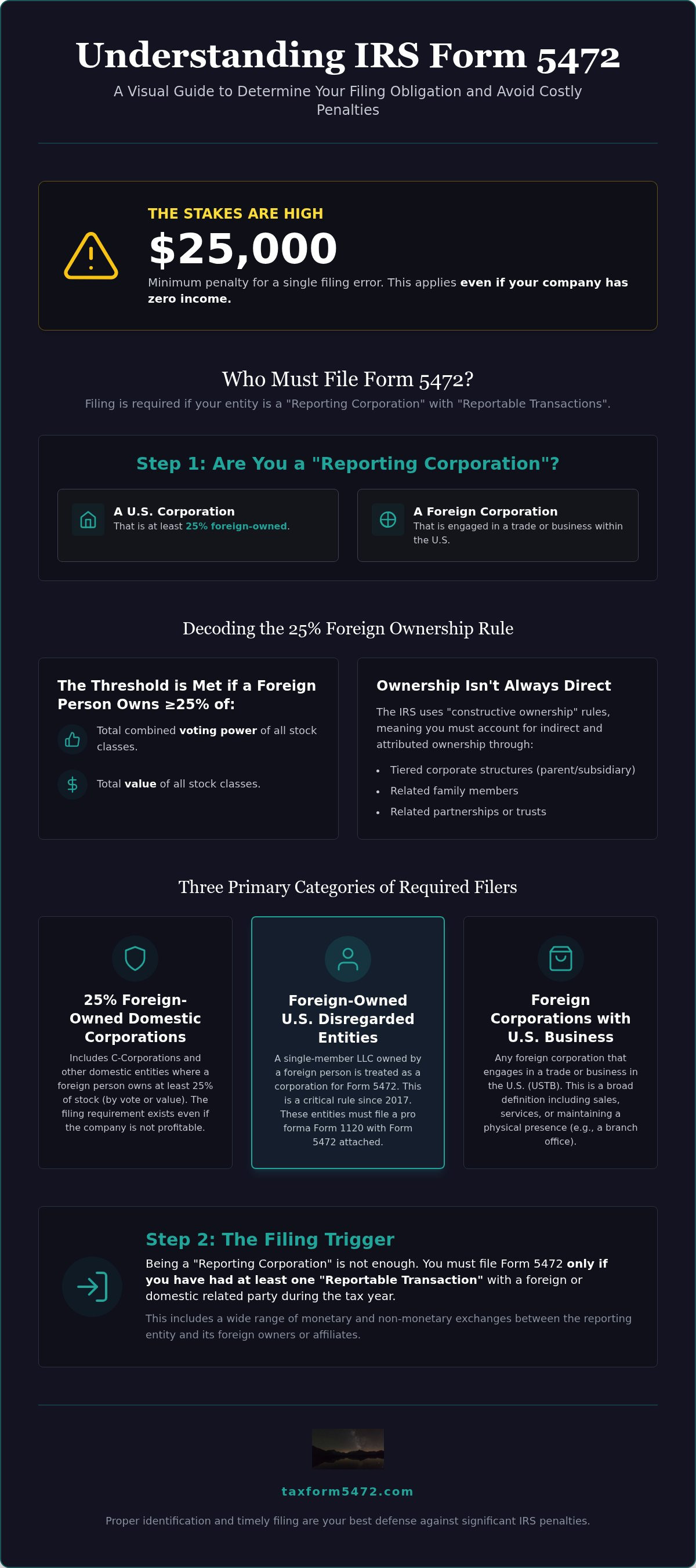
The IRS mandates disclosure for specific entities under Section 6038A. This category primarily includes two groups. The first is any U.S. corporation that is at least 25% foreign-owned. The second is any foreign corporation engaged in a U.S. trade or business. Determining who must file form 5472 starts with this classification. Compliance is a binary status. You either meet these criteria or you don't. This Form 5472 Overview details the historical context of these transparency requirements. Use these definitions to audit your current corporate standing.
The 25% Foreign Ownership Rule
Ownership is measured through two distinct lenses. You must calculate the total combined voting power of all stock classes. You must also calculate the total value of all stock classes. If a foreign person holds 25% or more of either, the entity is a reporting corporation. A "Foreign Person" includes any individual who isn't a citizen or resident of the U.S. It also includes foreign partnerships, foreign corporations, and foreign estates or trusts. Even a single-member LLC owned by a foreign individual is treated as a corporation for these purposes. Precision in these calculations is mandatory to avoid the $25,000 penalty.
A 25% foreign-owned corporation is a domestic entity where one foreign person owns at least 25% of the total voting power or value of all classes of stock at any time during the tax year.
Direct vs. Indirect Ownership
Ownership isn't always a straight line. The IRS applies "constructive ownership" rules to prevent entities from hiding behind tiered structures. This means you must account for indirect ownership through other companies. If a foreign individual owns a foreign corporation that owns a U.S. entity, the U.S. entity remains a reporting corporation. Attribution rules under Section 318 further complicate this. Stock owned by certain family members or related entities is often attributed to the foreign person. Understanding who must file form 5472 requires a deep dive into your entire organizational chart.
Complex parent-subsidiary chains are a common focus for IRS audits. The reporting obligation flows upward through every layer of ownership. If your U.S. company is part of a global group, you likely have a filing requirement. Don't assume that an intermediary company shields you from disclosure. Every entity in the chain must be evaluated against the 25% threshold. Identifying the ultimate foreign owner is the final step in confirming your compliance status. This clarity ensures your filings remain accurate and defensible.
Three Primary Categories of Required Filers
Identifying who must file form 5472 requires categorizing your entity type correctly. The IRS targets three primary groups to ensure transparency in cross-border financial activity. These include domestic corporations with 25% foreign ownership, foreign corporations with U.S. operations, and foreign-owned disregarded entities. Additionally, Section 6038C extends these requirements to foreign corporations engaged in a U.S. trade or business. This ensures that foreign entities operating through U.S. branches maintain the same level of transparency as domestic subsidiaries.
Domestic corporations are the most frequent filers. If a foreign person owns 25% of the voting power or stock value, the entity is a reporting corporation. This rule applies to C-Corporations and entities that have elected corporate taxation. It's a structural requirement that exists regardless of the company's profitability or operational scale during the year. You must evaluate this status annually to account for changes in shareholder composition. Don't assume that a lack of profit exempts you from these rules.
Foreign-Owned US Disregarded Entities
Single-member LLCs are typically "disregarded" for federal income tax purposes. However, Treasury Regulations Section 301.7701-2(c)(2)(vi) treats these entities as corporations for Form 5472 reporting. This regulation closed a significant transparency gap in 2017. Even if your LLC has zero U.S.-source income, you likely have a filing obligation. These entities must file a pro forma Form 1120 with Form 5472 attached. The trigger is the existence of a reportable transaction, not the generation of profit. Failing to recognize this status leads to the mandatory $25,000 penalty.
Foreign Corporations with US Trade or Business
Foreign corporations are reporting corporations if they engage in a U.S. trade or business (USTB). This definition is broad. It includes providing services, selling products, or maintaining a physical presence in the U.S. Branch operations of foreign companies are primary targets for this requirement. Consult the Official IRS Form 5472 Instructions to verify specific activity thresholds. Reporting requirements persist even if a tax treaty reduces or eliminates the actual tax liability. A treaty-based return position doesn't waive the disclosure requirement. Accuracy is paramount in these filings.
Identifying who must file form 5472 involves reviewing your entity structure against these categories every tax season. Changes in ownership or business activity can trigger new obligations. If you identify a requirement, using a streamlined digital interface ensures your documentation meets current IRS standards. This proactive approach prevents the accrual of continuation penalties. Focus on these three categories to maintain a clean compliance record. It's the most efficient way to manage your international tax risk.
Reportable Transactions: The Filing Trigger
Ownership is only half the equation. A reporting corporation must also have a reportable transaction with a foreign related party. This related party status extends to the 25% foreign shareholder and any person related to that shareholder under IRS definitions. Determining who must file form 5472 requires a granular audit of all value exchanges. Even if no cash changes hands, the obligation likely remains. The IRS uses these disclosures to monitor cross-border capital flows. Missing a single transaction triggers the full $25,000 penalty.
Common Monetary Transactions
Cash movements are the most frequent triggers. These are usually identified through standard accounting records. You must report:
- Sales and purchases of inventory.
- Rents and royalties paid or received.
- Interest on loans and borrowings.
- Commissions and management fees.
Non-Monetary and 'Free' Transactions
The zero-dollar transaction reporting trap is a common compliance failure. Many owners assume no cash means no filing. This is incorrect. Non-monetary exchanges are equally reportable. These include:
- Capital contributions from a foreign owner.
- Capital distributions to a foreign owner.
- Exchange of services without payment.
- Transfer of intangible property rights.
Filing Exceptions and Statutory Exemptions
Identifying who must file form 5472 requires a precise review of statutory exceptions. Not every foreign-owned entity has an annual obligation. If you meet ownership thresholds but lack reportable activity, you're exempt from the requirement. These exemptions are strictly defined. They offer relief to specific corporate structures and transaction types. You must confirm your eligibility before the filing deadline to avoid the $25,000 penalty.
Possessions and Foreign Bank Exemptions
Certain entities qualify for categorical relief. US Possession corporations often bypass these requirements. This applies to entities organized in American Samoa, Guam, the Northern Mariana Islands, or the US Virgin Islands. These corporations must meet specific income and ownership conditions to maintain the exemption. Foreign banks also see specific exclusions. If a foreign bank lacks a permanent establishment in the US under a tax treaty, it may not need to file. Section 883 exemptions provide additional relief. This applies to foreign corporations operating international ships or aircraft. These entities must still meet rigorous documentation standards. Failure to provide proof of exemption triggers the standard penalty during an audit.
When No Reportable Transactions Occur
A corporation can be operational without meeting reporting triggers. This happens when no value moves between the US entity and its foreign related parties. You must distinguish between an active business and a reporting corporation. If your business only transacts with unrelated US vendors, you don't file. However, inactive LLCs remain a high-risk area. Owners often overlook small capital injections or service exchanges. If a foreign owner pays a filing fee for the LLC, a reportable transaction has occurred. This single event defines who must file form 5472 for that tax year. Dormancy isn't a guarantee of exemption.
There's no de minimis dollar threshold for Form 5472. A single transaction of any value creates a filing requirement. Some treaty-based exceptions exist. These apply if the reporting corporation is a foreign entity and all its reportable transactions are covered by another information return. Record-keeping is mandatory regardless of your filing status. You must preserve evidence of your exemption for at least three years. This prevents the $25,000 non-compliance penalty during a look-back audit. Maintaining a clean audit trail is the only way to prove you didn't meet the filing criteria.
Confirming your status is the first step toward compliance. Use this automated preparation platform to verify your exemption status and document your findings. This proactive approach secures your business against administrative errors. It ensures your records are ready for IRS inspection. Focus on these narrow exemptions to determine if your filing obligation is waived this year.
2026 Deadlines, Penalties, and Filing Procedures
Meeting deadlines is the final step for those who must file form 5472. For calendar-year corporations, the 2025 tax year filing is due April 15, 2026. This deadline aligns with the corporation's income tax return. Form 5472 must be attached to Form 1120. If your entity uses a fiscal year, the due date is the 15th day of the 4th month after the close of your tax year. Missing these dates triggers immediate regulatory scrutiny.
Key Dates and Extension Requests
Extensions are available via Form 7004. This provides an automatic six-month extension to October 15, 2026. You must submit the request on or before the original due date. An extension to file the tax return automatically extends the time to file Form 5472. This is a critical tool for managing complex ownership calculations. Fiscal year variations change these dates, so you must track your specific closing period. Failure to request an extension results in immediate non-compliance status after the April deadline.
The Cost of Non-Compliance
The Internal Revenue Service enforces a minimum penalty of $25,000 for failing to file a timely or complete Form 5472 during the 2026 tax year. This applies per form, per year. If the failure continues for more than 90 days after IRS notification, additional penalties accrue. You face an extra $25,000 for each 30-day period or part thereof. There is no maximum limit for these continuation penalties. A "reasonable cause" defense exists but requires substantial documentation. You must prove the failure wasn't due to willful neglect. For the 2026 filing season, the Internal Revenue Service enforces a minimum penalty of $25,000 for failing to file a timely or complete Form 5472.
Digital Filing Solutions
Submission methods vary by entity type. Foreign-owned disregarded entities cannot file electronically. These must be mailed or faxed to the specific IRS office in Ogden, Utah. Standard C-Corporations may file electronically as part of their 1120 package. Identifying who must file form 5472 is simpler with automated tools. Manual filing increases the risk of transcript errors and missing data fields. Software validation is the only way to ensure 100% accuracy before submission.
Using taxform5472.com streamlines this entire process. The SaaS platform provides a digital interface for automated preparation. It validates your data against current IRS requirements. This reduces the risk of incomplete forms and subsequent penalties. Software validation ensures all reportable transactions are captured correctly. Digital preparation is the most efficient path to compliance for foreign-owned US entities. Secure your filing status today to avoid the $25,000 penalty.
Secure Your 2026 Compliance Status
Determining who must file form 5472 is the first step in protecting your US entity from federal audits. You now understand that ownership thresholds and reportable transactions create a binary filing status. The $25,000 minimum penalty ensures that manual errors aren't acceptable. Compliance requires precision in every data field. Proactive preparation ensures your business remains in good standing with the IRS.
Manual IRS forms are prone to errors. Automated compliance is the most efficient solution for foreign-owned corporations and disregarded entities. Specialized tools validate your information against current regulations. A user-friendly digital interface removes the ambiguity of complex tax instructions. This streamlined approach saves time and secures your financial records.
Take control of your regulatory obligations now. Avoid the risk of daily accrual penalties through accurate documentation. Start your Form 5472 filing today to ensure automated IRS compliance. Your business is ready for the 2026 tax season.
Frequently Asked Questions
Does a foreign-owned LLC with no income need to file Form 5472?
Yes, income is not the reporting trigger for foreign-owned entities. You must file if the LLC had any reportable transactions during the year. This includes capital contributions to pay for formation fees or annual maintenance costs. Even with zero revenue, the movement of value between the owner and the entity creates an obligation. Identifying who must file form 5472 depends on these specific exchanges rather than profit generation.
What is the minimum penalty for not filing Form 5472 in 2026?
The minimum penalty is $25,000 for the 2026 filing season. This fine applies to every form that is late, incomplete, or inaccurate. The IRS assesses this amount per tax year. If the failure continues after the IRS issues a notice, additional penalties of $25,000 accrue every 30 days. There's no maximum limit on these continuation penalties. Compliance is the only way to avoid these significant financial risks.
Can I file Form 5472 separately from my corporate tax return?
No, you can't submit the form as a standalone document. It must be attached to the reporting corporation's income tax return. For standard corporations, this is Form 1120. Foreign-owned disregarded entities must submit a pro forma Form 1120 to carry the 5472 attachment. Both documents must be filed together to be considered valid by the IRS. Separate submissions are generally treated as a failure to file.
Who is considered a 25% foreign shareholder?
A 25% foreign shareholder is any foreign person owning at least 25% of the total voting power or value of all stock classes. This definition includes individuals, foreign corporations, and foreign partnerships. The IRS uses constructive ownership rules to calculate these percentages through tiered structures. Determining who must file form 5472 requires a deep analysis of both direct and indirect ownership to identify the ultimate foreign controllers.
What happens if I file Form 5472 late?
Late filing results in an immediate $25,000 penalty. The IRS provides a 90-day window to comply after they issue a notice of failure. Once this period expires, the penalty increases by $25,000 for every subsequent 30-day period. These charges continue to accrue without a ceiling. Filing a timely extension via Form 7004 is the only method to legally delay your submission and protect your business from these costs.
Is an EIN required to file Form 5472 for a foreign-owned LLC?
Yes, an Employer Identification Number (EIN) is mandatory for the reporting process. The LLC needs this number to identify itself on both Form 1120 and Form 5472. You can't use a foreign tax ID or a personal identification number for the entity. Obtaining an EIN is a critical first step for any foreign owner. It acts as the primary tracking mechanism for the IRS regarding cross-border financial activity.
How do I report non-monetary transactions on Form 5472?
Report non-monetary transactions by disclosing their fair market value in the appropriate sections. This includes Part IV, V, or VI depending on the transaction type. You must account for capital contributions, distributions, and services provided without cash payment. The IRS requires a reasonable estimate of the value exchanged between related parties. You should maintain detailed records to support these valuations in the event of a federal audit.
Can I get a penalty abatement for a late Form 5472?
Abatement is possible only if you demonstrate "reasonable cause" for the delay. You must prove that you acted with ordinary business care but were still unable to meet the deadline. IRS standards for these requests are exceptionally high. Ignorance of the filing requirements isn't accepted as a valid excuse. The IRS evaluates each request on a case-by-case basis and requires substantial documentation to waive the $25,000 penalty.