
Could a U.S. company with no revenue still have a federal filing obligation? Yes. An owner contribution or draw may count as a reportable related-party transaction, depending on the entity and the facts. Foreign owned corporation compliance starts with classifying the entity and tracing its related-party activity, not with checking its sales total.
Foreign ownership can trigger additional reporting. The challenge is determining which rules apply, what counts as reportable, and when records must be ready. A late or incomplete Form 5472 can carry an initial $25,000 penalty per required form.
This 2026 guide explains how to assess potential Form 5472 requirements, identify transactions and records to review, and track filing timelines. It also covers other possible federal and state reporting duties, including BEA surveys and beneficial ownership rules. You’ll learn when specialized tax advice or focused Form 5472 preparation may be useful.
Key Takeaways
- Foreign owned corporation compliance depends on the entity’s status and the reporting rules that apply. Review federal tax reporting separately from state requirements and foreign-country duties.
- Assess ownership and related-party activity using current IRS definitions to determine whether Form 5472 may apply.
- Don’t assume that having no revenue or profit means there’s nothing to report. Review actual transactions, including activity with foreign related parties.
- Use an annual review process to confirm entity details, gather complete transaction records, and track filing deadlines.
- Compare your records and transaction complexity with your need for broader tax advice when choosing self-preparation, professional support, or focused Form 5472 preparation.
Foreign-Owned Corporation Compliance: What It Covers in the United States
Foreign-owned corporation compliance includes the U.S. tax, information-reporting, and recordkeeping duties that may apply based on a business’s legal form, tax classification, ownership, and transactions. No single form covers every obligation. Start by confirming how the entity is classified and what it did during the tax year.
Federal filing requirements are only part of the picture. State registration and reporting, reliable bookkeeping, and obligations in the owner’s home country are separate matters. Filing with the IRS doesn’t automatically satisfy them.
Which foreign-owned businesses are within this guide's scope?
This guide focuses on U.S. corporations with foreign ownership. Ownership alone doesn’t settle every filing question. For Form 5472, a U.S. corporation generally needs to assess whether it has at least 25% direct or indirect foreign ownership and had a reportable transaction with a related party. A foreign corporation engaged in a U.S. trade or business may also have Form 5472 duties if it meets the form’s requirements. Check current IRS rules against the entity’s specific facts.
An LLC is a state-law entity type, not a single tax classification. Its federal tax treatment can affect which returns and information filings apply. For example, certain foreign-owned U.S. single-member LLCs may be disregarded for income tax purposes but still have Form 5472 reporting duties and file it with a pro forma Form 1120. Confirm the entity’s classification before relying on a general rule. For broader context, see the foreign-owned U.S. corporation tax guide.
Compliance is broader than filing a single information return
Separate the review into three areas:
- Income tax returns: Determine which federal and state returns apply to the entity and its tax classification.
- Information returns: Check whether ownership, related-party relationships, and transactions trigger forms such as Form 5472. The Form 5472 information return provides a high-level overview of its purpose and history.
- Records and other duties: Maintain books that support reported figures, review state requirements, and identify foreign-country obligations separately.
Form 5472 applies only when its requirements are met. Preparing that form is a focused reporting task, not a complete tax advisory service or legal representation. If the entity’s classification is uncertain, its transactions are complex, or it has broader tax questions, qualified professional advice may be needed alongside Form 5472 preparation support.
How Ownership and Related-Party Activity Shape Form 5472 Reporting
Form 5472 is an information return used to report certain transactions between a reporting corporation and a foreign related party. It doesn’t calculate the corporation’s income tax. That calculation belongs on the applicable income tax return; Form 5472 provides information about specified related-party dealings.
Foreign ownership alone doesn’t answer every filing question. The analysis depends on the entity, ownership relationships, and transactions during the tax year. For foreign owned corporation compliance, assess each element against current rules rather than treating the owner’s nationality or the company’s label as decisive.
Identify the corporation, foreign owner, and related parties
Start with the entity’s formation documents, ownership ledger, tax classification, and records of ownership changes during the year. Map direct and indirect ownership, then identify individuals or entities that may be related to the corporation or a foreign owner.
The IRS instructions define the relevant ownership and related-party tests, including the 25% foreign shareholder concept and relationships under specified tax code provisions. Trace the ownership chain instead of relying only on the name shown on a company record. Definitions and thresholds can affect whether an entity is a reporting corporation and which parties count. Check the Official IRS Form 5472 instructions for the current rules before reaching a filing conclusion.
Review transactions beyond ordinary cash payments
Build the review from the books, bank activity, invoices, agreements, and owner records. Look beyond routine vendor payments and check for transactions such as:
- Capital contributions or other transfers from an owner.
- Loans, repayments, and interest between related parties.
- Reimbursements and shared expenses.
- Services, property transfers, or other dealings between affiliated entities.
A transaction’s label doesn’t determine its reporting treatment. Its substance, the parties involved, and the applicable Form 5472 rules matter. For example, a payment described as an expense reimbursement still needs review if it involves a related party. Document what happened, who was involved, the amount, and the business records that support it. See the Form 5472 reportable transactions guide for more detail.
Once ownership and activity are mapped, focused Form 5472 preparation support may fit your filing workflow. It addresses this information return, not every tax or legal issue. Review your records first, then consider Form 5472 preparation support if you need help with the form.
Common Compliance Assumptions That Can Leave Reporting Gaps
Low activity isn’t the same as a confirmed exemption. For foreign owned corporation compliance, review what the entity did, who it dealt with, and which filing rules apply. Calling a company “inactive” or “pre-revenue” doesn’t settle the reporting question.
Does a quiet or newly formed company still need a review?
Yes. Review the facts before deciding whether a filing is required. Formation, owner funding, expenses paid on the company’s behalf, and other dealings may be relevant. That doesn’t mean every inactive company must file Form 5472. Check the current IRS instructions against the entity’s ownership and transactions. Seek qualified tax advice if the classification or treatment of a transaction is unclear.
Misconception: No revenue or profit means no Form 5472 obligation.
Correction: Revenue isn’t the sole test. Assess ownership, related-party status, and whether reportable transactions occurred. IRS source: Instructions for Form 5472.
Misconception: A new company has no reportable activity until it begins selling.
Correction: Review formation-period transactions, including funding and dealings with related parties. Whether they trigger reporting depends on the facts and applicable rules. IRS source: Instructions for Form 5472.
Does filing one form satisfy every corporate obligation?
No. Form 5472 is an information return for specified related-party transactions. It doesn’t replace any applicable income tax return, state filing, or registration. The entity’s legal form, tax classification, activities, and locations can affect which obligations need review. The IRS instructions explain Form 5472 filing requirements, not every federal, state, or foreign duty.
Misconception: Filing Form 5472 completes the corporation’s U.S. tax compliance.
Correction: Determine separately which income tax returns and other filings apply. Form 5472 has its own filing rules and doesn’t resolve every filing duty. IRS source: Instructions for Form 5472.
For form-specific details, see the IRS Form 5472 filing overview. Tax reporting is also distinct from other reviews that may apply to a transaction. For example, the U.S. Treasury’s Committee on Foreign Investment in the United States (CFIUS) guidance covers a separate national security review framework. Whether any additional review applies depends on the facts.
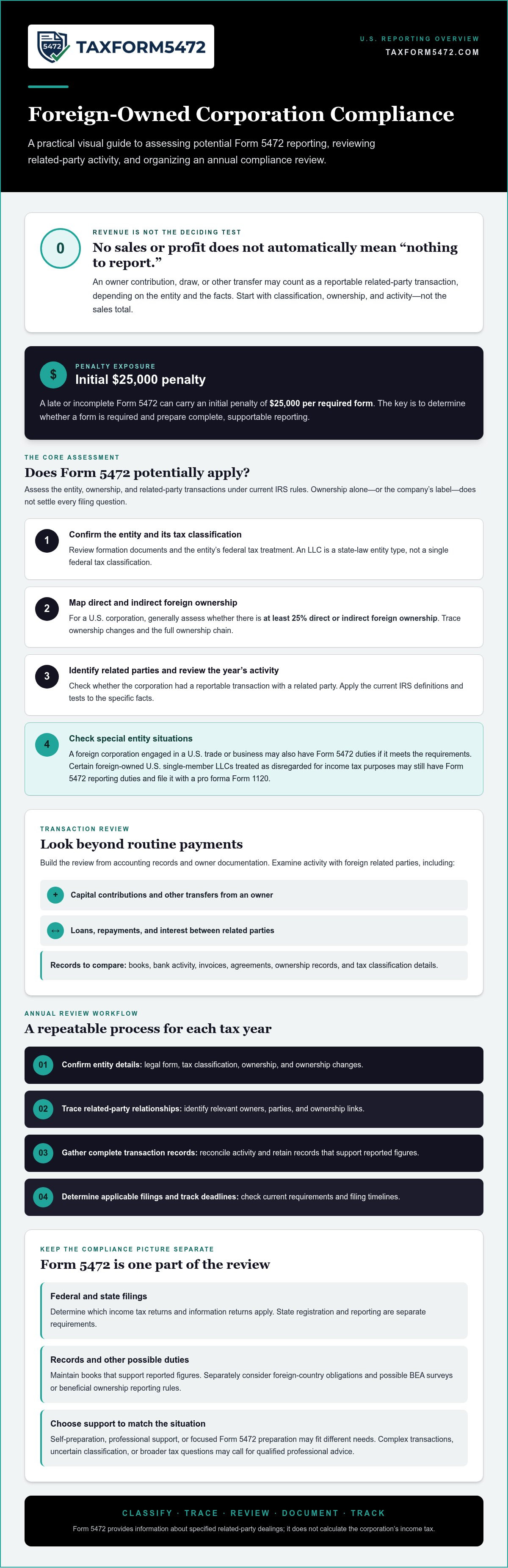
A Practical Annual Review for Foreign-Owned Corporation Compliance
A repeatable review reduces reliance on memory and makes missing records easier to spot. Start early, reconcile the books, and confirm each filing requirement against the entity’s classification and current instructions. Use this checklist as a workflow, not as a substitute for determining which rules apply.
Assemble records before preparing a return
Gather documents for the full tax year, including ownership records, transaction ledgers, agreements, invoices, bank records, and payment details. Compare related-party activity with the accounting records. For transactions that are unclear, note who was involved, what occurred, and which documents support the entry. Request qualified tax review where classification or reporting treatment is uncertain.
Review, prepare, submit, and retain documentation
- Confirm the entity. Review formation documents, tax classification, ownership, and any changes during the year. Thresholds and definitions: verify against current IRS instructions.
- Reconcile activity. Match related-party transactions to the ledger, agreements, invoices, and payment records. Resolve differences or flag them for review.
- Identify required filings. Determine which information returns and income tax returns may apply. Don’t assume one filing replaces another.
- Check the tax year and deadline. Confirm the due date and any extension procedure using current IRS instructions. As a reference point, Form 5472 for calendar year 2025 was due April 15, 2026; an extension to October 15, 2026, was available by filing Form 7004. Deadline and extension: verify for the entity’s tax year and filing circumstances.
- Review and submit. Check entity details, tax year, required forms, and submission instructions before filing. Save confirmation or other proof of submission.
- Retain the file. Keep copies of filed forms, supporting documents, reconciliation notes, and submission records with the company’s tax-year records.
Foreign owned corporation compliance is easier to manage when the records tell a consistent story. If a transaction’s nature or classification remains unclear, document the question and resolve it before finalizing the filing. Check the IRS’s current form instructions for applicable deadlines, thresholds, and filing procedures, since they can vary by entity and facts.
If you’ve assembled the records and need focused help with Form 5472, review online Form 5472 preparation. This addresses that form only, not every tax or state obligation.
When Form 5472 Preparation Software Fits the Compliance Workflow
Choose a preparation method based on the work involved, not convenience alone. Self-preparation may suit a filer who understands the applicable rules, has complete records, and can review the form carefully. A qualified tax professional may be appropriate when ownership, tax classification, or transaction treatment is uncertain, or when the company needs broader tax advice.
Focused preparation software or an online service can support the Form 5472 step when the filing requirement is understood and the necessary information is organized. It isn’t a substitute for legal advice, an income tax return, or review of other corporate obligations. In foreign owned corporation compliance, ask whether the tool fits the specific form task and the company’s circumstances.
What to check before using an online preparation service
Confirm that the service supports your entity type, tax year, and transaction situation. Review its information and document requirements before beginning. Make sure you can provide accurate ownership details and transaction records, and identify questions that fall outside the service’s stated scope.
Verify the process directly with the provider. Check what steps the service performs, what you must review or submit, and what confirmation or records you’ll receive. Don’t assume an online platform prepares other returns or handles state, foreign-country, or legal requirements unless those services are explicitly confirmed.
When to seek broader tax or legal guidance
Consider qualified advice if the entity’s tax classification is unclear, ownership changed during the year, related-party dealings are complex, or several reporting obligations may apply. A focused Form 5472 preparation service can address that information return, but it doesn’t resolve questions beyond its scope. It isn’t personal income tax filing or legal representation in Tax Court.
- Self-prepare: Consider this when you understand the rules and can support the reported information with complete records.
- Use focused preparation support: Consider this when you need help preparing Form 5472 and have gathered the required facts.
- Seek broader professional advice: Consider this when classification, transaction treatment, or other filing duties need analysis.
TaxForm5472 provides an online service focused on IRS Form 5472 preparation. Review the service details and confirm current preparation and submission steps before starting. Review the online Form 5472 preparation service.
Build a More Reliable Filing Process
Foreign owned corporation compliance starts with the facts: confirm the entity’s classification, trace ownership, and review related-party activity. Don’t treat low revenue or a single completed form as proof that every reporting duty is resolved. Keep records consistent, check current filing instructions, and seek qualified advice when transactions or obligations are unclear.
A repeatable annual review helps identify what needs attention before preparing a return. Gather ownership documents, transaction records, and supporting agreements, then confirm which filings apply and how they must be submitted.
For focused support with Form 5472, taxform5472.com provides an online preparation service designed to facilitate digital preparation and document submission. Its scope is specific to that information return, so assess separate tax, state, or legal needs independently. Review the service details and confirm current preparation and submission steps before beginning.
Review the online Form 5472 preparation service. With organized records and a clear review process, you can approach the next filing cycle with greater confidence.
Frequently Asked Questions
Does every foreign-owned U.S. corporation have to file Form 5472?
No. A U.S. corporation generally needs to file when it meets the foreign ownership threshold and has a reportable transaction with a related party. Form 5472 may also apply to a foreign corporation engaged in a U.S. trade or business if its filing requirements are met. Assess the entity, ownership, relationships, and transactions under current IRS instructions. Foreign ownership by itself doesn’t resolve the filing question.
Can a foreign-owned corporation have Form 5472 reporting obligations if it had no income?
Yes. No income doesn’t automatically mean there’s no Form 5472 reporting obligation. Review transactions with foreign related parties, including owner contributions, loans, reimbursements, and other dealings. A newly formed or low-activity company may still have transactions that need analysis. Whether a filing is required depends on the entity’s status and the transaction facts, so check current IRS instructions rather than relying on revenue or profit alone.
What transactions should a foreign-owned corporation review for Form 5472?
Review transactions between the corporation and foreign related parties, not just sales or regular cash payments. Examine owner contributions, loans and repayments, reimbursements, service arrangements, and property transfers. Check ledgers, bank activity, contracts, invoices, and expense records for amounts paid or received. A transaction’s label doesn’t determine whether it’s reportable. Apply current IRS rules to the parties, transaction type, and supporting facts.
Is Form 5472 the only U.S. compliance filing a foreign-owned corporation may need?
No. Form 5472 doesn’t replace applicable federal income tax returns or state filings and registrations. A company may also need to review other reporting duties, such as Bureau of Economic Analysis surveys, depending on its ownership, activity, and applicable thresholds. Requirements vary by entity and circumstances. Treat Form 5472 as one part of the company’s review, and assess other obligations separately using current official guidance.
When is Form 5472 due for a foreign-owned corporation?
Form 5472 is generally filed with the reporting corporation’s income tax return by that return’s due date, including extensions. For example, the calendar-year 2025 return deadline was April 15, 2026. A filing extension to October 15, 2026, was available by filing Form 7004. These dates are specific to that tax year. Verify the deadline and extension procedure for the entity’s tax year and filing situation.
What records should a foreign-owned corporation keep for Form 5472?
Keep records that support ownership, related-party status, and each transaction reviewed for reporting. These can include formation documents, ownership records and changes, agreements, transaction ledgers, invoices, bank statements, payment records, and bookkeeping entries. Retain filed forms and submission confirmation as well. Reconcile related-party activity to the books, and document unresolved items or classification questions so they can be reviewed before filing.
Can Form 5472 preparation software handle all foreign-owned corporation compliance?
No. Form 5472 preparation software or an online service can focus on preparing that information return, but it doesn’t cover every federal, state, or foreign obligation. It also isn’t a substitute for legal advice or unrelated tax-return preparation. TaxForm5472 focuses on IRS Form 5472 preparation and provides a digital platform designed to facilitate preparation and document submission. Confirm its current filing steps and scope directly with the provider.