
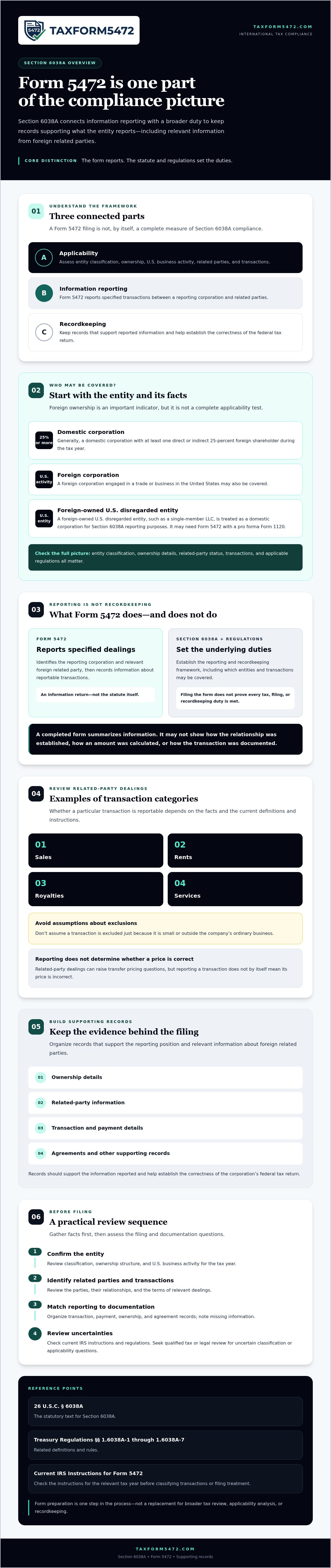
Filing Form 5472 is only one part of Section 6038A compliance. The section 6038A reporting requirements also include keeping records that support the information reported, including relevant records from foreign related parties. This distinction matters when you assess whether your entity is covered, which transactions to report, and what documentation to retain.
It can be unclear where Section 6038A ends and Form 5472 or other international tax rules begin. The answer depends on the entity’s structure, ownership, and transactions. For example, a foreign-owned U.S. disregarded entity may have a Form 5472 filing obligation even though it isn’t treated as a corporation for other federal tax purposes.
This guide explains who may be a reporting corporation, how Section 6038A duties connect to Form 5472, and which related-party transactions and records may need review. It also outlines information to gather and when professional review may help assess your circumstances. If Form 5472 applies, preparing it is one step in meeting the reporting obligation, not a substitute for the broader recordkeeping framework.
Key Takeaways
- Review the entity’s classification, ownership, and U.S. business activity before deciding whether the section 6038A reporting requirements may apply.
- Understand how Form 5472 reports specified transactions with related parties, and why the form’s fields don’t replace the underlying statutory duties.
- Organize ownership, related-party, transaction, payment, and agreement records to support the entity’s reporting position.
- Use a pre-filing review to identify relevant parties, transactions, and missing information before discussing obligations with a tax professional.
- Understand where online Form 5472 preparation fits into the compliance process, without treating it as a substitute for broader tax review or recordkeeping.
What Section 6038A reporting requirements cover
Section 6038A of the Internal Revenue Code sets information-reporting and recordkeeping rules for certain U.S.-connected corporations with foreign ownership or activity. These rules help the IRS examine transactions between a reporting corporation and related parties. The current statutory text is in 26 U.S.C. § 6038A; Treasury Regulations §§ 1.6038A-1 through 1.6038A-7 provide related definitions and rules.
Form 5472 is the information return used to report specified transactions under this framework. It is not the statute itself. The form collects transaction details, while Section 6038A and its regulations establish the underlying reporting and recordkeeping duties. Related-party dealings can also raise questions about transfer pricing principles, but reporting a transaction does not by itself mean its price is incorrect.
Which businesses may be reporting corporations?
Section 6038A generally covers a domestic corporation with at least one direct or indirect 25-percent foreign shareholder during the tax year, as well as a foreign corporation engaged in a trade or business in the United States. Foreign ownership is an important indicator, but it is not a complete applicability test. Entity classification, ownership details, related-party status, transactions, and applicable regulations all matter.
Under applicable rules, a foreign-owned U.S. disregarded entity, such as a single-member LLC, is treated as a domestic corporation for Section 6038A reporting purposes. It may need to file Form 5472 with a pro forma Form 1120. Confirm the entity’s classification and filing treatment against current IRS instructions and regulations before relying on this general description.
How Section 6038A differs from a general tax return
Section 6038A reporting is information reporting, not an income tax calculation. Form 5472 reports specified transactions between a reporting corporation and related parties. By contrast, a corporation’s income tax return reports information used to calculate its tax liability. Filing Form 5472 does not establish that the entity has met every tax, filing, or recordkeeping obligation.
Recordkeeping is a separate duty. The statute and regulations require records sufficient to establish the correctness of the corporation’s federal tax return, including relevant information about foreign related parties. Keep supporting details organized even if Form 5472 is prepared separately.
Before deciding whether the section 6038A reporting requirements apply, confirm the entity type, ownership structure, related parties, and transactions for the tax year. These facts can interact with other tax rules. Ask a qualified tax professional or legal adviser to review uncertain classification or applicability questions.
How Section 6038A connects to Form 5472 and related-party reporting
Section 6038A establishes the reporting and recordkeeping duties. Form 5472 is the IRS information return used to report specified transactions between a reporting corporation and related parties. The form’s fields capture required details, but they don’t replace the statute or Treasury regulations that determine which entities and transactions are covered. Consult the Section 6038A statute alongside the current IRS Instructions for Form 5472.
What information does Form 5472 report?
Form 5472 identifies the reporting corporation and relevant foreign related party, then records information about reportable dealings between them. Examples may include sales, rents, royalties, and services. Whether a particular payment or transaction is reportable depends on the facts and the definitions in the current regulations and IRS instructions. Don’t assume a transaction is excluded just because it is small or outside the company’s ordinary business.
For transaction categories and examples, see Reportable Transactions Form 5472: A 2026 Compliance Guide. Check the IRS instructions for the relevant tax year before classifying transactions. The form is a reporting tool, not a substitute for analyzing the relationship between the parties and the transaction’s terms.
When does Section 6038A require records beyond the filed form?
A completed form summarizes reportable information. It may not show how the business established the parties’ relationship, calculated an amount, or documented the transaction. Section 6038A recordkeeping is a related but separate compliance task: records must support the information reported and help establish the correctness of the corporation’s federal tax return.
Keep source documents that explain the transaction, not just the figures entered on the form. Depending on the facts, these may include agreements, invoices, payment records, and documents identifying the related parties. The records should let a reviewer trace reported amounts to the transaction’s business purpose and terms.
Before preparing a filing, compare the transaction list with contracts, accounting records, and payment documentation. Resolve gaps in party details or transaction descriptions, and seek professional review if classification or reportability is uncertain. Once the scope and supporting information are organized, an online Form 5472 preparation service can support the form-preparation step. It does not replace the broader Section 6038A analysis or recordkeeping review.
Which Section 6038A records and supporting details should a business maintain?
Section 6038A and Treasury Regulation § 1.6038A-3 set record-maintenance rules for reporting corporations. In general, records must be sufficient to establish the correctness of the corporation’s federal tax return, including relevant information about foreign related parties. The IRS Instructions for Form 5472 explain the form’s reporting context. Check the current instructions and regulations against the entity’s facts.
The section 6038A reporting requirements involve more than completing a return. Keep documentation that connects the corporation, related party, transaction, and reported amount. The examples below are practical organizing guidance, not a complete statutory list.
What records can support related-party transaction reporting?
Use records that show who was involved, what happened, how amounts were determined, and what terms governed the transaction. For example, an intercompany services agreement can explain the arrangement, while invoices, ledger entries, payment evidence, and relevant correspondence can help trace the amounts. Keep ownership and entity documents that support the corporation’s classification and related-party analysis.
| Record category | Questions it can help substantiate |
|---|---|
| Ownership and entity records | What is the entity’s classification, and who owned it during the tax year? |
| Related-party information | Who was the counterparty, and what supports treating the party as related? |
| Transaction records | What goods, services, property, or other dealings were involved? |
| Payment and accounting records | How were reported amounts calculated, recorded, and paid? |
| Agreements and correspondence | What terms, purpose, or business context helps explain the transaction? |
How should businesses organize records for review?
Use a consistent method to link each accounting entry to its counterparty, source documents, and any information reported on Form 5472. A transaction-level index can help identify missing support and reconcile reported figures with the books.
Contemporaneous supporting records help show what the parties agreed to and how the transaction was carried out. Preserve documents in an organized, accessible format, and confirm retention periods and access procedures with a qualified tax professional. Don’t assume a filed form or one universal retention period covers every recordkeeping obligation. Applicable requirements can depend on the entity and its circumstances.
How to assess Section 6038A requirements before filing
Start by assessing applicability, not by filling out the form. The section 6038A reporting requirements depend on the entity’s U.S. tax classification, ownership, related parties, and transactions for the tax year. Use this workflow to organize the facts before deciding whether Form 5472 may be required.
- Classify the entity. Gather formation documents and confirm its U.S. federal tax classification. Don’t assume the state-law entity type determines its federal treatment.
- Review ownership. Map direct and indirect owners, ownership percentages, and changes during the tax year. Include relevant organizational charts and ownership records.
- Identify related parties. List foreign and domestic counterparties, their relationships to the entity, and information supporting those relationships. Apply current definitions rather than relying only on company labels.
- Assess transactions. Compare the accounting ledger, invoices, agreements, and payment records to identify dealings with related parties. Flag transactions whose nature or reporting treatment is unclear.
- Verify supporting records. Check whether documentation substantiates ownership, counterparties, transaction descriptions, amounts, and terms. Note gaps before preparing a filing.
What facts should be checked first?
Bring the legal entity type, U.S. tax classification, ownership percentages, and relevant tax year into the review. Include indirect ownership chains and relationship details where applicable. A foreign-owned U.S. disregarded entity requires specific analysis under current rules. Don’t assume it follows the same filing treatment as an ordinary domestic corporation. Confirm its status against current IRS instructions and regulations.
For the form-specific next step, consult current Form 5472 requirements guidance and IRS instructions. Applicability review comes first. Filing deadlines and responses to missed filings are separate questions that depend on the entity’s facts and tax year.
When should a business seek professional review?
Get qualified tax advice if the ownership chain is unclear, entity classification is uncertain, or a transaction’s relationship or character is difficult to determine. Incomplete records or a possible missed filing are also reasons to seek timely guidance. Penalties may apply to filing failures; review dedicated Form 5472 penalty guidance for that separate issue.
Before the review, assemble formation and ownership records, prior filings, related-party details, transaction summaries, agreements, and available payment support. This gives a tax professional a clearer basis for assessing scope and next steps. If Form 5472 preparation is needed, use online Form 5472 preparation for that step, while addressing broader compliance questions separately.
How Form 5472 preparation fits into a Section 6038A compliance process
Form preparation comes after the business has assessed whether Section 6038A may apply and gathered facts to support its reporting. A practical sequence is to assess the entity’s scope, identify potentially reportable information, organize supporting records, and then prepare the applicable filing. The form is one part of the process. It doesn’t determine every legal or tax obligation.
What an online Form 5472 preparation service can help with
taxform5472.com provides online Form 5472 preparation for foreign-owned U.S. corporations. Before using a preparation service, assemble the entity’s classification details, ownership information, related-party identities, transaction summaries, and supporting records. These materials inform form preparation, but they don’t replace a separate review of whether the Section 6038A rules apply.
Confirm that a service’s current scope fits the entity’s circumstances. Don’t assume every entity type or reporting scenario is supported without checking. Preparation software or an online service also doesn’t provide a legal determination of entity classification or resolve every tax obligation.
What to confirm before choosing a preparation method
First, identify the need. Is the task limited to preparing Form 5472, or does it also require broader tax advice about ownership, related-party status, transaction treatment, or recordkeeping? The section 6038A reporting requirements can depend on facts that a form-preparation step alone may not assess.
For unclear ownership structures, uncertain entity classification, or transactions that are difficult to characterize, consult a qualified tax professional. Review the preparation service’s stated scope and current instructions before proceeding. Keep the distinction clear: professional advice can address fact-specific compliance questions, while the preparation service supports the Form 5472 step.
If Form 5472 preparation is the service you need, review online Form 5472 preparation. Check that the service’s current scope fits your entity before relying on it, and address broader Section 6038A questions separately.
Make Your Section 6038A Review Actionable
Start with the facts that determine scope: entity classification, ownership, related parties, and transactions. Then connect any Form 5472 reporting to records that support the information reported. These steps help clarify which section 6038A reporting requirements may apply and where further tax or legal review is needed.
Form preparation is one part of the process, not a substitute for deciding whether the rules cover your entity or confirming its wider tax obligations. Once you’ve gathered the relevant details, taxform5472.com offers online Form 5472 preparation through a digital platform designed to help streamline documentation for international ownership structures.
To address the form-preparation step, review online Form 5472 preparation. Organize the relevant information and seek the review your circumstances require before proceeding.
Frequently Asked Questions
Does Section 6038A apply to every foreign-owned U.S. business?
No. Section 6038A generally covers certain domestic corporations with a direct or indirect 25-percent foreign shareholder, and foreign corporations engaged in a U.S. trade or business. Foreign ownership alone doesn’t settle the question. Entity classification, ownership details, related-party relationships, and transactions matter. Review the entity’s facts and current IRS rules before deciding whether it has reporting or recordkeeping duties.
Is Form 5472 the only reporting requirement under Section 6038A?
No. Form 5472 is the primary information return used to report specified transactions with related parties, but Section 6038A also imposes recordkeeping duties. A business may need records supporting its return and information about foreign related parties. Filing Form 5472 doesn’t establish that the entity has met every federal tax or international reporting obligation. Review other requirements separately based on the entity’s circumstances.
What transactions may need to be reported under Section 6038A?
Reportable transactions include specified dealings between a reporting corporation and a related party. Examples include sales, rents, royalties, and services, as described in the applicable regulations and current Form 5472 instructions. The parties’ relationship and transaction facts affect the analysis. A separate Form 5472 is generally required for each related party with reportable transactions. Don’t assume a transaction is excluded without checking the rules.
What records should a business keep for Section 6038A compliance?
Keep ownership and entity records, documents identifying related parties, transaction agreements, invoices, accounting entries, and payment evidence where relevant. These materials help support who was involved, what occurred, the transaction terms, and the amounts reported. The statutory recordkeeping duty is separate from filing the form. Applicable retention rules can depend on the circumstances, so confirm retention and access procedures with a qualified tax professional.
Does a foreign-owned single-member LLC have Section 6038A reporting requirements?
It may. A foreign-owned U.S. disregarded entity, such as a single-member LLC, is treated as a domestic corporation for Section 6038A reporting purposes under applicable rules. It generally files Form 5472 with a pro forma Form 1120 when filing is required. There’s no general de minimis filing threshold for a foreign-owned U.S. disregarded entity. Verify the current IRS instructions and the entity’s facts.
Can a business use online software to prepare Form 5472?
Yes. An online preparation service can help prepare Form 5472, but it doesn’t determine whether Section 6038A applies or replace required recordkeeping and broader tax advice. Gather the entity’s classification, ownership details, related-party information, transaction records, and supporting documents first. taxform5472.com focuses on online Form 5472 preparation. Confirm that the service’s current scope fits the entity’s situation.
What happens if a business does not meet Section 6038A reporting or recordkeeping requirements?
Penalties may apply. The initial penalty for failing to file a substantially complete Form 5472 on time is $25,000. If the failure continues for more than 90 days after the IRS mails a notice, an additional $25,000 applies for each 30-day period or fraction of one. Recordkeeping failures can also create compliance issues. Seek timely tax advice about a specific missed filing or documentation gap.