
A single clerical oversight in Part II can trigger an immediate, non-negotiable $25,000 IRS penalty. Most general tax platforms fail to enforce the strict relational logic that foreign reporting entities require. Choosing a specialized digital tool for reporting foreign parent corporation data on form 5472 is essential to protect your U.S. entity from costly compliance assessments.
Deciphering direct and indirect foreign ownership chains under Section 6038A is complex. Relying on traditional accounting firms often brings excessive billable hourly rates for basic data formatting, yet manual spreadsheet entry carries unacceptable risks. The IRS increasingly relies on automated screening systems, meaning minor omissions or formatting mismatches will quickly generate penalty notices.
Automating your reporting workflow through dedicated compliance software removes recurring advisory overhead while embedding strict validation checks directly into data entry. This guide evaluates the best digital platforms available to capture, validate, and file foreign parent corporate data on IRS Form 5472 with speed and complete accuracy.
Key Takeaways
- Master Section 6038A reporting obligations to accurately capture foreign parent corporate details, registry numbers, and domestic connections.
- Select a specialized digital tool for reporting foreign parent corporation data on form 5472 to catch omissions before IRS submission.
- Compare manual entry, external advisory models, and purpose-built SaaS platforms to minimize processing delays and operational overhead.
- Streamline record assembly by organizing ultimate indirect parent entities and foreign taxpayer identification numbers ahead of filing.
- Deploy automated pre-submission validation rules engineered specifically to safeguard foreign-owned entities against automatic $25,000 penalties.
Why Reporting Foreign Parent Corporation Data on Form 5472 Requires Automation
Internal Revenue Code Section 6038A imposes strict information return mandates on any domestic or foreign reporting corporation that is at least 25% foreign-owned. Meeting these obligations requires complete corporate transparency regarding foreign ownership structures. Manual data transcription introduces unacceptable variance when mapping international operational entities into domestic regulatory filings. Deploying a dedicated foreign owned us corporation tax strategy centered around software validation removes these operational points of failure.
Traditional accounting practices rely on paper reviews and generic office software. These methods fail to cross-check foreign entity records against modern IRS schema requirements. Implementing a dedicated digital tool for reporting foreign parent corporation data on form 5472 provides programmatic controls that catch formatting errors, eliminate clerical oversights, and protect reporting entities from automated federal enforcement systems.
The Mechanics of Foreign Parent Reporting on IRS Form 5472
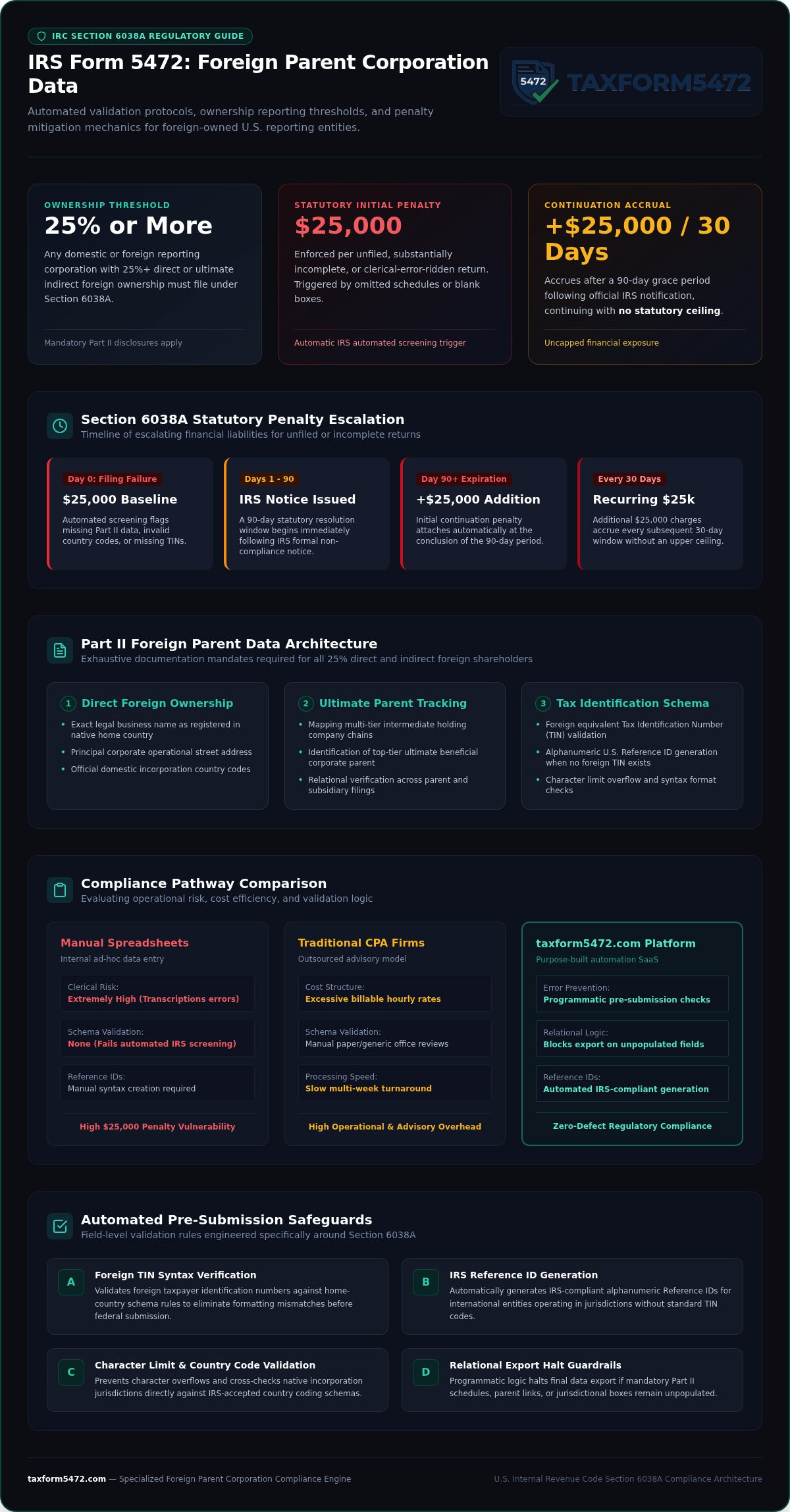
Part II of Form 5472 requires exhaustive documentation of all 25-percent direct and ultimate indirect foreign shareholders. Disclosures must capture exact legal names, principal corporate offices, and native incorporation jurisdictions. International identifiers present distinct compliance obstacles; filers must distinguish between a foreign equivalent Tax Identification Number (TIN) and a U.S. Reference ID. Standard reporting requirements demand precision across several specific dimensions:
- Direct corporate ownership: Legal business names, operational street addresses, and domestic incorporation country codes.
- Ultimate parent tracking: Intermediate holding arrangements mapped directly to the top-tier beneficial corporate parent.
- Tax identification schema: Correct entry of IRS reference IDs where foreign jurisdictions issue non-standard entity codes.
The Failure-to-File Risk: Avoiding Automatic Statutory Penalties
Under Section 6038A, the statutory penalty baseline stands at $25,000 per unfiled or substantially incomplete form. The IRS treats forms with omitted foreign parent schedules, missing tax codes, or blank jurisdictional boxes as unfiled returns. If non-compliance continues beyond 90 days following IRS notification, additional $25,000 continuation penalties accrue for each subsequent 30-day window without an upper ceiling.
Automated pre-submission validation safeguards corporate reporters against these enforcement triggers. A purpose-built digital tool for reporting foreign parent corporation data on form 5472 validates corporate identifiers, cross-checks country codes against acceptable IRS formats, and halts data export if mandatory relational fields remain unpopulated. This technical safeguard ensures zero-defect filings before documents reach federal processing centers.
Essential Features to Demand in a Form 5472 Digital Preparation Tool
Generic multi-tax platforms treat Form 5472 as a secondary schedule, often lacking the field-level validations required for cross-border entities. A specialized digital tool for reporting foreign parent corporation data on form 5472 provides programmatic guardrails built directly around Section 6038A. These tools prevent character limit overflows, catch invalid country codes, and verify relational data before generation.
Evaluating digital software requires looking past basic data entry forms. Modern cross-border compliance demands automated systems that actively check foreign legal entities against federal submission schemas.
Automated Parent Entity Validation and TIN Formatting
Part II disclosures require exact adherence to international identification rules. A purpose-built system validates foreign Tax Identification Numbers against home-country syntax rules while verifying the following structural requirements:
- Reference ID generation: Generating IRS-compliant alphanumeric reference IDs when foreign jurisdictions do not issue a standard TIN, as outlined in the official IRS instructions.
- Jurisdiction coding: Mapping foreign parent corporate domiciles directly to official ISO-3166 country codes.
- Address normalization: Standardizing non-U.S. postal formats to pass automated IRS scanning systems without rejection.
Related Party and Reportable Transaction Cross-Referencing
Foreign parent corporate data must tie logically to the transaction amounts reported in Part IV. A dependable platform prevents disconnected monetary entries by requiring every payment, capital transfer, or loan to match an authenticated related party record. Consulting a detailed guide on reportable transactions form 5472 rules helps filers categorize these transfers accurately. Automated software blocks incomplete submissions whenever an intercompany transfer lacks a designated foreign parent or shareholder relationship.
Data Security Protocols for Multinational Corporate Information
International corporate reporting involves sensitive beneficial ownership details, tax records, and cross-border financial flow data. Cloud platforms must protect these records through robust administrative standards:
- End-to-end encryption: Encrypted data vaults protect foreign corporate tax IDs and shareholder records in transit and at rest.
- Multi-user permissions: Dedicated access levels allow foreign directors, corporate controllers, and domestic administrators to review drafts securely.
- Persistent filing history: Secure historical records allow instant year-over-year roll forwards, eliminating redundant manual entity setup.
Deploying a purpose-built platform such as taxform5472.com simplifies this technical workflow while maintaining strict administrative security across all international parent filings.
Comparing Compliance Pathways: Manual Filing vs. CPAs vs. Dedicated Software
Filing corporate disclosures involves three primary execution routes: manual preparation, outside accounting advisory, or specialized automation platforms. Foreign reporting entities must balance risk, speed, and resource allocation. A careful review of official IRS Form 5472 Requirements demonstrates why treating this information return as a simple check-the-box exercise often leads to severe processing complications.
Using a specialized digital tool for reporting foreign parent corporation data on form 5472 provides a direct middle path between manual spreadsheet errors and expensive accounting hourly rates. Purpose-built systems replace variable advisory turnaround times with consistent, programmatic execution.
Cost and Speed Analysis Across Filing Methods
Traditional accounting arrangements run on billable hours. Even basic entity disclosures often incur steep administrative fees because service firms route foreign entity verification through multiple internal review layers. These advisory queues introduce scheduling bottlenecks close to the statutory April 15 deadline, or the extended October 15 cutoff secured through Form 7004.
A direct form 5472 cpa vs software comparison highlights clear operational distinctions:
- Manual entry: Zero software expenditure, but drains internal finance hours and exposes the business to postal delivery delays or submission oversights.
- External CPA firms: Extensive manual review that protects against certain errors, but introduces premium hourly rates and slow communication turnaround.
- Specialized software: Guided data flows that format foreign parent schedules rapidly while keeping preparation costs predictable.
Risk Mitigation and Error Reduction Comparison
Manual paper filings have exceptionally high clerical error rates. Hand-typed forms frequently misalign foreign alphanumeric registry numbers or invert corporate addresses, which can lead to automatic processing rejections. Paper documents also lack automated transmission receipts, creating significant uncertainty around whether submissions were received on time.
Relying on a digital tool for reporting foreign parent corporation data on form 5472 removes human transcription errors entirely. Algorithmic checks verify that corporate identifiers conform to federal database requirements before document generation. These platforms provide immediate generation stamps, giving foreign directors a documented audit trail that verifies compliance long before any statutory deadlines pass.
Step-by-Step Data Preparation: Ingesting Parent Records into Digital Systems
Organized preliminary documentation prevents intake bottlenecks. Ingesting offshore ownership profiles into automated systems requires compiling corporate records, entity hierarchies, and transaction summaries beforehand. Following a structured preparation sequence ensures your chosen digital tool for reporting foreign parent corporation data on form 5472 executes accurate pre-submission audits.
Executing data entry systematically reduces administrative processing time. Gather these critical details before entering information into digital workflows.
Step 1: Gathering Parent Corporate Registry Details
Assemble verified statutory documents for the offshore parent firm. The IRS requires exact legal characterizations that match foreign commercial registries. Prepare these core entity data points:
- Entity identity: Full legal corporate name, official founding date, and operational registration number issued by native commercial authorities.
- Jurisdictional records: Registered principal office location, principal country of business operations, and primary country of legal incorporation.
- Currency conversions: Spot exchange rates used to translate home-currency ledgers into U.S. dollars for all reportable balances.
Step 2: Structuring Direct vs. Indirect Ownership Percentages
Establish exact capitalization percentages across all ownership tiers. Form 5472 Part II requires separate disclosures for each direct 25-percent foreign shareholder as well as the ultimate indirect parent entity. If an overseas operating firm sits beneath a holding trust or foreign parent entity, map every step in the legal holding structure.
Calculate direct equity holdings first. Next, track indirect stakes by multiplying proportional shares across intermediary corporate entities. Document the ultimate beneficial entity possessing controlling authority to avoid incomplete disclosure flags.
Step 3: Executing Automated Ingestion and Final Field Validation
Transfer the compiled corporate profiles into dedicated digital preparation modules. Modern software parses these inputs to verify address structures, identify missing identification markers, and check related-party alignments before assembling submission packages. Completing a valid IRS Form 5472 filing requires zero unverified fields in Part II.
When you are ready to prepare your schedules, start your automated Form 5472 preparation to instantly validate parent company disclosures against mandatory IRS filing rules.
Selecting taxform5472.com for Rapid, Accurate Foreign Parent Compliance
General business tax software attempts to serve every filing category at once, resulting in cluttered workflows and overlooked international schedules. Single-purpose architecture eliminates this problem. Operating as an automated SaaS platform, taxform5472.com focuses exclusively on IRS Form 5472 preparation for foreign-owned U.S. corporate entities and disregarded entities.
Specialization ensures that every interface element supports Section 6038A compliance. As a dedicated digital tool for reporting foreign parent corporation data on form 5472, the software replaces manual transcription with guided, field-level validation protocols tailored to international corporate structures.
Engineered Exclusively for Form 5472 Architecture
The platform eliminates extraneous tax forms that complicate standard filing preparation. Users complete their filings through targeted intake fields designed around cross-border regulatory requirements:
- Targeted intake flows: Interface modules prompt specifically for foreign entity registration numbers, local tax identifiers, and ultimate holding arrangements without unrelated schedules.
- Disregarded entity support: Optimized paths generate compliant pro forma Form 1120 and Form 5472 documentation for foreign-owned single-member LLCs.
- Strict data verification: Automated data validation prevents missing foreign entity information triggers, ensuring every parent entity field meets official formatting rules.
Instant Verification and Automated Workflow Completion
Filing errors on international schedules carry severe consequences. Built-in system logic analyzes every foreign parent entry against IRS requirements before output generation, preventing incomplete disclosures from triggering automatic non-compliance assessments.
Pre-submission diagnostic routines verify character lengths, address completeness, and direct-versus-indirect ownership percentages instantly. The engine formats the finalized data package for rapid execution, giving international founders and corporate controllers complete confidence in their filing accuracy. Select the leading digital tool for reporting foreign parent corporation data on form 5472 to streamline your cross-border obligations and complete your submission securely at taxform5472.com.
Secure Your Foreign Corporate Disclosures With Confidence
Section 6038A enforcement leaves no margin for administrative oversights. Overlooking a single mandatory parent field invites an immediate $25,000 statutory penalty. Transitioning away from manual transcription protects cross-border operations while eliminating inflated professional advisory fees. Deploying an automated workflow transforms a high-risk reporting mandate into a fast, predictable process.
Selecting a dedicated digital tool for reporting foreign parent corporation data on form 5472 provides structural certainty. Automated data validation safeguards against the $25,000 statutory penalty by verifying foreign entity identifiers, ownership percentages, and international addresses before export. It ensures corporate disclosures align with IRS requirements from the first entry.
Protect your reporting entity with a platform engineered exclusively for cross-border compliance. Prepare Your Form 5472 Online to complete accurate, audit-ready filings quickly and keep your business fully compliant.
Frequently Asked Questions
What qualifies a foreign company as a foreign parent on Form 5472?
A foreign corporation qualifies as a reporting parent if it directly or indirectly owns at least 25% of the total voting power or value of all classes of stock in the U.S. reporting company. Constructive ownership rules apply when determining these percentages. Filers must disclose direct 25% foreign shareholders and ultimate indirect parent entities that exercise corporate control over the domestic business.
Can I enter a foreign address and foreign tax ID in a digital filing tool?
Yes. An effective digital tool for reporting foreign parent corporation data on form 5472 supports international address formats and foreign tax identification numbers. If the parent entity operates in a jurisdiction that doesn't issue standard corporate tax IDs, the platform formats an IRS-compliant reference ID number. The software normalizes international postal data to prevent syntax rejections during federal processing.
What happens if foreign parent corporate data is omitted on Form 5472?
Leaving Part II foreign parent information blank causes the IRS to treat the entire filing as substantially incomplete. Under Section 6038A, incomplete returns trigger an immediate $25,000 statutory failure-to-file penalty. If the omission isn't resolved within 90 days after IRS notice, continuation penalties add $25,000 for every subsequent 30-day period. Submitting complete, verified corporate parent records is critical to avoid these assessments.
Do digital tools validate both direct and indirect foreign parent information?
Dedicated platforms validate both tiers of corporate ownership. The software ensures that direct 25% foreign shareholders are completely documented alongside the ultimate indirect parent entity. Validation logic cross-references commercial registries, checks country codes against ISO standards, and confirms that ownership stakes reflect effective operating control. This prevents structural discrepancies between multi-tiered holding companies and their U.S. reporting entities.
Is specialized software necessary if my business already uses general bookkeeping tools?
General bookkeeping software tracks operational transactions, but it doesn't contain IRS informational tax return schemas. Preparing Part II foreign parent disclosures requires specialized validation logic to prevent field mismatches and missing identifier errors. Deploying a dedicated digital tool for reporting foreign parent corporation data on form 5472 bridges this operational gap, ensuring corporate records conform directly to federal reporting standards without manual intervention.
Can an automated platform prepare Form 5472 for a foreign-owned single-member LLC?
Yes. A foreign-owned single-member LLC is treated as a disregarded entity for income tax purposes, but federal rules treat it as a separate corporation for Section 6038A reporting. Specialized automation platforms assemble the required pro forma Form 1120 alongside the completed Form 5472 schedule. The system verifies foreign parent details and formats the entire document package specifically for IRS submission processing.
How does software help avoid the $25,000 IRS failure-to-file penalty?
Software enforces pre-submission validation rules that prevent filings with missing or misformatted fields. It blocks output generation if critical Part II details, like foreign tax IDs or registered addresses, are omitted. By cross-referencing intercompany reportable transactions against disclosed parent entities, the system eliminates the clerical oversights that trigger IRS automated penalty notices, ensuring an accurate, audit-ready compliance package every tax year.