
A single missing international disclosure triggers an automatic $25,000 assessment with no statutory ceiling. Once the IRS issues Notice CP215, an unfiled return sits on a strict 90-day clock before recurring $25,000 monthly penalties begin. If you're facing a form 5472 late filing penalty, waiting to react is an expensive mistake.
Receiving a massive assessment on a foreign-owned entity feels punitive, especially when your business had zero U.S. tax liability. Standard administrative waivers like First Time Abate don't apply to these international information returns, leaving foreign owners unsure how to fight back. Fortunately, statutory relief exists. You can stop escalation immediately, evaluate reasonable cause criteria under current IRS guidance, and submit a compliant penalty defense.
Below is the operational roadmap covering assessment mechanics, statutory abatement standards, and the concrete steps required to eliminate your exposure.
Key Takeaways
- Understand statutory assessment mechanics under IRC Section 6038A, including uncapped monthly compounding after the initial 90-day notice window.
- Identify the core structural oversights that trigger an automatic form 5472 late filing penalty, specifically on foreign-owned single-member LLC disclosures.
- Apply statutory reasonable cause criteria under Treasury regulations to seek penalty relief, recognizing that First Time Abate waivers do not apply.
- Execute immediate procedural steps to halt escalating assessments, compile complete intercompany records, and correct delinquent filings.
- Deploy automated preparation systems with built-in validation rules to eliminate omissions on related-party transactions and secure ongoing compliance.
The Form 5472 Late Filing Penalty: Statutory Rates and Escalation Rules
The IRS treats information reporting under Internal Revenue Code Section 6038A as an absolute compliance requirement. Unlike standard income tax filings, the statutory penalty does not track net taxable liability. It operates as a direct administrative charge against non-filing, incomplete submissions, or record-keeping failures.
The Baseline $25,000 Statutory Assessment
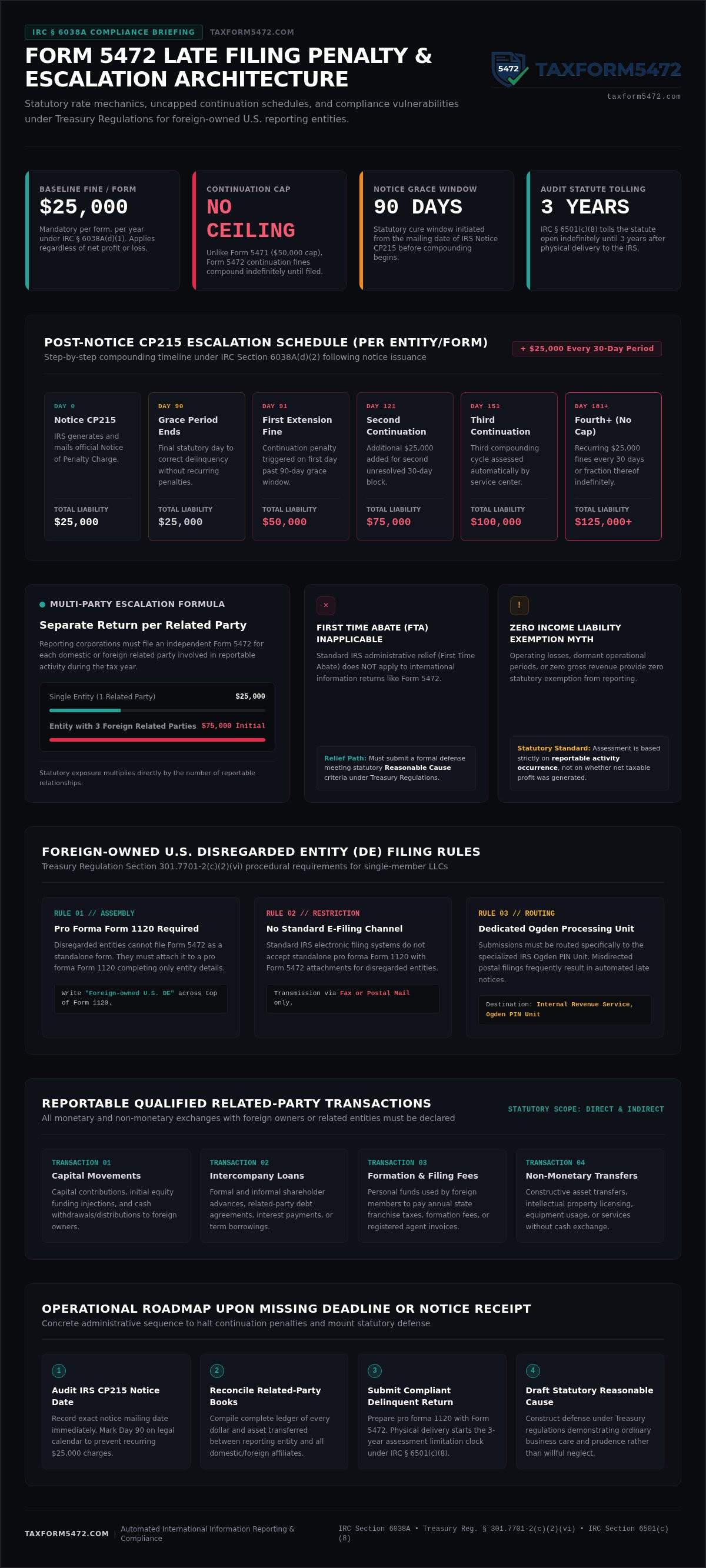
IRC Section 6038A(d)(1) mandates an automatic baseline penalty of $25,000 per form, per taxable year. This assessment applies uniformly to 25% foreign-owned U.S. corporations and foreign-owned single-member LLCs classified as disregarded entities. Operational losses or zero gross revenue provide zero protection. The statutory trigger depends entirely on whether reportable transactions took place, not whether the entity turned a profit.
Statutory exposure multiplies rapidly across corporate structures. A reporting corporation must file a separate Form 5472 for each domestic or foreign related party involved in reportable activity under established IRS Form 5472 reporting requirements. An entity with three foreign related parties faces an immediate $75,000 initial assessment for a single delinquent year. The IRS system automatically generates this assessment upon processing a delinquent return without a valid extension on record.
Compounding Penalties Under Section 6038A
When the IRS issues Notice CP215 (Notice of Penalty Charge), a strict statutory clock begins. Under IRC Section 6038A(d)(2), the taxpayer receives a 90-day grace period starting from the notice mailing date. If the delinquency remains unresolved past day 90, continuation penalties accrue immediately.
The IRS assesses an additional $25,000 for each subsequent 30-day period, or fraction thereof, until the failure is corrected. Unlike Form 5471 penalties, which cap continuation fines at $50,000, the form 5472 late filing penalty carries no statutory ceiling. Continuation assessments accumulate indefinitely.
Consider the escalation timeline for an unaddressed single-entity filing over six months post-notice:
- Day 0: Notice CP215 mailed. Initial assessment stands at $25,000.
- Day 90: Statutory grace window closes.
- Day 91: First continuation penalty applies. Total liability: $50,000.
- Day 121: Second continuation penalty applies. Total liability: $75,000.
- Day 151: Third continuation penalty applies. Total liability: $100,000.
- Day 181: Fourth continuation penalty applies. Total liability: $125,000.
In addition to monetary growth, IRC Section 6501(c)(8) tolls the assessment statute of limitations indefinitely. The federal statutory assessment window remains open for the entire corporate tax year until exactly three years after the required Form 5472 is physically delivered to the IRS.
Common Triggers Leading to Late Filing Assessments
IRS service centers rely on automated screening routines to identify non-compliance. Most assessments do not stem from deliberate tax evasion. Instead, they result from structural oversights, misunderstanding entity classifications, and incomplete disclosures.
Missed Deadlines for Foreign-Owned US Disregarded Entities
Foreign-owned single-member LLCs face unique procedural hurdles. Under Treasury Regulation Section 301.7701-2(c)(2)(vi), the IRS treats these disregarded entities as domestic corporations solely for information reporting under Section 6038A. They cannot file Form 5472 as a standalone document. The submission must include a pro forma Form 1120, completing only the entity details and writing "Foreign-owned U.S. DE" across the top.
These filings cannot be submitted through standard electronic filing channels. Filers must transmit them via fax or postal mail to the IRS Ogden PIN Unit. Missing the regular April 15 deadline without filing a timely Form 7004 extension triggers an immediate assessment. Reviewing core foreign owned us corporation tax guidelines prevents mistaking zero income tax liability for an exemption from informational filings.
Failure to Report Qualified Related-Party Transactions
A reporting entity must capture all direct and indirect monetary and non-monetary exchanges with related entities. This rule trips up many international owners. Reportable activity includes ordinary business purchases, owner loans, capital injections, cash withdrawals, and even personal funds used to pay annual state formation fees. Failing to log non-monetary asset movements or failing to track constructive ownership links triggers statutory non-compliance. Review the verified breakdown of reportable transactions form 5472 to ensure every intercompany transfer is documented correctly.
Filing Incomplete or Inaccurate Documentation
Submitting an incomplete form carries the exact same legal consequence as missing the deadline entirely. The IRS treats a "substantially incomplete" filing as a total failure to file under the IRS Instructions for Form 5472. Common triggers include:
- Omitting foreign taxpayer identification numbers (TINs) or reference IDs.
- Leaving direct or ultimate indirect foreign ownership percentages blank.
- Failing to provide exact gross monetary values in Part IV.
- Mismatching corporate legal names with IRS records.
Any of these defects exposes your company to an automated form 5472 late filing penalty. Deploying dedicated filing tools through taxform5472.com validates critical disclosure fields systematically, eliminating structural errors before submission.
Reasonable Cause Relief and Penalty Abatement Strategies
First-Time Abate (FTA) administrative waivers do not apply to Section 6038A assessments. Under Internal Revenue Manual 20.1.1.3, FTA relief is strictly restricted to standard income tax penalties under sections like 6651. For an assessed form 5472 late filing penalty, establishing statutory reasonable cause under Treasury Regulation Section 1.6038A-4(b) serves as the exclusive administrative remedy.
Establishing Reasonable Cause Under IRS Regulations
Securing relief requires affirmative proof that the corporation exercised ordinary business care and prudence. Acceptable factual grounds include verified medical incapacitation of key personnel, unavoidable record destruction from casualty events, or documented civil disruption. Mere ignorance of international informational filing obligations does not meet the legal threshold. Reviewing standard guidelines for IRS penalty relief for reasonable cause confirms that contemporaneous records, third-party documentation, and dated timelines are mandatory to validate every factual claim.
The Small Corporation Exception Standards
IRS Chief Counsel Advice (CCA) 202617012 establishes clear parameters for applying the liberal reasonable cause standard under Treas. Reg. Section 1.6038A-4(b)(2)(ii). To qualify under this Small Corporation Provision, an entity must satisfy four cumulative conditions:
- Global gross receipts of $20,000,000 or less for the tax year at issue.
- Demonstrated lack of prior knowledge regarding Section 6038A obligations.
- Limited operational presence and minimal physical footprint in the United States.
- Immediate, full cooperation upon discovering the deficiency.
Small business classification alone does not guarantee relief. Taxpayers must substantiate each condition with global financial records, entity history, and proof of prompt remediation.
Drafting and Submitting an Abatement Defense
Execute this administrative sequence when requesting relief from a form 5472 late filing penalty:
- Draft the legal statement: Document the precise operational facts leading to the delay. State why ordinary business care was maintained. Include a formal signature executed under penalties of perjury.
- Assemble exhibits: Attach fully completed, signed delinquent returns along with documented proof substantiating all claimed factual impediments.
- Submit to the issuing campus: Transmit the petition directly to the IRS campus address listed on Notice CP215. Use certified mail with tracking or verified receipt delivery.
- Monitor the processing cycle: Maintain submission records, log delivery confirmation timestamps, and prepare administrative appeal documentation if the initial service center review issues an adverse determination.
Steps to Take Immediately After Missing the Filing Deadline
Missing a regulatory filing deadline requires immediate, structured remediation. Delaying corrective action increases exposure to compounding assessments and keeps the federal statute of limitations open indefinitely. Taking proactive control of the situation limits statutory exposure.
Conducting an Immediate Compliance Assessment
Begin by auditing intercompany ledgers against foreign parent balance sheets. Pinpoint every transaction executed during the open tax period, including management fees, capital contributions, and intercompany debt. Verify foreign Taxpayer Identification Numbers (TINs) and domestic Employer Identification Numbers (EINs) across all entities in the corporate structure. Map all prior reporting periods without filed returns, as unfiled periods remain subject to IRS scrutiny without statutory expiration under Section 6501(c)(8).
Filing Delinquent Returns Prior to IRS Notice Issuance
Submitting completed returns before the IRS generates Notice CP215 yields substantial strategic advantages. Unsolicited submissions demonstrate ordinary business care, strengthening any subsequent administrative relief claim. Follow these operational steps:
- Prepare the complete return package, including the pro forma Form 1120 and Form 5472.
- Attach an explicit, signed Reasonable Cause Statement directly to the delinquent submission.
- Transmit the package via certified mail with return receipt requested or via verified fax (at 300 DPI resolution) to the IRS Ogden PIN Unit.
- Archive transmission timestamps, fax delivery logs, and postal receipts to create an immutable evidentiary trail.
- Maintain operational cash reserves in case the initial processing routine triggers a form 5472 late filing penalty notice before human review.
Correcting Incomplete Prior Year Filings
When an earlier submission contained missing schedules, invalid foreign entity data, or incorrect transaction values, an amended filing is mandatory. Leaving incomplete records on file creates continuous audit risk. Review procedural instructions on how to amend form 5472 to replace inaccurate records without triggering secondary notices.
Filing a complete amended informational package cuts off continuation penalty accruals and starts the three-year statutory assessment clock. To prepare and submit accurate international disclosures without administrative delays, prepare your IRS Form 5472 filing online.
Preventing Form 5472 Penalties Through Automated Preparation
Manual compliance processes create recurring operational risks. Spreadsheet tracking and manual PDF data entry frequently miss critical intercompany disclosures, especially across foreign jurisdictions. Managing Section 6038A requirements through dedicated digital tools eliminates human oversight and secures your corporate standing before deadlines pass.
Eliminating Common Manual Reporting Deficiencies
Manual submissions often fail basic schema checks. Omitted foreign entity identification numbers, missing ownership percentages, or misallocated intercompany payment categories trigger automatic rejection at IRS processing centers. When an information return gets rejected as substantially incomplete, the IRS treats it as unfiled.
Systematic data validation prevents these failures before transmission. Automated logic maps complex corporate trees, confirming every 25% direct and indirect foreign shareholder across multi-tier structures. Transactional values convert accurately into required IRS reporting schedules, preventing clerical formatting defects. Implementing automated form 5472 preparation protects your business from administrative oversights that lead directly to assessment notices.
Establishing Verifiable Records and Filing Verification
Treasury Regulation Section 1.6038A-3 mandates comprehensive record maintenance for all reportable transactions. Failing to produce these records during an inquiry carries the same statutory penalties as failing to file the return itself. Software platforms solve this by creating centralized, audit-ready compliance archives.
A structured compliance workflow delivers clear operational advantages:
- Validated records: Store intercompany balance reconciliations, owner contribution ledgers, and loan documentation in an exportable audit packet.
- Deadline tracking: Eliminate corporate calendar confusion between standard corporate tax schedules and foreign disregarded entity rules.
- Transmission verification: Maintain timestamped generation logs that verify timely completion and delivery.
Proactive compliance remains far more cost-effective than attempting penalty abatement after the fact. Eliminating reporting defects at the point of submission protects your corporate entity without expensive administrative battles or tax court litigation. To ensure complete statutory compliance and protect against an unexpected form 5472 late filing penalty, prepare and validate your reporting package directly through taxform5472.com.
Protect Your Entity from Escalating Assessments
A delinquent information return triggers swift administrative consequences under IRC Section 6038A. An initial assessment compounds every 30 days without a statutory ceiling once Notice CP215 is issued. Routine First Time Abate waivers don't apply, leaving statutory reasonable cause as your sole administrative defense. Taking immediate corrective action halts recurring charges and finally closes vulnerable assessment windows.
Manual workflows invite costly omission errors on related-party disclosures. Using specialized software designed specifically for foreign-owned US entity compliance provides essential structural protection. Automated input verification prevents Section 6038A reporting omissions before documents reach the IRS. Address compliance gaps promptly to protect your corporate standing and eliminate the risk of a form 5472 late filing penalty.
Prepare your compliant Form 5472 online now and secure your entity's standing with confidence.
Frequently Asked Questions
How much is the IRS Form 5472 late filing penalty in 2026?
Under IRC Section 6038A, the statutory base form 5472 late filing penalty is $25,000 per form, per year. This assessment applies separately for each related party involved in reportable transactions. If the return remains unfiled for more than 90 days after the IRS mails Notice CP215, continuation penalties add $25,000 for each subsequent 30-day window. There is no legal ceiling on cumulative continuation fines.
Can the Form 5472 late filing penalty be abated through reasonable cause?
Yes. IRC Section 6038A(d)(3) and Treasury Regulation Section 1.6038A-4(b) allow full abatement if you prove reasonable cause. Taxpayers must demonstrate they exercised ordinary business care and prudence despite the missed deadline. You must provide a formal written statement executed under penalties of perjury, supported by contemporaneous third-party documentation detailing the specific impediments that prevented timely compliance.
Does the First-Time Abate policy apply to Form 5472 penalties?
No. The IRS First-Time Abate (FTA) administrative waiver is strictly limited to domestic failure-to-file and failure-to-pay penalties under sections like IRC Section 6651. It does not apply to international information return penalties under Section 6038A or Section 6038C. Penalty relief for Form 5472 requires meeting statutory reasonable cause standards or qualifying under the Small Corporation Provision outlined in CCA 202617012.
What happens if a foreign-owned US LLC had no income or activity?
Having zero income or active business operations does not exempt a foreign-owned single-member LLC from filing. If the entity experienced reportable transactions, such as initial capital contributions, startup cost payments, owner draws, or payment of annual state registration fees, filing remains mandatory. Failing to file Form 5472 attached to a pro forma Form 1120 generates the full statutory $25,000 assessment regardless of profitability.
How does the IRS calculate the additional continuation penalties under Section 6038A?
Continuation assessments begin exactly 90 days after the IRS issues Notice CP215. Once that grace period expires, the IRS charges an additional $25,000 for each 30-day period, or fraction thereof, that the return remains delinquent. Unlike other international information returns that impose statutory caps, Form 5472 continuation penalties accrue indefinitely until the complete filing is officially received and accepted by the IRS.
Where do I send a Form 5472 penalty abatement request letter?
Send your penalty abatement letter directly to the IRS campus address printed on your Notice CP215. Do not send it to standard regional processing centers. Address the package to the penalty appeals or abatement unit specified on the notice. Always utilize certified mail with return receipt requested or approved private delivery services to maintain proof of delivery and delivery timestamps.
What constitutes acceptable reasonable cause for foreign corporate owners?
The IRS accepts substantiated claims demonstrating that non-compliance occurred despite ordinary business care. Acceptable grounds include the sudden death or serious incapacitation of a key operational officer, catastrophic destruction of financial records, or verified small corporation status under CCA 202617012. Ignorance of federal filing laws or reliance on incorrect non-professional advice does not qualify as reasonable cause under statutory standards.