
An automatic $25,000 penalty is the standard IRS response for the 2026 tax year. Knowing how to amend form 5472 correctly is the only way to mitigate this risk. This assessment is systematic. It occurs without manual agent review. It applies even if your entity is dormant. You likely feel the weight of this strict enforcement. The definitions of reportable transactions are complex. Errors occur. The IRS doesn't distinguish between a simple typo and intentional non-compliance. The cost of inaction is high.
This guide provides professional instructions for correcting errors and filing the necessary pro-forma returns. We'll outline the specific mailing procedures for the Ogden, Utah service center. We also discuss the requirements for penalty abatement and the role of automation in future compliance. This is a utilitarian roadmap for resolving current errors and preventing new ones. It focuses on the essential steps to secure your entity's standing. Follow these steps to resolve your filing status.
Key Takeaways
- Understand the $25,000 automatic penalty risk for incomplete or inaccurate Form 5472 submissions.
- Follow the precise technical workflow for how to amend form 5472 using corrected pro-forma returns.
- Identify the specific documentation required to establish "Reasonable Cause" for IRS penalty abatement.
- Deploy automated SaaS tools to validate data fields and eliminate future manual filing errors.
The $25,000 Penalty Myth: Why Minor Errors Matter
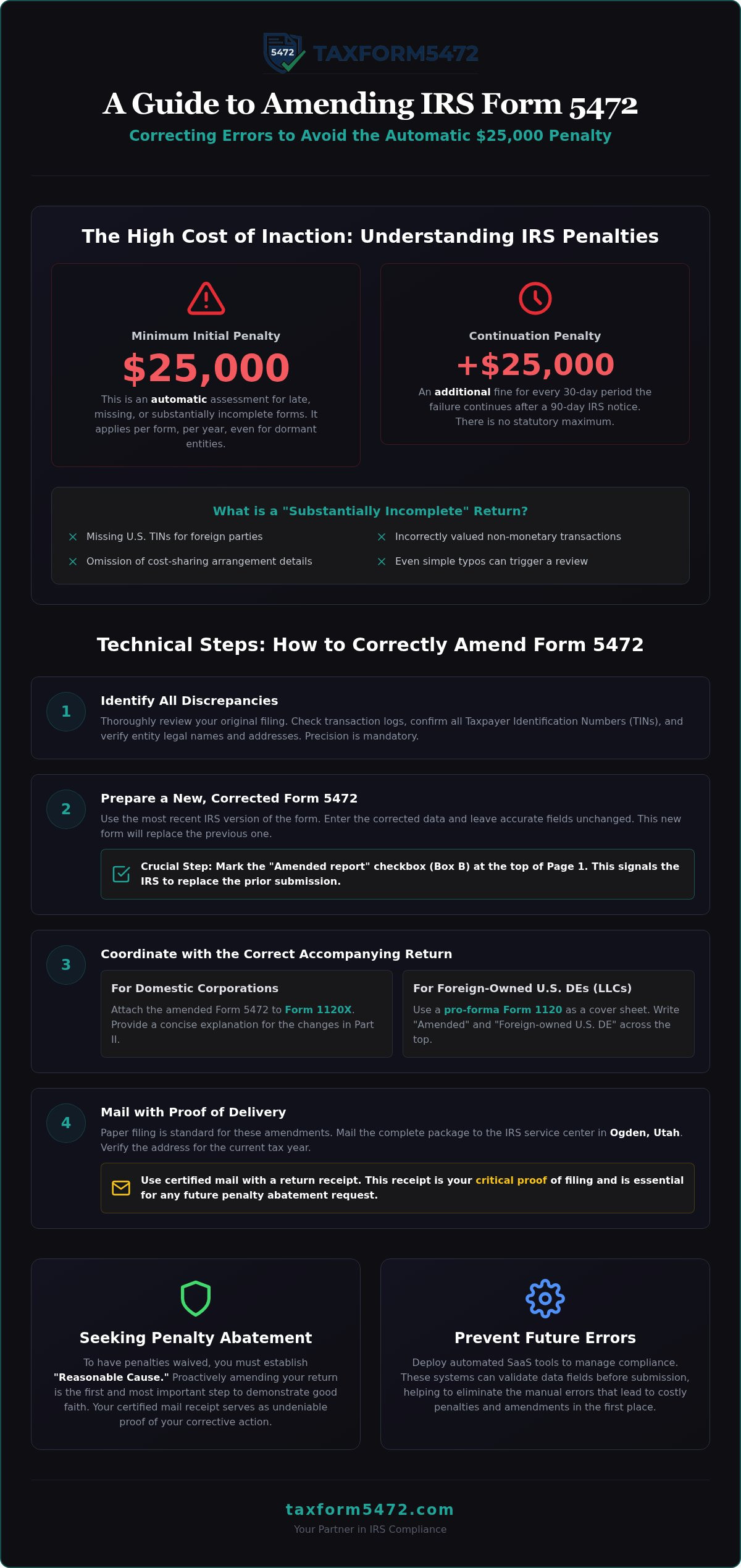
IRS enforcement is binary. You either complied or you didn't. For the 2026 tax year, the minimum penalty is $25,000. This amount applies per form, per year. A common misconception is that filing any version of the form stops the penalty clock. It doesn't. The IRS defines a failure to file to include missing, late, or substantially incomplete returns. If your data is flawed, the IRS treats the form as if it were never submitted. This triggers an automatic assessment. No agent review is required for this initial fine. Learning how to amend form 5472 is the primary path to demonstrate good faith compliance before an automated assessment begins.
Defining a Substantially Incomplete Return
Accuracy is a mandatory standard under IRC Section 6038A. The IRS uses these IRS information returns to monitor transactions between U.S. companies and foreign owners. A return is considered incomplete if it lacks specific identifiers or transaction details. Common errors include missing U.S. Taxpayer Identification Numbers (TINs) for foreign related parties. Incorrectly valued non-monetary transactions also lead to rejection. Omission of cost-sharing arrangement details is another frequent trigger. If you discover these errors, you must understand how to amend form 5472 to maintain compliance. Correcting these details proactively demonstrates a commitment to transparency and accuracy.
The Cost of Inaction
Ignoring a filing error leads to compounding financial loss. Once the IRS identifies a failure, they issue a formal notice. You have 90 days to respond. If the failure continues past this window, the continuation penalty applies. This adds an additional $25,000 for every 30-day period. There is no statutory maximum for these cumulative penalties. A small oversight can quickly escalate into a six-figure debt. Beyond the immediate fine, an inaccurate Form 5472 raises the audit risk for the entity's parent Form 1120. Amending the return serves as a strategic defensive action. It provides a factual basis for arguing reasonable cause later. Proactive correction is the only way to stop the automated enforcement cycle. Use a corrected return to signal that you're resolving the discrepancy. This is the first step in seeking a penalty waiver or abatement.
Technical Steps: How to Amend Form 5472 Correctly
Precision is mandatory. Start by identifying the specific discrepancy. Review transaction logs for non-monetary exchanges. Confirm related party Taxpayer Identification Numbers (TINs) against previous filings. Verify entity legal names and registered addresses. Small data gaps trigger the $25,000 penalty. Once identified, you must understand how to amend form 5472 to stop the automated enforcement cycle. Prepare a fresh Form 5472. Use the most recent IRS version of the form. Enter the corrected data in the relevant fields. Leave accurate fields unchanged to maintain consistency.
Mark the "Amended report" checkbox (Box B) at the top of Page 1. This tells the IRS to replace the prior filing in their database. Accuracy in this step is vital for avoiding secondary assessments. Refer to the Official IRS Instructions for Form 5472 for specific field requirements. Errors in the amendment itself lead to further scrutiny and potential audit flags. Automated Form 5472 preparation helps ensure these critical fields are validated before submission.
Coordinating with Form 1120X
The amendment process depends on your entity type. Domestic corporations use Form 1120X as a carrier. Attach the corrected Form 5472 to this return. Use Part II of Form 1120X to provide a concise explanation. State clearly why the correction is necessary. Foreign-owned disregarded entities (LLCs) follow a different path. They file a pro-forma Form 1120. This acts as a cover sheet for the corrected 5472. Write "Amended" and "Foreign-owned U.S. DE" across the top of the pro-forma 1120. Only include the entity's name, address, and items required by the instructions.
Mailing and Documentation
Paper filing is the standard for amended international returns. Foreign-owned disregarded entities cannot e-file these corrections. Mail the complete package to the dedicated IRS unit in Ogden, Utah. Use a private delivery service or certified mail with a tracking number. Always request a return receipt. This provides a timestamped record of your filing. The IRS often assesses penalties automatically through data matching. If you don't have a certified mail receipt, you lack proof of filing for a "reasonable cause" penalty abatement. Keep a full digital and physical copy of the submitted package. Verify the current mailing address for the 2026 tax year before sending. Learning how to amend form 5472 correctly includes maintaining this audit trail. Timely submission is the only way to avoid the $25,000 continuation penalty that applies every 30 days.
Form 5472 Late Filing Penalty: IRS Enforcement Reality
IRS enforcement is no longer a manual process. It's an algorithmic one. Automated systems match Form 5472 data against other international information returns. Discrepancies generate immediate penalty notices. A common myth suggests that transactions under $50,000 are exempt from penalties. This is false. IRC Section 6038A requires reporting for any transaction value. A $100 payment for services is as reportable as a $1,000,000 loan. If you've missed these small entries, you must learn how to amend form 5472 before the system flags the omission. Failure to report any value constitutes a failure to file. The $25,000 penalty applies regardless of the transaction's size.
Voluntary Disclosure vs. IRS Audit
Timing determines the severity of the IRS response. Filing a voluntary amendment signals a commitment to compliance. It provides a factual foundation for Form 5472 penalty relief strategies. If the IRS discovers the error first, the opportunity for a "good faith" defense diminishes. IRS-initiated discovery typically precludes successful penalty waivers. While the First-Time Abatement (FTA) program is generally unavailable for this form, a proactive amendment supports a "reasonable cause" claim. Beyond the $25,000 base fine, the IRS may apply accuracy-related penalties. These are calculated as a percentage of any tax underpayment. Proactive correction is a strategic move to limit these secondary assessments.
Common Triggers for Penalty Notices
Certain patterns consistently trigger IRS attention. Automated data matching identifies inconsistencies across several points:
- Mismatched data: Discrepancies between Form 5472 and the foreign parent entity's records.
- Unreported capital contributions: Foreign-owned LLCs often overlook owner-funded operational costs or small cash injections.
- Late primary returns: Filing Form 1120 after the deadline automatically invalidates the attached 5472, triggering the penalty.
Penalty Relief Strategies: Reasonable Cause and Abatements
Seeking relief from a $25,000 assessment requires a structured administrative approach. It is not a casual request. The IRS evaluates these requests based on specific legal standards. Your primary objective is to stop the collection process and reverse the penalty. Knowing how to amend form 5472 is only half the battle. You must also present a compelling case for why the initial filing was late or inaccurate. This requires a formal penalty protest letter. Be concise. Stick to the facts. Avoid emotional appeals. A utilitarian presentation suggests professional competence and a focus on compliance.
The FTA Limitation
First-Time Abatements (FTA) are common for domestic tax penalties. However, the IRS typically excludes Form 5472 from FTA eligibility. This program is designed for Form 1120 late filing or payment penalties. Administrative waivers for international information returns are discretionary. They are not guaranteed. The IRS prioritizes your three year compliance history. If you have a clean record, state this clearly in your protest. But do not rely on FTA as your primary strategy. You must prepare a more robust defense based on specific circumstances.
Documenting Reasonable Cause
Reasonable cause is the gold standard for penalty waiver. You must prove you exercised ordinary business care and prudence. The IRS demands a detailed narrative supported by physical evidence. Ignorance of the law is never a valid defense. Instead, focus on these documented factors:
- Professional Advice: Provide copies of written advice from a tax professional that proved to be incorrect.
- Unforeseen Circumstances: Document natural disasters, serious illness, or the death of a key individual responsible for compliance.
- Internal Procedures: Show that you had established compliance protocols that failed due to specific, documented errors.
- Small Corporation Provision: Highlight if your entity has gross receipts of $20 million or less. The IRS may apply the reasonable cause exception more liberally in these cases.
Delinquent International Information Return Submission Procedures (DIIRSP)
The DIIRSP provides a path for taxpayers who have not yet been contacted by the IRS. This procedure is for those who acted in good faith but missed a filing requirement. You must file the delinquent or amended forms with a reasonable cause statement attached. Learning how to amend form 5472 within the DIIRSP framework is a strategic defensive move. It positions your entity as a voluntary discloser. This status is vital for avoiding the more aggressive enforcement actions associated with IRS-initiated audits. Ensure all mandatory fields are completed to avoid a "substantially incomplete" rejection of your relief request.
Automated Compliance: Preventing Future Amendments
Manual entry is the primary cause of filing errors. SaaS solutions eliminate these vulnerabilities through systematic data mapping. Digital validation ensures every mandatory field is populated before submission. This directly prevents the "substantially incomplete" status that triggers automatic assessments. Electronic record-keeping satisfies the record maintenance requirements of IRC Section 6038A. Professional platforms generate a clear audit trail. This documentation is essential if the IRS ever questions transaction values or related party identities. Relying on software is a strategic shift from reactive correction to proactive compliance.
Understanding how to amend form 5472 is a necessary skill for resolving past mistakes. However, the goal for the 2026 tax year should be error-free initial filings. Manual paper corrections are inefficient and increase the risk of secondary errors. Automated systems provide a standardized environment for data entry. They use built-in logic to identify inconsistencies in reportable transaction data. This precision protects your entity from the $25,000 minimum penalty. Efficiency in tax reporting is not just about speed. It's about data integrity and risk mitigation.
The taxform5472.com Advantage
Our platform provides a streamlined interface specifically for foreign-owned U.S. corporations. It's built to handle 2026 compliance standards with precision. Manual CPA firms often charge high fees for routine data entry. This SaaS model offers a cost-effective alternative without sacrificing accuracy. The interface guides users through the specific requirements for disregarded entities and pro-forma 1120 attachments. It removes the guesswork from complex international reporting. High-frequency updates ensure the software reflects current IRS mailing addresses and form versions.
Implementing a Compliance Workflow
Accuracy depends on a consistent data collection process. Centralize your reportable transaction data throughout the year. Don't wait until the April 15 deadline to gather capital contribution or loan details. Use automated Form 5472 filing for accuracy and to validate data as it's entered. Schedule internal reviews quarterly to ensure all related party information remains current. This workflow minimizes the need to learn how to amend form 5472 in the future. A structured approach combined with digital tools ensures your entity remains compliant and audit-ready. Automation is the final step in securing your business against automated IRS enforcement.
Secure Your Entity Compliance Status
Amending Form 5472 is a strategic defensive measure. It stops the automated IRS enforcement cycle and establishes a factual basis for penalty relief. You now understand the technical requirements for filing corrected pro-forma returns. You recognize the necessity of documenting reasonable cause for the 2026 tax year. Proactive correction remains the only viable path to mitigating the $25,000 penalty risk. This guide has detailed exactly how to amend form 5472 to protect your business interests. Accuracy is the standard. Manual processes are no longer sufficient for international information returns. Transitioning to automated systems ensures your data remains validated and audit-ready. Our platform is specialized for foreign-owned entities. It provides a secure digital filing environment that satisfies IRC Section 6038A requirements. File your Form 5472 accurately with our automated platform to prevent future errors. Successful compliance is a direct result of using precise, professional tools. Take control of your filing status today.
Frequently Asked Questions
Can I e-file an amended Form 5472?
No. Foreign-owned disregarded entities must mail or fax corrections to the IRS unit in Ogden, Utah. Electronic filing is currently unsupported for these specific amended returns. You must submit a complete paper package including the corrected Form 5472 and a pro-forma Form 1120. Verify the specific 2026 mailing address before dispatching your documents. Learning how to amend form 5472 involves following these strict manual submission protocols to ensure the IRS receives your data.
What is the penalty for filing Form 5472 late in 2026?
The minimum penalty is $25,000 per form for the 2026 tax year. This fine applies to late filings, missing forms, or substantially incomplete submissions. If the failure continues for more than 90 days after IRS notification, additional $25,000 penalties accrue every 30 days. There's no maximum limit for these continuation assessments. This automated enforcement makes immediate correction via an amendment essential for risk mitigation. Accuracy is the only defense against these fines.
Do I need to file an amended Form 1120 with my amended 5472?
Yes. Form 5472 must be attached to a carrier return. Domestic corporations use Form 1120X to carry the update. Foreign-owned disregarded entities use a pro-forma Form 1120. You must write "Amended" at the top of these forms to signal a correction. This ensures the IRS processes the new data as an update to your existing record rather than a duplicate or original filing. Incomplete packages often trigger secondary processing delays.
How long does the IRS have to assess a Form 5472 penalty?
The standard assessment period is three years from the date the return was filed. However, if no return is filed or if the return is substantially incomplete, the statute of limitations never starts. This allows the IRS to assess the $25,000 penalty indefinitely. Filing a corrected return is the only way to start the clock and eventually close the window for IRS assessments. This emphasizes why proactive amendments are a critical compliance strategy.
Is there a statute of limitations on an incomplete Form 5472?
No. An incomplete Form 5472 is treated as a failure to file. The statute of limitations remains open indefinitely for any year where the reporting requirements aren't met. This exposes the entity to perpetual audit risk and compounding penalties. Understanding how to amend form 5472 correctly closes this exposure. Once a complete and accurate amended return is processed by the IRS, the three-year assessment window finally begins. Accuracy is mandatory for closure.
What qualifies as reasonable cause for a late Form 5472?
Reasonable cause requires proving you exercised ordinary business care but were unable to comply. The IRS considers factors like reliance on erroneous professional advice, natural disasters, or serious illness of a key officer. Ignorance of the law isn't a valid defense. You must provide a detailed factual narrative and supporting documentation. Small corporations with gross receipts under $20 million may receive more liberal consideration during the IRS review process.
Does a $0 revenue LLC still face the $25,000 penalty?
Yes. Revenue is irrelevant to the filing requirement. The obligation is triggered by "reportable transactions" with a foreign related party. This includes capital contributions, loans, or payments for administrative services. Even a dormant LLC with zero income must file if the foreign owner paid for the entity's annual registration fees. Missing these small transactions often leads to the $25,000 automatic assessment. The IRS matches bank records to identify these unreported flows.
How do I check the status of my amended tax return?
Use the "Where's My Amended Return?" tool on the official IRS website. You can also contact the IRS international tax line directly for status updates. Note that paper-filed amendments for foreign-owned entities often take 16 weeks or longer to process. Retain your certified mail receipt as proof of submission while waiting for system updates. This documentation is your primary defense if a penalty notice arrives during the processing window. Stay vigilant during this period.