
A $100 capital contribution can trigger a $25,000 IRS penalty. Your LLC is "disregarded" for income tax, yet it's fully visible for information reporting. This dual status creates immediate risk for international owners. Mastering foreign owned disregarded entity reporting is essential for 2026 compliance. Automated enforcement now matches bank records with tax filings to identify non-filers instantly. Silence from the IRS isn't safety; it's a pending audit.
It's natural to feel frustrated by the requirement to file a Pro Forma 1120 for an entity that pays no tax. The administrative burden is high. The cost of error is higher. This reference guide provides the technical framework to manage your Form 5472 obligations. We'll cover filing eligibility, reportable transaction identification, and the specific steps for a successful 2026 submission. Use this data to secure your standing and avoid federal scrutiny. Follow these protocols to ensure your filing is complete and timely. Accuracy is your best defense against automated penalties.
Key Takeaways
- Confirm entity classification under Regs. Sec. 301.7701-2 to define your specific reporting scope.
- Categorize monetary and non-monetary transactions subject to foreign owned disregarded entity reporting.
- Master the specific Pro Forma Form 1120 notations required for compliant IRS submission.
- Execute 2026 deadline and extension protocols to mitigate the $25,000 failure-to-file penalty risk.
- Leverage automated digital platforms to streamline complex Form 5472 and Pro Forma preparation.
Scope of Reporting for Foreign-Owned Disregarded Entities
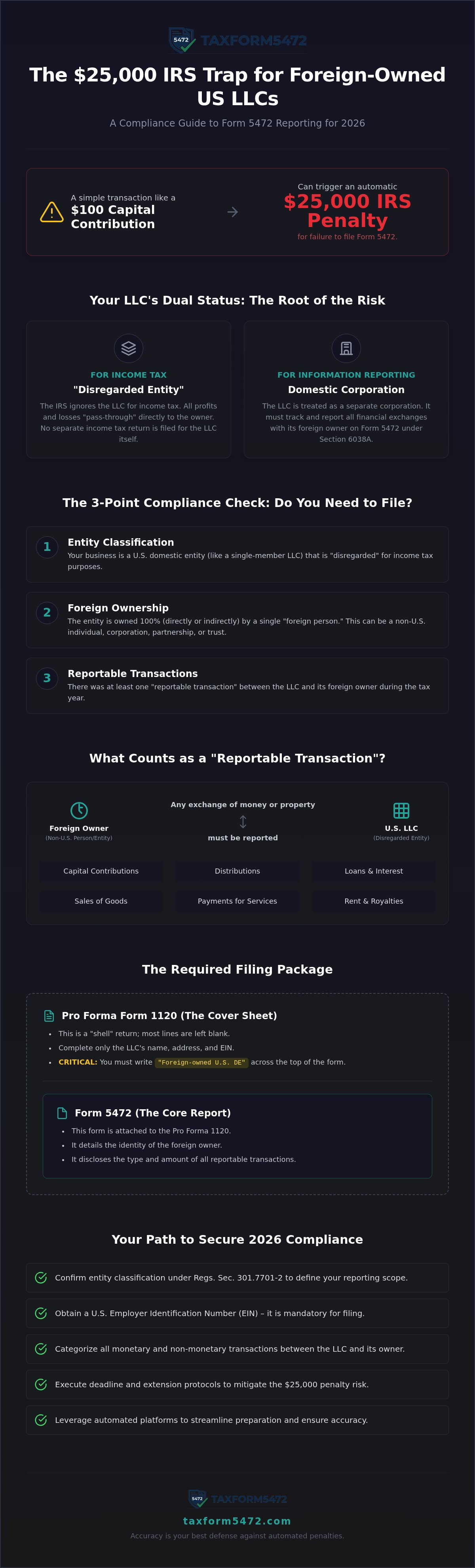
A domestic disregarded entity (DE) is typically a business structure with a single owner, such as a single-member LLC (SMLLC). Under Regs. Sec. 301.7701-2, the IRS ignores the entity for income tax purposes. The business activity generally flows directly to the owner's tax return. However, federal regulations create a specific exception for international owners. For information reporting, the IRS treats these entities as separate domestic corporations. This classification triggers mandatory filing under Section 6038A. Understanding the Scope of Reporting for Foreign-Owned Disregarded Entities is the first step in risk mitigation.
Every foreign-owned US LLC must obtain a US Employer Identification Number (EIN). You cannot file the required forms without this identifier. This rule applies even if the LLC has no income or active business operations. If a non-US person owns 100% of the entity, foreign owned disregarded entity reporting requirements are active. The IRS uses this framework to track cross-border transactions that might otherwise remain hidden due to the entity's disregarded status.
Determining Foreign Ownership Status
Ownership status depends on the tax residency and legal nature of the ultimate owner. The IRS applies different criteria for individuals and business structures. Compliance hinges on identifying the person or entity at the top of the ownership chain.
- Individuals: Non-US citizens who don't meet the Substantial Presence Test or hold a Green Card.
- Entities: Foreign corporations, partnerships, and trusts based outside the United States.
- Thresholds: Reporting applies when a foreign person owns 100% of the domestic DE directly or indirectly.
Ownership is often transparent. If a foreign corporation owns a US LLC, the LLC is foreign-owned. The reporting duty remains even if the foreign corporation is itself owned by US persons. You must look at the immediate owner of the US entity to determine the filing obligation.
Disregarded vs. Reporting Status
The term "disregarded" is often misleading for international investors. It only applies to income tax liability. The entity doesn't file a separate income tax return to pay taxes; it acts as a pass-through. For transparency, however, the IRS requires the entity to act like a corporation. It must track all financial exchanges with its owner. This dual status creates confusion but is the foundation of the current regulatory environment.
This distinction affects your foreign owned us corporation tax strategy. You must maintain separate books. Every capital contribution or expense payment is a reportable event. Failure to recognize this "corporate" reporting status leads to the $25,000 penalty. The IRS uses this data to monitor cross-border capital flows and identify potential tax evasion. Compliance is not optional for active or inactive entities.
Filing Requirements: Form 5472 and Pro Forma 1120
Foreign-owned disregarded entities don't file a standard income tax return. They use Form 1120 as a "pro forma" container. This shell exists solely to carry Form 5472. You must write "Foreign-owned U.S. DE" across the top of the Form 1120. This notation is mandatory. It alerts IRS processing systems that the return contains informational data rather than taxable income calculations. Review the official Filing Requirements: Form 5472 and Pro Forma 1120 to confirm current submission standards.
Compliance also involves strict record maintenance. Under Section 6038A, you must keep documentation that substantiates all reported transactions. This includes bank statements, contracts, and invoices. The IRS can request these records during an audit. Failure to provide them carries the same $25,000 penalty as failing to file the form itself. For 2026, consider the efficiency of digital preparation. While paper filing remains an option, it increases the risk of manual entry errors by IRS agents. You can use an automated preparation platform to minimize these risks.
Completing the Pro Forma Form 1120
The Pro Forma 1120 is a simplified version of the corporate return. You only complete the basic identifying information. This includes the legal name, address, and EIN of the LLC. You don't report income, deductions, or tax credits on this form. Most lines remain blank. Focus on the checkboxes in Items B and E. Item B must reflect the entity's initial, amended, or final return status. Item E must be checked if the corporation is a foreign-owned domestic disregarded entity. These technical markers ensure the IRS classifies your foreign owned disregarded entity reporting correctly.
Form 5472 Data Points
Form 5472 captures the details of the relationship between the LLC and its foreign owner. Part I identifies the reporting corporation, which is your US LLC. Part II requires information about the 25% foreign shareholder. You'll need their legal name, address, and foreign taxpayer identification number. Part III focuses on the "Related Party." This is usually the foreign owner or an affiliated company. For a granular look at every box, see our foreign owned llc form 5472 guide. Accuracy in these sections is vital. Incomplete forms are treated as non-filed, triggering immediate penalties.
Identifying Reportable Transactions for Disregarded Entities
Reportable transactions are the primary trigger for Form 5472 filings. Many owners mistakenly assume that a lack of US-source income exempts them from compliance. This is incorrect. The IRS focuses on the exchange of value between the entity and its foreign owner. Monetary transactions include sales, rent, royalties, and interest payments. If the LLC pays interest on a loan from the owner, you must report it. Non-monetary transactions are equally critical. Asset transfers and capital contributions fall into this category. Even the payment of formation or dissolution costs by the owner on behalf of the LLC constitutes a reportable event. If you paid a $100 state filing fee from a personal account, you've triggered a filing requirement. Loans and borrowings between the owner and the DE are also scrutinized. You must report the principal amounts and any interest accrued or paid during the period.
Capital Contributions and Distributions
Initial investments are often the first reportable transactions for a new LLC. You must disclose the total amount of capital contributed during the tax year. This includes cash, property, or services provided by the owner. Distributions follow the same rule. Any cash or assets moved from the LLC to the owner must be recorded. It's a common misconception that "zero-dollar" years don't require a filing. If the entity had no income but the owner paid a single administrative bill, foreign owned disregarded entity reporting is mandatory. The IRS uses these data points to track the entity's financial lifecycle from formation to dissolution. Every financial interaction is a disclosure event.
Related Party Definitions
The reporting duty extends beyond the direct owner to "related parties." This definition is broad under Section 6038A. It includes any 25% foreign shareholder and any person related to the reporting corporation or a 25% foreign shareholder. Direct and indirect owners are both covered. If a foreign parent company owns the LLC through a subsidiary, the parent is a related party. Entities under common control also trigger reporting. If you own two US LLCs and they exchange funds, that transaction is reportable. Attribution rules further complicate the landscape. These rules pull in family members and affiliated groups. Accurate foreign owned disregarded entity reporting requires identifying all these parties to ensure your Form 5472 is complete. Incomplete data is a primary cause of the $25,000 penalty.
Compliance Deadlines and the $25,000 Penalty Risk
The IRS enforces strict timelines for foreign owned disregarded entity reporting. For the 2025 tax year, the standard filing deadline is April 15, 2026. This date applies to all entities following a calendar year. Missing this window triggers an immediate $25,000 penalty. This isn't a percentage-based fine; it's a flat administrative assessment. If the IRS notifies you of a failure to file and you don't respond within 90 days, the cost escalates. An additional $25,000 is assessed for every 30-day period the non-compliance continues. There is no ceiling on these continuation penalties. Automated enforcement systems now match bank data against tax records to flag non-filers instantly.
Proactive management is the only way to avoid these costs. The IRS doesn't waive penalties for "not knowing" the rules. You must track your deadlines with precision. If you cannot meet the April deadline, you must act before the due date passes. Late filings without an extension are processed with automatic penalty notices. You can mitigate this risk by using a professional IRS Form 5472 preparation tool to ensure your data is ready for submission well before the 2026 cutoff.
2026 Filing Calendar
Most international owners operate on a calendar year basis. If your fiscal year differs, your deadline is the 15th day of the 4th month following the close of your tax year. You can secure a six-month extension by filing Form 7004. This must be submitted by the original April 15 due date. An approved extension moves your filing requirement to October 15, 2026. Note that state-level obligations may differ. Entities formed in specific jurisdictions must also monitor delaware llc form 5472 requirements to ensure full regional compliance. Missing the federal extension deadline removes all leeway for the 2026 cycle.
Mitigating Penalty Exposure
The IRS allows for penalty abatement under "reasonable cause" exceptions. However, this is a high legal bar. Simple ignorance of the law or reliance on a non-expert advisor rarely qualifies. Your filing must also be "substantially complete." Leaving parts of Form 5472 blank because the information is difficult to obtain is a high-risk strategy. The IRS treats an incomplete form as a failure to file. If your LLC has transactions with multiple related parties, you must file a separate Form 5472 for each one. Failing to disclose three separate related parties can result in an initial $75,000 penalty assessment. Accuracy is your primary defense against federal scrutiny.
Streamlined Form 5472 Filing via taxform5472.com
Manual preparation of IRS forms is prone to structural error. Digital automation solves this by enforcing strict data entry rules. Our platform handles the complex interaction between Form 5472 and the Pro Forma 1120 automatically. It ensures all required notations, such as the "Foreign-owned U.S. DE" header, are correctly placed and formatted. This precision is vital for foreign owned disregarded entity reporting in 2026. Automated validation checks monitor your inputs for completeness in real-time. This prevents the submission of "incomplete" forms that the IRS routinely uses to justify $25,000 penalties. Secure digital submission provides a reliable audit trail for federal compliance. You receive immediate confirmation of your filing status. Efficiency replaces the administrative friction of paper-based systems.
Why Use Automated Compliance Software?
Traditional accounting firms often treat information reporting as a secondary service. This leads to high fees and slow turnaround times. Automated software offers a specialized, cost-effective alternative. It eliminates the manual entry omissions that lead to IRS rejection or audit flags. The interface is utilitarian. It's designed for international owners who need results, not tax theory. Centralized record-keeping is a core feature. It stores your data securely for the required statute of limitations. This is essential if the IRS requests substantiation for reported transactions. You can retrieve past filings and supporting documentation instantly. This focus on digital storage mitigates the risk of lost paper records during an audit.
Getting Started with Your 2026 Filing
Compliance follows a logical, three-step progression. Our platform guides you through the technical requirements to ensure a compliant outcome for the 2026 tax season.
- Step 1: Input entity and foreign owner details. You'll need your US Employer Identification Number (EIN). Provide the legal name and address of the foreign owner. Include their foreign taxpayer identification number to satisfy Part II requirements.
- Step 2: Catalog reportable transactions for the tax year. This is the most critical phase. You must list all capital contributions, distributions, and loans. The system categorizes these as monetary or non-monetary events. This ensures your foreign owned disregarded entity reporting captures every event from formation costs to year-end distributions.
- Step 3: Generate and review your compliant tax forms. The system produces a ready-to-file PDF package including Form 5472 and the Pro Forma 1120. Review the data for accuracy before final submission.
This structured approach ensures no field is left blank. You maintain total control over your federal obligations without needing deep technical knowledge of the tax code. Start your 2026 filing early to ensure all related party information is gathered before the April 15 deadline. Accuracy is your primary defense against automated IRS penalty assessments.
Finalize Your 2026 Federal Reporting Obligations
Effective foreign owned disregarded entity reporting is a matter of administrative precision. The IRS uses Form 5472 to monitor cross-border financial flows. It doesn't require US-source income to trigger a filing. Every capital contribution, distribution, and loan must be documented on a Pro Forma 1120. Failing to meet the April 15, 2026, deadline results in an immediate $25,000 penalty. This risk is entirely preventable through organized record-keeping and timely submission. Accuracy is your primary defense against automated enforcement systems.
Automation eliminates the structural errors common in manual paper filings. Our platform is specialized for international owners. It offers a secure digital interface to manage these complex requirements. You can verify your data against IRS standards before final submission. Start Your Automated Form 5472 Filing Now to secure your compliance status. Professional tools provide the quiet confidence needed to navigate federal regulations. Your business deserves a streamlined path to compliance. Manage your 2026 obligations with efficiency and focus.
Frequently Asked Questions
Is a foreign-owned disregarded entity required to file Form 1120?
Yes. The entity must file a Pro Forma Form 1120. This document acts as a carrier for Form 5472. You only complete the identifying information and the "Foreign-owned U.S. DE" notation at the top. No income or expense data is reported on the 1120 itself. It exists solely to fulfill the information reporting mandate for disregarded entities under current IRS regulations. Accuracy in the header and checkboxes is mandatory for compliance.
What happens if I miss the Form 5472 filing deadline?
Missing the deadline triggers an automatic $25,000 penalty. This fine applies to each Form 5472 that's late or incomplete. If the failure continues for 90 days after IRS notification, additional $25,000 penalties are assessed every 30 days. There's no cap on these accruals. Filing a Form 7004 extension by April 15, 2026, provides an additional six months to avoid these assessments. Proactive filing is the only way to mitigate risk.
Does a foreign-owned LLC need an EIN to file Form 5472?
Yes. Every entity subject to foreign owned disregarded entity reporting must have a valid Employer Identification Number (EIN). The IRS uses this number to process the Pro Forma 1120 and Form 5472 package. You can't file using a personal tax ID or a foreign registration number. Obtain an EIN early in the tax year to ensure your digital or paper filing is processed without rejection. It's a foundational requirement for all filings.
Are capital contributions considered reportable transactions?
Yes. Capital contributions are non-monetary reportable transactions. This includes cash infusions, asset transfers, or the owner paying for entity formation and maintenance fees. There's no minimum dollar threshold for these disclosures. Even a small payment made by the foreign owner on behalf of the LLC necessitates a filing. You must report the total value of these contributions in the appropriate section of Form 5472 to maintain federal compliance.
Can I file Form 5472 electronically for a disregarded entity?
Yes. Electronic filing is the most efficient method for 2026. Digital platforms allow you to prepare and submit the Pro Forma 1120 and Form 5472 together. This method minimizes the risk of lost documents and provides a timestamped record of compliance. While the IRS accepts paper returns, digital submission is preferred for faster processing and reduced exposure to manual data entry errors. Software automation ensures all required fields are correctly populated.
What is the penalty for an incomplete Form 5472?
An incomplete form carries the same $25,000 penalty as a total failure to file. The IRS requires every mandatory field to be populated with accurate data. Missing related party details or failing to categorize transactions correctly renders the form invalid. You must ensure the filing is "substantially complete" to satisfy foreign owned disregarded entity reporting duties. Accuracy is the only way to avoid automated assessments. Incomplete submissions are treated as non-filings.
How long must I keep records for Form 5472 compliance?
You must retain all supporting documentation for at least three years from the filing date. Some professionals recommend seven years to cover all potential audit windows. These records must substantiate every transaction reported on Form 5472. Keep bank statements, invoices, and contracts in a secure digital format. Centralized record-keeping ensures you can respond quickly to IRS inquiries and defend your reported values during an audit. Digital storage is highly recommended.
Do I need to file Form 5472 if the LLC had no income?
Yes. Income isn't the trigger for this filing. The requirement depends on the existence of reportable transactions between the LLC and its foreign owner. If the owner paid a state renewal fee or contributed any capital, you must file Form 5472. Many "inactive" LLCs incur the $25,000 penalty because they overlook these administrative exchanges. Always audit your entity's financial activity regardless of its income status. Silence from the IRS doesn't imply compliance.