
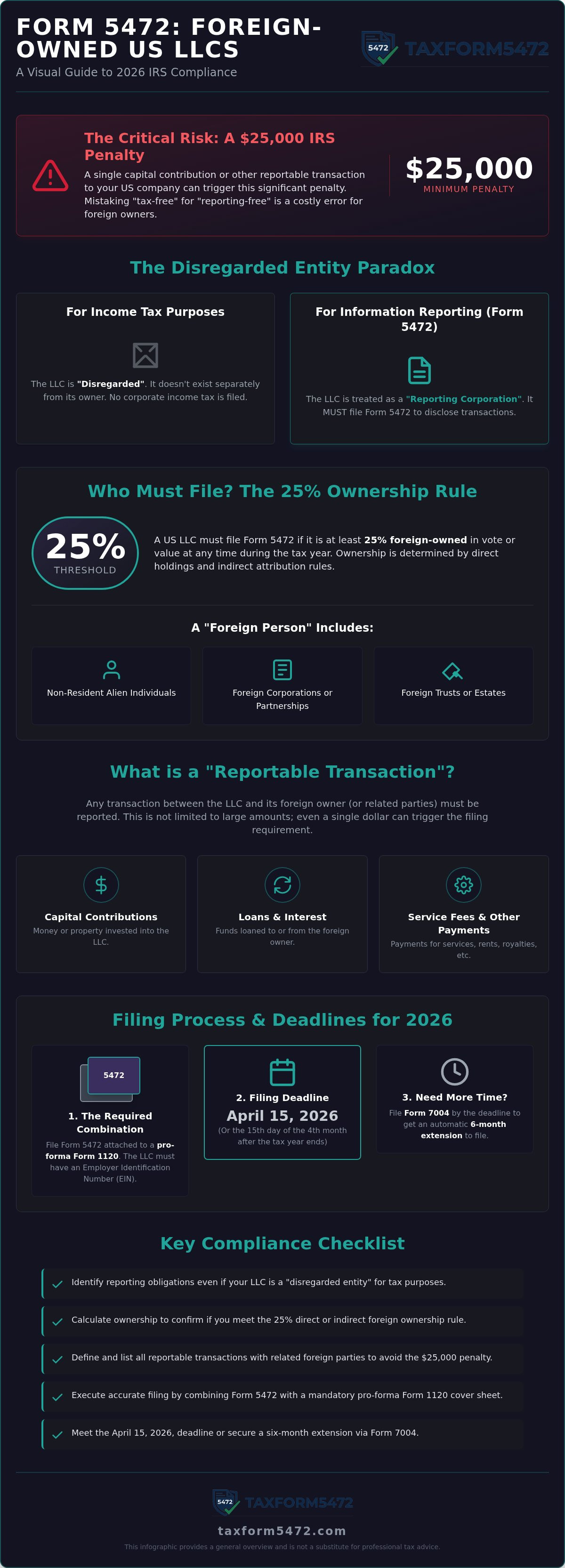
A single capital contribution to your US company can trigger a $25,000 IRS penalty. For international investors, the administrative burden often outweighs the tax liability. Filing requirements for a foreign owned llc form 5472 apply even when the entity is considered disregarded for federal income tax purposes. This technicality creates significant risk for owners who mistake tax-free status for reporting-free status. The IRS maintains strict enforcement for 2026. Ignorance of the filing deadline isn't a valid defense.
The distinction between tax liability and information reporting is often confusing. It's a common friction point in US compliance. This guide provides a precise technical reference for 2026. You'll gain clear confirmation of your filing obligations and a breakdown of reportable transactions to ensure total IRS compliance. We'll examine specific requirements for disregarded entities, the updated penalty structure, and the exact steps needed to file accurately by the April 15 deadline. Use this reference to maintain your standing. Ensure compliance. Avoid unnecessary financial exposure.
Key Takeaways
- Identify reporting obligations for a foreign owned llc form 5472 regardless of disregarded tax status.
- Calculate ownership thresholds using the 25% rule for direct and indirect foreign members.
- Define reportable transactions and related party relationships to mitigate $25,000 penalty risks.
- Execute accurate filings by combining Form 5472 with a mandatory pro-forma Form 1120 cover sheet.
- Meet the April 15, 2026, deadline or secure a six-month extension via Form 7004.
The Disregarded Entity Classification and Form 5472
The IRS treats a disregarded entity as a separate corporation for information reporting purposes. This status is a legal fiction created by Treasury regulations. For income tax, the LLC doesn't exist independently from its owner. For a foreign owned llc form 5472 filing, it's a reporting corporation. This dual status causes widespread confusion. Owners often assume no tax means no filing. That's a mistake. The IRS specifically reclassified these entities to close transparency gaps in international ownership. They prioritize data collection over immediate tax revenue.
Section 6038A enforces this transparency. It targets any domestic corporation with at least 25% foreign ownership. Since 2017, every foreign owned llc form 5472 requirement has applied to these disregarded structures. The reporting requirement is independent of profit or loss. It focuses on the movement of value. You must disclose capital contributions, loans, and service fees. Check the historical context on Form 5472 Wikipedia to see how these rules evolved to prevent base erosion and profit shifting.
Criteria for Wholly Foreign-Owned LLCs
Compliance applies to specific ownership structures. Your LLC is a reporting entity if it's 100% foreign-owned. A "foreign person" includes:
- Non-resident alien individuals.
- Foreign corporations or partnerships.
- Foreign trusts or estates.
This includes direct ownership. It also includes indirect ownership through other disregarded entities. Tiered structures don't provide an exemption. If a foreign person owns a holding company that owns the US LLC, the obligation persists. Filing is mandatory for every qualifying entity in the chain. There's no exception for inactive businesses. If the entity exists, the IRS expects a status update. Even a single dollar of capital contribution triggers the mandate.
The Purpose of Section 6038A Compliance
The IRS uses Section 6038A to monitor cross-border financial activity. It's an information-sharing tool. It allows the US to comply with tax treaties and exchange data with foreign governments. This oversight prevents the use of US entities for anonymous money movement. Understanding Foreign Owned US Corporation Tax obligations is part of this broader framework. The form doesn't always result in a tax bill. It results in a database entry. Failure to provide this data is viewed as a serious compliance breach. The $25,000 penalty reflects the high value the IRS places on this transparency.
Determining Ownership Thresholds for Reporting
A US LLC becomes a "Reporting Corporation" when a foreign person owns at least 25% of its total voting power or value. This determination follows Section 6038A guidelines. For a foreign owned llc form 5472, the threshold is often surpassed by default. Most single-member LLCs (SMLLCs) held by non-resident aliens represent 100% foreign ownership. This makes the filing mandatory regardless of the business's activity level. You must evaluate ownership at any time during the tax year. If the 25% mark is hit for even one day, the reporting obligation triggers.
The IRS uses specific criteria to identify these entities. Refer to the IRS Form 5472 Information for the official definition of a reporting corporation. The status applies to both domestic corporations and foreign-owned disregarded entities. Accuracy in this determination is critical. Errors in identifying ownership levels lead to the $25,000 penalty mentioned previously. It's a binary requirement. You either meet the threshold and file, or you risk the violation.
Direct Foreign Shareholders
Direct ownership is the most common trigger. It occurs when a non-resident alien individual or a foreign company holds the membership interest directly. Every foreign owned llc form 5472 must identify these owners by name, address, and tax identification number. The US entity requires a valid Employer Identification Number (EIN) to complete the filing. Without an EIN, the form is considered incomplete.
Tiered structures don't shield the entity from reporting. A foreign parent company owning a US subsidiary still meets the direct shareholder definition. The IRS requires transparency at every level of the corporate hierarchy. If you're unsure of your entity's status, using a professional Form 5472 preparation tool ensures your ownership structure is correctly disclosed and filed.
Indirect Ownership and Attribution
The IRS applies constructive ownership rules under Section 318. These rules attribute ownership from one person or entity to another. Ownership through foreign trusts, estates, or partnerships counts toward the 25% threshold. You must identify the Ultimate Beneficial Owner (UBO) to ensure compliance. This prevents the use of shell companies to hide the true source of control.
Attribution also applies to family members. Interests held by a spouse, children, or parents may be attributed to the foreign owner. This prevents owners from splitting interests among relatives to stay below the 25% mark. If multiple related foreign parties have interests, you may need to file multiple forms. A separate Form 5472 is required for each foreign related party that engaged in a reportable transaction during the year.
Categorizing Reportable Transactions with Related Parties
Identify the scope of your reporting. A reportable transaction is any exchange of value between the LLC and a related party. This includes cash, property, and services. The IRS defines a related party as any 25% foreign shareholder, any person related to that shareholder under section 267(b) or 707(b)(1), or any other person related to the reporting corporation. Accuracy here is vital for a foreign owned llc form 5472 submission. Failing to list a single transaction can trigger the $25,000 penalty.
The IRS uses these disclosures to verify arm's length pricing. They want to ensure transactions reflect market value. Review the IRS Form 5472 Information to understand how the government tracks these movements. Every transaction requires a separate Form 5472 for each related party involved. Don't group different related parties on one form. It results in an incomplete filing.
Common Monetary Transactions
Most filings focus on direct cash movements. These are easily tracked but often overlooked in casual business operations. Capital contributions are the most frequent trigger. Even the initial funding to open a bank account counts. Profit distributions and dividends are also reportable. You must list the total dollar amount for the tax year.
Loans are high-scrutiny items. This includes principal payments and interest. If the foreign owner pays a US expense on behalf of the LLC, it's often categorized as a contribution or a loan. Service fees for management, marketing, or technical support must be disclosed. Rents paid for office space or equipment use also fall into this category. Track these payments monthly to simplify year-end reporting.
Non-Monetary and Deemed Transactions
The IRS tracks value beyond bank transfers. Non-monetary transactions involve the exchange of tangible or intangible property. Transferring intellectual property, like trademarks or proprietary software, is a reportable event. This applies even if no cash changes hands. You must estimate the fair market value of the transfer for the foreign owned llc form 5472.
Using property without a formal rental agreement is another common trap. If the LLC uses a foreign owner's warehouse for free, the value of that use must be accounted for. Cost-sharing arrangements for research or development also require reporting. A deemed transaction is a transaction where the tax law treats an action as an exchange between related parties despite the absence of an actual transfer. This ensures the reporting captures the full economic reality of the business.
Deadlines, Extensions, and Compliance Penalties
The IRS enforces strict timelines for information returns. Missing the foreign owned llc form 5472 deadline results in an immediate $25,000 penalty. This fine applies per violation. If you own three foreign-owned LLCs and fail to file for each, the initial assessment reaches $75,000. The penalty isn't just for late filing. Submitting an incomplete or inaccurate form triggers the same financial consequence. Accuracy is as critical as punctuality.
Penalties escalate if the failure persists. If the IRS issues a notice of non-compliance, you have 90 days to respond. Failure to act within this window adds a $25,000 penalty for every 30-day period, or fraction thereof, that the failure continues. There's no upper limit to these accruals. A simple administrative oversight can quickly become a six-figure liability. This aggressive enforcement highlights the government's focus on international transparency.
Filing Timeline for 2026
The primary deadline for calendar-year entities is April 15, 2026. This date aligns with the standard US tax season. You must submit the form as an attachment to a pro-forma Form 1120. If you require more time, file Form 7004 by the April deadline. This grants an automatic six-month extension. The new deadline becomes October 15, 2026. Note that this only extends the filing time, not any tax payments if applicable. Using a dedicated IRS Form 5472 preparation service prevents errors during this dual-form submission process.
Risk Mitigation and Penalty Abatement
Mitigate your risk through early preparation. Gathering transaction data in January ensures a smooth April submission. Detailed records of capital contributions and owner loans are essential. If you receive a penalty notice, first-time offenders may occasionally qualify for "reasonable cause" abatement. This requires proving you acted in good faith despite the error. It's an uphill battle. The IRS rarely waives international reporting penalties without significant evidence.
Professional filing is the most effective safeguard. The cost of a compliance tool is negligible compared to a $25,000 fine. Automated systems check for missing data points that manual reviewers often overlook. Review the full IRS Form 5472 Filing guide to understand the automation benefits. Don't wait for an IRS notice. Secure your foreign owned llc form 5472 compliance now.
Efficient Preparation of Form 5472 and Form 1120
Efficient preparation requires precise data assembly. You must coordinate several identifiers to complete the filing. The US entity needs an EIN. The foreign owner needs a Foreign Tax Identifying Number (TIN). These numbers link the transaction to the specific reporting party. A foreign owned llc form 5472 is incomplete without these verified identifiers. Missing data results in immediate rejection or the assessment of the $25,000 penalty.
The pro-forma Form 1120 acts as a mandatory cover sheet for disregarded entities. This isn't a standard corporate tax return. It's an informational shell. You only complete the header and basic identification sections. You must clearly write "Foreign-owned U.S. DE" at the top of the form. This label signals the IRS to process the document as an information return rather than an income tax filing. Manual preparation often leads to errors in these technical labels. This results in the IRS misclassifying your submission.
Data Gathering Checklist
Gather your documentation before starting the submission. You need the legal name and physical address of every foreign related party. This includes parent companies and individual owners. You must also identify the nature of the relationship. This identifies whether they're a direct owner or a related affiliate. The most critical data point is the total dollar value of all reportable transactions. This figure must be exact. Don't use estimates or rounded numbers. The IRS uses these totals to cross-reference with other international tax data. Ensure you have records for:
- Capital contributions and distributions.
- Loan principal and interest payments.
- Service fees and management charges.
- The country of citizenship or organization for all related parties.
Automated Filing Solutions
Manual form preparation is high-risk. Handwriting errors or missing checkboxes trigger automatic compliance notices. Automated SaaS tools eliminate these friction points. They provide a digital interface tailored for international ownership structures. These platforms use real-time validation to ensure every field meets IRS requirements for 2026. This precision is vital for maintaining your entity's standing.
Digital submission via a specialized platform is faster than traditional mail or fax. It provides a clear audit trail. You receive confirmation that the IRS received your foreign owned llc form 5472. This documentation is your primary defense against late-filing penalties. Don't risk a $25,000 error on manual entry. Use a professional tool to secure your compliance. Start your Form 5472 preparation today to ensure an accurate and timely filing.
Secure Your 2026 Compliance Status
Compliance for a foreign owned llc form 5472 is an operational necessity. The IRS prioritization of transparency means administrative errors carry a minimum $25,000 cost. You must reconcile your disregarded entity status with these mandatory reporting obligations. Accurate identification of related parties and transaction totals is the only path to penalty avoidance. Use the thresholds and transaction categories discussed to audit your records before the April deadline. Precision is your primary defense against automated penalty assessments.
Secure digital preparation ensures your data meets current standards. Our automated IRS compliance software is specifically designed for foreign-owned US entities. It streamlines the complex relationship between Form 5472 and the pro-forma Form 1120. Don't let manual entry risks compromise your business standing. File your Form 5472 online to maintain total regulatory alignment. Precision today prevents significant financial exposure tomorrow. You have the tools to navigate these requirements efficiently and with total confidence.
Frequently Asked Questions
Is an EIN required for a foreign-owned LLC to file Form 5472?
Yes. The LLC must have an Employer Identification Number. Without it, the form cannot be processed. This identifier links the US entity to the IRS database. It's the primary reference for all corporate information returns. Obtain this number by filing Form SS-4. Do this well before the April deadline. The IRS uses this number to track all international reporting obligations. It's essential for opening US bank accounts and establishing a corporate presence.
What happens if my LLC had zero transactions during the year?
Filing is generally not required if there are zero reportable transactions. However, even a single capital contribution triggers the obligation. Most foreign owned llc form 5472 requirements stem from owner-funded expenses or bank account setup costs. Verify all bank statements. Even small administrative payments made by the owner count as reportable events. If truly zero transactions occurred, the filing mandate is typically paused. Audit your records carefully before deciding not to file.
Can I file Form 5472 separately from Form 1120?
No. Form 5472 must be attached to a pro-forma Form 1120. The IRS treats them as a single package for foreign-owned disregarded entities. Submitting one without the other results in an incomplete filing. This triggers the $25,000 penalty. You must mail or fax the combined documents to the specific IRS office in Ogden, Utah. Electronic filing is currently unavailable for these specific structures. Always submit the forms together to ensure proper processing and compliance.
Does the $25,000 penalty apply per owner or per form?
The penalty applies per form. A separate Form 5472 is required for each foreign related party involved in reportable transactions. If your LLC has three foreign owners and all contributed capital, you must file three forms. Failure to file all three results in a $75,000 total penalty. The IRS assesses these fines individually. Accuracy across all related party disclosures is critical. Missing a single related party form results in immediate and significant financial exposure.
How do I request an extension for my Form 5472 filing?
File Form 7004 by the original April 15 deadline. This provides an automatic six-month extension. Your new filing date becomes October 15, 2026. This extension applies to the combined package of Form 5472 and the pro-forma Form 1120. Ensure the form is postmarked by the deadline. Missing the extension window leaves the entity vulnerable to immediate late-filing penalties. Use this extra time to gather precise transaction data and ensure your submission is error-free.
What is a pro-forma Form 1120 for a disregarded entity?
It's an informational cover sheet for the foreign owned llc form 5472. You don't report income or expenses on this specific Form 1120. Only the identification section at the top is required. You must write "Foreign-owned U.S. DE" clearly across the header. This signals the IRS to skip tax calculations. It's a purely administrative requirement to facilitate the processing of the attached information return. It's a mandatory attachment for all disregarded entity filings.
Are capital contributions considered reportable transactions?
Yes. Every capital contribution from a foreign owner is a reportable transaction. This includes the initial investment used to establish the US entity. There's no minimum dollar threshold for reporting. A $100 contribution carries the same filing weight as a $1,000,000 transfer. Failure to disclose these movements is a common cause of $25,000 penalties. Track every owner-to-LLC transfer throughout the year. Even paying a registration fee from a personal account counts as a contribution.
Can a foreign individual file Form 5472 without a US SSN?
Yes. A US Social Security Number is not mandatory for the foreign owner. You must provide a Foreign Tax Identifying Number (TIN) instead. This is the tax ID issued by your home country. If your jurisdiction doesn't issue TINs, you must state "None" or "Not Provided" in the appropriate field. The US entity itself still requires its own EIN to complete the filing process. These identifiers allow the IRS to track international ownership without a US-based ID.