
A single missing form triggers an automatic $25,000 IRS penalty. For many international investors, the cost of a simple oversight exceeds the actual tax liability. Managing a foreign owned us corporation tax profile requires total precision. The complexity of IRS jargon and the nuances of LLC versus C-Corp reporting often lead to expensive errors. It's a high-stakes environment where uncertainty is a liability.
Compliance is a mandatory operational standard. You need a clear path to navigate these requirements without the risk of financial loss. This guide provides a professional framework for understanding US tax reporting and information disclosure. It's a utilitarian tool for foreign owners seeking to maintain regulatory standing. We focus on the essential facts you need to stay compliant.
We provide a checklist of required forms and specific 2026 filing deadlines. You'll learn how to handle the updated Form 5472 requirements and the transition to the NCTI regime. We also address the narrowed scope of BOI reporting for US-formed entities. This is your roadmap to avoiding penalties and ensuring administrative accuracy. Let's begin with the core reporting obligations.
Key Takeaways
- Identify 25% ownership thresholds for domestic entities. Differentiate between mandatory information reporting and standard income tax obligations.
- Mitigate financial risk by understanding the $25,000 penalty. This fine applies automatically to late, incomplete, or missing Form 5472 filings.
- Apply corporate reporting standards to foreign-owned LLCs. Disregarded status for income tax purposes does not exempt these entities from disclosure requirements.
- Manage foreign owned us corporation tax compliance using the Section 6038A framework. Follow the 2026 guide for precise information disclosure and record-keeping.
- Transition from manual filing to automated digital preparation. Use specialized tools to ensure submission accuracy and eliminate administrative errors.
Understanding Foreign-Owned US Corporation Tax Obligations
The Internal Revenue Service (IRS) maintains a rigorous monitoring system for international capital. When a foreign entity or individual establishes a US business, they enter a specific regulatory category. The core of foreign owned us corporation tax compliance is transparency. The government prioritizes information disclosure over immediate tax revenue. Profit levels don't dictate your filing requirements. Even a dormant company must meet its disclosure obligations to remain in good standing.
The 25% Foreign Ownership Threshold
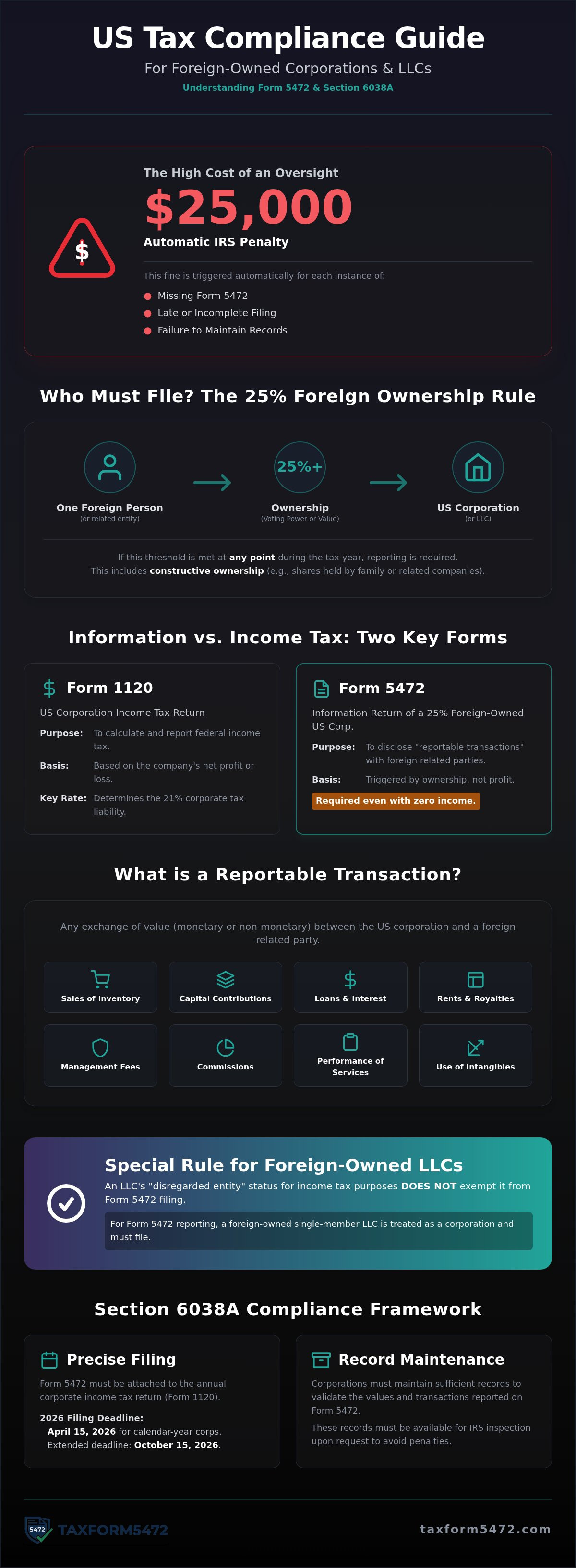
A domestic corporation is classified as foreign-owned if one foreign person holds at least 25% of its stock. This threshold applies to either the total voting power or the total value of all classes of stock. Ownership isn't limited to direct holdings. The IRS applies constructive ownership rules. This means shares held by family members, related corporations, or trusts are attributed to the foreign owner. You must look through layers of ownership to find the "Reporting Corporation" status. If the 25% mark is met at any point during the tax year, the disclosure rules trigger immediately.
Income Tax vs. Information Returns
Foreign owners often confuse tax liability with reporting duty. Form 1120 is the tool for calculating Corporate tax in the United States. It determines the 21% federal tax on net income. Form 5472 is different. It's an information return used to disclose "reportable transactions" with related parties. These transactions include sales of inventory, rents, royalties, and interest on loans. It also covers management fees and initial capital contributions. Understanding the nuances of foreign owned us corporation tax is the first step toward risk mitigation.
A "zero income" status doesn't waive the Form 5472 requirement. If a foreign owner pays incorporation fees from a personal account, that's a reportable transaction. The IRS requires this data to monitor capital movement across borders. Mandatory compliance ensures the IRS can audit the relationship between the US entity and its foreign parent. The goal is to prevent the shifting of profits out of the US tax base. Every transaction needs a clear paper trail. Documentation is your primary defense against automatic penalties. Precision in these early stages prevents administrative crises later.
Key Reporting Requirements: Form 5472 and Section 6038A
Internal Revenue Code Section 6038A provides the statutory basis for foreign owned us corporation tax transparency. It mandates that 25% foreign-owned domestic corporations maintain specific records and file detailed information returns. The primary instrument for this disclosure is Form 5472. It functions as an information return, not an income tax return. This distinction is vital. The IRS uses this data to track cross-border capital movement and verify arm's-length pricing. Failure to file or submitting an incomplete form triggers an automatic $25,000 penalty. For calendar-year corporations, the filing deadline is April 15, 2026. A six-month extension is available until October 15. You must attach this form to your annual corporate income tax return to meet federal standards.
What Constitutes a Reportable Transaction?
A reportable transaction involves any exchange of value between the US corporation and a related foreign party. Related parties include 25% foreign shareholders and any person related to the reporting corporation or the 25% shareholder under Section 482. Monetary transactions include sales of inventory, equipment, or property. They also cover rents, commissions, royalties, and interest payments on corporate debt. Non-monetary transactions are equally critical and frequently missed during manual audits. These include asset transfers, the performance of services without immediate payment, and the use of intangible property like trademarks. Capital contributions and loans from foreign owners are often overlooked. Even the initial funding used to pay for company formation is a reportable event. Reviewing IRS guidelines on Form 5472 ensures all qualifying events are captured accurately.
Record Maintenance Standards
Compliance extends beyond the annual filing. Section 6038A requires corporations to maintain financial records that validate the values reported on Form 5472. These records must be available for IRS inspection upon request. They generally include original entry books, transaction records, and pricing documents. If the IRS issues a summons and the corporation fails to produce records within the specified timeframe, additional penalties apply. For entities with significant transaction volumes, maintaining a clear paper trail is an operational necessity. Small corporations with less than $10 million in gross receipts may qualify for safe harbor rules, which simplify some record-keeping requirements. However, the $25,000 penalty for non-filing or late filing remains a constant risk regardless of company size. Many owners use Form 5472 preparation software to maintain accurate digital trails and ensure timely submissions.
Tax Treatment of Foreign-Owned US LLCs and Disregarded Entities
Foreign owners often select the Limited Liability Company (LLC) structure for its operational flexibility. For standard income tax, a single-member LLC is a "disregarded entity." It doesn't pay taxes at the entity level. However, a 2017 regulatory shift changed the foreign owned us corporation tax landscape for these entities. The IRS now treats foreign-owned disregarded LLCs as domestic corporations specifically for Section 6038A reporting. This means the LLC must file Form 5472 even if it has no US-source income. Compliance is not optional.
LLC Reporting vs. Corporate Reporting
The "tax-free" reputation of US LLCs is a common misconception for non-residents. While the entity might not owe income tax, the reporting burden is identical to a C-Corp. You must file a "pro-forma" Form 1120. This is a skeleton version of the corporate tax return. Its only purpose is to act as a cover page for Form 5472. You complete the name, address, and EIN sections, then check the box for a foreign-owned disregarded entity. The foreign owner is the "Direct Reporting Party." Failing to submit this pro-forma filing triggers the same $25,000 penalty. Even if the LLC's only activity was paying a formation fee, the filing requirement is active.
The Role of the EIN
An Employer Identification Number (EIN) is the primary identifier for your entity. Every foreign-owned US corporation or LLC needs one to fulfill foreign owned us corporation tax obligations. You can't submit Form 5472 without a valid EIN. Many foreign owners believe an SSN or ITIN is a prerequisite. This is incorrect. You can obtain an EIN by filing Form SS-4 via fax or mail. The process for non-residents is manual. It requires a "Responsible Party" who is an individual. Once issued, the EIN links your entity to the IRS compliance database. It ensures your information returns are correctly attributed to your business. Securing an EIN is the first step in your compliance timeline. Without it, you can't open a US business bank account or meet federal disclosure standards.
Compliance Risks: Managing the $25,000 Non-Filing Penalty
The IRS employs automated matching systems to detect missing disclosures. Precision is mandatory. For foreign owned us corporation tax entities, the penalty for non-compliance is significant. A flat $25,000 fee applies to each late or incomplete Form 5472. This assessment is per form, per year. If a corporation transacts with three related parties and fails to file, the initial penalty is $75,000. The statute of limitations for the entire tax return remains open indefinitely when an information return is missing. The IRS can audit your business years later because the filing window never closed. The clock only starts once the form is submitted.
The Cost of Non-Compliance
Assessments are automatic. Intent is irrelevant. The IRS only requires proof of the missing form to issue a notice. Continuing failure is even more punitive. If the failure persists for 90 days after IRS notification, an additional $25,000 penalty applies for every 30-day period. This creates an escalating financial liability that can quickly exceed the value of the business. Non-compliance also impacts corporate reputation and personal standing. Unresolved tax debt can interfere with US business visa applications or renewals. Federal agencies share compliance data across departments. A single missing form can halt your international expansion plans.
Penalty Abatement and Mitigation
Reasonable cause is the primary path to penalty abatement. It is a strict standard. You must prove ordinary business care and prudence were exercised. Complexity is not an excuse. Ignorance of Section 6038A requirements is not a valid defense. Most abatement requests are denied because the taxpayer cannot prove they were unable to file despite their best efforts. Proactive filing is the only cost-effective strategy. Reactive defense is expensive and the outcome is uncertain. Using a specialized IRS Form 5472 preparation service eliminates the risk of manual error and ensures deadlines are met. It provides a digital record of compliance. Accuracy is your best defense against automatic assessments. Don't wait for an IRS notice to address your reporting obligations.
Streamlining Tax Compliance for International Owners
Manual tax preparation is a legacy process. It introduces human error and creates administrative bottlenecks. For foreign owned us corporation tax management, efficiency is the only sustainable strategy. Digital platforms replace the slow exchange of documents with a streamlined interface. You move from data entry to data validation. This shift reduces the risk of the $25,000 penalty by ensuring every required field is complete. Automated systems provide a precise tool for maintaining corporate standing without the overhead of traditional consulting.
Automated vs. Manual Preparation
Traditional accountants often charge premium rates for international compliance. They follow a manual workflow that's susceptible to delays. In contrast, specialized SaaS platforms offer immediate delivery. You don't wait for a billable hour to pass; you interact with a system designed for speed. These platforms include integrated validation checks. If a related party address is missing or a transaction code is invalid, the system flags it instantly. This real-time feedback is absent in manual filing. You gain a digital audit trail that archives every submission. If the IRS requests documentation, your history is organized and accessible. It's a utilitarian approach that prioritizes your time and accuracy.
Next Steps for Foreign Owners
Preparation for the 2026 tax year begins with data organization. You must gather all related party transaction details. This includes every transfer of value, even those without a cash exchange. Verify that your EIN is active and correctly linked to your entity name. If you operate as a disregarded LLC, ensure your pro-forma records are ready. Precision in these steps simplifies the final filing process. Don't leave these requirements to the last minute. The April 15 deadline is a hard target. Organized records are your primary defense against automatic IRS assessments.
Efficiency is a competitive advantage in international business. Don't let administrative friction slow your US operations. Utilizing TaxForm5472 for professional filing provides the accuracy you need. It's a utilitarian solution for a complex regulatory requirement. The platform focuses exclusively on Section 6038A compliance, ensuring your foreign owned us corporation tax disclosures meet federal standards. Secure your corporate records and finalize your 2026 filings now. Compliance is the foundation of your US presence. Take action to eliminate the risk of the $25,000 non-filing penalty today.
Securing Your 2026 Compliance Status
Compliance is a prerequisite for US market participation. Every foreign owned us corporation tax entity faces strict disclosure standards. You've identified the disregarded entity trap and the necessity of the EIN. These aren't just administrative tasks; they're essential risk management functions. A single error or a missing pro-forma filing triggers an automatic $25,000 penalty. This financial risk is entirely avoidable through methodical preparation and timely action.
Efficiency requires modern tools. Manual filing is no longer a viable standard for international owners seeking precision. Our IRS compliance specialized platform focuses exclusively on Section 6038A requirements. It provides a streamlined online interface designed to eliminate human error and secure your corporate records for the long term. You gain a digital audit trail that protects your business from future IRS inquiries. It's a utilitarian approach to a complex regulatory requirement.
Automate your Form 5472 filing now to protect your business interests and ensure 2026 compliance. Avoid the $25,000 non-filing penalty with our streamlined submission process. Secure your standing with the IRS today. Your US expansion depends on precise execution and timely disclosure. We're ready to facilitate your professional success.
Frequently Asked Questions
Does a foreign-owned US corporation always owe income tax?
No. A corporation only owes federal income tax if it generates taxable income after allowable deductions. The current flat rate is 21%. However, tax liability is separate from reporting duty. Even a corporation with zero income or a net loss must file annual information returns. Failure to report transactions with related parties triggers penalties regardless of whether any income tax is actually due to the IRS.
What is the penalty for not filing Form 5472?
The initial penalty is a flat $25,000. This assessment is automatic for late, incomplete, or missing filings. If the failure continues for more than 90 days after IRS notification, additional $25,000 penalties apply for every 30-day period. These fees apply per form and per year. Maintaining accurate records for foreign owned us corporation tax compliance is the only way to avoid these cumulative financial assessments.
Can I file Form 5472 online?
Yes. Most corporations file electronically as part of their Form 1120 submission package. Manual paper filing remains an option but increases the risk of processing delays and manual errors. Using a specialized SaaS platform ensures your digital submission meets all IRS validation requirements. Electronic filing provides immediate confirmation of receipt. This is essential for proving timely compliance and avoiding the automatic $25,000 non-filing penalty assessment.
Do I need a US Social Security Number to file corporate taxes?
No. Foreign owners don't need a Social Security Number (SSN) to manage a US entity. You must obtain an Employer Identification Number (EIN) for the corporation itself. If an individual owner requires a personal US tax ID, they apply for an Individual Taxpayer Identification Number (ITIN). The EIN is the primary identifier for foreign owned us corporation tax filings and is required for opening business bank accounts.
What is a disregarded entity for foreign owners?
A disregarded entity is typically a single-member LLC that the IRS ignores for income tax purposes. The entity's financial activity is reported directly by the owner. However, for Section 6038A compliance, the IRS treats these LLCs as domestic corporations. This requires the filing of a pro-forma Form 1120 and a detailed Form 5472. This hybrid status is a frequent source of confusion and non-compliance for international investors.
How long must I keep records for my US corporation?
You must maintain records as long as they are relevant to any tax provision. The general standard is three years from the filing date. However, Section 6038A requires specific record maintenance for all reportable transactions. If an information return is never filed, the statute of limitations remains open indefinitely. The IRS can audit the entity at any time. Keeping records for seven years is a safer professional benchmark.
Is Form 5472 required if the company had no transactions?
No, but the definition of a reportable transaction is extremely broad. Most companies have at least one qualifying event. This includes the initial capital contribution used to pay formation fees or the owner paying business expenses from a personal account. Even small non-cash transfers are reportable. If any exchange of value occurred between the entity and a related party, you must file Form 5472 to remain compliant.
When is the deadline for foreign-owned US corporation tax filing?
For calendar-year entities, the deadline is April 15, 2026. This date applies to both the corporate income tax return and mandatory information disclosures. If you require more time, you can file an extension to move the deadline to October 15, 2026. Note that an extension to file is not an extension to pay taxes owed. Timely submission is critical to avoid the automatic $25,000 penalty assessment for missing forms.