
Does a U.S. business with foreign partners have to file Form 5472? Not necessarily. The phrase form 5472 for foreign partners can be misleading: foreign ownership matters, but the entity’s federal tax classification and its transactions with related parties also shape the filing analysis.
This distinction matters for partnerships and LLCs. A domestic partnership generally doesn’t file Form 5472 just because one or more partners are foreign. An LLC classified as a corporation, or a foreign-owned single-member LLC treated as a disregarded entity, may have a filing obligation if the applicable rules are met. A foreign partner’s status alone doesn’t settle the question.
This article explains how to identify an entity’s classification, distinguish a partner from a corporate shareholder or related party, and review transactions such as owner contributions, loans, and service payments. You’ll also learn which records to gather and which IRS instructions to review for the relevant tax year. If your business is a foreign-owned U.S. corporation with a filing obligation, an online Form 5472 preparation and filing workflow can help you address it.
Key Takeaways
- Form 5472 for foreign partners depends on more than a partner’s residency. Start by identifying the entity’s federal tax classification.
- Compare the entity’s legal structure with its tax classification. An LLC’s tax treatment can change the filing analysis.
- Review ownership and related-party transactions separately. Contributions, loans, and service payments may be relevant.
- Gather formation and classification documents, ownership details, and transaction records before reviewing the current IRS instructions.
- Use those facts to determine the next step: assess partnership-classified entities separately, and prepare to report if a corporation or disregarded entity meets the filing rules.
Form 5472 for Foreign Partners: What the Question Really Means
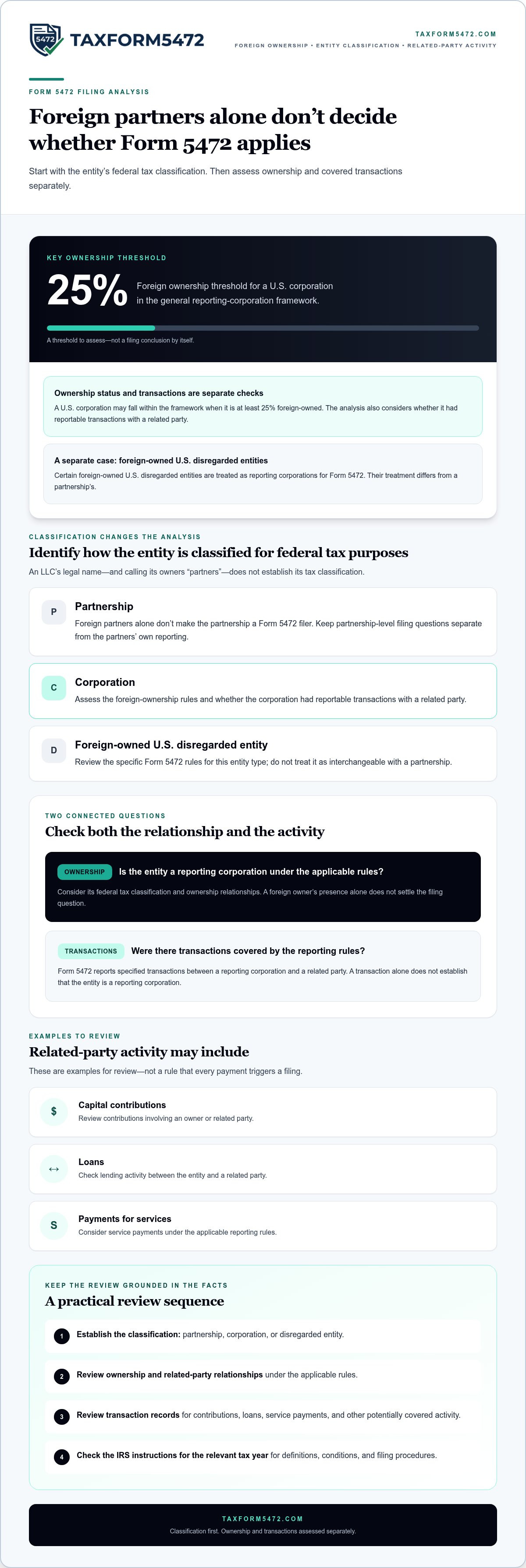
Foreign partners alone don’t determine whether Form 5472 is required. The first question is whether the U.S. business is treated as a reporting corporation under federal tax rules. The transaction rules then help determine what activity must be reported. A partnership generally doesn’t file Form 5472 simply because a partner is foreign.
For Form 5472 purposes, a reporting corporation generally means a U.S. corporation that is at least 25% foreign-owned or a foreign corporation engaged in a U.S. trade or business. Certain foreign-owned U.S. disregarded entities are also treated as reporting corporations for this filing. The exact analysis depends on the entity’s classification, ownership, and transactions. Review the IRS instructions for the relevant tax year before deciding whether to file. For high-level background on the form’s purpose and history, see Form 5472.
Are foreign partners the same as foreign shareholders?
No. A partnership has partners, while a corporation has shareholders. In everyday conversation, an LLC’s owners may be called “partners,” but that label doesn’t establish the LLC’s federal tax classification. An LLC could be classified as a partnership or corporation, or, in some cases, treated as a disregarded entity. The word “partner” alone doesn’t determine whether Form 5472 applies.
What does Form 5472 report?
Form 5472 is an information return used to report specified transactions between a reporting corporation and a related party. The analysis considers both the ownership relationship and the transactions during the tax year. A foreign owner’s presence, by itself, doesn’t establish that there are reportable transactions. Likewise, a transaction alone doesn’t establish that the entity is a reporting corporation.
Depending on the facts and applicable rules, transaction categories may include capital contributions, loans, and payments for services. These are examples, not a rule that every payment triggers a filing. The entity’s tax classification and its relationship to the other party still matter. For more detail on transaction categories and how to assess them, read the Form 5472 reportable transactions guide.
For a business asking about form 5472 for foreign partners, separate the questions: What is the entity’s federal tax classification? Is it a reporting corporation under the current instructions? Did it have transactions covered by the reporting rules? This approach helps keep partnerships and corporations from being treated as interchangeable.
How U.S. Entity Classification Changes Form 5472 Analysis
An LLC’s legal name doesn’t necessarily show how it’s classified for federal tax purposes. An LLC may be classified as a partnership or corporation, or treated as a disregarded entity. That classification changes how to assess Form 5472. Establish the entity’s federal tax classification before assessing whether Form 5472 applies.
| Federal tax classification | How to approach Form 5472 |
|---|---|
| Partnership | Foreign partners alone don’t make the partnership a Form 5472 filer. Review partnership-level facts separately from the partners’ own reporting. |
| Corporation | Assess whether it meets the reporting-corporation rules, including the applicable foreign-ownership and related-party transaction requirements. |
| Foreign-owned U.S. disregarded entity | Review it under the specific Form 5472 rules for foreign-owned U.S. disregarded entities. Its treatment differs from a partnership’s. |
If the U.S. LLC is classified as a partnership
A partnership has partners, not corporate shareholders. A foreign partner’s presence doesn’t, by itself, mean the partnership files Form 5472. Keep partnership-level filing questions separate from reporting obligations that may apply to an individual partner or another entity in the ownership chain. If a partner owns through a related company, or the business has other related entities, those relationships may need separate review.
If the entity is a corporation or disregarded entity
A corporation has shareholders. Under the general Form 5472 framework, a U.S. corporation may be a reporting corporation if it meets the foreign-ownership threshold and has reportable transactions with a related party. A foreign-owned U.S. disregarded entity is a separate case. It may have a Form 5472 filing obligation under rules that treat it as a reporting corporation for this purpose, even though it’s disregarded for certain income tax purposes.
Don’t decide from the entity name alone. Check the relevant-year Instructions for Form 5472 for definitions, conditions, and filing procedures. The IRS instructions set the rules for the specific tax year, including how ownership and transactions affect the filing analysis.
For more context on foreign-owned corporations, see this foreign-owned U.S. corporation tax guide. Once a corporation’s filing obligation is established, prepare its Form 5472 through the online Form 5472 preparation workflow.
When Foreign Ownership and Related-Party Transactions May Bring Form 5472 Into Scope
Form 5472 analysis has two connected but distinct parts: the entity’s ownership status and its transactions with related parties. Foreign ownership may place a U.S. corporation within the reporting-corporation framework, but ownership alone doesn’t identify which transactions must be reported. Ownership status helps determine whether the entity may be a reporting corporation; transaction rules determine what activity may need to be reported.
The details also depend on classification. A corporation and a foreign-owned U.S. disregarded entity can face different reporting rules. Don’t assume a transaction involving a foreign partner automatically triggers Form 5472. Check the entity type, the parties, and the current-year IRS Instructions for Form 5472 before treating an example as a filing trigger.
What counts as a related-party transaction?
Potentially relevant categories can include payments for services, loans or interest, property transfers, and capital contributions. These examples point to records worth reviewing, but they don’t mean every payment or transfer is reportable. The instructions define covered transaction categories, related-party relationships, and applicable exceptions. For a closer review of the reporting rules, see the Form 5472 reporting thresholds guide.
For example, a foreign owner may lend money to a U.S. corporation or pay a business expense on its behalf. Record the parties, amounts, dates, and purpose. Then assess whether the relationship and transaction fit the rules for that entity and tax year. The example alone doesn’t establish that a filing is required.
Why a foreign partner’s transactions need context
Start with three facts: who conducted the transaction, how that person or entity is related to the U.S. business, and how the business is classified for federal tax purposes. A partner’s transaction with a partnership isn’t automatically a Form 5472 transaction. The analysis may differ if a separate corporation in the ownership structure conducted the transaction or qualifies as a reporting corporation.
Foreign-owned U.S. disregarded entities have specific rules. Their reporting analysis may include owner transactions that differ from those considered for a partnership. Verify the precise treatment in the current IRS instructions rather than applying corporate or partnership assumptions.
For form 5472 for foreign partners, keep ownership records and transaction records together, but assess them separately. If the analysis establishes a filing obligation for a foreign-owned U.S. corporation, the online Form 5472 preparation and filing workflow is a practical next step.
A Practical Form 5472 Review for U.S. Businesses With Foreign Partners
Use this preliminary review to organize the facts before deciding whether Form 5472 applies. It’s a fact-gathering sequence, not a final tax or legal determination. Foreign partners alone don’t establish a filing requirement.
- 1. Identify the entity. Record its legal name, formation state or country, and ownership structure.
- 2. Confirm federal tax classification. Check elections and tax records. Don’t rely only on “LLC” or another legal label.
- 3. Map direct and indirect ownership. Identify each owner, ownership percentage, and related entity in the chain.
- 4. Review related-party transactions. Gather records of payments, loans, contributions, property transfers, and other dealings for the tax year. These are review categories, not automatic filing triggers.
- 5. Verify the current instructions. Compare the entity, ownership, and transaction facts with the IRS instructions for the relevant year. Don’t assume prior-year treatment still applies.
This sequence helps identify missing records and issues for further review. The filing path depends on the entity’s classification and its specific ownership and transaction facts. A partnership, corporation, and foreign-owned U.S. disregarded entity shouldn’t be treated as interchangeable. For broader filing context, see the IRS Form 5472 filing overview.
Which records should the business assemble?
Build one organized file for the tax year. Include:
- Formation documents, such as the articles of organization or incorporation and operating agreement.
- Federal tax classification records, including any elections and relevant tax filings.
- Ownership details, such as an ownership chart, owner names, percentages, and related-party information.
- Transaction descriptions and supporting books, invoices, loan documents, bank statements, and payment records.
Keep enough detail to identify who participated, what was exchanged, and how the transaction was recorded. This makes it easier to compare the facts with the reporting categories and exceptions in the current instructions.
When should the initial review move to filing preparation?
Move to preparation once the entity’s classification, ownership structure, and potentially reportable transactions have been reviewed against the applicable instructions. If the review indicates that a foreign-owned U.S. corporation has a Form 5472 filing obligation, use the online Form 5472 preparation and filing workflow. The phrase form 5472 for foreign partners isn’t enough to decide. Use the records and rules to establish the filing path.
Form 5472 Next Steps: Prepare the Filing When Your Entity Is Required to Report
Don’t infer a Form 5472 obligation from foreign partners alone. The next step depends on the entity’s federal tax classification and the facts that apply to it. A partnership-classified business follows a different review path from a corporation or foreign-owned U.S. disregarded entity.
Choose the right next step for the entity type
For a partnership-classified business, first confirm its federal tax classification and identify any partnership-level reporting questions. Keep those questions separate from reporting that may apply to a partner or a related entity.
If the business is a corporation or a foreign-owned U.S. disregarded entity, organize its ownership information and related-party transaction records. Then compare those facts with the current IRS instructions before deciding whether filing applies. The automated Form 5472 preparation guide provides broader context on preparing the filing.
Prepare Form 5472 online when filing applies
Once the review establishes that the entity has a Form 5472 filing obligation, begin preparation with the relevant ownership and transaction records. Use the instructions for the applicable tax year. Don’t rely only on a prior-year filing approach if the entity, ownership structure, or transactions have changed.
TaxForm5472 provides a focused online service for Form 5472 preparation and filing for foreign-owned U.S. corporations. It’s a practical step for corporations that have determined they’re required to report, not a substitute for classifying the entity or deciding whether the form applies.
For businesses researching form 5472 for foreign partners, settle the entity-specific filing question before starting preparation. If your foreign-owned U.S. corporation has a filing obligation, prepare and file Form 5472 online.
Confirm the Filing Path, Then Take the Next Step
To assess form 5472 for foreign partners, look beyond the presence of foreign owners. First confirm the business’s federal tax classification. Then assess ownership and related-party transactions under the IRS instructions for the relevant tax year.
A partnership, corporation, and foreign-owned U.S. disregarded entity can follow different reporting paths. Gather formation and classification records, ownership details, and transaction records before deciding whether Form 5472 applies. This organized review focuses attention on the relevant facts without assuming every business with foreign partners must file.
If your review confirms that your foreign-owned U.S. corporation has a Form 5472 filing obligation, use the focused online service for preparation and filing. Prepare Form 5472 online through a digital workflow designed for foreign-owned U.S. corporations.
Start by confirming the classification and organizing the records, then take the appropriate filing step.
Frequently Asked Questions
Do foreign partners make a U.S. partnership file Form 5472?
No. Foreign partners alone don’t make a U.S. partnership file Form 5472. The form generally applies to reporting corporations, so first confirm how the entity is classified for federal tax purposes. Keep any partnership-level reporting analysis separate from tax reporting that may apply to an individual partner or another entity. If the business is an LLC, its legal label alone doesn’t establish whether it’s classified as a partnership or corporation.
Can a foreign-owned LLC be required to file Form 5472?
Yes. A foreign-owned LLC may have a Form 5472 filing obligation if it’s classified as a corporation and meets the applicable reporting rules. A foreign-owned U.S. single-member LLC treated as a disregarded entity is a separate case. It may have to file Form 5472 with a pro forma Form 1120. Review the entity’s tax classification, ownership, transactions, and current-year IRS instructions before deciding whether filing applies.
What is the difference between a foreign partner and a foreign shareholder for Form 5472?
A foreign partner owns an interest in a partnership. A foreign shareholder owns stock in a corporation. These terms describe different legal and tax relationships, and an LLC’s owners may be called partners even if the LLC has a different federal tax classification. For form 5472 for foreign partners, don’t rely on everyday labels. Confirm the entity’s classification, then assess ownership and related-party transactions under the applicable rules.
Does a foreign-owned U.S. corporation always file Form 5472?
No. Foreign ownership alone doesn’t always mean a corporation must file. The analysis generally considers whether the corporation meets the applicable foreign-ownership test and whether it had reportable transactions with a related party. Review ownership by vote or value, related-party relationships, and transaction records for the tax year. The current IRS instructions define the applicable requirements and exceptions, so verify them before relying on a prior-year filing decision.
What transactions should foreign-owned businesses review for Form 5472?
Review related-party dealings that may fall within the Form 5472 reporting categories. Examples include capital contributions, loans, payments for services, and property transfers. These are review items, not automatic filing triggers. Record who was involved, their relationship to the business, what was exchanged, and how the transaction was documented. Then compare the facts with the current IRS instructions, which define reportable transactions and any applicable exceptions.
What should I do if I am unsure whether my entity is a partnership or corporation for tax purposes?
Start with the formation documents, any federal tax classification elections, and prior tax filings. An LLC’s legal name doesn’t settle its federal tax classification. Confirm whether it’s treated as a partnership, corporation, or disregarded entity for the relevant tax year. Then review ownership and transaction records against the current IRS instructions for Form 5472. This fact review helps establish the right filing path before you begin preparing forms.