
Could a cloud platform for submitting foreign shareholder loan details to irs help prepare the right Form 5472 filing? Yes, it can organize the information for preparation, but first determine whether the loan is a reportable transaction and which filing route applies to your entity. A foreign shareholder loan may be reportable when it involves a foreign related party.
Advances, repayments, year-end balances, and related-party details can be difficult to reconcile when records are spread across bank statements, accounting files, and loan documents. It also helps to distinguish a preparation platform from the IRS submission method. A platform organizes information and supports form preparation; the applicable filing route determines how the completed package reaches the IRS.
This guide explains when foreign shareholder loan activity may relate to Form 5472, which records to gather, and how entity type affects the filing route. It also outlines what to enter and verify in a digital workflow before you prepare and file. The goal is to connect your loan records to the applicable Form 5472 process.
Key Takeaways
- Assess the foreign shareholder loan in the context of the related party and entity before deciding how Form 5472 applies.
- Use a cloud platform for submitting foreign shareholder loan details to irs to organize information and prepare the form, while keeping preparation distinct from the IRS filing route.
- Gather loan agreements, ledger entries, bank records, and repayment evidence so you can verify transaction details before entering them.
- Compare workflows by Form 5472 focus, entity coverage, loan-data handling, submission role, and the steps you must complete.
- Follow the filing route for your entity type, then review the prepared Form 5472 and supporting details before filing.
When does a foreign shareholder loan belong in an IRS reporting workflow?
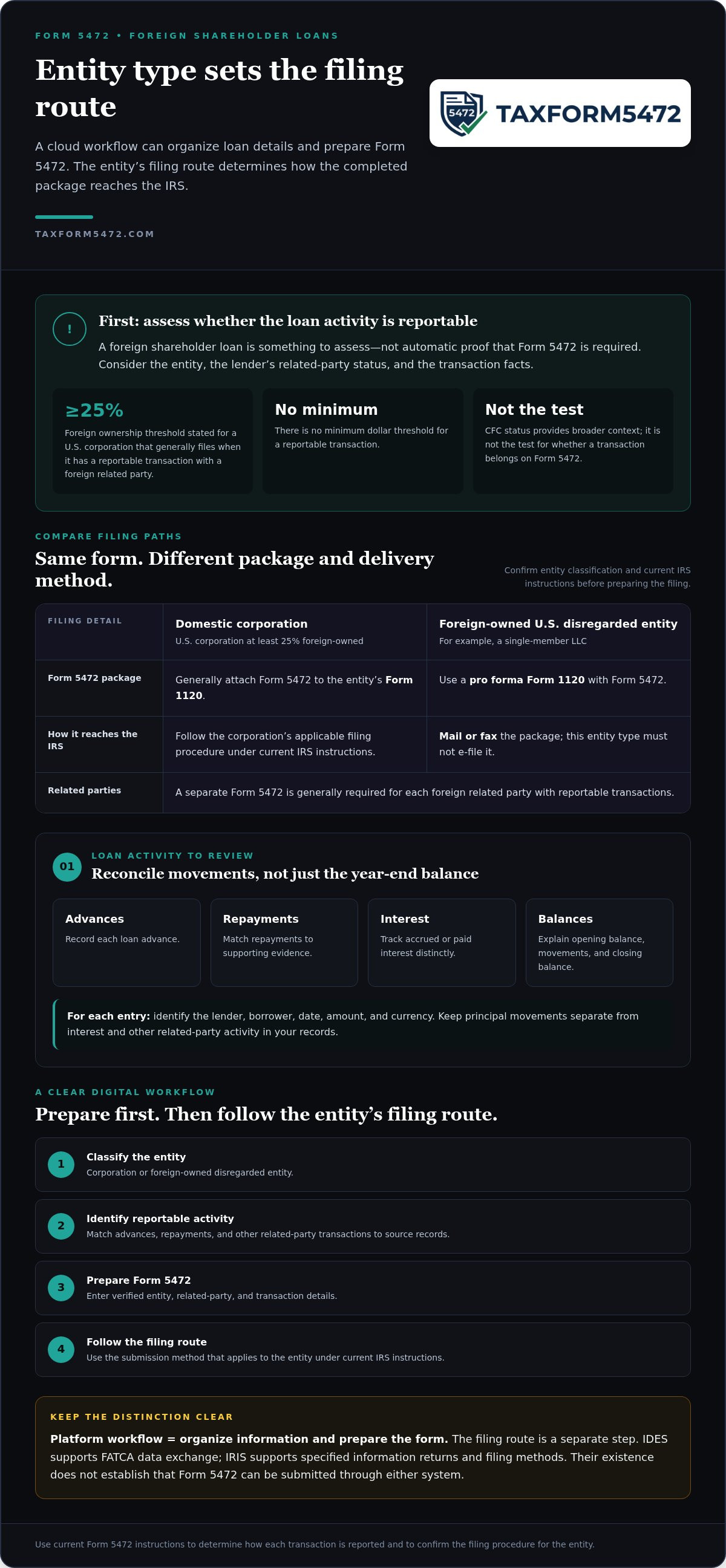
A loan from a foreign shareholder is a transaction to assess, not automatic proof that Form 5472 is required. Determine whether the U.S. entity falls within the filing rules and whether the lender is a foreign related party. A U.S. corporation that is at least 25% foreign-owned, or a foreign-owned U.S. disregarded entity, generally files Form 5472 when it has a reportable transaction with a foreign related party. The IRS instructions include borrowing and repayment activity among transactions to review. There is no minimum dollar threshold for a reportable transaction.
Keep the analysis specific to Form 5472. Controlled foreign corporation (CFC) rules provide broader context on U.S. rules for foreign ownership, but CFC status is not the test for whether a transaction belongs on Form 5472. Apply the form’s ownership, related-party, and transaction rules to the entity’s facts.
Which loan events should the business review?
Build a transaction record before mapping activity to the form. Review each advance, repayment, accrued or paid interest, and year-end balance. For each entry, identify the lender, borrower, date, amount, and currency using the agreement, ledger, bank record, or repayment evidence. Reconcile the records so you can explain the opening balance, each movement, and the closing balance.
Keep principal movements distinct from interest and other related-party activity in your records. Don’t assume every loan term or outstanding balance becomes a separate form line. Use the current Form 5472 instructions to determine how each transaction is reported and whether additional information is required.
Why entity type changes the filing path
Entity classification affects the return package and how it reaches the IRS. A domestic corporation generally attaches Form 5472 to its Form 1120. A foreign-owned U.S. disregarded entity, such as a single-member LLC, uses a pro forma Form 1120 with Form 5472 and must submit the package by mail or fax rather than e-file. Follow the current IRS instructions for the entity-specific filing procedure.
Identify each foreign related party involved, too. A separate Form 5472 is generally required for each such party with reportable transactions. Confirm the entity’s classification and filing route before preparing the package.
A cloud platform for submitting foreign shareholder loan details to irs supports Form 5472 preparation by organizing the information you provide and preparing the form. Preparation through an online service and delivery to the IRS are distinct steps. The applicable transmission procedure depends on the entity’s filing route.
How should a cloud platform handle Form 5472 loan details?
A useful digital workflow keeps four decisions in order: classify the entity, identify reportable activity, prepare Form 5472, then follow the applicable IRS submission instructions. This avoids a common mix-up: entering loan information into a preparation workflow is not the same as transmitting a completed form to the IRS.
- Classify the entity. Confirm whether the U.S. business is a corporation or a foreign-owned disregarded entity.
- Identify reportable activity. Match loan advances, repayments, and other related-party transactions to source records.
- Prepare Form 5472. Provide the entity and related-party details needed to prepare the form.
- Follow the filing route. Use the submission method that applies to the entity under current IRS instructions.
The filing route depends on the entity type and current IRS instructions. Corporations generally attach Form 5472 to Form 1120, while foreign-owned U.S. disregarded entities use a pro forma Form 1120 and submit the package by mail or fax. Review the IRS instructions for Form 5472 before filing.
What a focused digital workflow should make clear
A focused workflow should collect business and foreign related-party information and provide a way to enter transaction details supported by loan agreements, ledgers, and bank records. Keep principal advances, repayments, and interest distinguishable in your source records. Enter verified information and check how each item is treated under the current instructions.
TaxForm5472.com provides an online service focused on automated Form 5472 preparation for foreign-owned U.S. corporations and facilitates submission of tax documentation. Use the workflow to prepare the form and organize the filing process, while following the IRS submission procedure that applies to your entity.
How to distinguish Form 5472 filing from IRS data systems
IRS systems have specific purposes. IDES supports FATCA data exchange; it is not a general corporate tax-filing portal. IRIS supports specified information returns and filing methods. Its existence does not establish that Form 5472 can be submitted through it. Follow current IRS guidance for the form and entity type instead of assuming the systems are interchangeable.
A cloud platform for submitting foreign shareholder loan details to irs is useful when it connects loan records to Form 5472 preparation and helps you understand the next filing step. TaxForm5472.com offers an online Form 5472 preparation workflow. Organize your records, enter verified information, and follow the applicable submission procedure.
How to compare cloud platforms for foreign shareholder loan reporting
Compare the workflow, not just the word “cloud.” Look at how the service supports Form 5472 preparation, what loan information you provide, which entity types it serves, and how preparation fits into filing. Software can organize a process, but you still need to check loan agreements, bank records, and current IRS requirements.
| Option | Form 5472 focus | Loan-data workflow | Submission role and user responsibility |
|---|---|---|---|
| IRS systems | Provide official guidance or designated filing services, not necessarily form preparation. | You assemble and classify the loan records. | Use only the route and forms the IRS identifies as applicable. You remain responsible for accurate information. |
| General accounting tools | May track transactions but aren’t necessarily designed around Form 5472. | Use ledgers and reports to organize activity; verify related-party details and form treatment separately. | Determine how the form is prepared and submitted under the entity’s filing rules. |
| Professional preparation | A preparer may help analyze records and prepare the form. | Provide complete source documents and explanations of loan activity. | Clarify who reviews the form and who completes the applicable submission steps. |
| Focused Form 5472 platform | Centers its workflow on Form 5472 preparation. | Enter business, related-party, and transaction information supported by your records. | Understand which preparation steps the service performs and which filing actions remain yours. |
Which platform capabilities matter for this filing task?
Look for a workflow built around Form 5472 rather than a general accounting dashboard. It should make clear how to provide entity and foreign related-party details and how source records support reported transactions. Don’t assume automatic bank imports, loan classification, form review, or IRS transmission. Before starting, identify what you must enter, check, correct, approve, and submit.
Foreign-entity reporting can involve broader compliance questions. The Journal of Accountancy has covered concerns about burdens on legitimate domestic businesses. That discussion concerns beneficial ownership reporting, not Form 5472. The distinction is a reminder to identify the specific filing requirement that applies to your business.
When is a dedicated Form 5472 service a better fit?
A focused service can suit a business seeking an online Form 5472 preparation workflow rather than a general-purpose accounting tool. TaxForm5472.com provides automated online Form 5472 preparation and facilitates submission of tax documentation. Gather your records and use them to verify the information you provide. Unusual entity classifications or complex transaction questions may call for professional tax advice. For more filing context, see IRS Form 5472 filing guidance.
What records should you prepare before entering shareholder-loan details?
Prepare a source file before entering loan information into a Form 5472 workflow. Tie each document to the transaction it supports. That makes it easier to trace amounts to their source and resolve differences before preparing the form.
Which source records help document the loan?
Gather the records below and keep documents for each foreign related party together. Use consistent names for the lender and borrower across the files.
- Loan agreement and amendments: Collect the executed agreement and any changes to principal, interest terms, or repayment conditions.
- Accounting ledger: Export entries for advances, repayments, accrued or paid interest, and other related-party activity. Retain transaction dates, amounts, and currency.
- Bank statements: Find deposits and outgoing payments that support advances or repayments. Note the account and transaction reference where available.
- Repayment evidence: Gather payment confirmations, transfer records, or other documents supporting amounts recorded as repaid.
- Year-end balance support: Reconcile the opening balance and transaction activity to the closing balance in the ledger.
- Related-party details: Record the counterparty’s legal name and relationship to the U.S. business consistently with company records.
How should you check the data before preparation?
Separate principal movements from interest and other transaction categories in your working file. This is a recordkeeping step, not a decision about how each item maps to Form 5472. Confirm each transaction’s classification and required reporting fields against the current IRS instructions before preparing the form.
Reconcile each advance and repayment to its supporting agreement, ledger entry, and bank evidence. Check that dates, amounts, currencies, counterparties, and year-end balances agree. Flag missing dates, inconsistent currency entries, duplicate records, and balances that do not reconcile. Resolve or document each difference rather than silently changing a source amount.
Loan activity may occur alongside other dealings with a foreign related party. Review reportable transactions under Form 5472 for broader context, then use the current form instructions to confirm the treatment of each item.
Once the records are reconciled, a cloud platform for submitting foreign shareholder loan details to irs can support Form 5472 preparation. Enter verified information and retain the source documents for review. Use the organized loan details to prepare Form 5472 online.
Prepare and submit Form 5472 through a focused online workflow
Keep the final process in sequence: organize source records, enter verified details, review the prepared Form 5472, then follow the filing route for the entity. A cloud platform for submitting foreign shareholder loan details to irs can support form preparation, but an online workflow does not determine how the form must reach the IRS.
What to review before completing the filing
Check the prepared information against the records you gathered. Confirm the entity’s legal name and classification, the foreign related party’s details, and the classification and totals for each reportable transaction. Compare advances, repayments, interest entries, and balances with the loan agreement, ledger, and bank records. Resolve inconsistencies before proceeding.
Next, verify the complete filing package against current IRS instructions. Confirm which return or attachment applies, who must sign, the applicable deadline, and the permitted delivery method. The route depends on entity type: corporations generally file Form 5472 with Form 1120, while foreign-owned U.S. disregarded entities generally attach it to a pro forma Form 1120 and submit the package by mail or fax. Use the current instructions for the entity’s specific requirements.
How the online Form 5472 service fits the process
TaxForm5472.com provides an online service focused on automated preparation of Form 5472 for foreign-owned U.S. corporations and facilitates submission of tax documentation. Provide complete business, related-party, and transaction information through the workflow, then review the prepared details against your source records. Keep preparation distinct from IRS delivery and follow the filing instructions that apply to your entity.
- Organize loan agreements, accounting records, bank evidence, and related-party details.
- Enter verified information into the Form 5472 preparation workflow.
- Review the prepared information against supporting documents and current instructions.
- Submit the required package using the filing route for your entity.
Start with complete records. Start your Form 5472 filing.
Move from loan records to a prepared Form 5472
Foreign shareholder loan activity calls for careful review, not assumptions. Confirm the entity’s filing status and related-party connection, then reconcile advances, repayments, interest, and balances against source documents. Separate form preparation from IRS submission, and follow the filing route that applies to the entity.
A cloud platform for submitting foreign shareholder loan details to irs can support an organized preparation workflow, but accurate records and a final review remain essential. TaxForm5472.com provides a focused online service for automated Form 5472 preparation for foreign-owned U.S. corporations.
With agreements, ledgers, and payment evidence ready, you can begin preparation with clearer transaction details. Start your Form 5472 filing and prepare your information for review.
Frequently Asked Questions
Is a foreign shareholder loan reportable on Form 5472?
It may be reportable if the U.S. entity is subject to Form 5472 filing rules and the lender is a foreign related party. A U.S. corporation that is at least 25% foreign-owned, or a foreign-owned U.S. disregarded entity, generally files when it has a reportable transaction with a foreign related party. Assess loan advances and repayments under the current IRS instructions. There’s no minimum dollar threshold for a reportable transaction.
What loan details should I gather for Form 5472?
Gather the loan agreement and amendments, accounting ledger entries, bank statements, repayment evidence, and year-end balance support. Record the lender and borrower, their relationship, transaction dates, amounts, and currency. Keep principal advances and repayments distinct from interest and other related-party transactions in your records. Reconcile the activity to the opening and closing balances, then check the current Form 5472 instructions to determine how the transactions and details should be reported.
Can I submit Form 5472 through IRIS?
Don’t assume IRIS is an eligible submission route for Form 5472. The IRS describes IRIS for specified information returns and filing methods, but that does not establish Form 5472 eligibility. Check the current instructions for Form 5472 and the filing procedure for your entity type. For example, a foreign-owned U.S. disregarded entity generally submits Form 5472 with a pro forma Form 1120 by mail or fax, not through e-filing.
Does a foreign-owned LLC report shareholder loans differently?
It can, because the LLC’s U.S. tax classification affects its filing package and submission route. A foreign-owned single-member LLC treated as a disregarded entity generally attaches Form 5472 to a pro forma Form 1120 and files the package by mail or fax. A corporation generally attaches Form 5472 to Form 1120. Confirm the entity’s classification and use the current IRS instructions to verify its filing steps.
Can a cloud platform prepare Form 5472 from loan records?
Yes. A focused online service can use information you provide to support Form 5472 preparation. A cloud platform for submitting foreign shareholder loan details to irs can organize the workflow, but it does not mean loan records are automatically imported, classified, or verified. Provide complete, reconciled details and compare the prepared information with the agreements, ledger, and payment evidence. Preparation is separate from sending the form to the IRS.
Are IDES and IRIS the same as a Form 5472 filing platform?
No. IDES is used for FATCA data exchange, while IRIS supports specified information returns and filing methods. Neither should be treated as interchangeable with a dedicated Form 5472 preparation service. A Form 5472 platform focuses on collecting information and preparing the form; the applicable IRS filing route depends on the entity and current instructions. Verify the submission method before filing instead of relying on a system’s name or general purpose.
Do I need a US tax preparer to report a foreign shareholder loan?
Not necessarily. Determine whether the entity and transaction meet Form 5472 rules, prepare accurate records, and follow the correct filing route. A business may use an online Form 5472 preparation service, but it remains important to review the prepared information and complete the required filing steps. If the entity classification, related-party status, or transaction treatment is uncertain, consult a qualified tax professional for advice.
What happens if loan details are incomplete when Form 5472 is prepared?
Missing or inconsistent records can make it difficult to classify transactions, reconcile balances, and prepare accurate reporting. Resolve gaps before completing the form. Check dates, amounts, currency, counterparties, and supporting evidence against the loan agreement, accounting records, and bank documents. The IRS penalty for failing to file on time or filing a substantially incomplete Form 5472 is $25,000 per form. Don’t submit figures you can’t support with reliable records.