
Could a filing omission cost a business $25,000 even when it owes no tax? The non-compliance penalties Form 5472 can trigger apply per required form for a late filing or a substantially incomplete return. The amount can increase if the failure continues after the IRS sends notice.
It’s not always clear which situations create filing risk. A foreign-owned U.S. entity may have a reporting obligation because of transactions with a related party, including certain contributions, distributions, or loans. Missing a transaction, filing late, or overlooking a separate required form can change the consequences.
This article explains the potential statutory penalties, the filing failures that can lead to them, and why a clean filing history may not secure automatic relief. You’ll also learn what records and facts to gather if you discover an error, when professional advice may help, and how a consistent filing process can reduce the risk of missing a requirement.
Key Takeaways
- See how non-compliance penalties form 5472 can depend on the filing failure, the number of required forms, and whether it continues after IRS notice.
- Distinguish missed or late filings, incomplete information, and recordkeeping gaps before assessing the risk.
- Compare ownership and transaction records with filed returns and IRS correspondence to define the issue and identify next steps.
- Use a recurring annual process to assign responsibility, review records, prepare the return, and confirm filing.
What Counts as Form 5472 Non-Compliance, and Why It Matters
Form 5472 non-compliance means failing to meet a filing or reporting requirement that applies to a particular reporting corporation for a tax year. The failure may involve not filing a required form, filing it late, or submitting information that is inaccurate or substantially incomplete. These are distinct issues, and the entity’s status and circumstances determine which rules apply.
Form 5472 is an information return. It gives the IRS information about certain transactions between a reporting corporation and related parties. The obligation to report is separate from whether the business owes income tax. A company may owe no income tax and still have a Form 5472 filing duty. That distinction is central to understanding the non-compliance penalties Form 5472 can involve.
Which Form 5472 obligations can be missed?
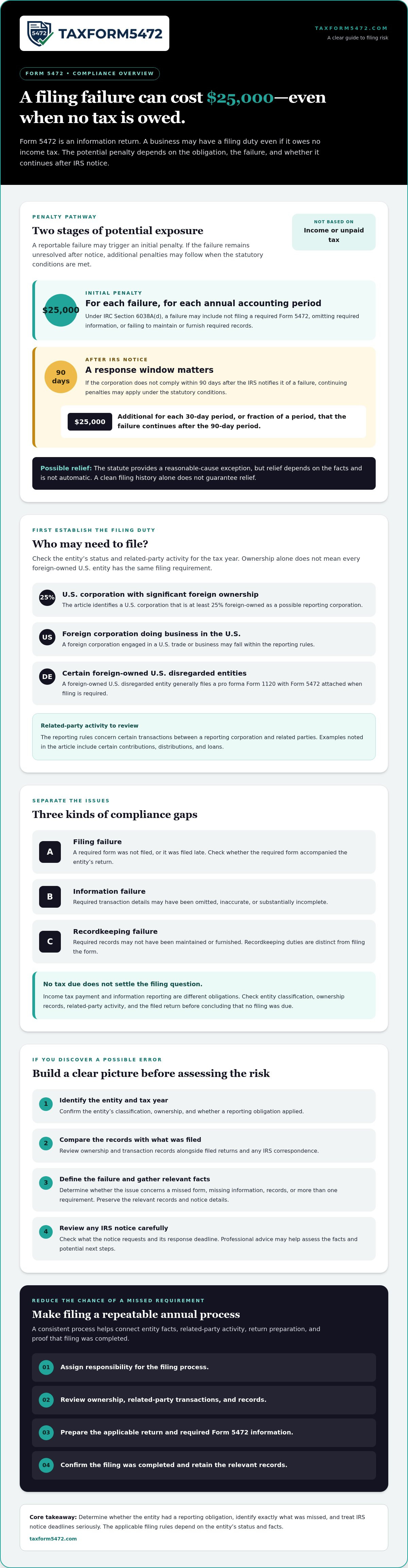
Start by determining whether the entity is a reporting corporation and whether it had reportable transactions with a related party during the tax year. The rules can cover a U.S. corporation that is at least 25% foreign-owned, a foreign corporation engaged in a U.S. trade or business, and certain foreign-owned U.S. disregarded entities. Ownership alone doesn’t make every foreign-owned U.S. entity subject to the same filing requirements.
When filing is required, Form 5472 generally accompanies the reporting corporation’s income tax return. A foreign-owned U.S. disregarded entity generally files a pro forma Form 1120 with Form 5472 attached. Depending on the entity and its transactions, a missed obligation might mean failing to file the form, omitting required transaction details, or not meeting the applicable attachment requirement. Review the IRS Instructions for Form 5472 for current filing rules. The Form 5472 overview provides additional background, but the IRS instructions control filing details.
IRC Section 6038A addresses reporting and recordkeeping requirements for certain reporting corporations. It also provides for penalties when applicable requirements aren’t met. The exact obligation depends on the entity’s status and facts, including its ownership and transactions.
Why a no-tax-due assumption can be misleading
Tax payment and information reporting answer different questions. A business may owe no income tax for the year, but that doesn’t by itself remove an applicable Form 5472 requirement. For example, a foreign-owned disregarded entity may need to report a reportable transaction even if it had no taxable income.
Before concluding that no filing was due, check the entity’s classification, ownership records, related-party activity, and filed return. Use the IRS instructions linked above for filing details. The key question is not only whether tax was owed, but whether the entity had a reporting obligation and met it accurately and on time.
How Form 5472 Penalties Work: Initial and Continuing Failures
The Form 5472 penalty has two stages. First, a reportable failure can trigger an initial penalty. If the failure remains unresolved after an IRS notice, additional penalties may follow. The amount depends on the applicable filing or recordkeeping duty, the tax year, and what happens after notice. It is not income tax, and it should not be confused with interest or penalties for other filing failures.
The initial penalty for a reportable failure
Under Internal Revenue Code Section 6038A(d), the initial penalty is $25,000 for each failure for each annual accounting period. The rule covers failing to file a required Form 5472, failing to include required information, or failing to maintain or furnish records required under Section 6038A. The IRS Instructions for Form 5472 describe the penalty and the reporting requirements.
The amount is not calculated as a percentage of the business’s income or unpaid tax. The key question is whether a reporting corporation failed to meet an applicable obligation. A late return, omitted information, and missing records may involve different facts. To assess the issue, identify the entity, tax year, required form or records, and nature of the failure. The statute also provides a reasonable-cause exception, but relief depends on the facts and is not automatic.
When a penalty may continue after IRS notice
An initial penalty may not be the end of the exposure. If the IRS notifies the reporting corporation of a failure and the corporation doesn’t comply within 90 days, Section 6038A(d) provides for an additional $25,000 for each 30-day period, or fraction of a period, that the failure continues after that 90-day period. This continuing penalty applies only when the statutory conditions are met. Review the notice carefully, including what it requests and the response deadline.
Under IRC Section 6038A(d) and the IRS instructions, a failure can trigger an initial $25,000 penalty; if it remains unresolved for more than 90 days after IRS notice, an additional $25,000 may apply for each subsequent 30-day period or fraction.
For an accurate assessment, keep the IRS notice, proof of filing, relevant returns, transaction records, and any response or correction together. Don’t assume that filing a late or amended form automatically removes an assessed penalty. If you’re considering an online preparation workflow for an eligible filing, review online Form 5472 preparation and confirm that the service fits your circumstances. Provide accurate information. Preparation alone doesn’t guarantee compliance or resolve an existing IRS matter.
Which Form 5472 Failures Create Different Compliance Risks?
Not every filing problem is the same. A missed return raises questions about whether a filing obligation existed and whether anything was filed. An inaccurate return calls for a closer look at what was reported and what was left out. Recordkeeping issues involve separate duties. Before assessing the non-compliance penalties Form 5472 may involve, identify the entity, tax year, ownership, related parties, and transactions.
| Failure scenario | Relevant facts | Questions to verify |
|---|---|---|
| Missed filing | Entity classification, ownership, related-party activity, and filed returns. | Was the entity a reporting corporation? Were reportable transactions present? Was Form 5472 required? |
| Late filing | Applicable due date, any extension, and filing evidence. | When was the form due, and when was it submitted? Was a required attachment included? |
| Incomplete or inaccurate information | Reported transaction details and supporting source records. | Were required items omitted or misstated? Does the return substantially provide the required information? |
| Recordkeeping concern | Records relevant to reportable transactions and the entity’s reporting duty. | Were required records maintained, and can the reported figures be supported? |
Late or missing returns versus inaccurate information
Timing and completeness require different checks. A form filed after its due date presents a timing issue. If no form was filed, first confirm that filing was required. For an incomplete or inaccurate filing, compare the submitted information with transaction records and other source documents.
Correcting an error doesn’t, by itself, determine how the IRS will treat the original failure or whether a penalty applies. For correction-specific considerations, see the existing Form 5472 amendment article. Keep the original filing, any corrected submission, and supporting records together for review.
Entity and transaction facts that change the analysis
Review the entity’s ownership and classification for the relevant tax year, then identify related-party activity. A foreign-owned U.S. disregarded entity may have specific filing and attachment considerations. Don’t assume that foreign ownership alone settles whether Form 5472 was required.
For transaction-level detail, consult the reportable transactions guide. The foreign-owned U.S. corporation tax guide can provide broader context on entity obligations. Together, these facts help distinguish a filing failure from a reporting error or a records issue, without assuming that every scenario carries the same compliance risk.
What to Do After Discovering a Possible Form 5472 Failure
Start with the records, not assumptions. A missed filing, an incomplete form, and a recordkeeping gap call for different checks. Use this sequence to establish what happened before deciding how to respond.
- Identify the tax year. Note the year involved, the entity’s classification and ownership for that period, and any filing deadline or extension that may apply.
- Gather the relevant records. Locate the filed income tax return, any Form 5472 and proof of submission, ownership records, and related-party transaction records. Collect IRS notices and correspondence. Record dates of filing attempts and communications.
- Assess the possible failure. Compare the records with the filing and reporting requirements that applied to the entity and year. Identify missing facts. Don’t treat an unfiled form, a late form, inaccurate information, and unavailable records as the same issue.
- Determine the next step. Establish whether a filing was required, what information may need correction, and whether an IRS notice sets a response deadline. Consider qualified tax advice before responding or making a correction if the facts are unclear.
Gather the records needed to assess the issue
Keep the documents organized by tax year. Include the return and attachments as filed, ownership changes, transaction details, and records supporting amounts reported. Preserve IRS notices and envelopes or electronic delivery records where available. A clear timeline helps distinguish a filing delay from a missed filing or a question about reported information.
If records are missing, list what’s unavailable and who may hold it. Avoid estimating or changing reported figures before you can compare them with source documents.
Know when the issue needs individualized advice
Seek advice from a qualified tax professional if you received an IRS notice, have repeated filing failures, or can’t determine whether the entity had a reporting obligation. Reasonable-cause relief depends on applicable rules and the specific facts. It isn’t automatic. For a focused discussion, see the dedicated Form 5472 penalty abatement article.
Because the non-compliance penalties Form 5472 may involve depend on the nature and duration of the failure, preserve your records and respond promptly to any notice. For eligible filers who have established what information is needed, review the Form 5472 filing process. The online service focuses on Form 5472 preparation. Confirm it fits your situation and provide accurate information. It isn’t a substitute for individualized advice or IRS dispute representation.
Prevent Future Form 5472 Non-Compliance With a Repeatable Filing Process
A recurring process makes filing duties easier to identify and verify. Assign one person to coordinate the annual review of ownership, entity classification, and related-party transactions. Set clear handoffs for gathering records, preparing the return, checking the completed form, and confirming what was filed.
Build an annual Form 5472 review checklist
Use the same review steps each year, while checking current IRS instructions and deadlines rather than relying on last year’s process.
- Confirm entity details. Record the entity’s ownership and classification for the tax year. Note changes during the year that may affect the filing analysis.
- Review related-party activity. Compare books and transaction records with contracts, invoices, loan documents, and other supporting records. Follow up on differences or missing details.
- Check filing requirements. Verify whether Form 5472 applies, which return or attachment is required, and the current due date. Confirm extension arrangements where relevant.
- Review before filing. Compare the completed form with source records. Check names, identifying details, and reported transactions for omissions or inconsistencies.
- Confirm and retain evidence. Save the filed return and form, submission confirmation, supporting documents, and relevant correspondence together by tax year.
This process helps surface questions before filing. It doesn’t replace a review of the entity’s specific facts, and software alone can’t guarantee accurate reporting or eliminate the non-compliance penalties Form 5472 may involve.
Use online preparation with clear expectations
Online preparation can provide a structured workflow for eligible users. taxform5472.com focuses on Form 5472 preparation and filing support through a digital interface. Before using a service, confirm that it fits the entity’s situation and understand how its filing workflow handles submission. The business remains responsible for providing complete, accurate information and reviewing the filing details.
If your filing needs fit the service, start with the online Form 5472 service. Treat it as a preparation option, not a guarantee against penalties or a substitute for individualized tax advice when the reporting duty is uncertain.
Make Your Next Form 5472 Filing More Deliberate
Form 5472 obligations depend on the entity, its ownership, and its reportable transactions. A missed filing, late submission, incomplete information, and recordkeeping gaps raise different questions. Identify the tax year and review the supporting records before choosing a response.
The potential non-compliance penalties form 5472 can involve make timely review important, especially if the IRS has sent a notice. Relief isn’t automatic. Keep filed returns, ownership details, transaction records, and correspondence organized, and seek qualified tax advice when the filing duty or response is uncertain.
For eligible users, taxform5472.com focuses on Form 5472 preparation and filing. Its digital interface supports submission of required tax documentation. Confirm the service fits your situation and provide complete, accurate information. Review the online Form 5472 service to assess whether it meets your filing needs.
A clear process helps you take the next step with better information and greater confidence.
Frequently Asked Questions
What is the penalty for not filing Form 5472?
For non-compliance penalties Form 5472, the statutory starting point is generally $25,000 for each failure for each annual accounting period under Internal Revenue Code Section 6038A. The rule covers certain failures to file or provide required information or records. If a failure continues for more than 90 days after IRS notice, additional penalties may apply for each 30-day period or fraction. The entity’s status, tax year, facts, and IRS actions matter.
Can the IRS assess a Form 5472 penalty if no tax is due?
Yes. Form 5472 is an information-reporting requirement, so owing no income tax doesn’t by itself mean there was no filing duty. First establish whether the entity’s classification, ownership, and related-party transactions required a return for that tax year. Reporting compliance and income-tax liability are separate questions. If you’re unsure whether the filing rules applied, review the current IRS instructions and seek qualified tax advice based on the entity’s facts.
Does a late Form 5472 filing automatically trigger the full penalty?
A late required Form 5472 can trigger the statutory penalty, but don’t assume every late filing receives an identical assessment. The applicable rule, tax year, filing history, IRS notices, and any available relief may affect the outcome. Confirm the relevant due date and retain proof of submission. If the IRS has sent a notice or the failure remains unresolved, seek qualified tax advice before deciding how to respond.
What happens if Form 5472 is filed with incorrect or incomplete information?
Incorrect or incomplete information can create a reporting failure, but its effect depends on what was omitted, the entity’s filing duty, and applicable law. Compare the filed form with source records and current IRS instructions. Keep the original return and supporting documents. Filing a correction doesn’t automatically remove a penalty or determine how the IRS will treat the original submission. Consult a Form 5472 correction guide for next steps.
Can a foreign-owned single-member LLC face Form 5472 penalties?
Yes, a foreign-owned U.S. single-member LLC treated as a disregarded entity may have a Form 5472 obligation when the applicable conditions are met. The analysis depends on entity classification, ownership, reportable transactions, and the tax year. A required filing generally includes a pro forma Form 1120 with Form 5472 attached. Don’t assume every single-member LLC has the same duty. Review a foreign-owned LLC guide or consult a qualified tax professional.
Can Form 5472 penalties continue after the IRS sends a notice?
Yes, continuing penalties may apply if the statutory conditions are met. If a failure remains unresolved for more than 90 days after IRS notice, an additional $25,000 may apply for each 30-day period or fraction that it continues. Preserve the notice and record its dates, requested actions, and response deadline. Get qualified advice promptly. Sending a response or filing a form doesn’t automatically stop or remove a penalty.
Can Form 5472 penalties be abated?
Penalty relief may be available under applicable rules, but it depends on the reason for the failure, supporting evidence, and the taxpayer’s circumstances. It isn’t automatic. Preserve relevant records and review the dedicated Form 5472 penalty-abatement article to understand the issues to assess. If you received an IRS notice or have a complex filing history, consult a qualified tax professional. An online filing tool can’t guarantee penalty relief.
Does using Form 5472 software prevent non-compliance penalties?
No. Software may help organize information and prepare a form, but it can’t guarantee that every filing duty has been identified or that the details supplied are complete and accurate. Confirm the entity’s eligibility, ownership, reportable transactions, and current filing requirements. taxform5472.com focuses on Form 5472 preparation and provides a digital interface to support submission of required tax documentation. The service isn’t a guarantee against penalties or a substitute for individualized tax advice.