
Does a web platform to submit foreign owner stock ownership data to irs report shareholders, transactions, or both? Form 5472 isn’t a general shareholder register. It identifies relevant foreign ownership and reports certain transactions between the reporting entity and foreign related parties. Knowing the difference helps you identify what to prepare before choosing a filing service.
It’s not always clear which form applies or whether an online platform supports your entity type and filing route. A foreign-owned U.S. corporation and a foreign-owned single-member LLC may have different filing requirements. A digital workflow can help organize preparation, but confirm what it submits and what proof of submission it provides.
This article explains the ownership and transaction information Form 5472 reports, then outlines what to check when comparing online filing platforms. You’ll learn how to assess eligibility, required information, workflow, support, and submission confirmation. The goal is a clear next step: identify the applicable filing, gather the right records, and understand your filing status.
Key Takeaways
- Distinguish ownership details from reportable related-party transactions before deciding what information to collect.
- Check that a web platform to submit foreign owner stock ownership data to irs supports your entity type, ownership structure, and required filing.
- Compare online preparation, CPA assistance, and manual filing based on review, submission responsibility, and follow-up.
- Use current IRS instructions to confirm which entity facts, parties, and transaction records apply to your filing.
- Verify the platform’s submission route and the confirmation or records you’ll receive before submitting.
What Does Foreign-Owner Stock Data Mean for IRS Form 5472?
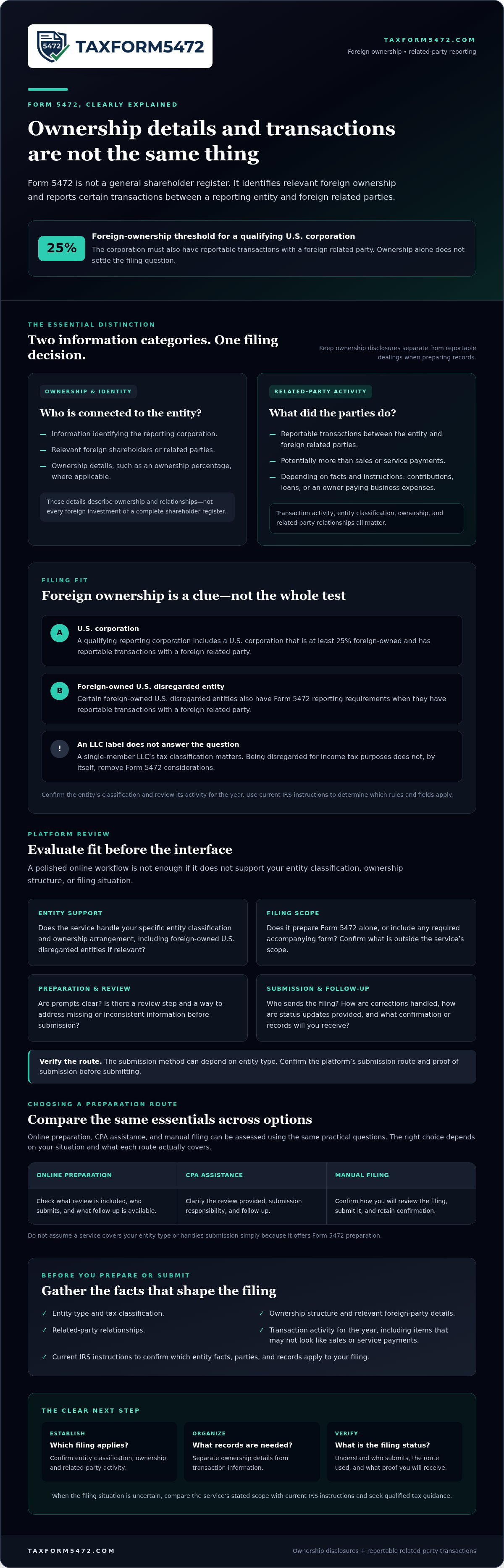
Foreign-owner stock data usually means details about a foreign shareholder’s ownership in a U.S. entity. It isn’t a general filing that records every foreign investment. Form 5472 reports specified ownership and identifying details alongside certain reportable transactions between a reporting entity and foreign related parties. Its scope is narrower than a complete shareholder register or an all-purpose investment report.
The form applies to qualifying reporting corporations, including U.S. corporations that are at least 25% foreign-owned and have reportable transactions with a foreign related party. Certain foreign-owned U.S. disregarded entities also have Form 5472 reporting requirements when they have reportable transactions with a foreign related party. A single-member LLC’s tax classification matters: being disregarded for income tax purposes doesn’t, by itself, remove Form 5472 considerations. Form 5472 offers a high-level overview. Use the current IRS instructions to confirm the rules for your situation.
Ownership is only part of the picture. Reportable transactions can include more than sales or service payments. Depending on the facts and applicable instructions, contributions, loans, or an owner paying business expenses may also need consideration. Entity classification, ownership, related-party relationships, and transaction activity all help determine the reporting obligation.
What foreign-owner information can Form 5472 request?
The form identifies the reporting corporation and asks for information about relevant foreign shareholders or related parties. Depending on the entity and applicable form instructions, that may include identifying details and ownership information, such as an ownership percentage. Don’t assume every field applies to every filer. Follow the current instructions for the form and tax year.
Keep the categories distinct. Ownership disclosures describe who owns or is related to the entity. Transaction information describes reportable dealings between the reporting entity and related parties. A web platform to submit foreign owner stock ownership data to irs should make clear which information its workflow collects. You still need to confirm that the requested details fit your filing situation.
Does every foreign-owned U.S. business file Form 5472?
No. Foreign ownership alone doesn’t settle the filing question. The entity’s classification and its transactions with related parties matter. A corporation and a foreign-owned U.S. disregarded entity can fall under different reporting rules, so don’t rely on the business being called an LLC or on its ownership status alone.
Before choosing a filing route, confirm how the entity is classified and review its activity for the year. For more detail, see IRS Form 5472 filing requirements. This check helps establish whether Form 5472 applies and what information to gather next.
How to Evaluate a Web Platform for IRS Ownership Reporting
Start with fit, not interface. A polished form won’t help if the service doesn’t support your entity classification, ownership structure, or Form 5472 filing situation. Confirm which forms are included and whether an accompanying return or other required document falls outside the service’s scope.
Check supported entity types, confirm the filing scope, and verify who prepares and submits the documents. This is the first filter for any web platform to submit foreign owner stock ownership data to irs. If your ownership structure is unusual or you’re unsure whether Form 5472 applies, seek qualified tax guidance before relying on an online workflow.
Does the platform support your entity and filing situation?
Ask whether the platform handles your specific entity classification and ownership arrangement, including whether it supports foreign-owned U.S. disregarded entities or only corporations. Confirm whether the service prepares Form 5472 alone or includes any required accompanying form. Don’t assume that a general Form 5472 description covers every filing situation. Compare the service’s stated scope with the official IRS guidance on Form 5472 and current instructions.
What should a complete digital filing workflow show?
Look for clear prompts, a review step, and a way to address missing or inconsistent information before submission. Ask how corrections are handled if you spot an error, who sends the filing, and how you’ll receive status updates. The submission method can depend on entity type. For example, foreign-owned U.S. disregarded entities generally submit Form 5472 with a pro forma Form 1120 by mail or fax, rather than e-filing. Verify the current requirements for your case.
Before proceeding, get direct answers to these questions:
- What access controls and privacy practices apply to the information you provide?
- How long are uploaded records retained, and how can you access or remove them?
- Who reviews the prepared filing, and what happens if information is incomplete?
- What proof of submission can you keep, such as a timestamp, receipt, or transmission record?
These details matter as much as data entry. A platform may help organize Form 5472 preparation, but don’t assume it provides a particular security feature, submission route, or IRS acceptance confirmation unless its current terms say so. If your filing need matches the service’s stated scope, review Form 5472 preparation options and confirm its supported entities, submission process, and records before starting.
Online Form 5472 Platform vs. CPA or Manual Preparation
The right filing route depends on how clearly you understand your entity, ownership, and related-party activity. A Form 5472 platform can structure information gathering. A CPA may provide individualized tax analysis. Manual preparation gives you direct control, but you’re responsible for interpreting the instructions and completing each step.
Compare the options by what they include, not by assumptions about accuracy or IRS acceptance. Confirm current requirements against the IRS Form 5472 Information page and its instructions.
| Criteria | Online platform | CPA assistance | Manual preparation |
|---|---|---|---|
| Eligibility | Check which entity types and ownership situations the service supports. | Ask whether the professional handles your entity and filing facts. | You determine whether the form applies using current instructions. |
| Data entry | Guided prompts may organize information; you provide and verify the facts. | The CPA may collect records and clarify details as agreed. | You identify and enter the required information yourself. |
| Review | Confirm whether a review is included and who performs it. | Clarify the scope of professional review and advice. | You check the completed form against the instructions. |
| Submission responsibility | Verify who submits, by which method, and what you must do. | Confirm whether the CPA submits or returns the filing to you. | You handle submission and retain evidence. |
| Follow-up | Ask what status updates and correction steps are available. | Agree on follow-up scope before engaging the CPA. | You monitor records and manage any follow-up yourself. |
When can a focused filing platform be a practical fit?
A focused workflow may suit a filer who understands the entity facts, can provide complete records, and needs help preparing Form 5472 rather than resolving broader tax questions. Confirm that the platform explicitly supports your entity classification and filing situation before entering information. Read more about automated Form 5472 preparation to understand what a guided process can and cannot establish.
When should a filer consider professional tax help?
Consider individualized professional review if entity classification is uncertain, related-party dealings are complex, or past records conflict. A software workflow can guide preparation, but it isn’t necessarily individualized tax or legal advice. For a closer look at the decision, see CPA versus software for Form 5472.
A web platform to submit foreign owner stock ownership data to irs can organize a defined filing task, but you still need to confirm eligibility, information, and submission responsibilities. No preparation route guarantees accuracy, acceptance, or freedom from penalties.
What to Prepare Before Submitting Foreign-Owner Data
Prepare the facts before opening a filing workflow. Start with current IRS instructions to determine which information and transactions apply to your entity and tax year. A platform may request extra documents to support its preparation process, but those requests aren’t automatically IRS requirements.
- Confirm entity facts. Verify the entity’s legal name, classification, address, tax year, and other identifying details against company records.
- Identify relevant parties. Determine which foreign shareholders or related parties belong in the filing, using the applicable instructions.
- Gather source records. Collect records that help confirm ownership and transaction details for the reporting period.
- Review the entries. Compare names, tax identification details, ownership information, and transaction amounts with source documents. Check for omissions or inconsistencies.
- Confirm and submit. Verify the filing period, submission route, responsible filer, deadline, and how you’ll retain submission evidence.
Transaction categories can be easy to overlook. Review the IRS instructions and this guide to reportable transactions under Form 5472 before deciding which activity to include.
Which records help verify ownership and related-party information?
Review formation documents, ownership records, and company records for the reporting period. Depending on your situation, these may help verify legal names, ownership percentages, and transactions with related parties. Reconcile details before entering them into a platform. Don’t treat any document as universally required unless current IRS instructions or the platform’s guidance confirms it applies.
What should you verify before authorizing submission?
Read the completed form against your records and the instructions. Confirm the reporting entity, tax year, identified parties, and transaction information. If you use a web platform to submit foreign owner stock ownership data to irs, ask who submits the filing, which route applies, and what confirmation or transmission record you can retain. Check the applicable deadline, too.
Keep copies of the final filing and relevant source records with any submission evidence. If your information is ready and Form 5472 preparation fits your needs, start Form 5472 preparation.
Using TaxForm5472 for Form 5472 Preparation and Filing
TaxForm5472 provides an online service focused on preparing and filing IRS Form 5472 for foreign-owned U.S. corporations. Its digital interface is intended to help organize the required information and facilitate tax-document submission. It may be relevant if Form 5472 is the filing you need, but confirm the service supports your entity classification and specific filing situation before proceeding.
What can users expect from a Form 5472-focused online service?
A focused workflow can help gather details for Form 5472 preparation in one place. Before you begin, check which entities and ownership situations the platform currently supports. Ask what information you’ll need to provide, who is responsible for submission, and which IRS submission method applies to your case.
Confirm what evidence of submission you’ll receive and how you can retain it. Don’t assume that completing an online workflow means the filing has been transmitted or accepted. Verify the platform’s current process and status updates directly. A web platform to submit foreign owner stock ownership data to irs is useful only if its scope and submission steps match your filing needs.
How to decide whether to proceed online
Proceed when you’ve confirmed that Form 5472 applies, the platform supports your entity and reporting situation, and your source information is ready. If you’re uncertain about entity classification, related-party transactions, or the reporting obligation itself, pause and seek qualified tax guidance. A digital preparation workflow doesn’t necessarily provide individualized tax or legal advice.
Before starting, confirm these points:
- Your entity type and filing situation are supported.
- You know what information and records the workflow requires.
- You understand who submits the filing and which route applies.
- You know what submission evidence or status confirmation to retain.
If those points fit your needs, review the Form 5472 online filing platform. Check its current scope and submission details before providing information or authorizing the next step.
Choose Your Filing Route With Clear Information
Form 5472 is not a general stock-ownership filing. It reports required information about certain foreign owners or related parties, along with applicable reportable transactions. Entity classification, ownership, and activity determine which filing rules apply.
Before choosing a web platform to submit foreign owner stock ownership data to irs, confirm that it supports your entity and filing situation. Review what information it collects, who prepares and submits the form, which submission route applies, and what evidence of submission you can retain. Use current IRS instructions to check the reporting details for your tax year.
TaxForm5472 focuses on IRS Form 5472 preparation for foreign-owned U.S. corporations. Its online interface is intended to help organize preparation and facilitate required tax-document submission. Confirm that your situation is supported and verify the platform’s current submission process before proceeding.
Review the Form 5472 online filing platform and check whether its scope matches your needs. With the right records and a clear understanding of the filing process, you can take the next step with greater confidence.
Frequently Asked Questions
Is there a separate IRS form for reporting foreign-owner stock ownership data?
Usually, Form 5472 is the relevant IRS form for certain foreign-ownership reporting situations, but it isn’t a general stock register. It identifies the reporting entity and relevant foreign shareholders or related parties, and reports certain transactions with those parties. Whether it applies depends on the entity’s classification, ownership, and transaction facts. Check the current IRS instructions to determine which reporting rules fit your situation.
Can I submit foreign shareholder information to the IRS online?
Sometimes, but preparing a form online and transmitting it electronically are different steps. A foreign-owned U.S. disregarded entity generally can’t e-file Form 5472; the form is submitted with a pro forma Form 1120 by mail or fax. Other filing situations may have different routes. Before using an online service, confirm the permitted method for your entity and exactly who submits the filing.
What information does Form 5472 report about a foreign owner?
Form 5472 requests identifying information for the reporting entity and relevant foreign shareholders or related parties. Depending on the filer and current instructions, it may also ask for ownership details, such as a percentage. The form also reports applicable transactions between the entity and foreign related parties. Ownership details and transaction reporting are separate parts of the filing, so gather records for both where they apply.
Does every foreign-owned U.S. LLC need to file Form 5472?
No. An LLC’s foreign ownership alone doesn’t determine whether Form 5472 is required. Its tax classification and reportable transactions with foreign related parties matter. Foreign-owned U.S. disregarded entities can have a filing requirement when reportable transactions apply, while corporations follow rules based on their own facts. Review the current IRS instructions for your entity and reporting year before deciding whether to file.
How do I choose a platform to prepare Form 5472?
Confirm that the service supports your entity type, ownership structure, and specific Form 5472 situation. Ask what forms it prepares, how it handles missing or corrected information, who submits the filing, and what submission evidence you’ll receive. A web platform to submit foreign owner stock ownership data to irs should make its workflow and responsibilities clear. Verify the filing route against current IRS instructions.
Can Form 5472 software replace a CPA?
Not in every situation. A focused software workflow may help organize Form 5472 preparation when you understand your entity facts and have consistent records. It doesn’t necessarily provide individualized tax advice or resolve complex questions. Consider qualified tax help if your entity classification is uncertain, related-party dealings are complicated, or historical records conflict. Neither software nor professional assistance guarantees accuracy, acceptance, or freedom from penalties.
What should I check after an online Form 5472 filing?
Confirm whether the filing was submitted, who submitted it, and which method was used. Save the completed form, supporting records, and any available timestamp, receipt, or transmission evidence. Don’t assume that an online workflow means the IRS received or accepted the filing. If the platform provides status updates or correction steps, review them and follow up if the submission record is unclear.