
Does a foreign owner automatically trigger the same IRS filing for every U.S. business? No. Reporting foreign ownership to IRS authorities depends on the entity’s classification, ownership stake, and reportable transactions. A foreign-owned corporation and a foreign-owned single-member LLC may face different filing rules.
It’s easy to confuse ownership disclosure with reporting transactions between a U.S. business and a foreign related party. Form 5472 may apply to a U.S. corporation with a direct or indirect foreign shareholder owning at least 25%. It may also apply to a foreign-owned U.S. disregarded entity, even if the entity had no income.
This 2026 guide explains which facts can affect your federal reporting obligations and where Form 5472 fits. You’ll learn which ownership and entity records to gather, how related-party transactions may affect reporting, and what steps to consider next. The goal is to help you identify potential filing requirements before overlooking an important detail.
Key Takeaways
- Reporting foreign ownership to IRS authorities involves more than checking ownership alone. Entity classification, U.S. activity, and related-party dealings can affect which rules need review.
- Separate transaction reporting from income tax filing. Different forms can address different obligations, so identify what each form is designed to report.
- Gather formation documents, ownership records, tax classification details, EIN information, and records of transactions with related parties.
- Use hypothetical scenarios to understand how ownership percentages and business activity may affect reporting, not as a final filing determination.
- Before deciding what to file, confirm the entity’s classification and review current IRS instructions. Complex ownership or transaction structures may require professional tax advice.
What does reporting foreign ownership to the IRS actually mean?
Reporting foreign ownership to the IRS means identifying tax filing rules that may apply because a foreign person owns or controls a U.S. entity, or because the entity has reportable dealings with a foreign related party. There isn’t one universal filing. The applicable rules depend on the entity’s federal tax classification, ownership structure, transactions, and U.S. tax activity.
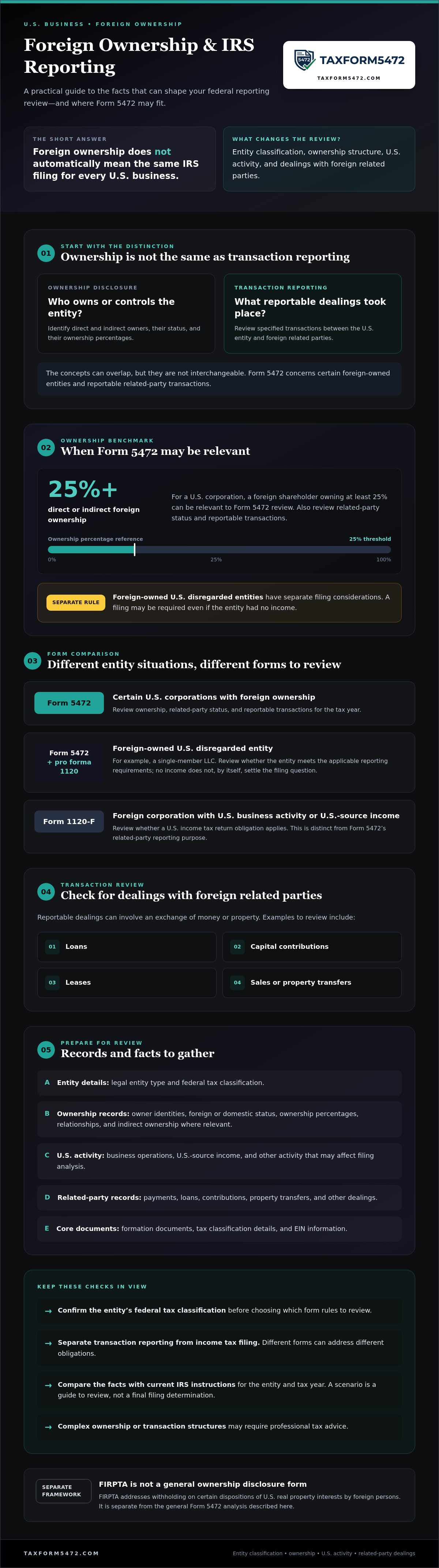
Ownership disclosure identifies who owns or controls an entity; transaction reporting identifies specified dealings between that entity and related parties. These concepts may overlap, but they aren’t interchangeable. Form 5472 applies to certain foreign-owned U.S. corporations and concerns reportable transactions with foreign related parties. Other filing rules may apply in different circumstances. For example, a foreign corporation’s U.S. business activity can raise separate income tax return questions.
Some foreign ownership situations also involve rules beyond the usual entity information-return analysis. FIRPTA addresses withholding on certain dispositions of U.S. real property interests by foreign persons. The Foreign Investment in Real Property Tax Act of 1980 (FIRPTA) is a separate framework, not a general ownership disclosure form.
Does foreign ownership automatically mean an IRS filing is required?
No single answer applies to every business. Start by confirming how the entity is classified for U.S. federal tax purposes. Then review its ownership and activity under the rules for potentially relevant forms. For Form 5472, a direct or indirect foreign ownership stake of 25% or more can be relevant for a U.S. corporation. Foreign-owned U.S. disregarded entities have separate filing considerations.
Ownership status and reportable transactions are separate facts to check. A related-party transaction can involve an exchange of money or property, such as a loan, capital contribution, lease, or sale. Don’t assume that every foreign-owned business files the same form, or that having no income resolves the filing question.
Which facts should owners identify first?
Gather these facts before choosing a form:
- Entity details: Legal entity type and federal tax classification.
- Ownership: Each owner’s identity, foreign or domestic status, ownership percentage, and relationship to the entity. Include indirect ownership where relevant.
- U.S. activity: Business operations, U.S.-source income, and other activity that may affect filing analysis.
- Related-party dealings: Payments, loans, contributions, property transfers, and other transactions involving foreign related parties.
These details establish what needs further review, but they don’t confirm a filing position on their own. Compare them with current IRS instructions for the entity and tax year before deciding what to file.
Which IRS forms may apply to a foreign-owned U.S. business?
There isn’t one form for every foreign-owned business. Start with the entity’s federal tax classification and the type of activity involved. This comparison highlights forms that may warrant review, but it isn’t a filing determination.
| Entity context | Potentially relevant form | What to review |
|---|---|---|
| Certain U.S. corporations with foreign ownership | Form 5472 | Ownership, related-party status, and reportable transactions for the tax year. |
| Foreign-owned U.S. disregarded entity, such as a single-member LLC | Form 5472 with a pro forma Form 1120 | Whether the entity meets the applicable reporting requirements. This filing may be required even if the entity had no income. |
| Foreign corporation with U.S. business activity or U.S.-source income | Form 1120-F | Whether the corporation has a U.S. income tax return obligation. This is distinct from Form 5472’s related-party reporting purpose. |
When might Form 5472 be relevant?
Form 5472 may apply to a U.S. corporation with at least one direct or indirect foreign shareholder owning 25% or more at some point during the tax year. Reporting may also apply to a foreign-owned U.S. disregarded entity under specific rules. Review ownership and related-party transactions separately. The Official IRS Instructions for Form 5472 explain definitions and filing details. For broader context, see the IRS Form 5472 filing guide.
Why entity classification changes the reporting path
A corporation and a disregarded entity can follow different federal reporting procedures, even if both are organized under state law as corporations or LLCs. When required, a foreign-owned U.S. disregarded entity generally files a pro forma Form 1120 with Form 5472 attached. Confirm the federal tax classification instead of relying only on the entity’s state-law name. If the classification is unclear, seek qualified tax advice.
For eligible businesses that have confirmed Form 5472 applies, a focused Form 5472 preparation service may help with that specific filing task.
How do ownership, transactions, and U.S. activity affect reporting?
Reporting foreign ownership to IRS authorities involves more than checking a shareholder’s country of residence. Review the ownership chain, the entity’s federal tax classification, and its dealings with foreign related parties. For certain U.S. corporations, a direct or indirect foreign ownership stake of at least 25% can be relevant to Form 5472. The law underlying certain corporation reporting requirements appears in U.S. Code § 6038A.
Transactions matter too. Form 5472 reportable transactions can include exchanges of money or property. The IRS instructions don’t provide a minimum dollar amount that automatically makes a reportable transaction irrelevant. Review monetary and nonmonetary dealings under the current instructions, and see the Form 5472 reportable transactions guide for more detail.
What counts as a related-party transaction?
Form 5472 uses IRS definitions to determine whether a party is related to the reporting corporation. The relationship may depend on ownership or control, including indirect relationships. Possible transactions include a sale, lease, royalty, loan, or capital contribution between the reporting corporation and a foreign related party. These examples aren’t exhaustive, and an example alone doesn’t establish a filing obligation. Check the current IRS instructions for applicable definitions and reporting rules.
- Hypothetical: A foreign parent transfers funds to its U.S. subsidiary. Record the transfer’s purpose, terms, amount, and parties for review.
- Hypothetical: A foreign owner provides property or services to a U.S. entity without a cash payment. Review the noncash arrangement under the instructions.
These examples identify facts to investigate. They don’t determine whether a particular business must file.
How U.S. activity fits into the assessment
Entity-level information reporting is separate from a foreign owner’s potential individual tax obligations. A business may need to assess whether its U.S. operations or U.S.-source income raise other federal tax questions, including whether income is effectively connected with a U.S. trade or business. Review those questions under the rules that apply to the specific entity and owner.
The analysis depends on ownership percentage and structure, tax classification, related-party dealings, and the entity’s U.S. activity. Keep transaction records and ownership documents together. If Form 5472 appears relevant, a focused Form 5472 preparation service may be an option for eligible businesses.
What records and checks help determine your reporting obligations?
Good records make your review more reliable. They don’t replace a tax determination, but they help you compare the entity’s facts with the rules for the relevant tax year. Use this sequence to organize the review.
A practical fact-gathering sequence for owners
- Confirm the entity details. Gather formation documents, the legal entity type, federal tax classification, tax year, and EIN. Check prior tax filings or classification elections if the current status is unclear.
- Map ownership. Record each direct and indirect owner, their status, ownership percentage, and relationship to the entity. Note changes during the year, including transfers or changes in ownership layers.
- Collect U.S. activity records. Summarize the entity’s U.S. business activity and relevant income. Keep this review distinct from any separate tax questions that may apply to owners.
- Reconcile related-party dealings. Compare the general ledger with bank records, invoices, loan agreements, contribution documents, contracts, and records of property or services exchanged. Include noncash dealings for review.
- Check current filing materials. Review the IRS form, instructions, and filing dates for the relevant tax year. Confirm which due date applies to the entity and whether an extension is available.
For broader entity-level context, read the foreign-owned U.S. corporation tax guidance. If your records indicate a possible Form 5472 requirement, compare the facts with current IRS instructions before reaching a conclusion.
Keep IRS reporting separate from other disclosure systems
IRS tax forms and ownership disclosures to other agencies serve different purposes. An IRS filing doesn’t automatically satisfy a separate reporting requirement. FinCEN, for example, is a different federal agency with its own rules. Beneficial ownership reporting requirements have changed, so verify current FinCEN guidance for the entity’s status instead of relying on an old checklist or assuming foreign ownership determines the answer.
For reporting foreign ownership to IRS authorities, keep a dated record of the sources reviewed, the tax year, and any unresolved questions. This helps distinguish confirmed facts from assumptions and makes follow-up more efficient.
If your review indicates that Form 5472 may apply to an eligible U.S. corporation, consider Form 5472 preparation for that specific filing task.
What should a foreign owner do next if Form 5472 may apply?
Move from a possible filing trigger to a documented review. Confirm the entity’s federal tax classification, organize ownership and transaction records, and compare the facts with current IRS instructions for the tax year. A preliminary review helps identify what needs clarification, but doesn’t confirm a filing position by itself.
- Verify classification. Check formation documents and any tax elections. Don’t assume the state-law entity label determines federal tax treatment.
- Confirm ownership and activity. Map direct and indirect owners, note changes during the year, and identify related-party dealings that may require review.
- Check current requirements. Use the IRS instructions and forms for the relevant tax year. Confirm the applicable deadline and any extension process instead of relying on an older calendar.
- Resolve open questions. Document unclear facts and seek qualified tax advice where the rules or records don’t provide a clear answer.
These steps can help focus a review of reporting foreign ownership to IRS authorities. Keep copies of the documents and instructions used, along with a record of assumptions that still need confirmation.
When should you seek tax guidance?
Get professional tax advice if the entity’s classification is uncertain, ownership runs through multiple entities, transactions have unusual terms, or prior filings may have been missed. These situations can require analysis beyond a standard document checklist. An online preparation tool can help with a defined filing task, but it doesn’t replace individualized legal or tax advice. No tool or review can promise a particular tax outcome or penalty result.
When an online Form 5472 service may fit
Consider a preparation service after assessing whether Form 5472 may apply and assembling accurate supporting information. Check the service’s eligibility requirements and what information it needs before proceeding. TaxForm5472 provides a focused online Form 5472 preparation service for foreign-owned U.S. corporations. Its scope is Form 5472 preparation, not a determination of every tax or legal obligation the business may have.
Prepare your Form 5472 online if you’ve confirmed the form may apply and are ready to organize the required information.
Make Your Next Filing Step With Confidence
Reporting foreign ownership to IRS authorities isn’t a single-form decision. Entity classification, ownership details, related-party transactions, and U.S. activity all help determine which rules need review. Organized records make it easier to check current IRS instructions and identify questions that still need answers.
Form 5472 is one part of that analysis, not a substitute for reviewing every potential filing obligation. If you’ve determined that Form 5472 may apply, use a focused preparation service for that specific task. Taxform5472.com offers specialized online Form 5472 preparation through a digital interface focused on foreign-owned U.S. business reporting.
Prepare your Form 5472 online if the form fits your filing needs. Confirm your information and eligibility before proceeding. A clear review can help you take the next step with better-prepared records and fewer unresolved questions.
Frequently Asked Questions
Does a foreign-owned U.S. company always have to report its foreign ownership to the IRS?
No. There isn’t one ownership form that applies to every foreign-owned business. For reporting foreign ownership to IRS authorities, first identify the entity’s federal tax classification, ownership structure, U.S. activity, and related-party transactions. Then review current IRS instructions for potentially relevant forms. The state-law entity name alone may not show which federal filing rules apply. If ownership or transactions are complex, seek qualified tax advice before deciding whether a filing is required.
Can a foreign-owned single-member LLC have a Form 5472 filing requirement?
Yes. A foreign-owned U.S. disregarded entity, such as a single-member LLC, may have Form 5472 reporting obligations under specific rules. Its filing process can differ from a corporation’s and may involve a pro forma Form 1120 with Form 5472 attached. The LLC’s state-law label doesn’t settle its federal tax classification. Confirm the classification, ownership, transactions, and current IRS instructions before concluding whether a filing is required.
What is Form 5472 used to report?
Form 5472 is an IRS information return used by certain reporting corporations to provide information about foreign ownership and reportable transactions with related parties. Whether it applies depends on the entity and its circumstances. Reportable dealings can involve exchanges of money or property, but examples alone don’t establish a filing requirement. Consult the current IRS instructions to check who must file, which transactions are reportable, what information is required, and how to submit the form.
Does forming a U.S. LLC mean a foreign owner owes U.S. income tax?
No. Forming an LLC doesn’t, by itself, establish whether a foreign owner owes U.S. income tax. The analysis may depend on the LLC’s federal tax classification, the type and source of income, business activity, and other facts. Information reporting obligations may also apply separately from whether income tax is due. Keep these tax questions distinct, and ask a qualified tax professional to review the owner’s circumstances before reaching a conclusion.
Is IRS ownership reporting the same as reporting to FinCEN?
No. The IRS and FinCEN are separate agencies, and their reporting systems serve different purposes. Filing a tax form with the IRS doesn’t automatically satisfy a separate FinCEN requirement, or vice versa. FinCEN rules can change, so check current official guidance for the entity’s specific status. Don’t rely on an older article or assume that a filing with one agency completes the business’s reporting obligations to another.
What records should a foreign-owned U.S. business keep for IRS reporting?
Keep formation documents, ownership records, federal tax classification details, EIN information, accounting records, and support for related-party transactions. Examples include agreements, invoices, bank records, loan documents, and records of property or services exchanged. Organize documents by tax year and note ownership changes during the year. The relevant records depend on the entity and potential filings, so compare your documentation with current IRS instructions before preparing a return.
Can an online service determine every tax obligation for a foreign owner?
No. An online Form 5472 preparation service focuses on that specific filing task. It may not assess every federal, state, or individual tax obligation that could apply to a foreign owner or business. Taxform5472.com provides an online service for Form 5472 preparation for foreign-owned U.S. corporations. Check its eligibility requirements and scope, and seek qualified tax advice for complex ownership, uncertain classification, or questions beyond Form 5472.