
A single omitted entry can trigger an automated $25,000 IRS penalty, even when your foreign-owned entity owes zero dollars in federal income tax. Executing compliant pro forma form 1120 with form 5472 preparation requires treating the return as a strict regulatory disclosure rather than a traditional corporate tax calculation. The Form 1120 acts merely as an informational wrapper, but the IRS enforces reporting rules with zero tolerance.
It's frustrating to parse conflicting tax instructions for a foreign-owned disregarded entity. Deciphering which corporate lines require completion, reporting non-taxable owner capital contributions, and figuring out which schedules to leave blank often leaves business owners uncertain about their actual compliance standing.
You'll master the exact preparation steps to file a compliant pro forma Form 1120 and Form 5472 package. We walk through each required line on Form 1120, define how to document related-party transactions, and detail the correct IRS submission methods to guarantee an error-free filing.
Key Takeaways
- Foreign-owned disregarded entities must utilize Form 1120 strictly as an administrative wrapper rather than an income tax return.
- Master compliant pro forma form 1120 with form 5472 preparation by identifying required informational lines and leaving standard tax schedules blank.
- Accurately categorize related-party transactions, including zero-tax capital contributions and owner distributions, to fulfill IRS disclosure mandates.
- Transmit completed filing packages exclusively through approved IRS fax numbers or certified mail to ensure verified delivery.
- Select optimal preparation workflows to eliminate clerical defects and systematically prevent statutory $25,000 non-compliance penalties.
Pro Forma Form 1120 with Form 5472: Filing Mandate and Entity Scope
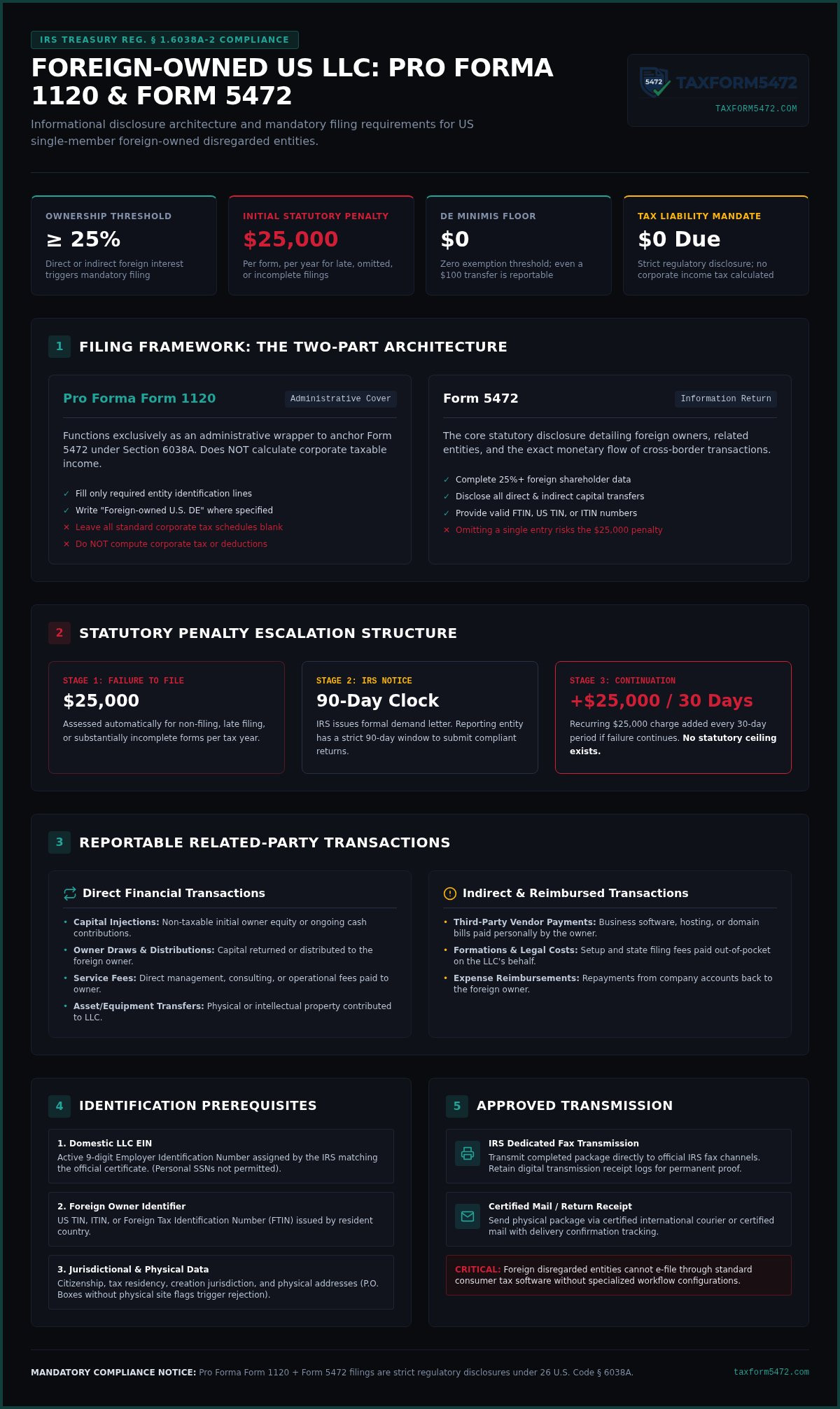
Filing an IRS informational return requires precision. A pro forma Form 1120 is not a standard corporate income tax return. Instead, it serves exclusively as an administrative cover sheet to anchor the Form 5472 information return. The Internal Revenue Service mandates this specific filing format under Treasury Regulation Section 1.6038A-2 to monitor cross-border capital movement and enforce international tax transparency.
The obligation begins when foreign ownership reaches or exceeds 25 percent direct or indirect interest in a domestic entity. Getting your pro forma form 1120 with form 5472 preparation right ensures you satisfy IRS compliance without unintentionally declaring taxable corporate income.
Foreign Disregarded Entity Classification Rules
The IRS treats single-member domestic LLCs owned by foreign individuals as domestic corporations purely for Section 6038A record-keeping and reporting rules. This classification is functional, not operational. The entity remains disregarded for substantive income tax calculations. You don't trigger corporate tax rates simply by submitting the form. Aligning your filing structure with the guidelines in our foreign owned us corporation tax compliance documentation keeps your entity legally disregarded while fulfilling federal disclosure rules.
Statutory Reporting Triggers and the $25,000 Non-Compliance Penalty
Any financial exchange between the domestic entity and its foreign owner constitutes a reportable event. The IRS maintains zero de minimis financial floor for foreign disregarded entities. A simple $100 initial capital transfer triggers the complete annual reporting package.
- Direct transactions: Capital injections, owner draws, service fees, or equipment transfers.
- Indirect transactions: Third-party vendor expenses paid personally by the foreign owner on the LLC's behalf.
- Initial penalty: An automatic $25,000 statutory assessment per form for unfiled, late, or substantially incomplete submissions.
- Continuation penalty: Additional $25,000 charges for every 30-day window following an unheeded 90-day IRS demand letter. No upper statutory ceiling exists.
The IRS evaluates submissions with zero latitude. Executing accurate pro forma form 1120 with form 5472 preparation protects your business from automated penalty assessments, administrative freezes, and permanent cross-border audit exposure.
Preparation Prerequisites: Required Entity and Transaction Data
Execution begins with structured documentation. Assembling records before starting pro forma form 1120 with form 5472 preparation prevents transcription errors that lead to IRS rejection notices or required amendments. You must gather complete identification credentials and full financial ledgers for the entire calendar year.
Every dollar exchanged between the reporting company and foreign owners requires precise reconciliation. Missing identifiers or unverified bank transfers stall reporting workflows and increase audit vulnerability.
Entity Identifiers and Employer Identification Numbers
Both entities in the reporting relationship require verified tax identification numbers. The reporting domestic LLC must secure an active nine-digit Employer Identification Number (EIN) directly from the IRS before filing. Operating under an individual's personal SSN is not permissible for disregarded corporate filings.
- Domestic entity EIN: Issued by the IRS, matching the official certificate of formation.
- Foreign owner tax identifier: A US TIN or ITIN if previously assigned. If neither exists, provide the official foreign tax identification number (FTIN) issued by the owner's resident jurisdiction.
- Jurisdiction details: Document the foreign owner's legal citizenship, tax residency, and the specific country under whose laws the owning entity was created.
- Operating locations: Establish confirmed physical addresses for both the domestic entity and the foreign owner. P.O. boxes without physical site descriptions trigger validation flags under the Official IRS Instructions for Form 5472.
Categorizing Reportable Related-Party Financial Transactions
Financial accounting must track every transaction between the LLC and the direct or indirect foreign owner. Review the specific parameters outlined in our guide to reportable transactions form 5472 to classify balance sheet movements accurately.
Identify and separate the following categories across your bank records:
- Capital injections: Cash contributions used to open accounts, fund initial operational costs, or cover platform fees.
- Distributions: Withdrawals, profit remittances, or capital returns paid to the foreign owner.
- Shareholder debt: Loan advancements from the owner to the entity, accrued interest, and structured principal repayments.
- Operational spending: Business expenses paid directly from the owner's personal foreign account without prior reimbursement.
Clerical mistakes during data categorization remain the primary cause of filing failures. Using an automated compliance platform like taxform5472.com standardizes your entity inputs and validates your numbers before generating submission files.
Step-by-Step Preparation: Completing the Pro Forma 1120 and Form 5472
Execution requires a disciplined sequence. Standard corporate tax workflows do not apply here. Entering financial metrics into standard operational schedules creates immediate processing errors at the IRS service center. Systematic pro forma form 1120 with form 5472 preparation means completing only the mandatory identifier blocks while bypassing the operational income schedules entirely.
Executing the Pro Forma Form 1120 Header
Treat Form 1120 strictly as an administrative wrapper. Follow this exact line-by-line protocol for page 1:
- Top margin: Write or type "Foreign-owned U.S. DE" clearly across the top border above the title header.
- Entity block: Enter the legal name, US business address, and nine-digit Employer Identification Number (EIN) in the standard corporate identification box.
- Box B: Check the box for "Initial Return", "Change of Address", or "Final Return" if applicable. Otherwise, leave blank.
- Box E: Enter the date the LLC was legally formed under state statute.
- Lines 1 through 31 (Income, Deductions, Tax): Leave every single entry blank. Do not enter zeroes. Entering "$0" or any numerical figure risks triggering an automated income tax assessment.
- Schedules C, J, K, L, M-1, and M-2: Leave these schedules blank. Do not complete balance sheets or reconciliation items.
- Signature area: The single member or designated manager must sign, date, and state their official title in the declaration block.
Entering Reporting Corporation and Related Party Data on Form 5472
Form 5472 captures the structural relationship between the entity and the foreign owner. In Part I, input the reporting company's details, ensuring the principal business activity description and NAICS code match your operational profile.
Proceed to Part II to report direct and indirect 25 percent foreign shareholders. Record the legal name, physical address, country of citizenship or incorporation, and taxpayer identification numbers. In Part III, define the related party. If the direct foreign owner is also the transacting party, duplicate the core identifiers and select the direct ownership relationship code.
Documenting Transactional Amounts and Part IV Disclosures
Part IV tracks the gross movements of money and property. All entries must appear in US dollars, converted at the official exchange rate active on the transaction date.
- Lines 10 and 21: Report the total gross dollar amounts for capital contributions received and distributions paid.
- Lines 13 and 24: Enter shareholder loan amounts, lines of credit drawn, or principal debt repayments.
- Non-monetary transfers: Detail intellectual property, services, or equipment swaps at fair market value.
Review Parts V and VI to confirm additional statutory disclosures before attaching Form 5472 directly behind the pro forma Form 1120. Defective entries can invalidate the return and require complex appeals under Form 5472 penalty relief procedures to abate the resulting $25,000 notice.
Preparation Methods: Manual Assembly vs. CPA vs. Automated Filing
Execution pathways dictate compliance outcomes. Selecting your preparation channel directly influences processing speed, clerical accuracy, and administrative cost. Completing pro forma form 1120 with form 5472 preparation requires evaluating three distinct operational methods: manual self-filing, professional CPA retention, and dedicated software automation.
Every foreign owner must assess personal risk tolerance against regulatory demands. A single structural error invalidates the submission and triggers immediate IRS scrutiny.
Evaluating Cost, Turnaround, and Error Risks
Manual PDF assembly carries the highest operational risk. Filing instructions span dozens of dense pages. Non-resident owners regularly misinterpret line restrictions, mistakenly entering numerical data on income lines or submitting partial related-party disclosures. These simple clerical errors prompt automatic rejection notices and statutory penalties.
Hiring a traditional accounting firm reduces clerical exposure, but introduces friction. CPAs typically charge hourly billing rates that quickly escalate, and filing turnaround can take several weeks during peak filing windows. Review the fee considerations detailed in our form 5472 filing cost analysis. You can also analyze the workflow trade-offs outlined in our form 5472 cpa vs software evaluation to determine if full-service accounting fits your operational scale.
Advantages of Purpose-Built Automation Platforms
Dedicated digital platforms streamline the filing process. Purpose-built systems restrict input fields to IRS-mandated parameters, automatically generating the pro forma Form 1120 wrapper while leaving corporate tax schedules blank. This programmatic approach eliminates manual transcription mistakes entirely.
- Deterministic form generation: Code-level formatting ensures exact alignment with current IRS layout mandates.
- Validation rules: Algorithmic checks confirm that related-party transaction totals match owner ledger entries.
- Rapid turnaround: Returns generate instantly upon data verification rather than waiting through external review queues.
Review the performance benchmarks outlined in our guide to automated form 5472 preparation. When you are ready to prepare a submission-ready filing, use taxform5472.com to complete your forms securely and minimize administrative exposure.
Submission Execution: Transmission Protocols and Record Retention
Completing the paperwork is only half the compliance mandate. Standard electronic filing through commercial tax software is not available for foreign-owned disregarded entities. The IRS Modernized e-File (MeF) system does not accept standalone pro forma Form 1120 packages without an underlying corporate tax return. Proper pro forma form 1120 with form 5472 preparation requires executing verified manual transmission protocols to establish an irrefutable filing record.
Every submission demands proof of timely delivery. The IRS relies on automated assessment systems for non-compliance, meaning delivery documentation is your sole defense against an erroneous penalty notice.
IRS Transmission Channels: Dedicated Fax vs. Certified Mail
Foreign disregarded entities must transmit their completed filing package directly to the specialized IRS processing center in Ogden, Utah. Select one of two approved delivery methods:
- Specialized IRS fax dispatch: Transmit the signed filing packet directly to the internal IRS fax line at 855-887-0188 (or 304-707-9471 from overseas locations). Retain the full electronic fax transmission report displaying the target number, timestamp, transmission status code, and total page count.
- Certified postal mail: Send the package via USPS Certified Mail with Return Receipt Requested, or use an IRS-designated private delivery service (PDS) like FedEx or UPS. Address shipments to the Internal Revenue Service Center, P.O. Box 409101, Ogden, UT 84409.
- Assembly order: Place the signed pro forma Form 1120 first as the cover sheet, followed immediately by Form 5472 and any supplemental line disclosures.
Recordkeeping Standards and Audit Protection Requirements
Under Section 6038A, the statutory burden of proof remains permanently on the reporting entity. If the IRS fails to log an incoming package, the assessment model automatically issues a $25,000 notice. You must maintain complete evidentiary files for at least five years from the filing date.
Store an exact, signed digital duplicate of the transmitted forms alongside the corresponding transmission receipt. Archive all primary financial documentation behind Part IV numbers, including foreign and domestic bank statements, loan agreements, cap table records, and invoices. Streamlined workflows eliminate transmission errors; prepare your Form 5472 on taxform5472.com to generate exact, audit-ready packages built directly to IRS processing requirements.
Execute Your IRS Filing Package with Complete Accuracy
Executing compliant filings protects your US business structure from automated IRS enforcement. A properly assembled return isolates your disregarded entity from corporate income tax liabilities while satisfying mandatory cross-border disclosure rules. Clean compliance hinges on three core actions: leaving operational lines blank on Form 1120, accurately logging owner capital movements on Form 5472, and securing verifiable dispatch logs from approved IRS transmission channels.
Manual paperwork introduces unnecessary clerical risks and costly delays. Meeting federal obligations doesn't have to drain your operational hours. Dedicated software solves this challenge by validating entity data and related-party transfers against strict federal standards before generation. Prepare your Form 5472 and pro forma 1120 now to produce audit-ready packages in minutes. Streamline your pro forma form 1120 with form 5472 preparation today, lock in your delivery confirmation, and run your business with total regulatory peace of mind.
Frequently Asked Questions
What is a pro forma Form 1120 when filed with Form 5472?
A pro forma Form 1120 acts as an administrative cover sheet for Form 5472. It establishes an informational record for foreign-owned disregarded entities without operating as a substantive corporate return. Only entity identification lines and formation details are completed. All corporate income, deduction, and tax computation lines remain blank. It satisfies Section 6038A informational disclosure mandates while preserving the entity's non-taxable disregarded status.
Do foreign-owned single-member LLCs owe income tax when filing pro forma Form 1120?
No, foreign-owned single-member LLCs do not calculate or pay corporate income tax on a pro forma return. The filing functions strictly as an information disclosure wrapper under Treasury Regulation Section 1.6038A-2. Unless your LLC elected corporate tax classification via Form 8832 or produced income effectively connected with a US trade or business, your entity incurs zero corporate income tax liability through this specific informational submission.
Can I electronically file a pro forma Form 1120 with Form 5472?
No, the IRS does not allow electronic transmission for standalone pro forma packages. Standard electronic filing systems reject Form 1120 submissions that lack operational income schedules and tax computations. Proper pro forma form 1120 with form 5472 preparation requires generating compliant physical documents and submitting them directly via certified postal mail or dedicated IRS fax lines. Always retain transmission confirmation logs to verify timely delivery.
What happens if I submit Form 5472 without the pro forma Form 1120 cover sheet?
Submitting Form 5472 alone invalidates the filing package. The IRS treats detached submissions as incomplete returns, rejecting them upon intake. This clerical failure triggers an automatic $25,000 failure-to-file penalty under Section 6038A. To prevent statutory fines, always bind Form 5472 behind the signed Form 1120 header, ensuring the phrase "Foreign-owned U.S. DE" appears clearly across the top margin.
What is the filing deadline for pro forma Form 1120 and Form 5472 in 2026?
For entities operating on a calendar tax year, the filing deadline is April 15, 2026. If you require additional time, you can secure an automatic six-month extension to October 15, 2026, by filing Form 7004 on or before April 15. The extension extends reporting deadlines for both Form 1120 and Form 5472, protecting your entity from late-filing penalty notices.
How do I report zero-dollar transaction years on Form 5472?
If your entity conducted absolutely zero reportable transactions with the foreign owner, Form 5472 filing is technically not triggered. However, almost all entities conduct transactions, such as initial formation payments, bank account opening deposits, or annual registered agent maintenance fees paid by the owner. When executing pro forma form 1120 with form 5472 preparation, document these baseline contributions accurately in Part IV to maintain complete transparency.
Where do I send the completed pro forma Form 1120 and Form 5472 package?
Send the signed filing package directly to the IRS Ogden service center. Filers inside the US can fax submissions to 855-887-0188, while international senders use 304-707-9471. If you choose postal delivery, dispatch the documents via certified mail with return receipt requested to: Internal Revenue Service Center, P.O. Box 409101, Ogden, UT 84409. Retain transmission receipts indefinitely as proof of compliance.