

The IRS assesses a $25,000 penalty for a single incomplete Form 5472. This fine is automatic. It requires no manual review. For foreign owners, reporting errors create immediate financial exposure. Deciding between a form 5472 cpa vs software is a critical choice for your compliance strategy. Every capital contribution, business loan, or state fee payment can trigger a filing obligation. Missing these details is costly. It leads to significant IRS scrutiny. You need a solution that balances precision with cost-efficiency.
Choosing the wrong path often leads to high billable hours or potential compliance gaps. You want to resolve complex related party transactions without the administrative burden. We understand the need for a streamlined, utilitarian process. This professional comparison evaluates CPA services against specialized automated software to help you identify the most efficient path. We examine the specific compliance risks, fixed-cost structures, and processing speeds of both options. You'll learn how to secure full IRS compliance while eliminating the manual back-and-forth of traditional tax preparation.
Key Takeaways
- Identify the $25,000 automatic penalty triggers. Learn the IRS definition of "substantially incomplete" filings.
- Compare the form 5472 cpa vs software models for cost-efficiency. Evaluate manual billables against fixed-fee automated logic.
- Detect common reporting errors in related party transactions. Prevent gaps in EIN data and transaction coding.
- Apply a decision framework based on transaction volume. Choose the optimal compliance path for foreign-owned entities.
- Leverage specialized digital interfaces for faster processing. Reduce manual data entry risks with automated preparation.
The $25,000 Compliance Stakes: Why Choice Matters
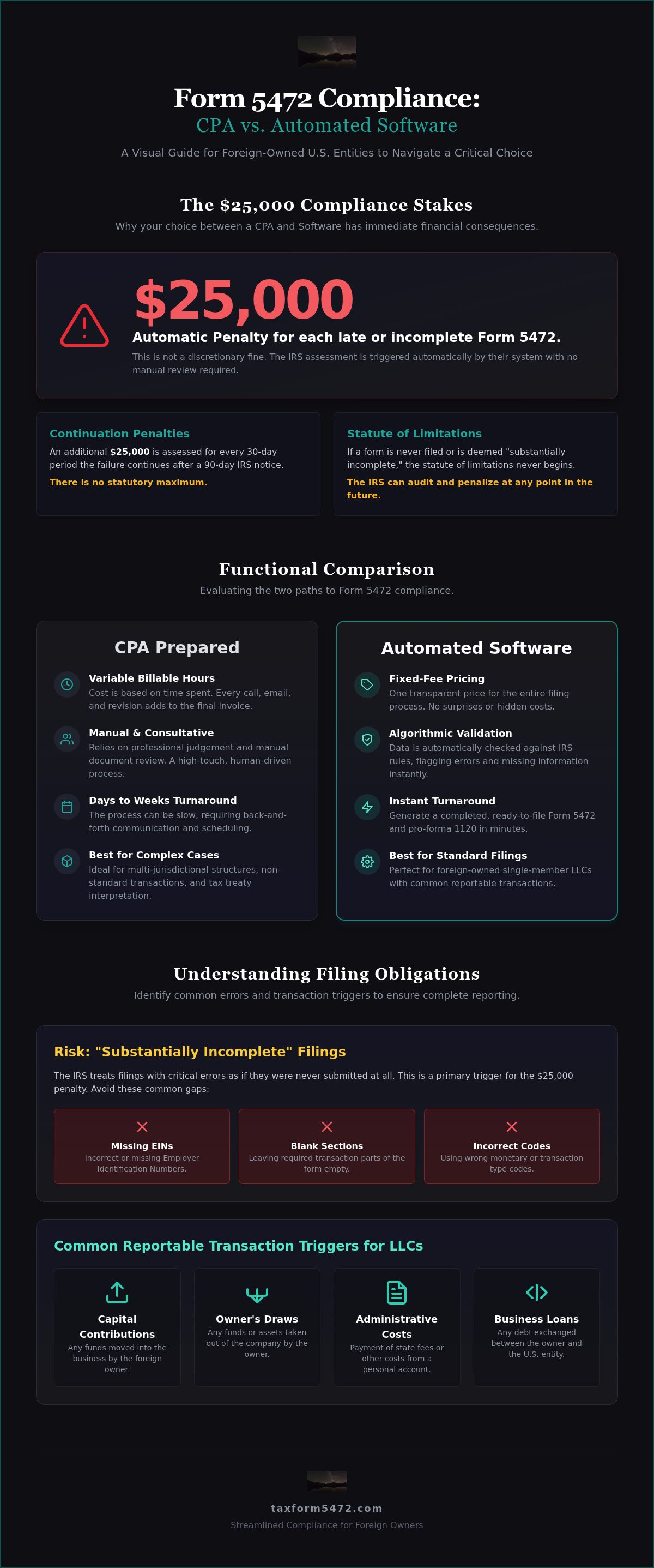
IRS Section 6038A carries a mandatory $25,000 penalty. This fine applies to every late or incomplete Form 5472. It's an automatic assessment. No human review occurs before the notice is issued. For foreign owners, the financial stakes are absolute. Your choice in the form 5472 cpa vs software debate determines your margin for error. The IRS uses this form to monitor related party transactions. It tracks every dollar moving between a U.S. entity and its foreign owners. In 2026, scrutiny has shifted. The agency now uses automated tracking to identify foreign capital in the U.S. financial system.
The Consequences of Late or Incomplete Filing
The $25,000 penalty isn't discretionary. It's a fixed cost for non-compliance. If a failure remains uncorrected for 90 days after an IRS notice, additional penalties apply. The IRS adds $25,000 for every 30-day period. There's no statutory maximum for these continuation penalties. Filing a placeholder or blank form is a high-risk strategy. Under the "Substantially Incomplete" rule, the IRS treats inaccurate filings as if they were never submitted. This includes leaving transaction sections blank or providing incorrect entity information. If a form is never filed, the statute of limitations never starts. The IRS can audit and penalize the entity at any point in the future.
2026 Reporting Requirements Overview
The deadline for the 2025 tax year is April 15, 2026. An extension to October 15, 2026, is available via Form 7004. Foreign-owned single-member LLCs face strict requirements. These entities are disregarded for income tax but treated as corporations for Form 5472 purposes. A reportable transaction triggers the filing. Income isn't a requirement. Common triggers include:
- Capital Contributions: Any funds moved into the business by the owner.
- Owner's Draws: Any funds or assets taken out of the company.
- Administrative Costs: Payment of state fees or formation costs from a personal account.
- Business Loans: Any debt between the owner and the U.S. entity.
Filers must also submit a pro-forma Form 1120. This document serves as the wrapper for the Form 5472. It ensures the data enters the corporate processing system correctly. In 2026, the IRS automated assessment model identifies missing pro-forma filings instantly. Precision in data entry is the only way to avoid the automatic $25,000 fine.
CPA Prepared vs. Automated Software: A Functional Comparison
Choosing between a form 5472 cpa vs software requires analyzing your entity's operational needs. The traditional CPA model relies on professional consultation and manual document review. This process is thorough but inherently slow. It revolves around billable hours. Every email and phone call adds to the final invoice. Conversely, automated software utilizes data-driven logic to generate filings. It operates on a fixed-fee basis. Results are often immediate. The primary differentiator is the mechanism of delivery: human expertise versus algorithmic precision.
Consider these functional differences:
- CPA: Variable billing, manual review, consultation-heavy, weeks-long turnaround.
- Software: Fixed pricing, algorithmic validation, data-driven, minute-long turnaround.
The CPA Value Proposition
CPAs provide strategic value for complex multi-national structures. If your corporation involves tiered ownership across multiple jurisdictions, manual oversight is beneficial. These professionals handle non-standard reportable transactions that require nuanced interpretation of tax treaties or specific legal exemptions. They also offer audit representation. If the IRS challenges a filing, a CPA provides professional accountability. This model suits businesses with high-complexity reporting requirements that go beyond standard data entry. It's a consulting-heavy approach for entities with intricate financial interdependencies.
The Case for Specialized Automation
Specialized automation eliminates the risks associated with manual data entry. Digital interfaces use guided workflows to ensure no mandatory fields remain empty. This is crucial for "substantially incomplete" risk mitigation. For foreign-owned disregarded entities, software offers a lower cost of compliance without sacrificing accuracy. Algorithms don't experience fatigue. They apply IRS logic consistently across every section of the form. Using automated Form 5472 preparation ensures that technical errors, such as missing EINs or incorrect transaction codes, are flagged before submission. The system enforces compliance through rigid data validation rules.
Turnaround times differ significantly between the two paths. A traditional CPA firm may take days or weeks to process a single filing. This delay stems from back-and-forth communication and manual verification steps. Software reduces this timeline to minutes. You input the data, the system validates it, and the form is ready for filing. For entities with straightforward related party transactions, the speed of automation provides a distinct operational advantage. It removes the administrative bottleneck from the compliance cycle. You gain certainty without the wait.
The Risk of "Substantially Incomplete" Filings
The IRS defines a filing as "substantially incomplete" when it lacks essential data required under Section 6038A. This status triggers the same $25,000 penalty as a complete failure to file. It is a critical factor in the form 5472 cpa vs software debate. Many filers believe manual review is the only safeguard against these gaps. This is a myth. Human oversight often misses technical nuances that algorithmic logic catches instantly. Precision is a matter of structured data, not just professional intuition.
The IRS assesses completeness based on data integrity. Missing EINs lead to immediate rejection. Incorrect transaction codes signal non-compliance. These errors are often invisible to the naked eye during a manual review. The myth that only a human can identify a related party ignores modern logic-mapping. Specialized software identifies these relationships by analyzing ownership percentages and transaction types. It asks the right questions to uncover hidden reporting obligations. It forces compliance through rigid data validation rules.
Common Pitfalls in Manual Preparation
Manual data entry is prone to simple errors. Transposing numbers in monetary reporting is common. A $50,000 contribution becomes $5,000. This discrepancy triggers automated IRS red flags. Misclassifying non-monetary transactions is another frequent error. These involve capital contributions or the use of personal funds for business formation costs. Many manual filers also overlook the Pro Forma 1120 requirement. Without this attachment, the Form 5472 cannot be processed. These technical failures lead to automatic penalty assessments because the IRS treats the submission as invalid from the start.
How taxform5472.com Solves the Completeness Gap
The taxform5472.com platform uses guided questionnaires to mirror IRS instructions. It breaks down complex reporting requirements into simple, manageable steps. This structure ensures users identify all related parties, even those they might otherwise overlook. Real-time validation checks for missing data before you can finalize the form. If a field is empty or formatted incorrectly, the system flags it immediately. You cannot proceed until the error is corrected. The final digital output adheres strictly to IRS formatting standards. This level of technical accuracy is difficult to achieve consistently through manual preparation. Automation provides a reliable safety net for foreign-owned entities. It ensures your filing is substantially complete and safe from automatic fines.
Decision Framework: When to Automate vs. Consult
Selecting the right path in the form 5472 cpa vs software debate requires a systematic assessment of your entity's data. Not every foreign-owned corporation needs high-cost consulting. Conversely, some complex structures shouldn't rely on basic data entry alone. Use this four-step framework to determine your compliance strategy. First, quantify your reportable transactions. High volumes of standard data, like monthly owner draws, favor automation. Second, map your ownership. Direct foreign ownership is logically straightforward. Third, define your objective. Compliance is a reporting task; strategy is a consulting task. Finally, calculate the total cost. Billable hours for manual review often exceed the value of standard filings.
Scenario A: When Software is the Optimal Choice
Software is the most efficient choice for foreign-owned single-member LLCs. These entities are disregarded for income tax but must file Form 5472 to report basic capital contributions or state fee payments. Dormant U.S. corporations also fit this model. They have zero active operations but still face the $25,000 penalty risk for non-filing. Automation provides a fast, fixed-price solution for these scenarios. It removes the uncertainty of variable billing while ensuring technical accuracy. If your goal is to meet a deadline without manual back-and-forth, choose the digital path.
Scenario B: When a CPA is Necessary
A CPA is necessary for multi-tiered international structures. Complex attribution rules require professional interpretation of constructive ownership across multiple jurisdictions. If your entity is currently facing an IRS audit or has already received a penalty notice, you need professional intervention. Transactions involving complex non-monetary asset transfers, such as intellectual property or real estate swaps, also require manual oversight. These situations demand strategic tax advice that goes beyond standard reporting. In these cases, the higher cost of a CPA is a necessary investment for legal and financial protection.
Most foreign owners find themselves in Scenario A. Their reporting needs are structured and repetitive. They don't require expensive tax planning; they require a reliable way to avoid automatic fines. For these users, a utilitarian digital interface is the most logical tool. It provides the speed of software with the specialized logic required for IRS Section 6038A. Select the most efficient path for your business by using automated Form 5472 preparation to secure your 2026 filing status.
Taxform5472.com: Streamlined Compliance for Foreign Owners
taxform5472.com is a specialized platform for preparing and filing Form 5472. It offers a direct resolution to the form 5472 cpa vs software dilemma. This SaaS-based solution streamlines compliance for foreign-owned US corporations. It eliminates the ambiguity of manual reporting. The platform focuses on high-frequency, clear terms that signal a professional service environment. It functions as a precise tool rather than a conversational partner. Users gain a streamlined, modern utility that prioritizes functionality and user intent.
Efficiency is the primary objective. The transition from raw data to IRS-ready documentation happens in minutes. Traditional firms often require multiple meetings to achieve the same result. This platform removes those bottlenecks. It uses a clean, direct approach to data entry. This reflects a high degree of focus on the user's time. Every navigational step serves a specific informational purpose. The system minimizes decorative weight. It focuses exclusively on the essential components of your professional interaction with the IRS.
A User-Friendly Compliance Interface
The digital interface simplifies the reporting process. It guides users through each mandatory field. This step-by-step approach ensures no data points are missed. It addresses the "substantially incomplete" risks identified earlier in this guide. The environment is secure. It protects sensitive entity information and EIN data. By removing the manual back-and-forth, the platform reduces the total cost of compliance. There is no need for billable consultation hours. You receive a final, formatted document ready for IRS submission. It is a utilitarian approach to a complex administrative requirement.
Focusing on Form 5472 Specialization
General tax software lacks the specialized logic required for foreign-owned entities. This platform is different. It is built specifically for Form 5472 and Form 1120 pro-forma requirements. The logic-checks are rigorous. They identify reportable transactions, such as capital contributions and owner's draws, with algorithmic precision. This focus ensures that your entity meets the 2026 reporting standards. It bridges the gap between software speed and specialized compliance knowledge. Start your 2026 filing with taxform5472.com to ensure your documentation is IRS-ready and technically accurate.
The modern alternative to traditional firms is here. Businesses now prioritize fast processing and fixed-cost filing. Automation provides this certainty. It replaces the variable nature of billable hours with a predictable, result-oriented service. You avoid the fear of IRS penalties through technical accuracy. This is the most efficient path for Form 5472 compliance. It provides a quiet confidence that your filing is complete. Select the tool that values your time and professional focus.
Secure Your 2026 IRS Compliance Status
Compliance logic is now a digital utility. The decision in the form 5472 cpa vs software debate depends on your entity's structural complexity. Most foreign owners require technical accuracy rather than strategic tax consulting. Specialized automation provides this precision. It eliminates the manual errors that lead to incomplete filings. You gain a fixed-cost solution with immediate turnaround. Digital interfaces guide you through every mandatory section. This ensures your documentation adheres to strict IRS formatting standards.
Efficiency is the new standard for US tax reporting. You can bypass the high billables and back-and-forth of traditional firms. Select a platform that offers specialized 5472 automation and a digital compliance interface. This approach secures your entity's standing while protecting your time. You benefit from fixed filing fees and a results-oriented workflow. It's the most efficient way to maintain your corporate standing.
Automate Your Form 5472 Filing Now. Take control of your compliance requirements today. Establish your 2026 status with confidence.
Frequently Asked Questions
Can I file Form 5472 myself without a CPA?
Yes, you can file independently. Many foreign owners use specialized software to handle Section 6038A requirements. This approach removes the need for high billable hours and manual consultation. You must ensure all reportable transactions are accurately identified to avoid the $25,000 penalty. Automation provides the necessary logic-checks for self-filing. It ensures your documentation meets all IRS formatting standards for the 2026 tax year. Results are immediate and technically precise.
What is the most common mistake made when using software for Form 5472?
The most common error is failing to report non-monetary transactions. These include capital contributions or paying business fees from personal accounts. Users often assume only cash movements matter. Specialized tools mitigate this risk by using guided questionnaires to uncover hidden obligations. This ensures all related party activities are captured correctly. Incomplete data leads to automatic IRS fines. Precision in reporting is the only way to avoid the mandatory $25,000 penalty.
How much does a CPA typically charge for Form 5472 preparation in 2026?
CPA fees in 2026 vary based on firm size and engagement complexity. Traditional firms typically charge hourly rates for consultation and manual document review. This often results in a higher total cost compared to fixed-fee digital solutions. For simple foreign-owned LLCs, the billable hours for manual preparation can exceed the value of the service. Software provides a predictable, cost-efficient alternative. It allows you to manage compliance without the uncertainty of variable professional service invoices.
Does the IRS prefer CPA-prepared returns over software-generated ones?
No, the IRS does not prioritize CPA-prepared returns. The agency focuses on data accuracy and completeness. Modern automated systems generate filings that meet all technical formatting standards. In the form 5472 cpa vs software comparison, the IRS treats both as valid if the data is "substantially complete." Algorithmic validation often produces fewer technical errors than manual data entry. You achieve the same compliance status through a more efficient, data-driven process. Results are ready for submission instantly.
What happens if the software misses a related party transaction?
Missing a transaction triggers the $25,000 automatic penalty. This occurs regardless of the preparation method used. Specialized software uses specific logic to uncover these transactions by analyzing ownership structures and fund movements. Generic tax software may miss these nuances. You must use a tool designed for Section 6038A compliance. High-quality automation reduces the risk of oversight through rigid validation rules. It ensures every reportable event is identified before the final documentation is generated.
Is automated software safe for single-member LLCs?
Yes, it's highly effective for foreign-owned single-member LLCs. These entities usually have straightforward reporting needs, such as capital contributions or owner draws. Automation handles these standard transactions with high precision. It provides a faster, more cost-efficient path than traditional accounting firms. You receive an IRS-ready document without the administrative burden of manual consultation. The digital interface simplifies data entry and reduces the risk of technical errors. It is a secure, utilitarian solution for compliance.
How do I know if my filing is "substantially complete"?
A filing is substantially complete when all mandatory fields and reportable transactions are included. This includes correct EINs, transaction codes, and the pro-forma Form 1120 wrapper. Automated platforms perform real-time validation to confirm these elements before you file. If the system flags an error, you must correct it to meet IRS standards. This technical certainty is a key advantage of the form 5472 cpa vs software choice. It removes the guesswork from your annual reporting obligations.
Can I switch from a CPA to software mid-year?
Yes, you can transition to software at any time. You simply need your entity's basic information and transaction history for the tax year. Digital platforms allow you to input this data directly into a secure interface. This switch often reduces compliance costs and speeds up the filing process. It allows you to move from variable billable hours to a streamlined, fixed-cost model for your 2026 reporting. You gain immediate access to automated logic and IRS-ready documentation.