
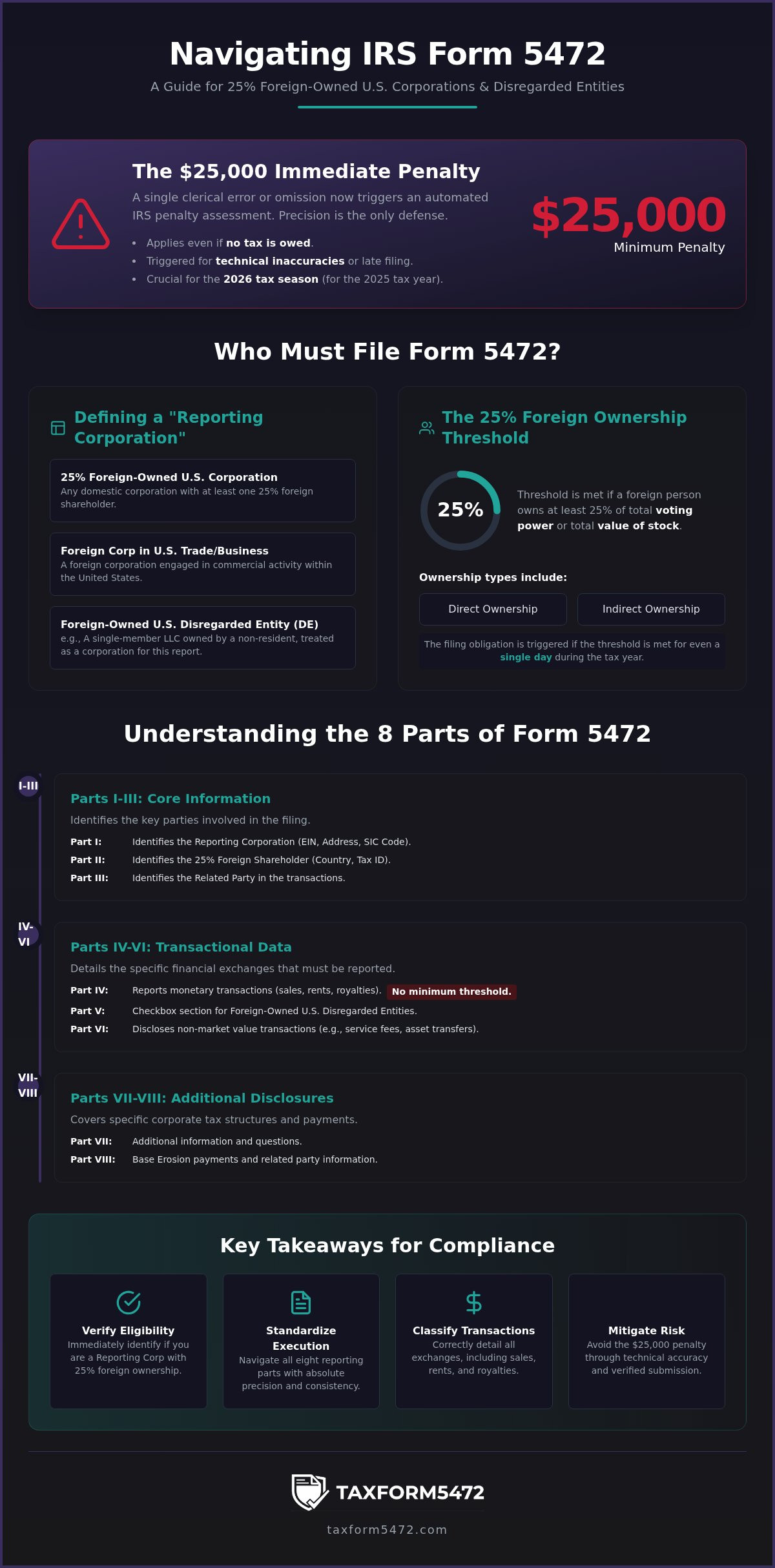
A single clerical error now triggers an immediate $25,000 IRS penalty. For foreign owners of U.S. entities, the 2026 tax season demands absolute technical accuracy. These form 5472 instructions provide a direct path through the reporting requirements for 25% foreign-owned corporations and disregarded entities. Precision remains the only defense against automated IRS penalty assessments.
Compliance is often buried under complex jargon and high-risk manual entry. You need a clear filing path that eliminates data errors and ensures penalty avoidance. This guide delivers that outcome. It allows you to execute IRS Form 5472 compliance with precision using streamlined instructions and verified reporting requirements.
The following sections detail the April 15 deadline, the specific pro-forma Form 1120 attachment for LLCs, and the broad definition of reportable transactions. Every step focuses on successful submission and risk mitigation.
Key Takeaways
- Verify eligibility. Identify reporting corporations and 25% foreign ownership thresholds immediately.
- Standardize execution. Use these form 5472 instructions to navigate all eight reporting parts with precision.
- Classify transactions. Detail monetary exchanges including sales, rents, and royalties to ensure compliance.
- Mitigate risk. Eliminate the $25,000 penalty through technical accuracy and verified submission methods.
Filing Eligibility: Who Must Use Form 5472
Identifying your filing status is the most critical phase of the 2026 tax season. Errors in this stage lead directly to non-compliance. The IRS requires specific entities to disclose transactions with foreign related parties to maintain transparency within the broader system of Taxation in the United States. You must determine if your business qualifies as a Reporting Corporation before proceeding with any data entry.
Defining the Reporting Corporation
A Reporting Corporation isn't just a standard U.S. company. The definition covers two primary categories. First, it includes any domestic corporation that is 25% foreign-owned. Second, it includes foreign corporations engaged in a U.S. trade or business. Many owners overlook the third category: foreign-owned U.S. Disregarded Entities (DEs). If you own a single-member LLC as a non-resident, the IRS treats it as a corporation for these specific reporting purposes.
The 2026 filing requirements are rigid. You must file even if the entity had no taxable income. The "disregarded" status only applies to income tax, not to the information reporting mandated by these form 5472 instructions. Failure to identify as a Reporting Corporation results in an immediate $25,000 penalty. This applies even if no tax is actually owed to the government.
The 25% Foreign Ownership Threshold
The 25% rule serves as the primary trigger for Form 5472. An entity meets this threshold if at least one foreign person owns 25% of the total voting power or 25% of the total value of all stock classes. Calculating this requires a deep look at your corporate structure. You can't just look at direct shareholders. The IRS applies constructive ownership rules; indirect ownership through other entities counts toward the 25% limit.
- Direct Ownership: A foreign individual or entity holds stock directly in the U.S. corporation.
- Indirect Ownership: A foreign person holds ownership through a chain of other corporations, partnerships, or trusts.
- Foreign Persons: This group includes non-resident alien individuals, foreign corporations, and foreign partnerships.
Verify your shareholder records for the 2025 tax year now. These form 5472 instructions emphasize that the threshold is measured at any time during the year. If a foreign person held 25% for a single day, the filing obligation is triggered. Don't wait until the April 15, 2026, deadline to map your ownership tiers. Use the 2026 filing guide to confirm your status and prepare for the reporting phase.
Form Structure: Understanding the Eight Parts
Successful filing requires a systematic approach to the document's layout. Form 5472 consists of eight distinct parts. Each section serves a specific regulatory function. You must ensure data consistency across all fields to avoid the $25,000 penalty. Referencing the Official Form 5472 Instructions helps verify current field requirements for the 2026 cycle. Technical accuracy in the document's structure is the only way to satisfy IRS transparency mandates.
Core Information Sections (Parts I-III)
Part I identifies the Reporting Corporation. You must enter the legal name, physical address, and Employer Identification Number (EIN). Accurate Standard Industrial Classification (SIC) codes are mandatory here. These codes describe your principal business activity. Part II shifts focus to the 25% Foreign Shareholder. This section requires the shareholder’s country of citizenship or organization and their specific foreign tax identification number. Part III identifies the Related Party. This is the entity or individual involved in the reportable transactions. Identification errors in these parts often trigger manual IRS reviews.
Transactional Data Requirements (Parts IV-VI)
Part IV functions as the technical core of the filing process. You must aggregate all monetary transactions between the Reporting Corporation and the Related Party. This includes sales of stock in trade, rents, royalties, and interest paid or received. There is no minimum dollar threshold. Even a single transaction triggers the reporting requirement. You must report gross totals for the entire tax year. If you didn't have sales but moved capital, those movements must still appear here.
Part V is a specific checkbox section for foreign-owned U.S. Disregarded Entities. If your LLC is treated as a DE, you must complete this section to notify the IRS of your status. Part VI then requires disclosure of transactions involving less-than-full consideration. This includes service fees or asset transfers that don't match fair market value. You must also disclose loans or advanced funds in this section. These parts require strict adherence to the latest form 5472 instructions to ensure no transfers are omitted.
Part VII and Part VIII cover additional items and Base Erosion payments. These sections apply to specific corporate tax structures and require detailed financial analysis. Managing these complex data points manually increases the risk of clerical mistakes. Utilizing automated preparation software ensures these totals align with your financial records and meet 2026 standards.
Identifying Reportable Transactions and Related Parties
Precision in data identification is mandatory. You must analyze every exchange between the U.S. reporting corporation and its foreign related parties. This scrutiny applies to both monetary and non-monetary events. The IRS uses these disclosures to track capital flow and ensure tax transparency. Understanding the legal framework of Form 5472 is the first step in classifying these interactions correctly. Don't rely on net figures. The IRS requires gross amounts for every reportable category.
Monetary vs. Non-Monetary Exchanges
Monetary transactions are the most common reporting trigger. You must list all amounts paid or received in U.S. dollars during the 2025 tax year. These form 5472 instructions require the aggregation of several specific categories. Accuracy here prevents audit triggers.
- Sales and Purchases: Report the gross value of inventory or stock in trade.
- Rents and Royalties: Include payments for the use of intangible property or physical equipment.
- Service Fees: Document all administrative, technical, or managerial fees.
- Interest: Disclose all interest paid or received on intercompany debt.
Non-monetary transactions often escape manual tracking. You must report any transfer of property, such as equipment or intellectual property, even if no cash changed hands. This includes transactions for less-than-full consideration. If you transferred a U.S. asset to a foreign owner, it's reportable. Document these transfers with the same rigor as cash payments. Platform fees and administrative costs paid on behalf of the related party must also be included in your final totals.
Related Party Definitions
The definition of a "Related Party" extends beyond the 25% foreign shareholder. Under Section 6038A, this term encompasses a broad network of entities. You must identify any person or corporation that shares a specific relationship with the reporting corporation. This includes any entity related under Section 267(b) or 707(b)(1). Common control is the primary indicator. If a foreign individual owns both the U.S. corporation and a foreign supplier, transactions between those two entities are reportable. These form 5472 instructions mandate that you verify these relationships across your entire corporate structure. Failure to identify a related party leads to incomplete filing and immediate penalty risk. Always verify the status of indirect owners and sibling corporations before finalizing your 2026 submission.
Execution: Step-by-Step Filing Instructions
Execution requires a structured workflow. Transition from data gathering to final submission without omitting technical details. Follow these form 5472 instructions to maintain compliance for the 2026 tax season. Precise documentation is your only defense against the $25,000 failure-to-file penalty. The IRS uses automated assessment models. Any discrepancy in your 2026 filing triggers an immediate notice. Precision in the execution phase eliminates these risks.
Data Collection and Preparation
Audit your 2025 financial records. Extract every transaction total from your accounting software. Categorize every total by type: sales, service fees, royalties, or interest. Manual extraction leads to clerical errors. Verify current shareholder addresses and tax residency status for all 25% foreign owners. You must have their foreign tax identification numbers (TIN) ready before you begin the data entry process. Accuracy at this stage prevents downstream corrections.
- Confirm the reporting corporation's EIN is active and correct.
- Verify the April 15, 2026, filing deadline for calendar-year entities.
- Submit Form 7004 by the original due date for a six-month extension to October 15, 2026.
Disregarded entities face unique requirements. Foreign-owned single-member LLCs must prepare a pro-forma Form 1120. This document acts as a cover for Form 5472. It contains basic entity information like name, address, and EIN. You don't file a full corporate return. The pro-forma attachment is mandatory for a valid submission. Electronic filing is currently unavailable for these specific entities. You must mail or fax the completed package to the IRS service center in Ogden, UT. Ensure you use the correct 2026 mailing address to avoid processing delays.
Section-by-Section Completion
Complete the form in sequential order. Part I requires the Reporting Corporation's specific data. Include the principal business activity code. This code must match your entity's actual operations. Move to Part II and Part III to detail foreign ownership structures. Country codes require absolute accuracy for international data sharing protocols. Part IV quantifies all reportable transactions. These totals must match your ledger exactly. Disclose any loans or advanced funds in Part VI to maintain full transparency.
Review the final document for clerical errors. A missing signature or an incorrect EIN nullifies the entire filing. The IRS treats substantially incomplete forms as non-filed. This triggers the same $25,000 penalty as a missed deadline. Eliminate these risks through specialized technology. Use our IRS Form 5472 Preparation tool to automate the data entry process and ensure technical precision for your 2026 submission.
Compliance Management and Submission Methods
Submission methods vary by entity type. U.S. corporations filing Form 1120 generally use electronic submission. Form 5472 attaches directly to the primary return in these cases. Electronic filing provides immediate receipt confirmation and reduces processing times. Foreign-owned U.S. disregarded entities face different requirements. These entities cannot e-file. You must mail or fax the pro-forma Form 1120 and Form 5472 to the IRS service center in Ogden, UT. This manual requirement increases the risk of delivery failure or clerical oversight. Review the IRS Form 5472 filing overview for specific 2026 mailing address updates and automation tips.
The $25,000 Penalty Framework
The IRS has increased scrutiny for the 2026 tax year. The base penalty for failure to file is $25,000. This amount also applies to filings deemed substantially incomplete. If the IRS identifies a failure, they mail a formal notice. You have a 90-day window from the mailing date to correct the error without further charges. Missing this window triggers a continuing penalty. The IRS assesses an additional $25,000 for every 30-day period, or fraction thereof, that the failure continues. There is no maximum cap on these cumulative penalties.
Automated penalty assessment is now a standard IRS tool. Increased data sharing between U.S. financial institutions and the IRS makes non-compliance easily detectable. Even businesses with no sales can trigger these fines through unreported capital contributions or owner draws. These form 5472 instructions emphasize technical accuracy to prevent these automated triggers. Evaluate the form 5472 cpa vs software analysis to determine which compliance path minimizes your financial exposure.
Data Accuracy and Record Retention
Record maintenance is a legal requirement under Section 6038A. You must keep all documents sufficient to determine the correct tax treatment of related party transactions. Maintain these records for a minimum of three years from the filing date. This statutory period aligns with the standard IRS audit window. Specific records to archive include:
- Bank statements showing intercompany transfers.
- Signed loan agreements and interest payment schedules.
- Invoices for inventory, royalties, or service fees.
- Detailed ledger entries for non-monetary asset transfers.
Automated tools replace manual record-keeping errors. They provide a precise audit trail and ensure your 2026 filing matches your internal accounting. Use these form 5472 instructions to standardize your data collection. Accurate records serve as your primary defense during an IRS inquiry. Don't rely on memory or disorganized spreadsheets. Digital precision ensures successful submission and long-term compliance.
Securing 2026 Tax Compliance
IRS compliance for foreign-owned entities is a high-stakes technical requirement. The $25,000 penalty for failure to file or maintaining incomplete records is a significant financial risk. These form 5472 instructions provide the necessary framework for the accurate reporting of monetary and non-monetary transactions. You must identify your reporting status and aggregate all intercompany data before the April 15, 2026, deadline. Precision remains your only defense against automated IRS assessments.
Manual data entry often leads to clerical errors that trigger immediate IRS notices. You can eliminate these risks using an automated compliance tool. Our specialized digital interface is designed specifically for foreign-owned U.S. entities. It streamlines the data collection process and ensures your reporting totals align with your ledger. Prepare and file Form 5472 automatically to ensure your submission meets all technical standards. This efficient approach replaces manual filing errors with digital accuracy.
Organize your financial records now. Secure your entity's standing and move forward with confidence for the upcoming filing cycle.
Frequently Asked Questions
Is Form 5472 required if there were no transactions during the year?
Filing is not required if the entity had zero reportable transactions during the tax year. You must be certain no monetary or non-monetary exchanges occurred. This includes owner's draws, capital contributions, and intercompany loans. Even a single dollar transfer triggers the requirement. These form 5472 instructions emphasize that active entities usually have at least one reportable event. Verify your ledger for any administrative payments before deciding not to file.
Can I file Form 5472 online without a CPA?
You can file Form 5472 online using automated software without hiring a CPA. Specialized digital interfaces provide a precise path for data entry. This method reduces manual errors and ensures technical accuracy for the 2026 tax season. Standard U.S. corporations can e-file as an attachment to Form 1120. However, foreign-owned disregarded entities must still submit via mail or fax. Automated tools generate the necessary pro-forma documents for these manual submissions.
What happens if I miss the Form 5472 filing deadline?
Missing the deadline triggers an immediate $25,000 penalty. The IRS applies this fine for late submissions or for filings that are substantially incomplete. If the failure continues for more than 90 days after an IRS notice, additional penalties apply. The IRS assesses $25,000 for each 30-day period until you comply. There is no maximum limit on these cumulative fines. Timely filing is the only way to avoid these automated penalty assessments.
Do single-member LLCs owned by foreigners need to file Form 5472?
Single-member LLCs owned by foreigners must file Form 5472. Although these are disregarded entities for income tax purposes, the IRS treats them as corporations for information reporting. You must attach the form to a pro-forma Form 1120. This requirement applies even if the LLC has no U.S. source income or sales. Every foreign-owned disregarded entity must disclose transactions with its owner or other related parties to maintain compliance for 2026.
What is the penalty for an incomplete Form 5472?
The penalty for an incomplete Form 5472 is $25,000. The IRS considers a form "not filed" if it lacks critical data or contains significant clerical errors. This includes missing related party information or incorrect transaction totals. Automated IRS systems scan for these gaps during the processing phase. Accuracy in every section is mandatory. Using these form 5472 instructions helps ensure all eight parts of the document meet the required technical standards.
Is an extension available for Form 5472?
An extension is available by filing Form 7004 before the original April 15 deadline. This provides an automatic six-month extension to October 15, 2026. You must file the extension request correctly to avoid the failure-to-file penalty. This extension applies to both the corporate return and the attached Form 5472. It doesn't extend the time to pay any taxes owed. Always confirm the extension status to ensure your submission remains within the legal window.
How long should I keep records related to Form 5472?
You must maintain records related to Form 5472 for at least three years. This statutory period starts from the date you file the return. These records must verify the correct tax treatment of all reportable transactions. Specific items to retain include:
- Bank statements showing intercompany transfers.
- Signed loan agreements and invoices.
- Ledger entries for non-monetary transfers.
Organized record-keeping serves as your primary defense against compliance challenges during an IRS inquiry.
Does Form 5472 apply to foreign individuals or just corporations?
Form 5472 applies to the U.S. entity, not the foreign individual directly. The reporting requirement is triggered when a foreign individual owns 25% or more of a U.S. corporation or disregarded entity. The U.S. business is the "Reporting Corporation" responsible for the filing. While the individual is the foreign related party, the corporation must disclose the transactions. Compliance focuses on the entity's financial interactions with its foreign owners and their affiliated networks.