
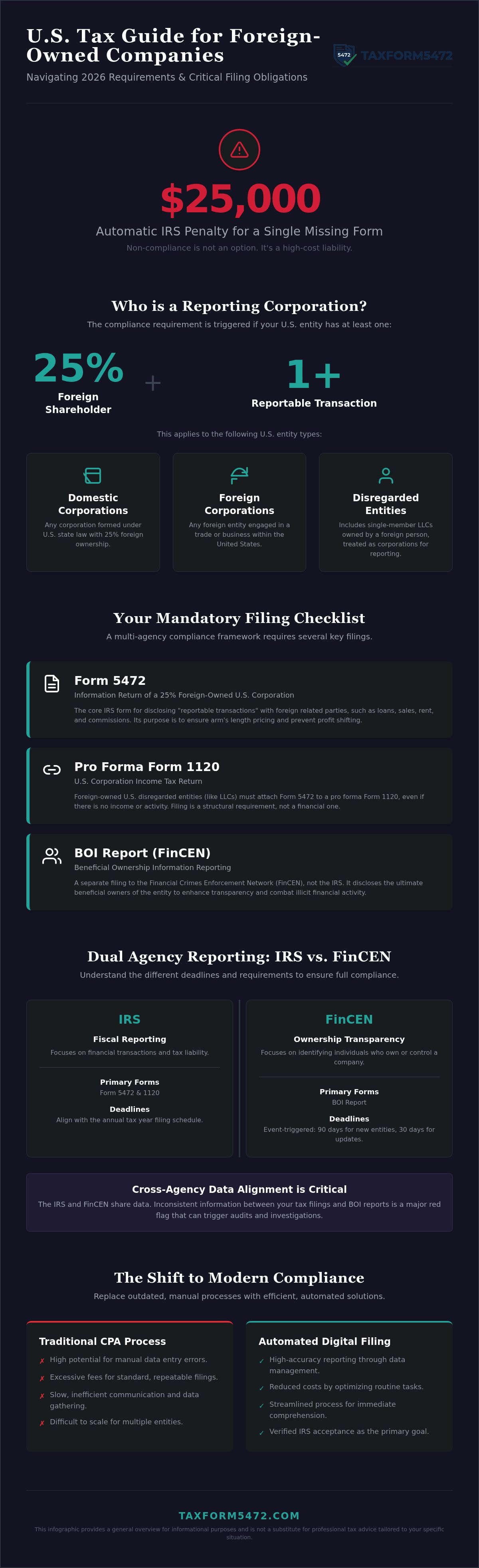
A single missing form triggers an automatic $25,000 IRS penalty. This is the reality of non-compliance. For many, tax reporting for us companies with foreign owners feels like a trap. The complexity of US international tax laws is high. Traditional CPA firms often charge excessive fees for standard filings. You need a more efficient way to manage your obligations.
Compliance is a data management task. It's not just a legal hurdle. You deserve a professional resource that simplifies the process. This guide provides that clarity. We offer a direct path through 2026 requirements for foreign-owned entities. You'll find a mandatory form checklist and methods to lower compliance costs. We prioritize verified IRS acceptance over complex narratives.
We'll preview the specific forms required for your entity. This resource ensures your US company remains in good standing without traditional overhead. Expect a utility-focused breakdown of your reporting duties. We focus on essential components and immediate comprehension. Let's review the mandatory filing criteria.
Key Takeaways
- Identify mandatory IRS forms for foreign-owned entities to ensure compliance with 2026 regulations.
- Mitigate financial risks and avoid the $25,000 penalty associated with tax reporting for us companies with foreign owners.
- Master core filings by understanding specific requirements for Form 5472, Form 1120, and BOI reporting.
- Maintain operational standards through Section 6038A safe harbor provisions for transaction records.
- Optimize efficiency by replacing manual CPA processes with automated digital filing solutions.
Core Reporting Obligations for Foreign-Owned US Entities
US tax reporting for foreign investors involves two federal agencies. The Internal Revenue Service (IRS) governs fiscal reporting. The Financial Crimes Enforcement Network (FinCEN) handles beneficial ownership transparency. These agencies now share data. Effective 2026, accuracy is mandatory. Inconsistent data triggers audits. Tax reporting for us companies with foreign owners requires precise alignment between all filings. It's no longer an isolated task. It's a cross-agency data alignment process.
Determining Reporting Corporation Status
Reporting status depends on ownership. A 25% foreign-owned US corporation must file. This includes domestic entities and foreign corporations in US trade. Foreign-owned disregarded entities are also included. Single-member LLCs are treated as corporations for this purpose. Identify all 25% foreign shareholders immediately. Indirect ownership is calculated through attribution rules. If a foreign parent owns a US subsidiary through multiple layers, the 25% rule still applies. You must look through holding companies to find the ultimate beneficial owner. This transparency is central to modern US tax policy. Use the 25% threshold as your primary compliance trigger. Exceptions are limited to entities with zero related-party transactions.
- Domestic Corporations: Formed under US state law.
- Foreign Corporations: Engaged in a US trade or business.
- Disregarded Entities: Single-member LLCs owned by a foreign person.
The Objective of International Information Returns
Section 6038A and Section 6038C drive IRS enforcement. The goal is transparency. The IRS monitors related-party transactions to prevent profit shifting. Reportable events include sales, rents, and commissions. Loans and interest payments are also scrutinized. Tax reporting for us companies with foreign owners must document these monetary flows. Related-party transactions include both monetary and non-monetary exchanges. For example, the transfer of intellectual property must be reported at fair market value. The IRS uses this data to verify arm's length pricing.
Treaties may lower tax rates. They never remove the filing requirement. 2026 standards prioritize digital data integrity over manual explanations. Safe harbor provisions exist for record maintenance. However, they require strict adherence to IRS formats. Failure to provide this data leads to substantial penalties. Accurate data management is the foundation of 2026 compliance. Professional filing relies on precise data management. This reduces the risk of manual audits. High-accuracy reporting is the only way to avoid the current $25,000 penalty threshold.
Essential IRS Forms: 5472, 1120, and BOI Requirements
Compliance requires a specific form set. Each document serves a unique regulatory purpose. Form 5472 tracks related-party transactions. Form 1120 reports the company's fiscal status. Beneficial Ownership Information (BOI) reporting satisfies FinCEN requirements. Form 1042-S documents US source income paid to foreign individuals. Tax reporting for us companies with foreign owners is a precise data exercise. Missing one form compromises the entire filing status. Professional accuracy is the only defense against automated penalties.
Mandatory Filing for Foreign-Owned LLCs
Foreign-owned disregarded entities face corporate reporting rules. The IRS treats single-member LLCs as corporations for transparency. This requires filing Form 5472 and a pro forma Form 1120. Follow the updated form 5472 instructions for 2026. Inactive LLCs are a common compliance trap. Many owners assume zero revenue means zero filing. This is incorrect. If the entity is active in the state, it must report to the IRS. Failure to file results in the standard $25,000 penalty regardless of income levels. Filing is a structural requirement, not a financial one.
BOI Reporting vs. IRS Tax Filing
Deadlines vary between the IRS and FinCEN. IRS filings typically align with the tax year. FinCEN BOI reports follow formation or change triggers. New entities must file within 90 days. Changes to ownership require updates within 30 days. Data points overlap significantly. Both systems require owner names, addresses, and identification numbers. However, the submission portals are distinct. Manage these requirements separately to ensure transparency. Using automated IRS Form 5472 preparation streamlines the tax portion of this burden. Efficient data entry reduces the risk of conflicting information between agencies.
Form 1042-S adds another layer of complexity. It covers dividends, interest, and royalties. It also includes compensation for services. Withholding agents must issue this form by March 15. The IRS uses this to verify that foreign persons pay appropriate taxes on US earnings. Accurate withholding is essential. It prevents the IRS from pursuing the US company for unpaid taxes. Treat each form as a component of a larger data strategy. Consistency across all filings is the primary goal for 2026 compliance. Accuracy is non-negotiable.
Record Maintenance Standards Under Section 6038A
Section 6038A defines the record-keeping mandate. Compliance isn't just about filing. It's about substantiation. Tax reporting for us companies with foreign owners relies on a robust audit trail. You must maintain records that support all reported related-party transactions. This includes monetary flows and non-monetary exchanges.
Safe harbor provisions offer a structured path. To qualify, you must maintain specific categories of records. These include original entry books and transaction records. You must also keep material that explains the pricing of related-party transactions. The IRS requires these documents to be available in English. They must be available in the US or produced within 60 days of a formal request.
The 'Agency Agreement' is a critical component. A US reporting corporation must be authorized to act as the agent for the foreign related party. This authorization applies specifically to Section 7602, 7603, and 7604. It ensures the IRS can access foreign-based records. Failure to establish this agreement leads to severe consequences. The IRS may unilaterally determine the cost of goods sold or expenses. This often results in significantly higher tax liabilities.
Documenting Reportable Transactions
Specific transactions require detailed evidence. Sales of inventory and property transfers are primary targets. You must also document rents and royalties paid to foreign affiliates. Intercompany loans are scrutinized for interest rates and repayment terms. Every data point must align with your IRS Form 5472 filing. Non-monetary transactions, such as shared administrative services, must have a valuation methodology. Maintain clear ledgers for all related-party activity. This prevents data gaps during a review.
IRS Audits and Information Requests
IRS audits demonstrate significant summons power. They can request records located outside the US. If you fail to produce these documents, the IRS can apply the noncompliance penalty. This often involves disallowing deductions related to the transaction. For 2026, digital record storage is the professional standard. Use secure, encrypted cloud platforms. Organize files by tax year and transaction type. Immediate retrieval is essential. Tax reporting for us companies with foreign owners is increasingly digital. Your records must be as accessible as your filings. Maintain these archives for at least ten years to ensure full protection.
Penalty Risks and Compliance Mitigation Strategies
The $25,000 penalty is a baseline. It is not a maximum. Failure to file Form 5472 triggers this amount automatically. Willful neglect can escalate to criminal penalties. The IRS identifies non-compliant entities through automated data matching. They compare bank records, treaty information, and FinCEN filings. Tax reporting for us companies with foreign owners is monitored with increasing precision. You can't rely on obscurity. Use Form 7004 to secure a six-month extension if you need more time. This simple step prevents an immediate late-filing trigger.
Managing the $25,000 Penalty Risk
Penalty triggers are binary. A late filing is a failure. An incomplete filing is also a failure. If the IRS determines your form lacks "substantial" information, they treat it as unfiled. This starts the $25,000 clock. Once the IRS issues a notification, you have a 90-day window to correct the error. If the failure continues after this period, the IRS applies additional fines. These are cumulative. You face an extra $25,000 for every 30-day period of continued non-compliance. There is no ceiling on these cumulative penalties. Accuracy and speed are your only protections.
- Initial Failure: $25,000 per form.
- Notification Period: 90 days to resolve.
- Continued Failure: $25,000 per 30-day increment.
Reasonable Cause and Penalty Abatement
Penalty abatement is possible but difficult. You must demonstrate "reasonable cause" for the failure. The IRS defines this as exercising ordinary business care and prudence. Ignorance of US tax laws is rarely accepted as a valid excuse. You must document your specific efforts to comply. This includes internal memos, communication with professionals, and proof of data collection. Inconsistent reporting across agencies undermines an abatement claim. Consider the risks of manual errors. When evaluating form 5472 cpa vs software, prioritize systems that minimize data entry mistakes. Digital automation provides an audit trail that manual processes lack.
Mitigation requires a proactive stance. Don't wait for an IRS notice. Review your prior years' filings for consistency. If you discover an error, use a voluntary disclosure approach. This often results in more favorable treatment than an audit discovery. Effective tax reporting for us companies with foreign owners demands a standardized workflow. Use a dedicated platform to ensure all fields meet IRS standards. You can prepare your Form 5472 online to reduce the risk of incomplete submissions. Professional tools ensure your data matches IRS expectations before you file.
Streamlining Filing with Automated Compliance Tools
Manual preparation is obsolete. It's slow and prone to error. Digital automation is the professional standard for 2026. Tax reporting for us companies with foreign owners is now a streamlined process. Automated tools handle the complexity of international tax laws. They ensure every field meets IRS requirements. This shift reduces reliance on high-cost manual labor. It prioritizes speed and data integrity. Efficiency is no longer optional. It's a requirement for staying ahead of IRS enforcement.
The Digital Filing Workflow
Automation starts with structured data entry. Input your US corporation details and foreign owner information once. The system identifies reportable transactions based on your inputs. It flags sales, loans, and royalties automatically. This eliminates the risk of overlooking a $25,000 trigger. Validation checks run before final submission. They verify TIN formats and address accuracy. The software checks for missing mandatory attachments. It confirms that related-party details align with current regulations. This step ensures the IRS accepts the filing on the first attempt. A digital workflow is a precise tool for modern compliance. It transforms a complex legal hurdle into a manageable data task.
Cost-Effective Compliance for International Owners
Hourly CPA rates are a significant burden. Traditional accounting fees often exceed the value of the filing itself. SaaS platforms offer a predictable, fixed-cost alternative. You pay for the filing, not the time spent on administrative overhead. This model is ideal for owners with multiple US entities. Scalability is built-in. You manage all filings from a single dashboard. This centralizes your data for future reviews and audits. It provides a clear history of your compliance status. If you're ready to secure your status, Prepare your Form 5472 now. Efficiency is the primary benefit of digital adoption. It allows you to reallocate resources to growth rather than administration.
Regulatory updates are a constant risk. Manual forms require constant checking against new IRS instructions. Automated platforms apply 2026 standards instantly. You don't need to track legislative changes or new filing codes. The software handles the updates automatically. This ensures your tax reporting for us companies with foreign owners remains current. It removes the guesswork from international compliance. Focus on your business while the utility handles the filing. Digital submission is the most reliable path to verified IRS acceptance.
Securing Your 2026 Compliance Status
Regulatory scrutiny is increasing. The alignment between IRS and FinCEN data is now a mandatory requirement for all entities. Tax reporting for us companies with foreign owners must be precise to avoid the automatic $25,000 failure-to-file penalty. You've seen how Section 6038A record maintenance and the correct filing of Forms 5472 and 1120 form the backbone of a successful US operation. Efficiency is found in digital tools rather than manual accounting processes.
Transitioning to an automated online platform reduces human error and lowers compliance costs. Our specialized foreign owner support and professional digital interface provide the utility needed for complex international reporting. Automated IRS compliance ensures your filings meet 2026 standards without the overhead of traditional firms. Start your Form 5472 preparation online today to verify your status. Manage your US obligations with confidence and focus on core business growth.
Frequently Asked Questions
What is the deadline for tax reporting for US companies with foreign owners in 2026?
The filing deadline is April 15, 2026, for corporations operating on a calendar year. If you file a timely extension using Form 7004, the deadline moves to October 15, 2026. Fiscal year entities must file by the 15th day of the fourth month following the close of their tax year. Missing these dates triggers the automatic $25,000 penalty for Form 5472 non-compliance.
Does a dormant US LLC with a foreign owner still need to file Form 5472?
Yes. A foreign-owned US LLC is a reporting corporation. Even without revenue, you must file if any reportable transactions occurred. The IRS often views the payment of state franchise taxes or legal fees by the foreign owner as a reportable transaction. Inactive status does not exempt the entity from federal reporting requirements. Accuracy is required to maintain the entity's standing.
What are the penalties for missing the BOI reporting deadline versus Form 5472?
Form 5472 carries a $25,000 initial penalty for late or incomplete filings. FinCEN BOI reporting carries civil penalties of up to $500 for each day the violation continues. BOI non-compliance can also result in criminal fines up to $10,000 and two years of imprisonment. Both agencies have separate enforcement tracks. You must manage both deadlines independently to avoid significant financial exposure.
How do I report non-monetary transactions on Form 5472?
Report the fair market value of the exchange in the appropriate section of the form. This includes transfers of intellectual property, shared administrative services, or the use of tangible property without cash payment. You must maintain contemporaneous records that support your valuation methodology. The IRS scrutinizes these transactions to ensure they meet arm's length standards. Precise documentation is your primary audit defense.
Can I file Form 5472 online without a CPA?
Yes. You can use an automated SaaS platform to manage tax reporting for us companies with foreign owners. These tools provide a professional digital interface that guides you through data entry. The software validates your information against current IRS standards and generates the required forms. This approach eliminates the high hourly rates of traditional firms while maintaining high accuracy and verified IRS acceptance.
What is a 'Related Party' for IRS reporting purposes?
A related party includes any 25% foreign shareholder of the US company. It also covers any person or entity related to the reporting corporation or the 25% shareholder under Section 267(b) or 707(b)(1). This definition encompasses family members, subsidiaries, and sister companies. Identifying these relationships is essential. Every transaction with these parties must be disclosed on Form 5472 to ensure full compliance.
Is an ITIN required for a foreign owner to file Form 5472?
No. An Individual Taxpayer Identification Number (ITIN) is not always required for the foreign owner on Form 5472. You may use a foreign tax identification number (FTIN) issued by your home country. However, the US reporting corporation itself must have a valid Employer Identification Number (EIN). Ensure all identification numbers are accurate to prevent the IRS from rejecting the digital filing.
What happens if I filed Form 1120 but forgot Form 5472?
The IRS considers the filing incomplete. This triggers the $25,000 penalty immediately. Tax reporting for us companies with foreign owners requires both forms to be filed together. You should file an amended return as soon as the error is discovered. Prompt correction is a factor the IRS considers during penalty abatement requests. Use an automated platform to ensure all mandatory forms are attached before submission.