
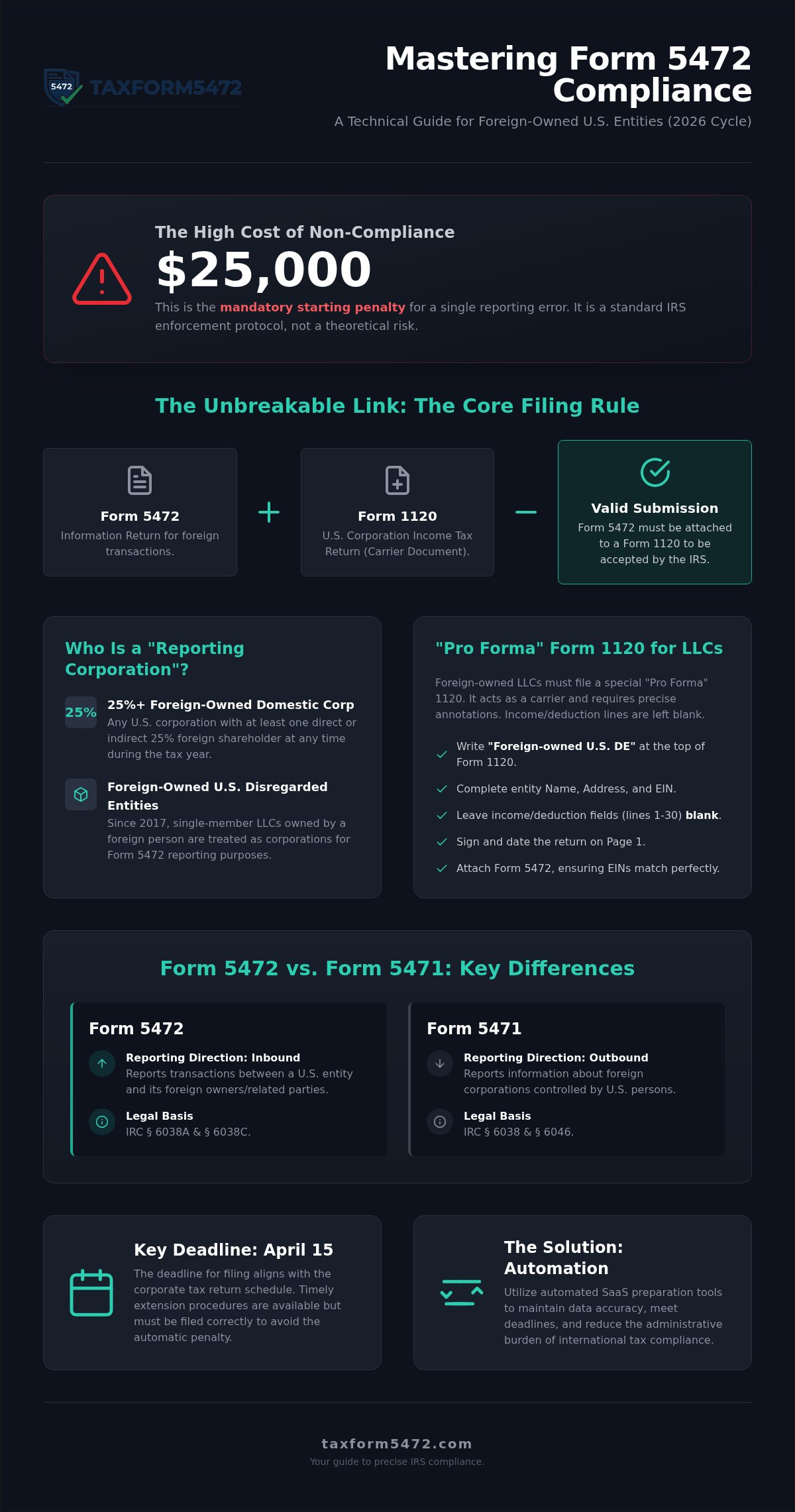
A $25,000 IRS penalty is the mandatory starting point for a single reporting error. For foreign owners, this isn't a theoretical risk. It's a standard enforcement protocol. Filing form 5472 with form 1120 is the required mechanism to track international transactions. You're likely facing the complexity of "Pro Forma" filings or the delay of obtaining a U.S. TIN. These technical hurdles create significant compliance anxiety. It's a precise challenge that demands a precise solution.
This guide provides that solution. It delivers the technical framework to master the 2026 compliance cycle. You'll learn to assemble the "Pro Forma" return, meet the April 15 deadline, and identify every reportable transaction. We focus on the essential data points required to satisfy IRS standards. Use this resource to eliminate errors and secure your business against automated assessments. Efficiency is the priority. Compliance is the result.
Key Takeaways
- Understand the structural relationship between Form 5472 and its carrier return, Form 1120.
- Execute the specific requirements for filing form 5472 with form 1120, focusing on mandatory "Pro Forma" header protocols.
- Differentiate between inbound reporting (Form 5472) and outbound reporting (Form 5471) based on ownership direction and thresholds.
- Confirm 2026 deadlines and extension procedures to avoid the fixed $25,000 non-compliance penalty.
- Utilize automated SaaS preparation tools to maintain data accuracy and reduce the administrative burden of international tax compliance.
Understanding the Link Between Form 5472 and Form 1120
Form 5472 is an information return. It doesn't calculate income tax. Its purpose is transparency. The Internal Revenue Service (IRS) uses it to monitor transactions between U.S. entities and foreign related parties. Despite its descriptive nature, the form cannot be submitted alone. It's an attachment. IRS regulations dictate that filing form 5472 with form 1120 is the only valid submission method for domestic reporting corporations.
For standard C-Corporations, this process is integrated. The Form 5472 attaches to the annual income tax return as a supporting schedule. For foreign-owned Disregarded Entities (DEs), the process is more technical. These LLCs must generate a "Pro Forma" Form 1120. This document serves as a carrier return. It contains minimal data but satisfies the procedural requirement for the 5472 attachment. You don't need taxable income to trigger this obligation.
Reporting Corporations vs. Disregarded Entities
Tax status determines filing complexity. Under Section 6038A, a "Reporting Corporation" includes any domestic corporation with at least 25% foreign ownership. This definition expanded significantly in 2017. Now, foreign-owned single-member LLCs are classified as corporations for reporting purposes only. They are "disregarded" for income tax but "reporting corporations" for information disclosure.
This distinction is critical. You may have zero U.S. source income. You may owe zero U.S. tax. However, the requirement for filing form 5472 with form 1120 remains. The 1120 acts as a structural shell. It identifies the entity while the 5472 details the transactions. Failure to provide this shell renders the information return incomplete. It's a procedural trap that often leads to automated penalties.
The Legal Basis for Joint Filing
The mandate is rooted in federal law. Section 6038A and Section 6038C establish the authority for information gathering. These statutes ensure the IRS can audit cross-border transactions for arm's-length pricing. Treasury Regulation 1.6038A-1 provides the operational instructions. It explicitly requires the information return to be filed with the entity's income tax return. For the 2026 compliance year, a reporting corporation is defined as any domestic entity with 25% foreign ownership or a foreign corporation engaged in a U.S. trade or business. Compliance depends on these legal pillars:
- Section 6038A: Governs 25% foreign-owned domestic corporations.
- Section 6038C: Governs foreign corporations in U.S. business.
- Treasury Regulation 1.6038A-1: Mandates the joint filing of Form 5472 and Form 1120.
Accuracy is not optional. The IRS uses these regulations to enforce a strict $25,000 penalty regime. Each missing form or incomplete attachment triggers an assessment. Professional preparation ensures every legal requirement is met through a single, cohesive filing packet. Efficiency starts with understanding the law.
The Pro Forma Form 1120 Requirement for LLCs
The "Pro Forma" Form 1120 is a procedural necessity. It functions as a skeleton for the information return. For foreign-owned LLCs, this document doesn't report profit or loss. It identifies the reporting entity. The process of filing form 5472 with form 1120 requires specific technical annotations to avoid rejection. Precision in the header and box selections is mandatory. Without these markers, the IRS may process the return as a standard corporate filing, leading to incorrect tax assessments or unnecessary inquiries.
Step-by-Step Pro Forma Preparation
Start with the top margin. Write "Foreign-owned U.S. DE" clearly at the top of Form 1120. This label signals to the IRS that the entity is a disregarded LLC filing solely for information purposes. Complete the Name, Address, and Employer Identification Number (EIN) fields. Use the EIN assigned to the LLC, not the owner's personal TIN. Check box B in the top section if this is the initial return for the entity. Check box E on the first page. This box is technically for consolidated returns, but IRS instructions for foreign-owned DEs specifically mandate this selection for the 2026 cycle. Leave the income and deduction sections (lines 1 through 30) blank if no U.S. trade or business exists. Do not enter zeros. Blank fields are the standard for Pro Forma filings. The foreign owner or an authorized U.S. person must sign the bottom of Page 1. This signature validates the entire packet and confirms the accuracy of the attached 5472.
Attaching the Form 5472
The Form 5472 must be physically or digitally attached behind the Pro Forma 1120. Verification is the final step. Ensure the EIN on Form 5472 matches the EIN on Form 1120 exactly. In Part 1 of Form 5472, the "Reporting Corporation" section must mirror the data on the 1120 carrier return. Any discrepancy between these two forms can trigger an automated $25,000 penalty for an "incomplete" filing. Accuracy in filing form 5472 with form 1120 protects the entity from the standard non-compliance penalty. Refer to the Official IRS Instructions for Form 5472 for specific transaction codes and reporting thresholds. For a comprehensive walkthrough of the 2026 requirements, consult our IRS Form 5472 Instructions: Professional 2026 Filing Guide. Managing these technical details is simpler with automated preparation tools that enforce these formatting rules and ensure your submission meets every IRS specification.
Form 5472 vs. Form 5471 Comparison
Comparison is essential for cross-border compliance. Form 5472 tracks inbound investment. Form 5471 tracks outbound investment. One monitors what enters the U.S.; the other monitors what leaves. While filing form 5472 with form 1120 is the standard for foreign-owned domestic entities, Form 5471 follows a different logic. It applies when a U.S. person holds a significant interest in a foreign corporation. Ownership direction dictates the form selection. Form 5472 reports transactions from a foreign related party to a U.S. entity. Form 5471 reports the activities of a foreign corporation to the U.S. government. Both forms serve the same goal: transparency.
Key Differences in Reporting Obligations
The reporting corporation for Form 5472 must have at least 25% foreign ownership. This triggers the mandatory process of filing form 5472 with form 1120. In contrast, Form 5471 applies to U.S. persons owning 10% or more of a foreign corporation. This 10% threshold is significantly lower, reflecting the focus on offshore tax deferral. Reportable transactions on Form 5472 focus on money moving between related parties. This includes loans, sales, and capital contributions. Form 5471 focuses on Subpart F income and Global Intangible Low-Taxed Income (GILTI). The penalty structures are now identical. For the 2026 tax year, the penalty for failing to file either form is $25,000 per violation. Additional penalties accrue if the failure continues after notification. Filing frequency matches the tax year of the reporting entity.
When Both Forms Might Be Required
Complex structures often trigger dual requirements. A U.S. LLC might be foreign-owned, requiring a 5472. If that same LLC owns a subsidiary in another country, it may also require a 5471. Reciprocal trade relationships create similar overlaps. If a foreign owner uses a U.S. entity to manage other international holdings, the compliance burden doubles. It's a high-stakes environment where one missed attachment results in a five-figure fine.
Synchronization is vital. Both forms are typically attached to the IRS Form 1120 or the owner's personal return. You must verify ownership percentages at the end of each accounting period. Changes in equity can shift an entity from one reporting category to another within a single month. For a detailed breakdown of these obligations, see our IRS Reporting for Foreign Investors: 2026 Compliance Resource. Accurate classification is the only way to avoid the $25,000 assessment. Efficiency depends on recognizing these distinctions early in the tax year.
Deadlines and the $25,000 Non-Compliance Penalty
The IRS does not offer leniency for administrative delays. For calendar-year entities, the deadline for filing form 5472 with form 1120 is April 15, 2026. This date is absolute. If your entity operates on a fiscal year, the deadline falls on the 15th day of the fourth month following the close of the tax year. Missing this window triggers an automatic assessment. Precision is the only defense against these systemic penalties.
Managing the April 15 Deadline
Extensions are available but require proactive steps. Use Form 7004 to request a six-month extension, moving the deadline to October 15, 2026. For a disregarded entity, this extension must be filed under the LLC's name and EIN. You can't use the owner's personal extension to cover the entity's reporting obligation. Obtain your EIN immediately. Waiting until the final weeks of the tax season often leads to processing delays that jeopardize your compliance status. Early preparation is a prerequisite for a successful filing.
The Cost of Incomplete Filing
Financial loss occurs even without tax liability. The $25,000 penalty applies to late filings, missing forms, or substantially incomplete data. This is a "per form" penalty. If your LLC had reportable transactions with three different related parties, you must file three separate Forms 5472. Failure to do so results in a $75,000 initial assessment. The IRS also mandates strict record maintenance. If you can't produce the records used to determine the correct treatment of transactions, additional penalties apply. These assessments are often automated and difficult to contest.
The clock doesn't stop after the initial fine. If the failure continues for more than 90 days after the IRS mails a notice of failure, an additional $25,000 penalty is assessed for each 30-day period (or fraction thereof) that the non-compliance persists. There's no upper limit on these cumulative fines. The assessment period for these penalties never expires if the form remains unfiled. Protect your capital by ensuring your submission is both timely and technically perfect. Avoid these automated risks by using professional IRS Form 5472 preparation software to secure your 2026 filing.
Automating Your 5472 and 1120 Compliance
Manual tax preparation is a systemic risk. The technical complexity of filing form 5472 with form 1120 increases the probability of clerical errors. For foreign owners, these errors aren't just inconveniences. They're $25,000 liabilities. Automation eliminates the variables of manual entry. Software-as-a-Service (SaaS) platforms provide a structured environment for data input. These tools ensure the "Pro Forma" Form 1120 is formatted to exact IRS standards. They handle the specific annotations required for disregarded entities without human intervention. This shift to digital preparation is the most effective way to secure 2026 compliance.
Precision is the primary benefit of automation. SaaS tools use logic-based validation to check for missing EINs or mismatched transaction codes. This prevents the "incomplete filing" status that triggers automated penalties. Traditional accounting firms often charge high fees for these specialized forms. They rely on billable hours and manual review. Automation relies on efficiency and algorithmic accuracy. Digital preparation is a cost-effective alternative for international ownership structures. It provides a direct path to a complete filing packet. Security is also enhanced through encrypted data handling. This protects sensitive ownership information and creates a clear digital audit trail.
Why Use taxform5472.com?
Our platform focuses exclusively on Section 6038A compliance. It's a precise tool for a specific, high-stakes task. The interface guides users through the entry of complex foreign ownership data. It simplifies the identification of related parties and reportable transactions. Built-in validation ensures every mandatory field is populated before the final document is generated. This specialization reduces the administrative burden on foreign owners. It transforms a complex regulatory requirement into a streamlined digital process. You get a results-oriented solution that prioritizes your time and your capital.
Getting Started with Filing
Compliance begins with data organization. Prepare all records of related party transactions for the 2026 tax year. This includes capital contributions, loans, and any exchange of value between the LLC and its owners. Enter this data into our automated preparation tool. The system generates the necessary Pro Forma Form 1120 and the attached Form 5472 according to current IRS specifications. Review the output for accuracy and proceed with submission. Secure your 2026 compliance status today to avoid the risks of last-minute manual errors. For a detailed roadmap, consult our IRS Form 5472 Filing: 2026 Compliance and Automation Guide. Efficiency is the standard. Compliance is the goal.
Secure Your 2026 Compliance Status
Compliance is an ongoing operational requirement. The $25,000 penalty per form makes technical accuracy mandatory. You've identified the necessity of the Pro Forma shell and the specific header requirements for disregarded entities. Successful filing form 5472 with form 1120 requires strict adherence to these procedural standards. Every reportable transaction must be documented with precision to satisfy Section 6038A. Procedural gaps are the primary cause of automated assessments.
Errors are costly. Specialized automation replaces the uncertainty of manual entry. Our platform is built for foreign-owned U.S. entities to streamline this exact reporting cycle. Eliminate the risk of automated IRS assessments. Secure your records. Meet your deadlines. Use a tool that anticipates IRS requirements. Efficiency is not a luxury; it's a prerequisite for international business operations.
Start Your Form 5472 Filing Now to protect your business and avoid $25,000 IRS penalties. Our service is specialized for foreign-owned U.S. entities and ensures your documents meet every technical benchmark for the 2026 cycle.
Accuracy is within reach. Maintain your focus on growth while we handle the technical details of your disclosure. Efficiency is the standard. Compliance is the result.
Frequently Asked Questions
Is Form 5472 required if the LLC has no income?
Yes. The requirement for filing form 5472 with form 1120 depends on reportable transactions, not taxable income. Any movement of funds between the foreign owner and the U.S. LLC triggers the mandate. This includes capital contributions, loans, or the payment of business expenses by the owner. Even a $100 transaction requires a complete filing. Zero income doesn't grant an exemption from these information disclosure rules. Accuracy is required regardless of your profit status.
Can I file Form 5472 electronically without Form 1120?
No. Form 5472 is a mandatory attachment to a corporate return. It cannot be submitted as a standalone document. For foreign-owned disregarded entities, the process involves filing form 5472 with form 1120 on paper or via fax. Electronic filing isn't supported for these specific "Pro Forma" submissions. You must assemble the full packet to satisfy the IRS procedural requirements and avoid automated rejection. Standalone submissions are considered invalid and incomplete by the IRS.
What happens if I file Form 1120 but forget to attach Form 5472?
The IRS treats the submission as a failure to file. An incomplete return triggers an immediate $25,000 penalty. The assessment applies because the information return is a critical component of the corporate filing. You must submit a corrected packet immediately. Prompt action might help when requesting a penalty abatement, but the initial fine is often automated and issued without a prior warning. Incomplete filings are the most common cause of 2026 tax assessments.
Do I need a Social Security Number (SSN) to file Form 5472?
No. A Social Security Number isn't a prerequisite for this filing. The U.S. entity must have its own Employer Identification Number (EIN). The foreign owner provides their Foreign Tax Identifying Number (FTIN) from their home country. If an ITIN exists, it should be used, but it's not mandatory if an FTIN is provided. Focus on securing the entity's EIN early to ensure the 2026 deadline is met. SSNs are only for U.S. residents.
How many Form 5472s do I need if I have three foreign owners?
You must file one Form 5472 for each foreign related party that engaged in a reportable transaction. If three foreign owners each contributed capital or received payments, three separate forms are required. These are all attached to a single Form 1120 carrier return. Each missing form is a separate violation. This could result in $75,000 in total penalties if all three are omitted from the annual submission. Multiple owners require multiple, distinct disclosures.
Can I get the $25,000 penalty waived for reasonable cause?
Waivers are possible but difficult to obtain. You must prove "reasonable cause" by showing you acted with ordinary business care. The IRS rarely accepts a lack of knowledge as a valid reason. Detailed documentation of your attempts to comply is necessary. Most successful abatements require professional assistance to navigate the complex administrative appeals process. Prevention through accurate filing remains the most cost-effective strategy for international owners. Don't rely on the possibility of a waiver.
What is a reportable transaction for a foreign-owned LLC?
A reportable transaction is any transfer of money or property between the LLC and its related parties. Examples include:
- Initial or subsequent capital contributions.
- Loan repayments or interest.
- Payments for services or rents.
- Sales of inventory or equipment.
The IRS monitors these exchanges for transparency. Even small transactions trigger the $25,000 penalty if they aren't disclosed. Documentation is essential for every exchange of value during the 2026 cycle.
Is a 'Pro Forma' 1120 the same as a regular corporate tax return?
No. A Pro Forma 1120 is a streamlined version of the standard return. It functions only as a cover page for the 5472. You leave the income and deduction sections blank. You don't calculate tax or report profit. Its only purpose is to identify the reporting corporation. A regular corporate return reports actual business operations and calculates a tax liability. Disregarded entities use the Pro Forma version to satisfy information reporting requirements exclusively.