
Does a $25,000 assessment for a "no-income" entity seem disproportionate? It is the current IRS standard. One missing Form 5472 triggers an immediate, non-discretionary penalty. Managing foreign-owned US corporation compliance is now a high-risk operation. Terminology regarding reportable transactions is dense. Deadlines for disregarded entities are absolute. They apply even when no tax is owed. This guide provides the technical framework on how to avoid form 5472 penalties through precise reporting and professional mitigation.
The financial stakes are high. Complexity in IRC Section 6038A requirements leads to avoidable manual errors. This article identifies specific IRS penalty triggers and outlines professional strategies to protect your entity. You'll gain a clear compliance roadmap for the 2026 tax year. We detail the steps for successful penalty abatement and the use of automated filing tools. Transition from manual risk to digital precision. Follow this roadmap to secure a waiver and maintain professional standing.
Key Takeaways
- Identify the $25,000 IRS Section 6038A penalty framework. Learn why zero-income entities face immediate assessments for incomplete reporting.
- Master how to avoid form 5472 penalties by identifying non-monetary transactions. These include cost-sharing and intercompany loans.
- Evaluate strict criteria for reasonable cause relief. Understand why First-Time Abatement is restricted for international forms.
- Establish a 2026 administrative roadmap. Secure an EIN and categorize related parties before the April deadline.
- Use automated SaaS tools to eliminate manual errors. Digital validation ensures all fields meet IRS standards.
IRS Section 6038A: The $25,000 Penalty Framework
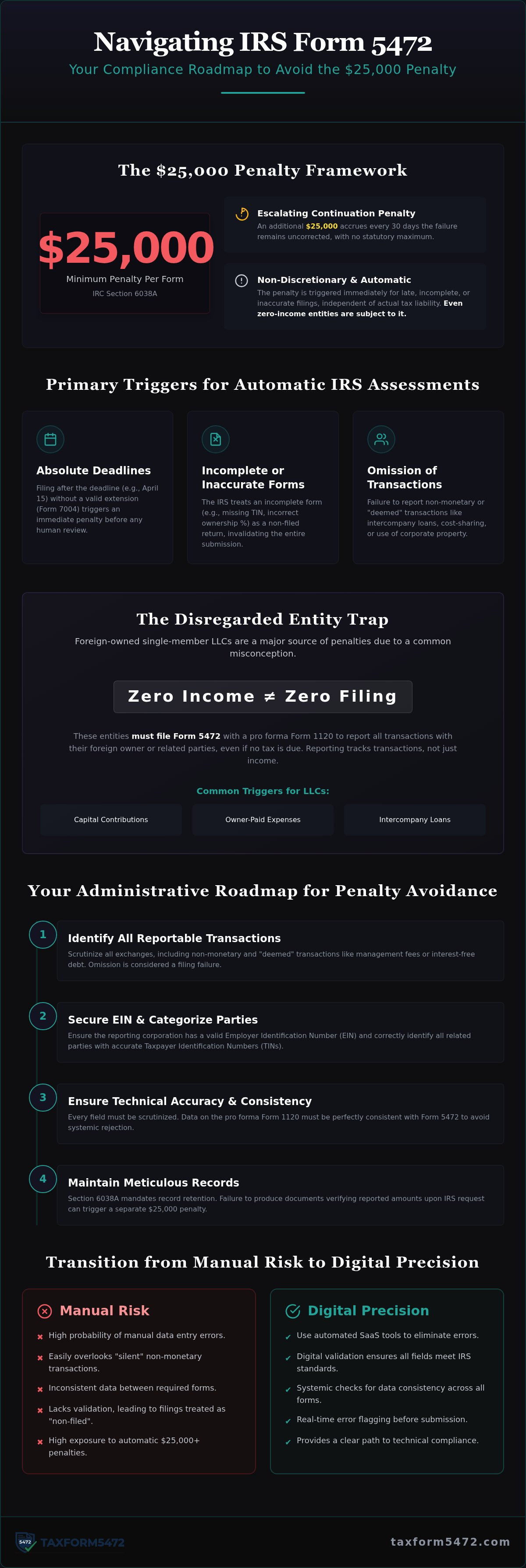
IRS Section 6038A establishes the regulatory foundation for foreign-owned US corporations. The primary enforcement mechanism is a $25,000 minimum penalty per form. This assessment isn't a suggestion. It applies to late, incomplete, or technically inaccurate filings. Precision is the only defense. Risk multiplies for entities with multiple reportable transactions or various related parties. Each missing form or disclosure triggers a separate $25,000 charge. The IRS maintains a strict zero-tolerance policy for international reporting failures.
Financial impact often exceeds the initial assessment. An IRS notice of failure starts the clock. A continuation penalty of $25,000 accrues every 30 days the failure remains uncorrected. No statutory maximum exists. A single oversight can escalate into a six-figure liability within months. Understanding how to avoid form 5472 penalties requires a technical grasp of these compounding risks. The IRS doesn't require proof of tax evasion to levy these amounts. Failure to report is the only evidence needed.
Non-Discretionary Nature of Assessments
IRS systems use automatic triggers. Penalties occur immediately upon late receipt. The assessment is independent of actual tax liability. You might owe zero tax and still face the $25,000 charge. The IRS treats an incomplete form as non-filed. Missing a single mandatory field invalidates the entire submission. Key triggers for automatic assessment include:
- Missing Taxpayer Identification Numbers (TIN) for related parties.
- Omission of small transactions below internal materiality thresholds.
- Errors in describing foreign owner relationships or ownership percentages.
- Submission without the required pro forma corporate return (Form 1120).
- Inconsistent data between the pro forma return and Form 5472.
Disregarded Entity Exposure in 2026
Foreign-owned single-member LLCs are disregarded entities. These entities must file Form 5472 attached to a pro forma Form 1120. Many owners overlook this requirement. They assume zero income equals zero filing. This is a critical error. Reporting tracks transactions, not just tax. Simple capital contributions or owner-paid expenses trigger the filing mandate. Documentation must be absolute. Digital preparation tools ensure data meets 2026 standards. Professional software provides a clear path on how to avoid form 5472 penalties through technical accuracy. For 2026, every foreign-owned disregarded entity must submit Form 5472 to report all transactions with its foreign owner or related parties.
Primary Triggers for Automatic IRS Assessments
The IRS identifies non-compliance through systemic data matching. Deadlines are absolute. Filing after April 15 without a valid extension triggers the $25,000 assessment immediately. This happens before any human review. Precision is the only defense. Understanding how to avoid form 5472 penalties requires strict adherence to the tax calendar. Secure Form 7004 extensions early to prevent automated flags.
Non-monetary transactions often escape notice during manual preparation. These are "silent" triggers. Cost-sharing arrangements, intercompany loans, and the use of corporate property are reportable. If a foreign parent company pays a US subsidiary's insurance premium, a reportable transaction has occurred. It must be disclosed in Part IV. Omission constitutes an incomplete filing. The IRS views these "deemed" transactions as significant data points for international tax enforcement.
Ownership data must be precise. The IRS cross-references ownership percentages with previous filings and international disclosures. Inaccurate identifiers for related parties create immediate red flags. If a related party's address or country code is missing, the form is deficient. Technical accuracy in these fields is mandatory. Every field in Part V must be scrutinized for consistency with the pro forma 1120. Even with zero-dollar values, certain disclosures remain necessary for compliance.
Technical Errors and Omissions
Part IV reporting requires granular categorization of monetary exchanges. Deemed transactions involve value transfers without actual cash movement. These are common in complex international structures. Management fees or interest-free debt often go unreported. Incorrect EINs or tax year designations on the pro forma return lead to systemic rejection. A rejected filing is legally equivalent to a non-filing. Utilizing an automated preparation interface helps eliminate these technical discrepancies through real-time validation checks before submission.
Record Maintenance Violations
Section 6038A mandates record retention for all reporting corporations. You must maintain documents that verify reported amounts and related-party relationships. The IRS can issue a summons for these records at any time. Failure to produce them within the specified window triggers a separate $25,000 penalty. This is additive to the filing penalty. Safe harbor record-keeping rules exist for entities with less than $10 million in US gross receipts. However, these rules don't exempt the entity from core reporting mandates. Maintain clear digital archives to mitigate audit risk.
Relief Mechanisms: Reasonable Cause and SCP Guidance
Systemic assessments require technical rebuttals. Abatement isn't a right; it's an administrative process. International forms like Form 5472 are generally excluded from the standard IRS First-Time Abatement (FTA) policy. This exclusion makes the reasonable cause standard the primary route for penalty reversal. Success depends on aligning your defense with IRS Internal Revenue Manual (IRM) guidelines. Learning how to avoid form 5472 penalties involves mastering these specific relief protocols before a notice arrives.
Small Corporation Provision (SCP) Criteria
Treasury Reg. 1.6038A-4 offers a specific path for smaller entities. This is the Small Corporation Provision (SCP). It provides a more liberal relief standard than general reasonable cause. To qualify, a corporation must have less than $20 million in US gross receipts for the year. The IRS also evaluates the total value of reportable transactions. If transactions are limited and the error was non-willful, the SCP allows for a penalty waiver. You must demonstrate a clean compliance history. No previous Section 6038A penalties should exist on the entity's record. This provision serves as a technical safe harbor for minor reporting discrepancies.
Establishing Reasonable Cause
Reasonable cause requires a showing of good faith. You must prove that the failure wasn't due to willful neglect. The IRS evaluates whether you acted with ordinary business care and prudence. Reliance on professional advice or specialized compliance software is a strong factor. If you used an automated preparation platform and an error occurred, document the technical effort made to comply. Keep records of all communication with tax professionals. The core evidence needed for a reasonable cause statement is a detailed chronological narrative supported by third-party documentation that proves the taxpayer acted in good faith despite the filing failure.
Delinquent International Information Return Submission Procedures (DIIRSP) provide another option. This path is for taxpayers who haven't been contacted by the IRS regarding the missing form. You must file the delinquent return with a reasonable cause statement attached. This protocol can stop the $25,000 assessment before it starts. It's a proactive measure. Waiting for an IRS notice usually eliminates this option. Technical compliance is the only way to ensure long-term asset protection. Use these mechanisms to rectify past errors and establish a clean record for 2026.
Administrative Protocol for Penalty Avoidance
Compliance follows a strict timeline. It requires early initialization. Secure a valid Employer Identification Number (EIN) well before the filing window opens. Finalize related party identification by Q1. This ensures sufficient time for technical data verification. Learning how to avoid form 5472 penalties starts with a disciplined administrative calendar. If data collection stalls, file Form 7004 immediately. This grants an automatic 6-month extension. You must submit this request by the original April 15 deadline. Late extension requests are invalid and provide no protection from assessments.
Standardized digital workflows protect data integrity. Manual entry increases the risk of transposition errors. These errors trigger the same $25,000 penalty as a total failure to file. Maintain a central repository for all intercompany agreements. Consistency across tax years is vital for IRS risk profiles. Sudden changes in ownership structure or transaction types require immediate documentation updates. Every transaction must have a corresponding digital record that matches the reported amounts exactly.
Pre-Filing Data Collection
Categorize every transaction accurately. Distinguish between monetary exchanges and non-monetary cost-sharing arrangements. Verify foreign owner addresses and foreign tax identification numbers against official documents. Inaccurate data in these fields leads to systemic rejection. Review the IRS Form 5472 filing guide for a technical breakdown of mandatory fields. Ensure every related party's legal name matches their official foreign registration. Discrepancies in naming conventions often cause processing delays or automated flags.
Filing Mechanics for Foreign Owners
Foreign-owned LLCs face unique filing logistics. You must attach Form 5472 to a pro forma Form 1120. This pro forma return acts as a cover sheet. It identifies the entity but reports zero income if no US trade or business exists. Leave most lines on the 1120 blank. Only complete the identifying information and the "foreign-owned disregarded entity" checkbox. Submission protocols for disregarded entities typically involve faxing or mailing to specific IRS service centers. These centers differ from standard corporate filing locations.
Always confirm receipt. Maintain proof of timely submission. Keep certified mail receipts or fax confirmation logs in a permanent compliance file. This documentation is your primary defense during an IRS inquiry. Digital submission through an automated preparation platform is the most efficient method to ensure technical accuracy. It eliminates the risks associated with physical mail and manual processing. Start your Form 5472 preparation today to secure your entity against 2026 penalties.
Automated Preparation for Technical Compliance
Technical precision is the only absolute defense against IRS assessments. Manual data entry introduces systemic risk into the compliance process. SaaS platforms eliminate these human variables by providing a controlled, logic-based environment for form preparation. Every field on Form 5472 requires specific formatting and valid identifiers. Automated systems identify discrepancies before submission. This technical oversight is the most efficient method for how to avoid form 5472 penalties in 2026. Transitioning from spreadsheets to a dedicated digital interface secures your entity against the $25,000 non-compliance assessment.
Validation checks are the core of automated compliance. These systems ensure all mandatory fields are populated according to IRS specifications. If a foreign taxpayer identification number (TIN) or a specific country code is missing, the platform prevents submission. This prevents the "incomplete filing" trigger that leads to automatic penalties. Digital record-keeping also simplifies the administrative burden. Centralized archives allow for instant retrieval of supporting documents. This capability is critical if the IRS issues a summons for records as discussed in previous sections. It's a professional, cost-effective alternative to traditional manual preparation models.
Software vs. Manual Compliance
Risk profiles differ significantly between manual and automated workflows. Manual preparation by a CPA often involves high hourly costs and potential data transposition errors. Software utilizes standardized digital filing workflows to maintain data integrity across multiple tax years. Review the detailed form 5472 cpa vs software analysis to understand these risk factors. Entities with multiple reportable transactions see the greatest efficiency gains. Automation handles complex intercompany exchanges with higher accuracy than manual entry. It ensures that "deemed" transactions aren't overlooked in the reporting cycle.
Securing Your 2026 Filing
Immediate initialization is required for the 2026 tax year. Register your entity on a secure platform now. Input your related party data and categorize your intercompany agreements early in Q1. This proactive approach allows for technical verification well before the April deadline. Foreign-owned disregarded entities face unique scrutiny and must ensure their pro forma 1120 is technically perfect. Don't risk a $25,000 assessment on a manual oversight. Use a precise tool designed for international tax requirements. Prepare your Form 5472 online to guarantee your compliance status and eliminate filing errors.
Secure Your 2026 Compliance Status
IRS enforcement of Section 6038A is systemic and uncompromising. The $25,000 penalty applies regardless of tax liability or intent. Success depends on technical precision and strict adherence to the filing calendar. You've identified the primary triggers and administrative protocols necessary for professional protection. Implementing these strategies is the only proven method for how to avoid form 5472 penalties. Precision in reporting "deemed" transactions remains a critical defense against automated assessments.
Manual filing is a high-risk strategy for foreign owners. Transposition errors and missing fields lead to immediate rejection and subsequent fines. Utilize a compliance-focused SaaS to streamline your international ownership structure. Our digital filing interface provides automated validation checks to ensure every mandatory field meets current IRS standards. It's a precise IRS Form 5472 automation tool designed for foreign-owned entities and disregarded LLCs. Automate your Form 5472 compliance to avoid penalties. Professional preparation ensures your focus remains on global operations rather than administrative risk. Compliance is a technical standard. Maintain yours with quiet confidence.
Frequently Asked Questions
Can I get a Form 5472 penalty waived for a first-time mistake?
Generally, no. Standard First-Time Abatement policy does not apply to international information returns. Relief requires establishing reasonable cause or meeting the Small Corporation Provision criteria. The IRS considers these forms high-priority for international tax enforcement. Proving good faith and a lack of willful neglect is the primary path for a waiver. Documentation must show that the error was non-willful and corrected immediately upon discovery.
How do I request an abatement of Form 5472 penalties?
Submit a written statement explaining the reasonable cause for the failure. Include a signed declaration under penalties of perjury. Detail the specific facts showing you acted with ordinary business care and prudence. Attach supporting documentation like communication logs or professional advice records. This process is essential for learning how to avoid form 5472 penalties after an assessment has been issued by the IRS.
What is the Small Corporation Provision for penalty relief?
It is a liberal relief standard defined under Treasury Reg. 1.6038A-4 for entities with limited US gross receipts. Qualifying corporations must have less than $20 million in US gross receipts for the tax year. The IRS evaluates the total value of reportable transactions and the entity's compliance history. This provision allows for penalty waivers for minor or non-willful errors if the corporation has no previous Section 6038A violations.
Does the IRS offer an extension for Form 5472 filing?
Yes, you can obtain an automatic six-month extension by filing Form 7004. You must submit this request by the original filing deadline, typically April 15. The extension applies to the corporate tax return and the attached Form 5472. Late extension requests are not accepted. Securing this additional time is a fundamental step in how to avoid form 5472 penalties caused by late submissions.
What happens if I file Form 5472 with missing information?
The IRS treats an incomplete form as a failure to file. Missing a single mandatory field, such as a Taxpayer Identification Number or a description of a reportable transaction, triggers the $25,000 penalty. The assessment occurs automatically through systemic data matching. Inaccurate related-party data or incorrect ownership percentages also invalidate the submission. Technical accuracy is mandatory for all international information returns. Precision is the only defense.
How much is the late filing penalty for Form 5472 in 2026?
The initial penalty is $25,000 per form for late, incomplete, or inaccurate filings. If the failure continues for more than 90 days after IRS notification, additional continuation penalties apply. The IRS assesses an extra $25,000 for every 30-day period of non-compliance. There is no statutory maximum for these cumulative assessments. Maintaining a strict compliance calendar is the only way to prevent these compounding financial risks.
Is a foreign-owned LLC with no income exempt from penalties?
No, foreign-owned disregarded entities have a strict filing mandate regardless of taxable income. Reporting requirements focus on transactions between the entity and its foreign owner or related parties. Capital contributions, owner-paid expenses, and intercompany loans are all reportable events. Failure to file the Form 5472 with a pro forma Form 1120 results in the standard $25,000 assessment. Income level does not dictate reporting obligations.
What evidence is required for a reasonable cause defense?
Provide a chronological narrative of the compliance effort. Include evidence of reliance on professional tax advice or specialized software platforms. Document any external factors that prevented timely or accurate filing. Proof of internal controls and standard business procedures supports the claim of ordinary business care. The IRS requires specific, third-party documentation to verify that the reporting failure was not due to willful neglect or lack of effort.