
A single missing digit on your information return can lead to common form 5472 filing mistakes that trigger an automatic $25,000 penalty. The IRS no longer waits for manual audits. Their systems flag incomplete forms instantly. It's a significant financial risk for a clerical error. IRS instructions for non-residents are complex. Reportable transaction definitions remain a primary source of confusion. Precision is the only defense against automated enforcement.
This article identifies frequent errors to help you safeguard your foreign-owned US entity. You'll learn how to verify your filing requirements and streamline your process before the April 2026 deadline. We'll examine the disregarded entity trap, the necessity of pro-forma 1120 filings, and the broad range of transactions that require reporting. Use this list to verify your structure and ensure your next submission is accurate.
Key Takeaways
- Identify the $25,000 flat penalty for omissions and how it compounds across related entities.
- Clarify mandatory reporting obligations for inactive or dormant foreign-owned LLCs with zero revenue.
- Define reportable transactions beyond cash transfers to include non-monetary exchanges and services.
- Avoid common form 5472 filing mistakes by adhering to IRS substantial completeness standards.
- Streamline 2026 compliance using automated preparation tools to eliminate manual data entry errors.
IRS Compliance: The $25,000 Penalty Reality
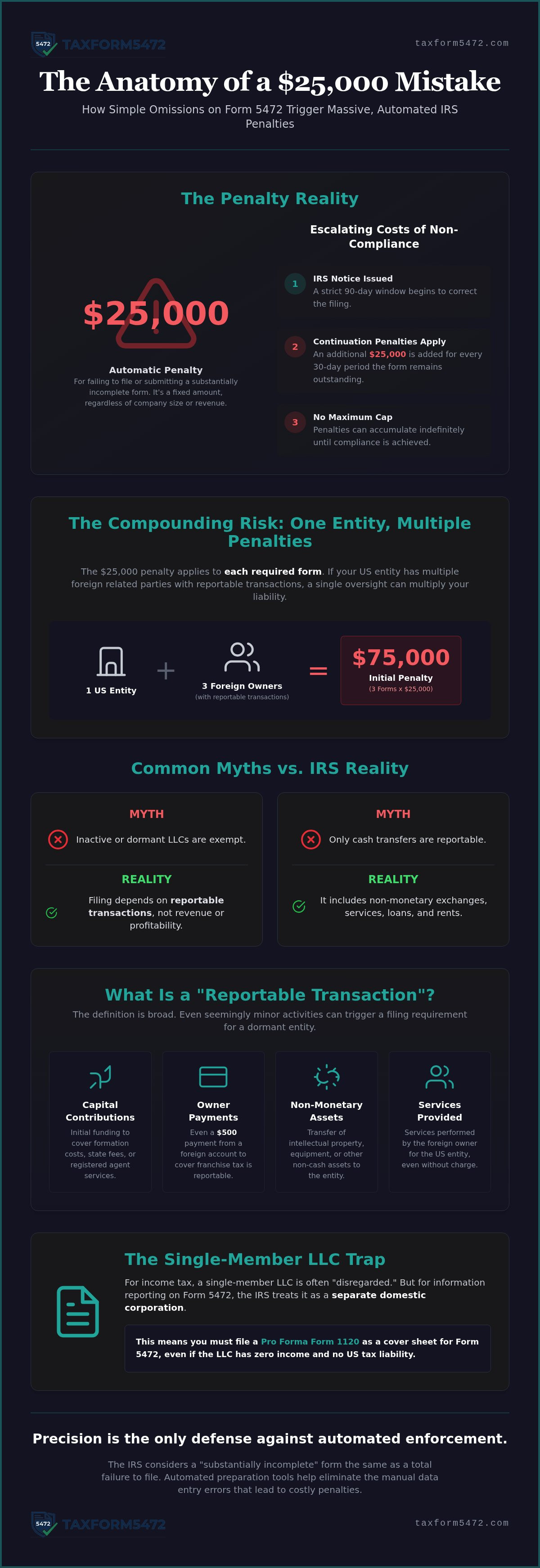
The IRS treats Form 5472 as a primary enforcement tool for international tax transparency. Failing to file this return, or submitting a substantially incomplete one, triggers an automatic $25,000 penalty. This amount is fixed. It doesn't vary based on company size or revenue. Even a dormant LLC with zero US income falls under these requirements. Many form 5472 filing mistakes occur when owners assume small errors are negligible. The IRS considers an incomplete form equivalent to a total failure to file.
The Cost of Non-Compliance
The initial $25,000 assessment is the baseline. If the failure isn't corrected within 90 days of an IRS notice, continuation penalties apply. The IRS adds $25,000 for every 30-day period the form remains outstanding. There's no maximum cap for these assessments. For the 2026 tax year, the IRS has deployed automated tools to cross-reference data and flag missing returns. These systems identify non-compliance without manual intervention. You can find specific filing steps in our Avoiding Form 5472 Penalties: 2026 Compliance Guide.
The 90-day window begins the moment the IRS mails a notice of failure. It's a strict deadline. If you don't respond with a complete and accurate filing, the automated penalty cycle begins. This cycle adds $25,000 for each month or fraction of a month that the failure continues. Waiting for a second notice is a costly error. Prompt action is the only way to halt escalating costs.
Compounding Risks for Multiple Owners
Financial exposure increases with the number of foreign related parties. A single US corporation may need to file multiple forms for one tax year. A reporting corporation is generally any US entity that is at least 25% foreign-owned. A related party includes any 25% foreign shareholder or any person related to that shareholder. Identifying these relationships is a critical step in the compliance process.
If your US entity has three foreign owners and you fail to report transactions with all of them, the initial penalty is $75,000. Each form carries its own set of continuation penalties. Mistakes often happen when owners fail to identify every related party involved in reportable transactions. These transactions include loans, rents, and capital contributions. Missing one party creates a separate $25,000 liability. Precision in identifying these relationships is necessary to prevent compounding penalties.
Myth: Inactive Entities and Dormant LLCs Are Exempt
Revenue is not the metric for compliance. The IRS mandate for Form 5472 depends on the existence of reportable transactions, not profitability or active trade. An inactive entity remains subject to Section 6038A regulations. If a foreign-owned US entity exists, it must evaluate its filing status annually. Assuming that a "dormant" status provides a safe harbor is one of the most common form 5472 filing mistakes. The IRS doesn't recognize a lack of activity as a valid reason for non-disclosure if a single transaction occurred during the tax year.
Disregarded Entity Reporting Requirements
Single-member LLCs are typically disregarded for federal income tax purposes. However, for information reporting, the IRS treats them as domestic corporations. This distinction is critical. You must file a Pro Forma Form 1120 to serve as a cover for Form 5472. Non-resident founders often overlook this because they don't have a US tax liability or a physical presence. The IRS instructions for Form 5472 explicitly state that these entities must report transactions with their foreign owners, regardless of income levels. Relying on an automated Form 5472 preparation service helps ensure these structural nuances are handled correctly.
Founders often wait until they've made their first sale to consider tax compliance. This delay is a mistake. The reporting requirement is triggered by the entity's classification and its relationship with foreign owners. If your LLC is 100% owned by a non-US person, it's a reporting corporation. The obligation to file exists as long as there is at least one reportable transaction. Even if the business never launches, the formation itself often involves reportable events.
The Capital Contribution Trigger
Initial funding is a primary trigger for reporting. When a foreign owner transfers cash to a US LLC to cover formation costs, state filing fees, or registered agent services, they've conducted a reportable transaction. This applies to non-monetary assets as well. Intellectual property, equipment, or even services provided by the owner without charge must be documented. These are considered capital contributions. They fall under the category of "amounts paid or received in connection with the formation" of the entity.
Consider a standard scenario. A founder establishes a Delaware LLC but decides not to move forward with the project. The entity generates $0 in revenue. However, the founder paid $500 from a personal foreign account to cover the state's annual franchise tax. That $500 payment is a capital contribution. It's a reportable transaction. Failing to file Form 5472 for this $500 event results in a $25,000 penalty. The IRS doesn't care that the business was "unused." The discrepancy between the transaction value and the penalty is extreme. Precision during the setup phase is the only way to avoid these form 5472 filing mistakes.
Myth: Only Cash Transfers Are Reportable Transactions
The IRS defines reportable transactions broadly. It isn't just about bank wire transfers. Section 482 covers any exchange of value between a US entity and its 25% foreign owners. If you ignore non-cash items, you're making one of the most expensive form 5472 filing mistakes. The $25,000 penalty applies to the failure to report these "invisible" exchanges just as strictly as it does to cash. The reporting obligation starts the moment a foreign person or entity owns at least 25% of the voting power or value of the US corporation's stock.
Common Monetary Transactions
Standard business operations often trigger a filing. Buying inventory from a foreign parent is a primary example. Loan principal and interest payments are also mandatory to report. Management fees, royalties for using a brand name, and equipment purchases fall into this category. The IRS Instructions for Form 5472 provide a complete list of these specific line items. Accuracy here is vital. Even if the transaction is at market value, it's a disclosure requirement. Don't assume that an "at-cost" sale exempts you from the filing requirement.
The Invisible Transactions: Non-Monetary Exchanges
The biggest risk lies in transactions where no money changes hands. The IRS looks for "deemed" transactions. If a foreign owner provides accounting or administrative services to the US LLC for free, that service has a market value. It's a reportable transaction. Using a foreign parent's proprietary software or trademarks without a license fee is another frequent trigger. These are often missed because there's no paper trail in the bank statements. They're invisible to traditional bookkeeping but visible to IRS auditors looking for form 5472 filing mistakes.
Valuation is mandatory for these exchanges. You must assign a fair market value to these services or assets. The IRS uses these figures to monitor for transfer pricing abuse. If a foreign entity allows its US subsidiary to use office space or equipment without charge, that's an exchange of value. Failing to quantify and report this leads to substantial completeness issues. Substantial completeness is the legal standard for a valid filing. If you omit these non-monetary items, the IRS treats the entire form as unfiled, triggering the automatic penalty cycle.
Requirement: Substantial Completeness Standards
Filing a Form 5472 is not a check-the-box exercise. The IRS applies a "substantial completeness" standard to every submission. If your form lacks critical data, it's legally equivalent to not filing at all. This triggers the same $25,000 penalty as a total failure to file. Many form 5472 filing mistakes stem from the belief that "close enough" is sufficient. It isn't. Automated IRS systems now scan for missing fields. Blank spaces or "N/A" entries in required sections trigger immediate flags. Accuracy is the only defense against automated assessments.
Identifying Substantial Omissions
Missing Taxpayer Identification Numbers (TINs) or Employer Identification Numbers (EINs) are primary triggers for rejection. You must provide the exact legal name and physical address of the foreign related party. Incorrectly classifying the relationship between the US entity and the foreign owner is another common error. Substantial completeness is the threshold where the IRS can reasonably verify tax liability. Omissions that prevent this verification invalidate the entire form. Using "estimated" numbers without a clear methodology is high-risk. The IRS expects precise figures derived from contemporaneous records. If you don't have exact values, you must document your estimation process to meet the reasonable cause exception.
Record Maintenance Obligations
Section 6038A requires reporting corporations to maintain permanent books of account or records. These records must be sufficient to establish the correctness of the federal income tax return. You must keep these records in the United States. Alternatively, you can agree to provide them within 30 to 60 days of an IRS request. Failure to produce these documents upon demand triggers the $25,000 penalty. This applies even if you filed the form on time. Poor record-keeping is often the root cause of form 5472 filing mistakes. You must track all exchanges of value throughout the year. This includes digital receipts, contracts, and transfer pricing documentation. Ensure your compliance by using a Form 5472 preparation tool to organize your data correctly.
The IRS enforcement trend for 2026 focuses on data consistency. They compare your Form 5472 data with other filings, such as the Beneficial Ownership Information (BOI) report. Discrepancies between these forms suggest a lack of substantial completeness. You have a limited window to respond to an IRS summons for records. Standard response times are often 30 days. Extensions are rare. If the IRS determines your records are non-existent or inaccessible, they'll assess the flat penalty per form, per year. Maintain a centralized digital archive of all foreign-related transactions to avoid this outcome.
Solution: Automated Preparation and Filing
Manual compliance is a high-risk strategy. Relying on manual data entry often leads to form 5472 filing mistakes that trigger automatic penalties. Traditional methods involve spreadsheets and manual cross-referencing. These processes lack real-time validation. Automated preparation platforms treat compliance as a data integrity task. They use algorithmic checks to ensure every field meets the substantial completeness standard. This shift from manual to digital reduces the likelihood of clerical errors that result in a $25,000 assessment.
Reducing Human Error with SaaS
SaaS platforms provide an interface designed for international ownership structures. They include built-in validation for EIN formats and foreign tax identification numbers. If a required field is blank, the system flags it immediately. This prevents the submission of an "incomplete" form. For complex groups with multiple related parties, automation maps these relationships digitally. It ensures that every 25% owner is accounted for without duplication or omission. You can compare these efficiencies in our guide on Form 5472 CPA vs. Software: Evaluating Compliance Risks and Costs.
Traditional CPA methods often involve high billable hours for data entry. Software eliminates this overhead. It focuses on accuracy through logic-based inputs. The system identifies reportable transactions based on your financial data. This includes the non-monetary exchanges that human preparers often miss. By automating the identification of capital contributions and "deemed" transactions, you remove the guesswork from your filing. Precision is built into the workflow.
Digital Filing Readiness
The 2026 tax year requires strict adherence to updated IRS logic. For calendar-year filers, the deadline is April 15, 2026. Automated tools track these deadlines and provide digital alerts. They also simplify the technical requirements for disregarded entities. The system automatically generates the necessary Pro Forma Form 1120. This document acts as the mandatory cover for your Form 5472. Without it, the IRS treats your filing as invalid. Automation ensures these documents are linked and formatted correctly for mail or fax submission.
Data security is a priority when handling sensitive foreign owner information. Professional platforms use encryption and secure storage to protect your records. This centralized archive also helps you meet the record maintenance obligations of Section 6038A. If the IRS requests documentation, your records are organized and accessible. This readiness is the most effective way to avoid form 5472 filing mistakes and the resulting financial exposure. Prepare your Form 5472 now to secure your 2026 compliance.
Secure Your 2026 Compliance Status
The IRS automated enforcement model for 2026 leaves no room for error. A single omission or an incorrect tax identification number triggers the flat $25,000 penalty. Dormant entities and non-monetary exchanges are not exempt from these reporting requirements. Substantial completeness is the only legal standard that protects your US entity from compounding assessments. Most form 5472 filing mistakes occur during manual data entry and complex relationship mapping. Relying on outdated manual processes increases your risk profile unnecessarily.
Precision is mandatory for international ownership structures. Our platform is built for 2026 IRS compliance standards and specializes in foreign-owned US entities. It streamlines Pro Forma 1120 generation to ensure your filing is technically valid. This automated approach reduces manual entry errors and ensures every field meets IRS data validation rules. Automate your Form 5472 preparation and avoid $25,000 mistakes.
Accurate filing is achievable with the right tools. Take control of your compliance strategy now to safeguard your US business. You can file with confidence and focus on your operations instead of penalty notices.
Frequently Asked Questions
Does a dormant US LLC need to file Form 5472?
A dormant US LLC must file if any reportable transaction occurred during the tax year. This includes initial capital contributions or payments for formation fees. The IRS does not exempt entities based on inactive status. If a foreign owner paid a state franchise tax, that is a reportable event. Failing to disclose this leads to significant form 5472 filing mistakes and a $25,000 penalty. Verify your transaction history to ensure compliance.
What is the penalty for filing Form 5472 late in 2026?
The penalty for late or incomplete filing in 2026 is $25,000 per form. Assessment is often automated. If the failure continues 90 days after IRS notification, additional $25,000 penalties apply every 30 days. There is no maximum limit. Accuracy is essential to avoid these systemic assessments. The IRS treats substantially incomplete forms as a total failure to file. Precision protects your entity from escalating financial liability and compounding costs.
Who is considered a 25% foreign shareholder for Form 5472?
A 25% foreign shareholder is any non-US person owning at least 25% of the voting power or value. This includes direct and indirect ownership. The IRS applies constructive ownership rules to determine these thresholds. You must look through holding companies to identify ultimate beneficial owners. Precise identification is required to avoid form 5472 filing mistakes regarding related party disclosures. Error in ownership mapping leads to automatic $25,000 assessments per party.
Can I get a Form 5472 penalty abatement for first-time mistakes?
First-time abatement is generally not available for Form 5472. You must demonstrate "reasonable cause" to waive the $25,000 assessment. The IRS may grant relief if you show good faith and a lack of willful neglect. Small corporations often receive liberal consideration for these exceptions. You must submit a detailed written statement explaining the circumstances. Verification of your specific situation is required to halt the penalty cycle and prevent further assessments.
What is a "reportable transaction" for a foreign-owned LLC?
Reportable transactions include any exchange of value between the US entity and its foreign owners. Common examples include:
- Inventory or equipment sales
- Loans and interest payments
- Capital contributions or distributions
- Rents and management fees
Non-monetary exchanges like free services or intellectual property use also trigger reporting. There is no minimum dollar threshold. A single transaction of any amount requires disclosure to avoid penalties.
Is an EIN required to file Form 5472?
A valid Employer Identification Number (EIN) is mandatory. You cannot file Form 5472 without this identifier. Foreign-owned disregarded entities must obtain an EIN specifically for the LLC. The IRS uses this number to track compliance and link data to the foreign owner. Filing with a missing or incorrect EIN results in an incomplete submission. This mistake triggers an automatic $25,000 penalty. Secure your EIN early to ensure filing readiness.
How do I file Form 5472 for a disregarded entity?
Foreign-owned disregarded entities must file by mail or fax. E-filing is not available for these structures. Attach Form 5472 to a pro-forma Form 1120. This simplified corporate return acts as a mandatory cover sheet. Complete only the basic entity information and the foreign-owned status checkbox on the 1120. Assembly errors lead to rejection. Precision in this manual process is necessary for a valid, penalty-free submission to the IRS.
What is the deadline for Form 5472 for the 2025 tax year?
The deadline for calendar-year filers is April 15, 2026. This applies to the 2025 tax year. File Form 7004 by the original due date to obtain an automatic 6-month extension. This moves the filing deadline to October 15, 2026. An extension to file does not extend tax payment deadlines. Missing these dates results in immediate penalty assessments. Prompt action is the most effective way to maintain compliance and avoid automated fines.