

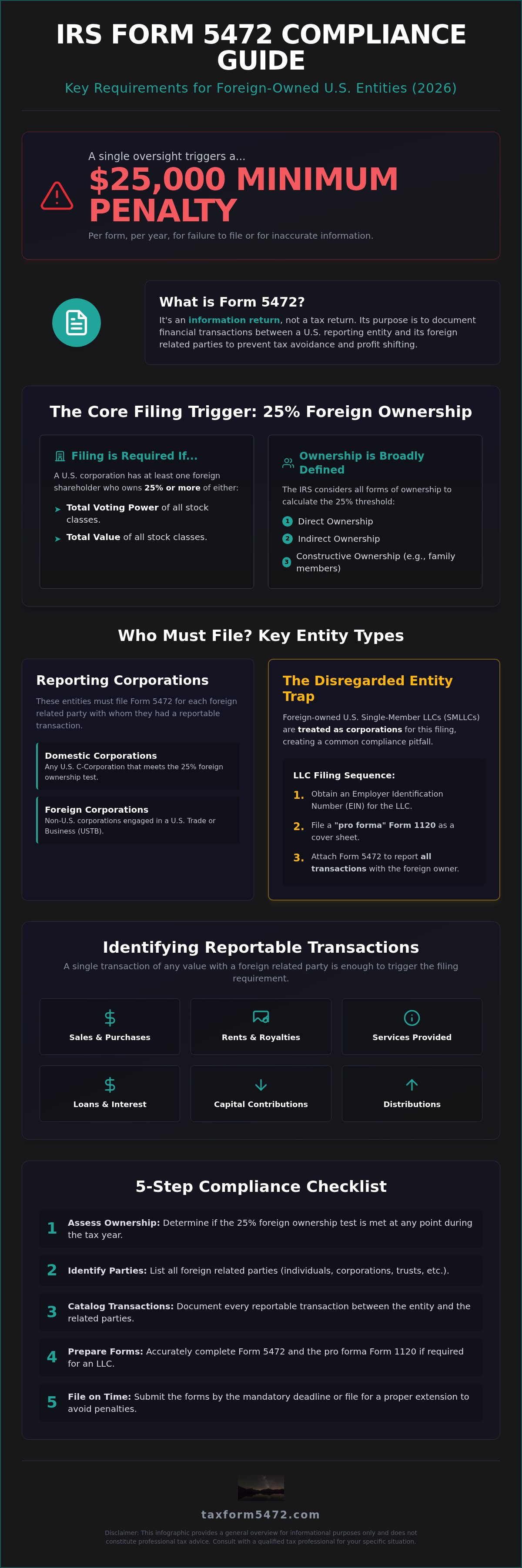
A single oversight in your tax filing now triggers a $25,000 minimum penalty. For foreign-owned U.S. entities, compliance isn't a suggestion; it's a binary state. IRS jargon is often dense and unnecessarily complex. You're likely dealing with significant uncertainty regarding your specific reporting obligations. We understand the need for precision. This guide provides a direct, technical breakdown of the 2026 form 5472 requirements to ensure your entity remains in good standing and avoids costly IRS scrutiny.
We've stripped away the filler. This article delivers a clear checklist of filing criteria for foreign-owned corporations and disregarded entities. You'll gain a functional understanding of the 25% ownership rule. We'll categorize reportable transaction types with absolute clarity. We'll also confirm the mandatory deadlines, extension protocols, and filing methods for the upcoming cycle. This is a utilitarian resource for results-oriented professionals. No long-winded introductions. No descriptive filler. Just the data you need for 2026 compliance. Expect efficiency. Expect accuracy. Let's get to work.
Key Takeaways
- Identify 25% foreign ownership thresholds and specific form 5472 requirements for 2026.
- Categorize reportable transactions, including sales, rents, and royalties, to ensure complete disclosure.
- Verify mandatory deadlines and extension protocols to mitigate the $25,000 non-compliance penalty.
- Streamline filing using automated preparation tools to eliminate manual entry errors.
Understanding IRS Form 5472 and Section 6038A
Form 5472 is a specialized compliance instrument. It's an information return, not an income tax return. It documents financial interactions between U.S. reporting corporations and foreign related parties. The legal authority for this reporting originates from Internal Revenue Code Sections 6038A and 6038C. These sections provide the IRS with the necessary data to monitor cross-border capital flows. The goal is simple: prevent tax avoidance through profit shifting. Both domestic corporations and foreign corporations engaged in a U.S. trade or business (USTB) must comply. For a detailed history of the form's implementation and use, the Form 5472 Wikipedia page offers a comprehensive background on its regulatory evolution.
The 25% Foreign Ownership Threshold
A reporting corporation is defined by a specific ownership stake. The threshold is 25%. This applies if one foreign person owns at least 25% of the total voting power or the total value of all stock classes. The IRS looks at the highest percentage to determine status. Calculations aren't limited to direct holdings. Direct, indirect, and constructive ownership rules are all in play. Under constructive ownership, shares held by family members or affiliated entities are attributed to the primary foreign owner. This ensures that ownership isn't fragmented to bypass the 25% trigger. Once this threshold is met, the form 5472 requirements become mandatory for every reportable transaction occurring during the tax year. Compliance is a binary state based on these specific percentages.
Foreign Disregarded Entities (DDEs)
Foreign-owned single-member LLCs face unique rules. These are typically domestic disregarded entities. For standard income tax purposes, they're often invisible. For reporting, the IRS treats them as domestic corporations. This ensures transparency for foreign owners using U.S. structures. Every DDE must obtain an Employer Identification Number (EIN). You can't file without one. Even if the entity has no U.S. tax liability, it must file a "pro forma" Form 1120 with Form 5472 attached. The definition of a "foreign person" is broad. It includes individuals, partnerships, trusts, and estates. If you own 100% of a U.S. LLC as a non-resident, these form 5472 requirements apply to you directly. The focus remains on the movement of money, property, or services between the entity and its owner. There are no minimum dollar amounts to trigger this obligation; a single transaction is sufficient.
Entity-Specific Filing Requirements and Criteria
Filing status depends on entity classification and ownership structure. The IRS identifies two primary groups: domestic and foreign reporting corporations. If your entity fits these profiles, form 5472 requirements apply immediately. Compliance is mandatory for each foreign related party involved in a reportable transaction. Accuracy is the only way to mitigate risk.
- Domestic Reporting Corporations: Any U.S. C-Corporation with at least 25% foreign ownership.
- Foreign Reporting Corporations: Non-U.S. entities engaged in a U.S. Trade or Business (USTB).
- Exceptions: These are rare. You don't file if no reportable transactions occurred. Small corporations with minimal assets may have specific safe harbors. Consult IRS Form 5472 Information for technical exemption criteria.
U.S. Corporations with Foreign Shareholders
Standard C-Corporations must track ownership changes throughout the tax year. If a foreign shareholder's stake reaches 25% at any point, the obligation is triggered. This includes direct and indirect holdings. You must identify all "Related Parties." This definition follows Section 267(b) or 707(b)(1). It covers family members, partners, and affiliated corporations. Every transaction between the U.S. corp and these parties is reportable. Don't assume small dollar amounts are exempt. The IRS requires disclosure regardless of the transaction's size. Precise identification of these relationships is the first step in meeting form 5472 requirements for the 2026 cycle.
Reporting for Foreign-Owned Disregarded Entities
Foreign-owned single-member LLCs (SMLLCs) face strict oversight. These are typically "disregarded entities" for income tax. For reporting, the IRS treats them as domestic corporations. This is a common compliance trap. You must follow a specific administrative sequence. First, obtain a U.S. Tax ID (EIN) for the LLC. You can't use your personal SSN or ITIN for this filing. Second, prepare a pro-forma Form 1120. This document acts as a cover sheet. It carries no tax data but links the LLC to the Form 5472. Third, disclose all transactions with the foreign owner. This includes capital contributions and withdrawals. Using automated preparation tools can standardize this data entry. It ensures the pro-forma 1120 and Form 5472 are synchronized. This reduces the risk of manual filing errors that lead to IRS inquiries.
Identifying Reportable Transactions and Monetary Limits
A reporting obligation doesn't exist in a vacuum. It requires a reportable transaction. If your entity has no financial or operational interactions with its foreign related parties, you don't file. This scenario is rare for active businesses. Most cross-border structures involve regular movement of capital, services, or goods. Identifying these triggers is central to meeting form 5472 requirements. There's no minimum dollar threshold. A single transaction of any value triggers the full disclosure mandate. Accuracy here is the only way to avoid the $25,000 failure-to-file penalty.
The IRS categorizes these interactions into monetary and non-monetary buckets. Monetary transactions are straightforward. They involve the direct exchange of cash or credit. Non-monetary transactions are more complex. They include any exchange of value that isn't cash, such as bartered services or the use of intellectual property. Both types carry the same weight. Precision in Part IV and Part VI of the form is non-negotiable. You must report the total dollar amount for each category of transaction with each related party.
Common Monetary Transaction Types
Most filings focus on routine business operations. These are easily tracked via accounting software but must be categorized correctly. Reportable monetary transactions include:
- Inventory and Property: Sales or purchases of stock, raw materials, and equipment.
- Operational Fees: Management fees, technical service payments, and commissions paid to related parties.
- Rents and Royalties: Payments for the use of tangible property or intangible assets like trademarks.
- Financial Flows: Principal amounts and interest paid on intercompany loans.
Small errors in these categories often lead to audits. Ensure every payment matches your internal ledger and foreign bank statements. If you've paid insurance premiums to a foreign related party, those are also reportable in this section.
Non-Monetary and Deemed Transactions
This area represents the highest risk for non-compliance. The IRS requires disclosure even when no money changes hands. If a foreign parent provides administrative services to a U.S. subsidiary without charging a fee, it's a reportable event. Intellectual property transfers and cost-sharing arrangements also fall under this umbrella. For foreign-owned U.S. LLCs, "deemed" transactions include capital contributions and distributions. If you move personal funds into the business bank account, it's a reportable transaction. These form 5472 requirements ensure the IRS can track the entity's total economic activity. Don't overlook transactions that don't appear on a standard P&L statement. If it affects U.S. taxable income, it's reportable.
Filing Deadlines and the $25,000 Penalty Risk
Timing is a critical factor. Form 5472 isn't a standalone submission. You must file it as an attachment to the entity's income tax return, typically Form 1120. Missing the 1120 deadline means missing the 5472 deadline. Compliance is absolute. If you've identified that your entity meets the form 5472 requirements, your primary focus must shift to the internal calendar. Precision in timing prevents unnecessary IRS inquiries.
Deadlines for the 2026 Tax Year
For calendar-year entities, the filing deadline is April 15, 2026. This date covers the 2025 tax year. If your entity operates on a fiscal year, the deadline is the 15th day of the 4th month following the close of your tax year. Weekends and federal holidays shift these dates to the next business day. In 2026, April 15 falls on a Wednesday. No shifts apply for the standard deadline. The October extension deadline also remains standard for 2026.
Extensions are available. File Form 7004 before the original deadline to secure an automatic 6-month extension. This moves your filing requirement to October 15, 2026. An extension to file is not an extension to pay taxes. However, since Form 5472 is an information return, the extension primarily provides additional time for data gathering and related party identification. Meeting form 5472 requirements requires proactive planning.
Penalty Escalation and Abatement
Financial stakes are high. The minimum penalty for failure to file or filing an incomplete form is $25,000. The IRS doesn't distinguish between a missing form and one with missing data. Both trigger the same fine. Accuracy in reporting transactions is as vital as the filing date itself. A single omitted related party transaction can lead to the full penalty amount.
Penalties escalate quickly. If the IRS notifies you of a failure and you don't correct it within 90 days, additional charges apply. You'll face a $25,000 penalty for each 30-day period of non-compliance. There's no maximum cap on these ongoing fines. The cost of non-compliance can easily exceed the value of the underlying transactions.
Abatement is difficult but possible. You must demonstrate "reasonable cause" for the failure. The IRS evaluates if you exercised ordinary business care and prudence. Ignorance of the law or reliance on a third party without oversight rarely qualifies. For 2026, the IRS continues to maintain strict scrutiny over international transparency. Eliminate the risk of manual errors and late submissions. Use automated IRS Form 5472 preparation to ensure your filing is precise and on time.
Automated Compliance: Streamlining Form 5472 Preparation
Manual filing is a high-risk strategy. The complexity of related party identification often leads to technical errors. These mistakes trigger the $25,000 penalty discussed previously. Digital platforms eliminate this volatility. They standardize data entry for Part IV transactions. This ensures every reportable interaction is captured. SaaS solutions also automate the generation of necessary attachments. This includes the mandatory pro-forma Form 1120 for disregarded entities. Electronic filing provides an immediate audit trail. You get instant confirmation of receipt. There's no uncertainty about delivery. You maintain a digital record for future audits.
Efficiency is a requirement, not an option. Traditional methods rely on manual spreadsheets. These are prone to version control issues and formula errors. A specialized SaaS platform creates a centralized environment for your data. It applies consistent logic across all filing years. This historical continuity is essential for tracking long-term intercompany loans and interest payments. It ensures your 2026 submission aligns with previous filings. Discrepancies often trigger IRS flags. Automation removes this risk by maintaining a single source of truth for your corporate structure.
Benefits of Digital Filing Software
Precision is the primary advantage. Calculating 25% ownership isn't always simple. Constructive ownership rules add layers of complexity. Software handles these calculations automatically. It applies the rules to your specific structure. This ensures you meet all form 5472 requirements without manual guesswork. Validation checks prevent the submission of incomplete forms. You can't skip critical fields. This protection is vital for the 2026 cycle. Time efficiency is another factor. Digital preparation is significantly faster than traditional CPA methods. It allows results-oriented professionals to focus on operations rather than administrative jargon. It's a precise tool for a specific task.
Executing Your 2026 Filing
Success requires organization. Start by gathering your entity data. You'll need the EIN and complete ownership details. Identify every foreign related party. Next, compile all transaction amounts for the 2025 tax year. This includes monetary and non-monetary exchanges. Once your data is ready, input it into the system. The platform will categorize transactions based on current form 5472 requirements. Review the final output for accuracy. Submit the filing electronically. This process minimizes exposure to IRS scrutiny. It turns a complex legal obligation into a streamlined task.
Ready to secure your compliance? Prepare and file your Form 5472 automatically. Efficiency is just a click away.
Securing Your 2026 Tax Compliance
Compliance is a binary state. You're either protected or exposed. The $25,000 failure-to-file penalty is a significant operational risk for any foreign-owned U.S. entity. Precision is the only mitigation strategy. This guide outlined the specific form 5472 requirements for the 2026 cycle. You must identify related parties. You must categorize every reportable transaction. You must meet the April 15 deadline without exception.
Manual filing increases the margin for error. SaaS-driven precision offers a streamlined alternative. It ensures global compliance support while eliminating the risks of incomplete submissions. Digital tools provide an immediate audit trail and standardized data entry. Transition from manual uncertainty to automated accuracy. Automate your Form 5472 filing now to secure your standing with the IRS. Efficiency leads to results. Stay focused on your core business operations while we handle the technical filing details. Your 2026 compliance status is a priority. Secure it today.
Frequently Asked Questions
Is Form 5472 required if the company had no income?
Yes, income level doesn't dictate filing status. Reportable transactions trigger the obligation. If a foreign owner contributes capital or pays entity expenses, you must file. These interactions often occur during pre-revenue stages or years with net losses. Meeting form 5472 requirements depends on economic activity, not profitability. Don't assume a $0 tax liability or lack of sales exempts you from these strict informational reporting mandates.
What is the penalty for not filing Form 5472 in 2026?
The initial penalty is $25,000 for the 2026 tax cycle. This fine applies to each late or incomplete form. If the IRS issues a notice and you don't comply within 90 days, the fine increases. You'll face an additional $25,000 for every 30-day period of continued non-compliance. There's no maximum limit on these cumulative penalties.
Can I file Form 5472 without a U.S. EIN?
No, you can't file without a valid Employer Identification Number (EIN). The reporting corporation must have its own U.S. tax ID. This applies even to foreign-owned disregarded entities that don't pay income tax. Obtain an EIN before the filing deadline to ensure compliance. You cannot use a foreign tax ID or a personal Social Security Number for the entity's filing.
Does a foreign-owned LLC have to file Form 5472 every year?
Yes, filing is an annual requirement if reportable transactions occur. Most active foreign-owned LLCs have recurring interactions with their owners. These include capital injections, withdrawals, or payment of business expenses by the owner. If no reportable transactions happen during the tax year, the filing isn't required. However, such instances are rare for operating businesses.
What is considered a "related party" for Form 5472 purposes?
A related party includes any 25% foreign shareholder. It also covers any person or entity related to the reporting corporation under Section 267(b) or 707(b)(1). This encompasses family members and affiliated companies. The definition is broad to prevent tax avoidance through indirect relationships. Identifying these parties is essential to satisfy form 5472 requirements correctly.
How do I request an extension for Form 5472?
Submit IRS Form 7004 to request an automatic extension. You must file this before the original April 15 deadline for calendar-year entities. This grants an additional six months to complete the filing. The new deadline becomes October 15. This extension applies to the entire tax return, including the attached Form 5472. It doesn't extend the time to pay taxes owed.
Is Form 5472 filed separately from the main tax return?
No, Form 5472 isn't a standalone filing. You must attach it to the entity's U.S. income tax return, typically Form 1120. Foreign-owned disregarded entities follow a specific protocol. They file a "pro forma" Form 1120 as a cover sheet for the Form 5472. Submitting the form separately from the tax return is a common error that leads to penalties.
What happens if I file an incomplete Form 5472?
The IRS treats an incomplete form as a failure to file. This triggers the standard $25,000 penalty immediately. Missing data in Part IV or Part VI is a frequent cause for these fines. Every reportable transaction category must be addressed with accurate dollar amounts. Precision is mandatory. Don't leave fields blank if they apply to your entity's activity.