

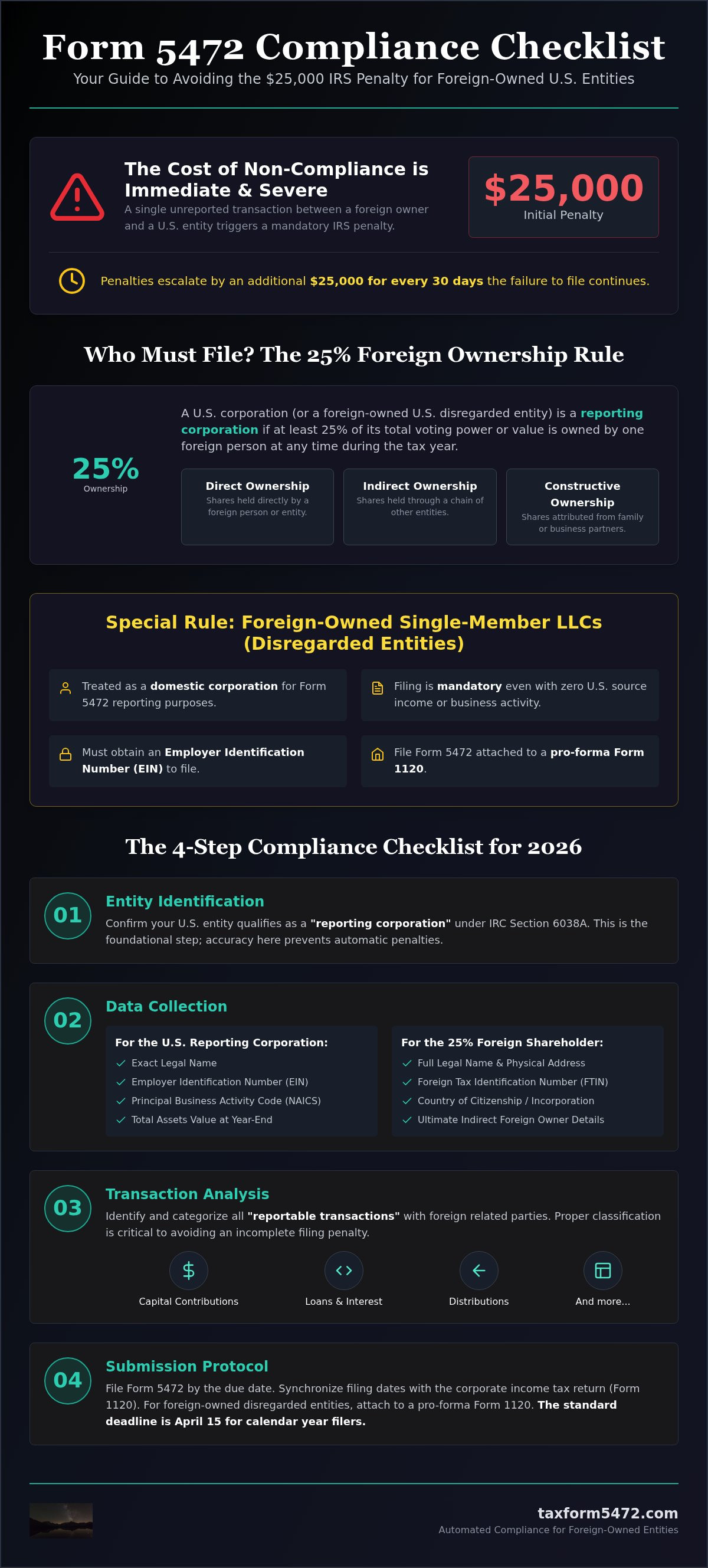
A single $1 transaction between a foreign owner and a U.S. entity triggers a mandatory $25,000 IRS penalty if left unreported. IRS scrutiny of international ownership structures is at an all-time high. This form 5472 checklist provides the technical requirements for 2026 compliance. It's designed to eliminate confusion and secure your filing status. The IRS now uses automated systems to match bank data with tax filings. Missing a single form leads to an immediate $25,000 fine. Additional penalties of $25,000 apply every 30 days if the error remains uncorrected.
Compliance for foreign-owned LLCs is an exacting task. You understand the pressure of complex ownership rules and reportable transactions. This guide provides a direct solution. It ensures you collect the required data before the April 15 deadline. Our checklist isolates the essential variables. It confirms if your 25% foreign ownership triggers a filing requirement. You'll learn to categorize capital contributions, loans, and distributions. This article prepares you for the 2026 filing season. It focuses on precision and total penalty avoidance.
Key Takeaways
- Identify 25% foreign ownership thresholds and reporting corporation status. Confirm your specific filing obligations for the 2026 tax year.
- Utilize the form 5472 checklist to gather essential EIN and legal entity data. Accurate preparation streamlines the entire submission process.
- Categorize monetary and non-monetary transactions with related parties. Proper analysis prevents the immediate $25,000 IRS penalty for incomplete filings.
- Synchronize filing dates with Form 1120 deadlines. Maintain strict compliance with calendar or fiscal year requirements to avoid automated IRS assessments.
- Transition from manual data collection to automated preparation tools. Digital interfaces ensure all mandatory fields meet current IRS standards for foreign-owned entities.
Entity Identification: Determine Filing Obligations
Compliance begins with precise entity classification. You must determine if your U.S. entity qualifies as a reporting corporation under Section 6038A. Use this form 5472 checklist phase to verify your status immediately. Failure to identify your filing requirement doesn't waive the $25,000 penalty. The IRS applies this fine per entity, per tax year. Accuracy at this stage prevents automated penalty notices.
The 25% Foreign Ownership Rule
A U.S. corporation is a reporting corporation if at least 25% of its total voting power or value is owned by one foreign person. This threshold applies at any time during the tax year. Ownership isn't limited to direct holdings. You must evaluate indirect and constructive ownership to remain compliant. Trace your ownership structure using these criteria:
- Direct ownership: Shares held directly by a foreign individual, corporation, or partnership.
- Indirect ownership: Shares held through a chain of entities or holding companies.
- Constructive ownership: Shares attributed from family members or business partners under Section 318 rules.
Identify the Ultimate Indirect Foreign Owner. This is the individual or entity at the top of the ownership chain. Your data collection must trace back to this level to satisfy IRS disclosure requirements. Clear documentation of this hierarchy is the first step in your form 5472 checklist.
Disregarded Entities and Form 5472
Foreign-owned single-member LLCs (SMLLCs) face specific requirements. While these entities are often disregarded for income tax purposes, they're treated as domestic corporations for Section 6038A reporting. This status triggers the mandatory filing of Form 5472. It applies even if the entity doesn't have a U.S. tax liability.
Every foreign-owned disregarded entity must obtain an Employer Identification Number (EIN). You can't file without this identifier. Even if the LLC had zero U.S. source income or no active business operations, reportable transactions often exist. Moving capital from a personal account to a business account is a reportable event. These entities must file Form 5472 attached to a pro-forma Form 1120. Mark the top of the Form 1120 with "Foreign-owned U.S. DE" to ensure correct processing at the Ogden, UT IRS center.
Engagement in a U.S. trade or business is a secondary factor. If your entity is a reporting corporation, the presence of any reportable transaction with a related party necessitates a filing. Verify your entity status now to avoid the automated penalty assessments starting in 2026. Use your findings here to guide the data collection phase that follows.
Data Collection: Required Information and Records
Systematic data collection is the foundation of compliance. You must gather specific identifiers for the U.S. reporting corporation before starting the filing process. Use this form 5472 checklist to track mandatory records. Incomplete data is a primary cause of IRS rejections and subsequent $25,000 penalties. Accuracy is non-negotiable.
Begin with the U.S. entity's core details. You need the exact legal name as it appears on the SS-4 confirmation letter. The Employer Identification Number (EIN) is mandatory. You can't substitute this with a personal SSN or ITIN. Identify the principal business activity code using the current NAICS directory. This six-digit code must reflect the entity's primary source of revenue. Finally, record the total assets value at the close of the tax year. This figure must reconcile with your internal balance sheet and the pro-forma Form 1120.
Foreign Shareholder Information
The IRS requires comprehensive disclosure of the 25% foreign shareholder. Gather the full legal name and current physical address. P.O. boxes are generally insufficient. You must provide the Foreign Tax Identification Number (FTIN) issued by the shareholder's home country. If the owner is an individual, record their date of birth and country of citizenship. For corporate owners, document the date and country of incorporation. Missing any of these variables can trigger a non-compliance notice. Once you gather these records, use automated preparation tools to organize the data for submission.
Related Party Identification
Identifying related parties is often the most complex phase. A related party includes any 25% foreign shareholder, any person related to that shareholder, or any entity under common control. You must define the specific relationship for each transaction reported. Is the party a parent company, a subsidiary, or an affiliate? Documentation must be precise.
- Legal Name: Ensure the name matches foreign registration documents.
- Physical Address: Use the primary place of business or residence.
- FTIN Verification: Confirm the tax ID for every related entity involved in reportable transactions.
Maintain these records for at least five years. The IRS may request proof of ownership or transaction details during an audit. This form 5472 checklist ensures you have the necessary documentation ready for 2026 filing requirements. Move to the next phase only after verifying every identifier listed above. Accurate data entry at this stage prevents the automated penalties currently used by the IRS to track foreign capital.
Transaction Analysis: Identifying Reportable Events
The IRS defines reportable transactions broadly. Any movement of value between the reporting corporation and a related party triggers a disclosure requirement. Use this form 5472 checklist to verify every transaction recorded in your financial statements. Even transactions with no profit or loss impact require reporting. Accuracy is essential to avoid the $25,000 penalty for incomplete filings. The IRS uses these disclosures to track profit shifting and asset concealment.
Audit your related party loans immediately. Both principal and interest payments must be disclosed in Part IV. Verify capital contributions and distributions. For foreign-owned disregarded entities, moving money from a personal account to the business account is a reportable event. This is a common trap for new business owners. Ensure every entry in your ledger corresponds to a specific category on the form. Check your records. Did you pay management fees? Report them. Did you receive a loan? Disclose it. The IRS matches these figures against the related party's own tax filings. Discrepancies trigger audits.
Monetary Transactions Checklist
Monetary transactions involve the actual transfer of currency. You must report the total dollar amount for each category during the tax year. Ensure your accounting software isolates these related-party flows for easy extraction. Key categories include:
- Inventory: Sales and purchases of tangible stock or raw materials.
- Rents and Royalties: Payments for the use of property, patents, or trademarks.
- Interest: All interest paid or received on related-party debt.
- Service Fees: Commissions, management fees, and technical service payments.
Non-Monetary and Special Transactions
Non-monetary transactions are often overlooked. The IRS treats the exchange of property or services as reportable even without cash flow. These "deemed" transactions must be valued at fair market value. For example, if a parent company provides free marketing services to its U.S. subsidiary, this is a reportable event. Cost-sharing arrangements also fall into this category. You must disclose any contributions to shared research and development costs. Finally, record formation or dissolution transactions. Initial capital injections of equipment or intellectual property are reportable. This form 5472 checklist ensures these "invisible" transactions are captured before you file. Precision here differentiates a compliant return from an incomplete one.
Review your transaction list against the related party identifiers gathered in the previous section. Every transaction must be linked to a specific foreign owner or affiliate. Once your list is complete, you're ready to move to the submission protocol. This sequence ensures no data is left behind.
Submission Protocol: Deadlines and Penalties
Filing Form 5472 is an annual requirement tied to your corporate tax return. You must align your submission with the Form 1120 due date. Use this form 5472 checklist to track these critical dates. The IRS assesses penalties based on the postmark date or fax timestamp. Missing the deadline triggers an immediate $25,000 fine per form.
Deadlines vary by tax year structure. Calendar year corporations follow the standard April schedule. Fiscal year entities must file by the 15th day of the fourth month following the close of their tax year. If your entity operates on a non-calendar year, verify your specific window immediately. Accuracy is paramount. The IRS uses automated systems to flag late filings.
The 2026 Filing Calendar
For the 2025 tax year, the standard filing deadline is April 15, 2026. You can secure an automatic six-month extension by filing Form 7004 before this date. This moves your final submission deadline to October 15, 2026. An extension to file Form 1120 automatically extends the deadline for Form 5472. The IRS assesses a $25,000 penalty for each Form 5472 that is filed late, incomplete, or inaccurate.
Penalty Mitigation
Avoiding the $25,000 penalty requires proactive management. If you miss a deadline, you may request penalty abatement based on "reasonable cause." This requires proving you acted with ordinary business care and prudence. The IRS rarely grants these waivers without substantial documentation. Maintain a complete form 5472 checklist and a detailed audit trail for every reportable transaction. Documentation should include bank statements, contracts, and ownership records.
Non-compliance costs escalate quickly. If the IRS issues a notice regarding a missing or incomplete form, you have 90 days to comply. After this window, the IRS adds a $25,000 penalty every 30 days until the form is received. There is no ceiling on these cumulative fines. To ensure your filing meets every IRS technical requirement and avoids these assessments, prepare your form using our automated platform.
Submission methods are restrictive for foreign-owned disregarded entities. These entities can't e-file. You must submit your pro-forma Form 1120 and Form 5472 via mail or fax to the IRS center in Ogden, UT. Confirm receipt through certified mail with a return receipt requested. Digital preparation tools streamline this process by generating the exact documents required for physical submission. This ensures your data matches the IRS's expected format.
Automated Compliance: Preparation with taxform5472.com
Manual filing creates operational risk. Digital data entry replaces the uncertainty of paper forms. Use your finalized form 5472 checklist to populate the digital interface. The platform is designed for foreign-owned U.S. entities. It streamlines the preparation of Part I through Part VIII. Every data point is validated against current IRS requirements. This systematic approach ensures your filing is complete before submission. Accuracy is the only defense against automated IRS penalties.
The $25,000 penalty for an incomplete form is an automated IRS process. Our software prevents this. It flags empty fields and inconsistent data. It verifies the relationship codes for related parties. It ensures monetary and non-monetary transactions are categorized correctly. The platform provides a secure environment for sensitive ownership data. International owners require this level of professional focus. It moves you from data collection to filing status with quiet confidence.
Why Use Automated Preparation?
Manual entry is inefficient. It's prone to human error. Automated preparation saves time on complex ownership structures. It manages multiple related parties without data redundancy. The professional interface meets global compliance standards. It translates complex IRS instructions into functional data fields. This results in a precise federal reporting document. You avoid the confusion of technical jargon. You focus on the essential components of your professional interaction. The tool is utilitarian and results-oriented.
Next Steps for Filing
Start with your gathered records. Upload the data to the secure portal. The system generates a ready-to-file Form 5472 and the required pro-forma Form 1120. Review the output for accuracy. Ensure the "Foreign-owned U.S. DE" label is present for disregarded entities. Print the documents. Sign where required. Submit your package to the IRS processing center in Ogden, UT. Use certified mail or fax. This provides a verifiable audit trail. Timely submission is the final step in avoiding IRS scrutiny. Maintain your records for five years to ensure audit protection.
Secure Your 2026 Compliance Status
IRS compliance is a data-driven requirement. You've verified your 25% foreign ownership status and mapped every reportable transaction within this guide. This form 5472 checklist provides the technical structure needed to avoid the $25,000 penalty. Precision in your records ensures a streamlined filing process. Automated IRS systems now track foreign capital with higher scrutiny. You must act before the April 15 deadline to maintain your entity's good standing. Digital preparation eliminates the risk of manual entry errors and incomplete fields.
Our user-friendly digital platform is specialized for foreign-owned U.S. entities. It's designed for 2026 compliance. It simplifies the preparation of complex federal reporting documents into a results-oriented workflow. You can generate accurate forms and secure your entity's status instantly. Start Your Automated Form 5472 Preparation to finalize your submission. You're now prepared to move from data collection to filing with quiet confidence.
Frequently Asked Questions
What is the penalty for not filing Form 5472 in 2026?
The base penalty for failing to file is $25,000 per tax year. If the IRS notifies you of a missing form and you don't comply within 90 days, the fine increases. An additional $25,000 is assessed for every 30-day period that the failure continues. There's no maximum limit on these cumulative fines. Using a form 5472 checklist ensures you don't miss the mandatory disclosure fields that trigger these automated assessments.
Does a foreign-owned LLC need an EIN to file Form 5472?
Yes, every reporting corporation needs an Employer Identification Number (EIN). You can't use a personal SSN or ITIN for this filing. Foreign-owned disregarded entities must obtain an EIN to identify the entity on the pro-forma Form 1120. This number is the primary identifier the IRS uses to track international ownership structures. You should secure your EIN well before the 2026 filing deadline to avoid processing delays.
Can I file Form 5472 if the company had no income?
Yes, you're required to file if a reportable transaction occurred, even with zero company income. Reportable events include capital injections, loans, or property transfers between the entity and its owners. Many foreign owners incorrectly assume zero revenue means zero filing obligations. The IRS uses this form to track the movement of capital, not just taxable profits. Even a $1 transaction between related parties necessitates a complete filing.
What is the deadline for Form 5472 in 2026?
The filing deadline for calendar-year corporations is April 15, 2026. This date applies to the 2025 tax year reporting period. If you need more time, file Form 7004 to secure an automatic extension to October 15, 2026. Fiscal-year entities must file by the 15th day of the fourth month after their year ends. Always confirm your entity's specific tax year structure to ensure you don't trigger the $25,000 late-filing penalty.
Who is considered a "Related Party" for Form 5472?
A related party is any 25% foreign shareholder or any person related to that shareholder. This definition also includes any entity under common control with your U.S. reporting corporation. You must identify parents, subsidiaries, and affiliates involved in any movement of value. List these entities on your form 5472 checklist along with their foreign tax IDs. Precise identification is critical because the IRS matches this data against other international disclosures.
Is Form 5472 filed separately or with a tax return?
Form 5472 is an informational attachment to your U.S. corporate tax return. You must file it with Form 1120. Foreign-owned disregarded entities use a pro-forma Form 1120 solely to carry the Form 5472. These specific entities are prohibited from e-filing. You must submit your documents by mail or fax to the IRS center in Ogden, UT. Always use a trackable mailing method to prove your submission date.
What records must I keep to support my Form 5472 filing?
You should keep bank statements, contracts, and ledgers that support every reported transaction. Documentation must confirm the fair market value of any non-monetary exchanges. Maintain records of all related party addresses and Foreign Tax Identification Numbers (FTINs). The IRS expects you to keep these files for at least five years. Organized records demonstrate reasonable cause if you ever need to contest a penalty or respond to an audit inquiry.