
A single overlooked entry on your tax filing now triggers a $25,000 penalty. The IRS has expanded its automated enforcement for 2026, using AI-driven risk scoring to flag inconsistencies in reportable transactions form 5472 with surgical precision. It's a high-stakes environment where manual data entry errors are no longer just a minor inconvenience. They're a significant financial liability for any foreign-owned U.S. entity. This level of scrutiny demands a methodical approach to documentation.
You've likely found that IRS instructions are intentionally opaque. It's difficult to distinguish which cross-border transfers require disclosure and which are exempt. This guide simplifies the process by identifying every transaction type required for total compliance. You'll learn exactly what to list, how to categorize complex items, and how to secure definitive proof of filing. We've compiled a comprehensive list of reportable items to remove the guesswork from your administrative workflow. We'll preview the essential 2026 updates, including the impact of the One Big Beautiful Bill Act, to ensure your reporting is fast, accurate, and final.
Key Takeaways
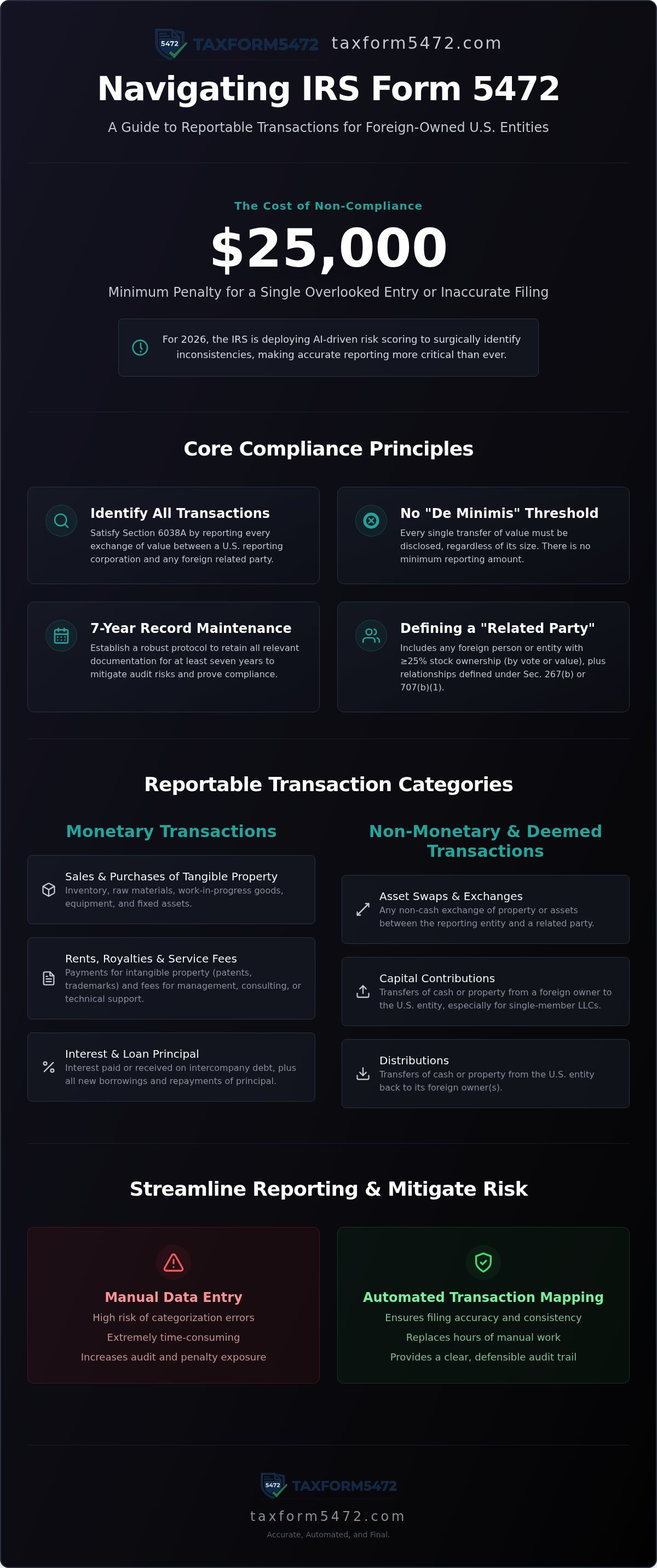
- Identify all reportable transactions form 5472 to satisfy Section 6038A requirements and eliminate filing gaps.
- Differentiate between monetary exchanges like service fees and non-monetary transfers such as asset swaps.
- Verify all value transfers regardless of size, as no "de minimis" threshold exists for these disclosures.
- Establish a 7-year record maintenance protocol to mitigate audit risks and the $25,000 non-compliance penalty.
- Automate transaction mapping to replace manual data entry and reduce categorization errors.
Understanding Reportable Transactions on Form 5472
A reportable transaction is any exchange of value between a U.S. reporting corporation and a foreign related party. It isn't restricted to traditional monetary payments. Any transfer of assets, services, or rights triggers the requirement. The legal basis for this disclosure lies in Sections 6038A and 6038C. These statutes empower the IRS to scrutinize international dealings. Compliance is mandatory for foreign-owned U.S. corporations and disregarded entities (LLCs). Failure to disclose these events leads to a minimum $25,000 penalty. This amount applies for each late or inaccurate form filed. Accuracy is a financial necessity.
Defining the Related Party
The IRS uses a broad definition for a related party. The foundational metric is the 25% ownership threshold. This applies to any foreign person or entity owning at least 25% of the reporting corporation's stock by vote or value. Ownership can be direct or indirect through attribution rules. You must also account for relationships defined under Section 267(b) or 707(b)(1). This includes family members, partners, and other entities within a controlled group. Identifying these parties is the first step in mapping your reportable transactions form 5472. For a foundational summary of these requirements, consult this Form 5472 Overview. Complex corporate chains often hide related party status; you must audit your entire ownership tree annually.
The Scope of Section 6038A
Section 6038A focuses on transparency in transfer pricing. The goal is to ensure that transactions between related entities reflect market rates. It prevents companies from shifting profits to lower-tax jurisdictions. This scope extends to domestic corporations with at least one 25% foreign shareholder. It also captures foreign-owned U.S. disregarded entities. Since 2017, single-member LLCs owned by foreign persons must file Form 5472. These entities are now visible to the IRS for reporting purposes. Even if an LLC has no taxable income, it must report capital contributions and distributions. The IRS uses AI-driven risk scoring to analyze these attachments. Any inconsistency in reporting can trigger an audit. Maintaining detailed records is the only defense against the escalating $25,000 non-compliance penalties. You should treat every reportable transactions form 5472 as a high-priority filing.
Monetary Transaction Categories for 2026
Identify the flow. List the amount. Report accurately. The IRS classifies monetary transactions as any exchange involving physical currency or electronic transfers. These represent the most frequent reportable transactions form 5472. For the 2026 tax year, the focus remains on ensuring cash flows reflect arm's length pricing. Every dollar moved between a U.S. company and its foreign owner must be categorized correctly. Mislabeling these cash flows often triggers the $25,000 base penalty. Accurate data mapping is your primary defense against automated IRS flags.
Sales and Purchases of Tangible Property
Inventory transfers represent a significant portion of cross-border activity. This category includes raw materials, work-in-progress goods, and finished products. You must report these transfers at fair market value. Equipment and other fixed asset sales also fall under this requirement. The IRS requires clear documentation for the physical movement of these goods. If you sell machinery to a related party, the price must match what an unrelated third party would pay. Documentation must prove the valuation method used. This prevents the IRS from claiming profit shifting through underpriced or overpriced goods.
Rents, Royalties, and Service Fees
Intangible property and professional support require precise reporting. You must disclose rents paid for office space, warehouses, or specialized equipment. Royalties for patents, trademarks, and copyrights are high-risk items for the IRS. Service fees cover management, consulting, and technical support provided by the foreign related party. These often include headquarters costs or shared administrative expenses. For the latest guidance on these specific line items, refer to the Official IRS Form 5472 Information. Proper categorization prevents the IRS from re-characterizing these payments as hidden dividends or capital distributions. Consistency in these descriptions is vital for long-term compliance.
Interest and Loan Principal
Financial debt between related parties is a primary focus of transfer pricing audits. You must report both interest paid and interest received. Loan principal movements, including new borrowings and repayments, are also reportable. The IRS expects an arm's length interest rate on all intercompany debt. Failure to charge market rates can lead to tax adjustments and significant penalties. Tracking these movements manually is prone to error and consumes valuable time. Using a specialized automated preparation tool ensures your financial data maps directly to the required fields without manual entry risks. This approach provides a clear audit trail for every financial transaction reported.
Non-Monetary and Deemed Transactions
IRS scrutiny extends beyond bank transfers. Even if no currency changes hands, a transfer of value creates a reporting obligation. These non-monetary events are frequent triggers for the $25,000 non-compliance penalty. Many entities overlook these items because they don't appear on standard cash flow statements. For the 2026 tax year, you must audit all asset swaps, service barters, and internal reallocations. These represent essential reportable transactions form 5472 that require precise valuation and disclosure. Failure to document these "invisible" exchanges suggests a lack of internal controls to IRS auditors.
Reporting Non-Cash Transfers
Barter transactions involve the exchange of goods or services without physical payment. A common example is a U.S. company providing technical support in exchange for raw materials from a foreign parent. You must report these at fair market value. Asset swaps, where equipment or property is traded, follow the same rule. Transfers of intangible property, such as patent rights or brand access without an immediate invoice, are also reportable. Valuation is the primary challenge here. You must use a recognized transfer pricing method to determine the value of the non-cash item. Documentation should include the logic used to establish the price as if the parties were unrelated. For technical specifics on these requirements, review the IRS guidance on Form 5472. Precise record-keeping is the only way to justify these valuations during an audit.
Deemed Related Party Transactions
Deemed transactions occur when the IRS "deems" a transfer of value has happened, even without a formal agreement. Constructive dividends are a primary example. This happens when a U.S. corporation pays for a foreign shareholder's personal expenses or provides a benefit without expecting repayment. The assumption of debt by a related party also qualifies. If a foreign parent pays off a U.S. subsidiary's loan, the IRS views this as a reportable event. Internal reallocations of profit or shared administrative expenses must be tracked with equal care. For foreign-owned U.S. disregarded entities, the stakes are even higher. Any capital contribution or distribution is considered a reportable transactions form 5472. This includes the initial funding of an LLC or the withdrawal of funds by the foreign owner. In 2026, the IRS uses automated risk scoring to flag entities that report high operational activity but zero reportable transactions. This discrepancy often initiates a manual review of the entity's books.
Cost-sharing arrangements for research and development (R&D) require separate categorization. When a U.S. entity shares the costs and risks of developing intangible property with a foreign affiliate, every payment or "buy-in" must be listed. These arrangements are high-priority targets for transfer pricing adjustments. Ensure your internal accounting identifies these shared costs before the filing deadline to avoid late-stage data mapping errors.
Thresholds and Record Maintenance Requirements
The IRS applies a zero-tolerance policy for reporting thresholds. Unlike Form 1099, which often triggers at $600, or certain Form 5471 requirements with higher caps, Form 5472 has no "de minimis" exception. Every value exchange requires disclosure. Even a $1 transaction between a U.S. company and its foreign related party is reportable. This lack of a floor means you can't ignore small-value items. Omitting a single minor transaction can invalidate the entire form. This triggers the $25,000 penalty for failing to file a complete and accurate return. For a detailed breakdown of these limits, see our Form 5472 Reporting Threshold: 2026 IRS Compliance Guide.
The Absence of a Reporting Minimum
Small transactions often signal larger transfer pricing issues to auditors. A $50 service fee or a $100 equipment rental might seem insignificant. However, the IRS views these as potential indicators of systemic profit shifting. If you omit these, you risk an audit of your entire intercompany ledger. The cost of defending a $10 omission far exceeds the effort of reporting it. AI-driven risk scoring now detects patterns of missing data by comparing your returns against industry benchmarks. If your operational expenses don't match your reported transactions, the system flags the discrepancy. Total transparency is the only way to maintain compliance in 2026.
Required Documentation Standards
Reporting is only half of the requirement. You must also maintain records that support every entry. The IRS mandates a 7-year retention period for these documents. This timeline exceeds the standard 3-year statute of limitations for many other tax forms. Your records must be sufficient to establish the correctness of the reportable transactions form 5472. You must be ready to produce these documents upon request during an examination. Essential documentation includes:
- Financial Records: Bank statements, wire transfer receipts, and general ledger entries showing cash movement.
- Legal Agreements: Signed intercompany contracts, loan agreements, and service level agreements (SLAs).
- Invoices: Itemized bills showing the date, specific amount, and nature of the transaction.
- Valuation Logic: Transfer pricing studies or internal memos explaining how you determined arm's length prices.
Safe harbor rules offer very limited relief. They typically apply only to specific low-value services or small entities with minimal foreign assets. Most foreign-owned U.S. corporations won't qualify for these exceptions. You should assume all intercompany activity requires full documentation. Preparing these files manually is a significant administrative burden. You can prepare Form 5472 online to ensure your data mapping aligns with these strict IRS standards. This digital approach creates a reliable audit trail for your 7-year retention obligation and reduces the risk of manual categorization errors.
Streamlining Reporting with Automated Filing
Manual reporting is a liability. It relies on human interpretation of complex codes. This is a high-risk approach. Automation replaces interpretation with logic-based mapping. You ensure every reportable transactions form 5472 is captured. This isn't just about speed. It's about audit defense. Human error is the primary cause of the $25,000 penalty. Automated systems validate every field. They ensure your filing is complete and final. You move from a reactive posture to a proactive compliance strategy.
Digitizing the Transaction Log
Digitizing your log is the first step. Manual spreadsheets are prone to errors. They lack version control. Automation software identifies reportable items by scanning for related-party identifiers. It categorizes inventory sales and service fees automatically. This process handles data mapping with precision. You prepare data once. The system generates the electronic file. This eliminates manual entry on IRS forms. It's where most mistakes happen. The system cross-references your inputs against Section 6038A standards. It flags inconsistencies before they reach the IRS. This anticipatory check prevents costly re-filings. It also manages the pro forma Form 1120 requirements for disregarded entities. This specific filing path is often misunderstood in manual processes. It also creates a digital audit trail for your 7-year retention requirement.
Fast Filing for 2026
Fast filing is now a requirement. IRS enforcement has accelerated. You need a process that matches this speed. Traditional methods are slow. They involve too much back-and-forth communication. Specialized tools reduce filing time to minutes. You gain access to secure portals. Direct submission ensures your data reaches the IRS instantly. Receipt is immediate. You get a digital timestamp. This is irrefutable proof of compliance. For a deeper look at these workflows, read our Automated Form 5472 Preparation: 2026 Efficiency and Compliance Guide.
Automation handles the complexities of deemed transactions. These are often missed in manual reviews. They lack bank entries. Software logic identifies value transfers without cash. This includes debt assumptions and service swaps. It ensures your reportable transactions form 5472 is comprehensive. Choosing a specialized tool over a generalist CPA prioritizes accuracy. You move from a manual data entry exercise to a streamlined digital workflow. This approach minimizes risk. It maximizes administrative efficiency. You spend less time on paperwork and more time on business operations.
Secure Your 2026 IRS Compliance Status
The IRS has removed the margin for error. A single omission of a reportable transactions form 5472 entry now triggers an immediate $25,000 penalty. This zero-threshold environment requires meticulous attention to every intercompany movement. You've identified the monetary, non-monetary, and deemed transactions that define your reporting obligation. Now, you must ensure your documentation meets the strict 7-year retention standard. Manual entry is no longer a viable strategy for modern foreign-owned entities. It's simply too slow and prone to high-cost mistakes. Automated systems provide the only reliable path to total accuracy and audit readiness.
Efficiency is your best defense against automated IRS enforcement. Our platform provides specialized online preparation for foreign-owned U.S. corporations and LLCs. You gain access to secure digital filing that maps your transaction data directly to the required fields in minutes. This streamlined approach ensures total compliance and provides immediate proof of receipt. Don't leave your corporate standing to chance. Take control of your administrative workflow and protect your business from escalating penalties. File Form 5472 Online Now and maintain your compliance with quiet confidence.
Frequently Asked Questions
What are the most common reportable transactions for a foreign-owned LLC?
Common items include capital contributions, loans, and distributions. Since 2017, foreign-owned single-member LLCs must report any exchange of value with their owner. This includes initial funding, withdrawal of profits, and payment of expenses by the owner on behalf of the LLC. These represent essential reportable transactions form 5472 for small business compliance. Reporting these items prevents the $25,000 penalty associated with incomplete or missing filings.
Is there a minimum dollar amount for reporting on Form 5472?
No minimum reporting threshold exists for most transactions. The IRS requires disclosure of any value exchange, even if the amount is $1. Unlike other tax forms with de minimis exceptions, Form 5472 mandates total transparency. Omitting small items can invalidate the entire form and trigger the $25,000 penalty. Accuracy across all transaction sizes is mandatory for 2026 filings. Every intercompany dollar must be accounted for to ensure full compliance.
Do I need to report non-monetary transactions like asset swaps?
Yes, you must report all non-monetary exchanges between the reporting corporation and a foreign related party. This includes barter arrangements, service swaps, and asset trades. You must establish a fair market value for these items using recognized transfer pricing methods. Documentation of the valuation logic is required to support these entries during an audit. The IRS views non-cash transfers as high-risk items for profit shifting and scrutinizes them accordingly.
What happens if I fail to report a transaction on Form 5472?
Failure to file a timely or accurate Form 5472 results in a $25,000 penalty. This penalty applies per form and per year. If the failure continues for more than 90 days after IRS notification, additional $25,000 penalties accrue every 30 days. Inaccurate reporting is treated as a failure to file. The IRS now uses AI-driven scoring to identify missing data. Professional digital filing is the most effective way to mitigate these risks.
Can I use software to categorize reportable transactions automatically?
Yes, specialized software can automate the mapping of financial data to IRS categories. Automated tools identify related-party identifiers and categorize inventory sales, service fees, and loans. This reduces human error and ensures all reportable transactions form 5472 are captured. Digital filing through secure portals also provides immediate confirmation of receipt. This approach secures your compliance status for the 2026 tax year and eliminates the need for manual data entry on complex forms.
Are dividends paid to a foreign owner considered reportable transactions?
Dividends and other distributions are reportable transactions. You must disclose the total amount paid to the foreign owner during the tax year. This includes both cash dividends and constructive dividends where a benefit is provided without repayment. These payments must be categorized correctly to avoid re-characterization by the IRS. Proper reporting prevents profit-shifting flags in the automated enforcement system and ensures your intercompany ledger remains transparent and audit-ready.
How long must I keep records of my reportable transactions?
The IRS requires you to maintain supporting records for 7 years. This includes bank statements, wire transfers, invoices, and signed intercompany contracts. This retention period ensures you can establish the correctness of your filing during an examination. Failure to maintain these records is treated the same as a failure to file, triggering the $25,000 penalty. You should maintain digital copies of all documentation to facilitate immediate retrieval during an IRS audit.
Does Form 5472 require a transfer pricing study for all transactions?
A formal transfer pricing study isn't explicitly required for every filing, but you must establish arm's length pricing. You need documentation proving that related-party prices match what unrelated parties would pay. For high-value or complex transactions, a study provides the strongest defense against IRS adjustments. You must be prepared to explain your valuation logic for all reported items. Maintaining clear logic for your pricing is essential for long-term corporate compliance.