
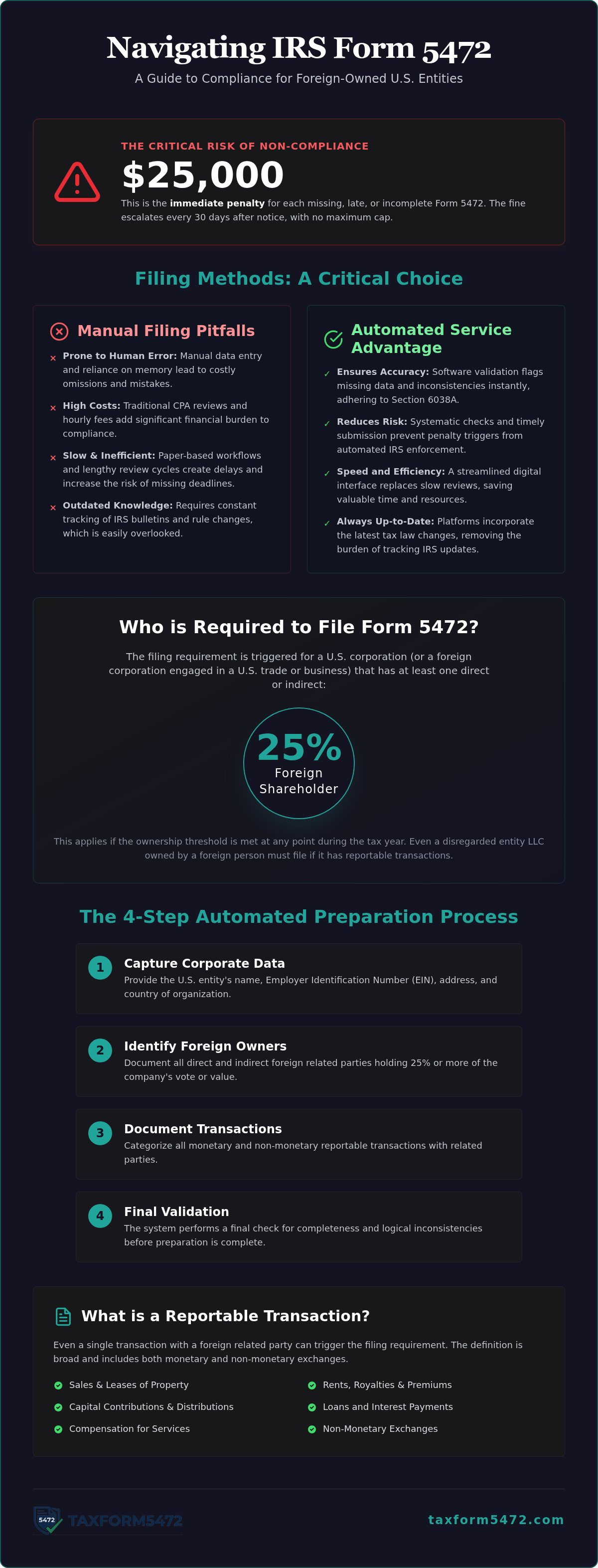
A single missing Form 5472 triggers an immediate $25,000 penalty. This fine escalates every 30 days without a maximum cap. For foreign-owned U.S. corporations, an irs form 5472 filing service is now a necessity for survival. You know the pressure of strict deadlines and complex tax terminology. High CPA fees add weight to the burden of international compliance. Manual errors are both costly and avoidable in the current digital environment. The IRS is increasing its focus on foreign-owned entities through automated data matching and bank record reviews.
This guide provides a direct path to regulatory security. Professional automation simplifies data entry and ensures timely 2026 submission. You gain peace of mind through a streamlined digital interface designed for speed. We detail current requirements, automated IRS enforcement trends, and steps to avoid multi-year penalties. Transition from manual complexity to a precise filing utility. Secure your entity status with modern tax documentation. Focus on your business operations while the system handles the data requirements.
Key Takeaways
- Minimize manual data entry errors. Automation ensures strict adherence to Section 6038A regulations.
- Mitigate the $25,000 non-compliance risk. Understand why the IRS penalizes missing or incomplete filings.
- Determine your filing status. Identify specific triggers for U.S. corporations with 25 percent foreign ownership.
- Streamline your 2026 submission. Use a professional irs form 5472 filing service for faster, secure completion.
Why Utilize a Professional Form 5472 Filing Service?
Compliance is a binary state. You're either compliant or you're facing a $25,000 penalty. This initial fine applies to each missing, late, or incomplete form. For foreign-owned U.S. entities, the margin for error is zero. An irs form 5472 filing service removes the ambiguity of manual reporting. It ensures your entity adheres to Section 6038A regulations without the overhead of traditional accounting firms. For a foundational understanding of these requirements, review this Form 5472 Overview. Digital interfaces translate complex IRS instructions into functional data fields. This approach prioritizes speed and accuracy. Timely submission is the only defense against automated IRS enforcement. Penalties accrue every 30 days after the initial notice. Professional filing prevents this escalation through systematic validation.
Automation vs. Manual Filing Processes
Manual filing relies on human memory. It's prone to oversight. Software validation identifies missing reportable transactions instantly. If a capital contribution or owner's draw is omitted, the system flags it. Automated platforms incorporate 2026 tax law changes as they occur. You don't need to track IRS bulletins or memorandum updates. The system handles the logic. Digital storage is another critical advantage. The IRS requires records to be maintained for a specific period. Automated systems archive your data securely. This ensures you're ready for any future inquiry. It's a precise, modern utility for global entrepreneurs. Use it to eliminate the friction of paper-based workflows.
Specialized Support for Foreign Owners
Foreign owners of U.S. LLCs face unique challenges. Many believe "disregarded" status means no filing is required. This is a common misconception. Even with zero income, a reportable transaction as small as $100 triggers a filing requirement. Specialized workflows guide you through these specific scenarios. The process is built for international founders who operate outside the U.S. It clarifies what counts as a related party transaction. You get a streamlined path to compliance. No complex terminology. No unnecessary delays. The system acts as a focused tool for your professional obligations. It's about results-oriented preparation for your U.S. entity. Secure your status and avoid the trap of non-compliance.
Efficiency is the goal. Modern filing services replace slow CPA reviews with high-speed validation. This shift saves time and reduces the risk of human error. As the IRS adopts advanced data-matching in 2026, your filing must be exact. Automated systems provide the precision required for this environment. They align your data with current bank record reporting. This proactive approach keeps your business invisible to penalty triggers. It's the most reliable method for maintaining international tax standing today.
How the Automated Preparation Process Works
Efficiency requires a systematic data flow. A professional irs form 5472 filing service replaces manual entry with a four-step digital workflow. This process eliminates the ambiguity found in the Official IRS Form 5472 Instructions. It starts with your U.S. entity details. It concludes with a validated submission ready for the IRS. Digital tools ensure no required field is left blank.
Step 1 captures corporate data. You enter the entity name, Employer Identification Number (EIN), and business address. Step 2 focuses on ownership. You identify all foreign related parties holding 25 percent or more of the company's vote or value. Step 3 requires the categorization of reportable transactions. This includes both monetary and non-monetary exchanges. Step 4 is the final validation. The system checks for logical inconsistencies before the preparation is complete.
Gathering Required Corporate Data
Begin with the U.S. corporation's administrative profile. You must provide the exact business address and the country of organization. Identifying 25 percent foreign shareholders is a critical requirement. The system tracks both direct and indirect ownership levels. This ensures no related party is overlooked. You also document the nature of the U.S. trade or business. This context is essential for accurate IRS classification. Clear data entry prevents future inquiries.
Documenting Reportable Transactions
Reportable transactions extend beyond simple cash transfers. You must document loans, sales, and rents involving related parties. Non-monetary transactions also require disclosure. This includes cost-sharing arrangements and the exchange of services without immediate payment. A single $100 capital contribution to a bank account can trigger this requirement. For a detailed breakdown of these categories, consult our Guide to Reportable Transactions. Accuracy here prevents the $25,000 non-compliance penalty. Precision is your best defense.
The automated process handles the complex logic of Section 6038A. It ensures your data aligns with the latest IRS expectations for the 2026 tax year. If you want to simplify your compliance workflow, consider an automated preparation platform. It's a precise tool for high-speed filing. Final validation ensures every field meets the required standards before submission. This methodical approach provides the security foreign owners need to maintain their U.S. entities. Your compliance status remains secure.
Mitigating the $25,000 Non-Compliance Penalty
The IRS enforces an automatic $25,000 penalty for failure to file. This isn't a discretionary fine; it's a statutory requirement under 26 U.S. Code § 6038A. If your filing is incomplete or inaccurate, the same $25,000 amount applies. The risk doesn't stop at the initial assessment. If the IRS sends a notice and the failure continues for 90 days, an additional $25,000 accrues every 30 days thereafter. There's no maximum cap on these assessments. A professional irs form 5472 filing service provides a verifiable audit trail. This documentation is your primary defense during a compliance review.
Digital timestamps and submission receipts serve as proof of intent. This is critical for the "reasonable cause" exception clarified in recent IRS memorandums. Automated systems ensure every required field meets current standards before transmission. You avoid the trap of "observation" becoming "enforcement." The IRS now uses advanced data-matching to identify non-filers through bank records. Precision in your reporting is the only way to remain invisible to these automated triggers. Secure your entity with a system built for 2026 standards.
Common Filing Mistakes to Avoid
Errors often stem from procedural misunderstandings. Missing the filing deadline is the most frequent issue. Form 5472 must be attached to a pro forma Form 1120. Filing one without the other results in immediate non-compliance. Another common error is failing to report non-monetary transactions. Cost-sharing or service exchanges are reportable even if no cash moves between parties. Incorrectly identifying the foreign reporting corporation also triggers penalties. The IRS requires precise data on the foreign shareholder's jurisdiction and tax ID. Automated systems validate these fields to prevent rejection and subsequent fines.
Risk Management for Foreign-Owned LLCs
Single-member LLCs face a specific "disregarded entity" trap. For income tax purposes, the IRS ignores these entities. For information reporting, they are fully "regarded." This distinction is where many foreign owners fail. You must treat the LLC as a corporation for Form 5472 reporting purposes. If you discover a past error, learn How to Amend Form 5472 to mitigate ongoing risks. Establish a recurring compliance schedule. Annual filings should be prepared well before the April 15 deadline to allow for data verification.
The IRS uses automated enforcement to match U.S. bank records with tax filings. If your LLC has a U.S. bank account but no filed 5472, the system flags the discrepancy. Proactive management is cheaper than reactive correction. Competitors often focus on penalty removal after the fine arrives. This approach is risky and expensive. Automated filing focuses on prevention. It aligns your data with current IRS enforcement standards. Secure your entity now to avoid the $25,000 escalation. Efficiency is your most effective compliance strategy.
Filing Requirements for Different Entity Types
Reporting obligations differ by entity structure. A professional irs form 5472 filing service identifies these distinctions automatically. U.S. corporations with at least 25 percent foreign ownership must file. This threshold applies to either the total voting power or the total value of all classes of stock. Foreign corporations engaged in a U.S. trade or business (USTB) share this requirement. The trigger is any reportable transaction with a related party. Accuracy in entity classification is mandatory for 2026 compliance.
The Foreign-Owned U.S. LLC Requirement
Single-member LLCs owned by a foreign person are "disregarded" for income tax. They're "regarded" for information reporting. This creates a specific filing requirement. The IRS treats the LLC as a corporation solely for Section 6038A. You must attach Form 5472 to a pro-forma Form 1120. Review our Foreign Owned US Corporation Tax Guide for detailed entity mapping. Disregarded entities cannot e-file. The completed forms must be submitted by mail or fax to the IRS office in Ogden, Utah. Automated systems generate the necessary pro-forma return to ensure a complete filing package.
The pro-forma Form 1120 is a procedural necessity. It serves as a cover page for the disregarded entity's data. You must complete only the identifying information and check the required boxes. No income or expenses are reported on this specific return. It exists purely to facilitate the attachment of Form 5472. Omitting the pro-forma 1120 is a critical error. It results in a rejected filing and triggers the standard non-compliance penalty. Digital preparation tools validate these entries against current 2026 IRS standards.
C-Corporations and Foreign Shareholders
C-Corporations must track ownership tiers carefully. Direct and indirect ownership both count toward the 25 percent limit. If a foreign person holds 25 percent of a parent company, the U.S. subsidiary must file. Reporting also extends to transactions with 50 percent related parties. Multi-tier structures increase complexity. Automation tracks these relationships across jurisdictions. It ensures every related party is identified correctly. Tracing ultimate ownership is a requirement for Part II of the form.
Foreign corporations with U.S. operations face distinct triggers. If the entity engages in a U.S. trade or business, it's a reporting corporation. This includes branch operations. Transactions between the U.S. branch and foreign offices are reportable. This includes allocations of expenses and cost-sharing arrangements. Precision in entity reporting prevents IRS rejection. Use a system that understands these distinctions. You can prepare your Form 5472 online to ensure correct entity classification. Secure your 2026 compliance status today.
Secure Your 2026 Compliance Today
Immediate access to the 2026 filing interface is available now. You don't need to wait for traditional tax windows to open. A professional irs form 5472 filing service removes the friction of manual reporting. You move instantly from data entry to a validated submission package. Streamlined workflows prioritize your time. Automated systems handle the complex logic of Section 6038A. You avoid the $25,000 penalty through proactive, high-speed preparation. The system is built for the current IRS environment of automated enforcement and bank record matching. It's a precise utility for the modern global founder.
Why TaxForm5472 is the Efficient Choice
TaxForm5472 is a specialized utility. It isn't a generic tax platform. We focus exclusively on foreign-owned entity compliance for U.S. corporations and LLCs. The interface is minimalist and results-oriented. Founders don't need to navigate complex tax terminology to remain compliant. Traditional methods often involve slow messaging threads or expensive hourly rates. You can compare the differences in our guide on Form 5472 CPA vs. Software. Efficiency is the primary objective. Every field is optimized for speed. The platform operates as a precise tool rather than a conversational partner. It's ready for business when you are.
Next Steps for Filing
Prepare your corporate records before starting. You need your U.S. EIN, business address, and foreign shareholder details. Document all related party transactions from the 2025 tax year. This includes capital contributions, loans, and payments for services. Log in to the automated preparation tool to begin. The system guides you through each required disclosure. Ensure your submission is completed before the 2026 deadline of April 15. The system generates the necessary pro-forma documentation automatically. This ensures your filing package is complete and ready for submission to the IRS office in Ogden, Utah.
Submit your data with quiet confidence. The platform provides dedicated support for Form 5472 specific queries. You get answers focused on your unique reporting requirements. Direct electronic preparation capability is available for eligible U.S. corporations. For disregarded entities, the system produces a signature-ready PDF for fax or mail. This methodical approach ensures your business remains in good standing. You gain a digital audit trail of your compliance efforts. This documentation is essential if the IRS ever requests proof of filing. Don't wait for an automated penalty notice. Secure your 2026 compliance today through a streamlined, professional utility. Your entity's security is the priority.
Maintain Compliance for Your U.S. Entity
Compliance is a continuous professional obligation. The 2026 tax landscape requires absolute precision. Automated validation is the only reliable method to prevent the $25,000 non-filing penalty. You've identified how entity-specific requirements, such as the pro-forma Form 1120 attachment for disregarded entities, are mandatory for acceptance. Manual errors are now visible to the IRS through automated data-matching systems. Precision is your primary defense against costly assessments.
Utilizing a professional irs form 5472 filing service ensures your data aligns with current reporting standards. Our specialized Form 5472 compliance platform provides a secure digital preparation environment. Penalty-focused validation checks every field for logical consistency before submission. This methodical approach provides the audit trail necessary for global business operations. Efficiency replaces the friction of traditional accounting. Your entity's standing remains secure.
Start your IRS Form 5472 filing now to finalize your 2026 documentation. Secure your U.S. corporation or LLC today. Your business is ready for growth.
Frequently Asked Questions
Is Form 5472 required if there were no transactions?
Filing is not required if zero reportable transactions occurred during the tax year. However, the definition of a transaction is broad. A capital contribution as small as $100 triggers the obligation. Most foreign-owned U.S. entities have at least one transaction to maintain the business bank account. You must verify all activity before deciding not to file. Missing a required submission results in an automatic $25,000 penalty.
Can I file Form 5472 online without a CPA?
You can file without a CPA by using an irs form 5472 filing service. Automated platforms provide a digital interface to prepare the required documentation. These systems guide you through entity information and transaction categorization. This approach reduces the high fees associated with traditional accounting firms. It's a precise utility designed for founders who prioritize efficiency. The software ensures your data meets 2026 IRS standards before submission.
What happens if I miss the Form 5472 filing deadline?
Missing the April 15 deadline results in an immediate $25,000 penalty per form. This fine applies even if the form is filed late or contains inaccuracies. If the failure continues for 90 days after an IRS notice, an additional $25,000 accrues every 30 days. There's no maximum cap on these penalties. Using an automated platform helps ensure timely submission and provides a digital audit trail of your compliance efforts.
Do foreign-owned LLCs need an EIN to file?
Every foreign-owned U.S. LLC must have an Employer Identification Number (EIN) to file. This number is the primary identifier for the entity in the IRS system. You cannot complete Form 5472 without a valid EIN for the reporting corporation. If your LLC is newly formed, you must obtain this number before the filing deadline. The EIN links your corporate data to the information reporting requirements mandated by Section 6038A.
What is a reportable transaction for Form 5472?
A reportable transaction is any exchange of value between the U.S. company and its foreign owners. Even non-monetary transactions, such as cost-sharing arrangements, must be reported. A single $100 transaction triggers the full requirement. Common examples include:
- Capital contributions or owner's draws
- Loans or interest payments
- Rents and royalties
- Sales of inventory or equipment
- Payments for professional services
Accuracy in this section is critical for avoiding IRS scrutiny.
Can I request an extension for my Form 5472 filing?
You can request a six-month extension by filing Form 7004. This moves the 2026 deadline from April 15 to October 15. The extension must be filed on or before the original due date. Form 5472 is an attachment to your corporate tax return, so the extension applies to the entire filing package. Timely extension filings prevent the automatic $25,000 late penalty. Always maintain digital proof of the extension submission.
Is Form 5472 filed separately from the tax return?
Form 5472 is never filed as a standalone document. It must be attached to the entity's income tax return, typically Form 1120. For foreign-owned disregarded entities, you must use a pro-forma Form 1120 as a cover page. This package is then submitted by mail or fax to the IRS office in Ogden, Utah. An irs form 5472 filing service automates the assembly of this complete filing package to ensure absolute compliance.