
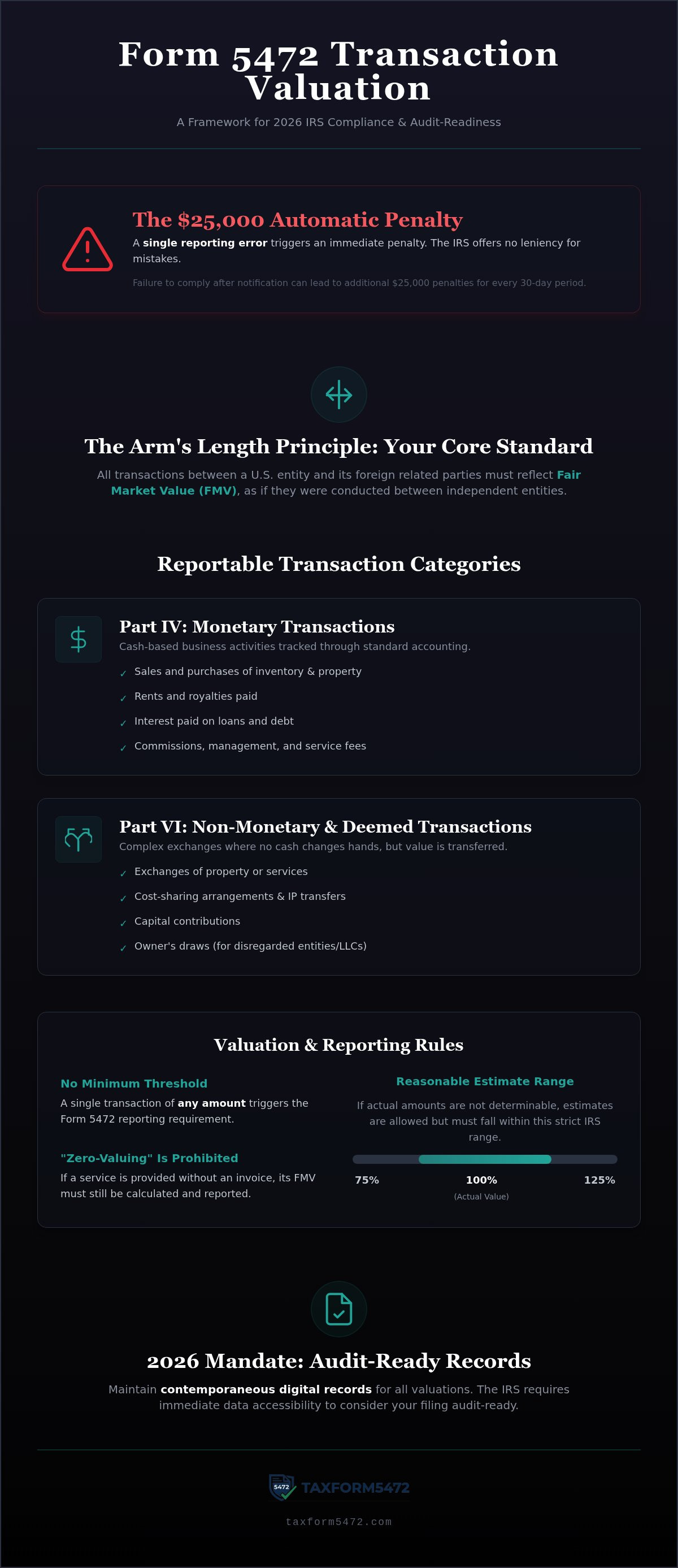
A single reporting error on Form 5472 triggers an automatic $25,000 penalty. The IRS offers no leniency for mistakes when valuing transactions for form 5472. For foreign-owned U.S. entities, the line between an owner's draw and a reportable transaction is thin. You likely feel the pressure of transfer pricing complexity. Distinguishing between monetary and non-monetary values shouldn't be guesswork. These concerns are valid. The 2026 compliance standards require absolute precision. Accuracy is your only defense against aggressive IRS enforcement.
Master these requirements through this professional framework. We provide the exact steps to categorize transactions and satisfy the arm's length principle. This article outlines an audit-ready record-keeping strategy to simplify your filing process. We'll examine USD conversion rules, the $50,000 small-amount reporting threshold, and documentation for non-monetary exchanges. Expect a clear path toward total compliance. Eliminate the risk of costly IRS notifications. This is the definitive standard for your 2026 reporting cycle.
Key Takeaways
- Identify all reportable transactions between US entities and foreign related parties. Prevent the $25,000 failure-to-file penalty.
- Apply the Arm's Length Principle to every exchange. Ensure all reported figures reflect current Fair Market Value (FMV).
- Master the precise framework for valuing transactions for form 5472. Categorize monetary and non-monetary exchanges with absolute accuracy.
- Maintain contemporaneous digital records. Meet 2026 IRS requirements for immediate data accessibility and audit readiness.
- Deploy specialized compliance software. Use automated validation logic to detect missing transaction values before submission.
Reportable Transaction Categories Under Section 6038A
Reporting obligations apply to 25% foreign-owned U.S. corporations and disregarded entities. The scope of IRS Form 5472 is expansive. It tracks every exchange of value between the U.S. entity and its foreign related parties. You must be meticulous when valuing transactions for form 5472 because there is no minimum dollar threshold for reporting. A single transaction of any amount triggers the requirement. Accuracy is mandatory. You must file a separate Form 5472 for each related party that engaged in a reportable transaction during the tax year.
The IRS categorizes these exchanges into two primary groups. Monetary transactions appear in Part IV. Non-monetary or "deemed" transactions appear in Part VI. Precise categorization is the first step in compliance. Mislabeling a transaction can lead to audit flags. Systematic identification ensures all data flows correctly into the final filing.
Monetary Transaction Types
Part IV captures traditional cash-based business activities. These are often the easiest to track through standard accounting software. They include:
- Inventory and Property: All sales and purchases of tangible goods.
- Rents and Royalties: Payments for the use of buildings, equipment, or intangible assets.
- Financial Costs: Interest paid on loans, advances, or other debt instruments from foreign owners.
- Services: Commissions, management fees, and professional service charges.
Every figure must reconcile with your financial statements. Small errors in Part IV reporting suggest poor record-keeping to the IRS. This increases your risk profile. Automated preparation tools minimize these manual entry risks by pulling data directly from your ledger.
Non-Monetary and Deemed Transactions
Part VI reporting is more complex. It involves transactions where no cash changes hands. You must focus on valuing transactions for form 5472 that involve property or services. This includes cost-sharing arrangements and intellectual property transfers. If you exchange assets for services, the fair market value of those assets must be disclosed. There's no "immaterial" amount in the eyes of the IRS. Every exchange requires a documented valuation method.
Foreign-owned LLCs face specific challenges with "deemed" transactions. Capital contributions and owner's draws fall into this category. Even if there's no invoice or formal contract, the transfer of value is reportable. The IRS uses Part VI to gain visibility into these internal shifts of wealth. Missing a single owner's draw can result in a $25,000 penalty. If the failure continues for more than 90 days after notification, additional $25,000 penalties apply every 30 days. Use a digital interface designed for international structures to flag these non-cash events. This ensures your filing is complete and audit-ready.
Methods for Valuing Related Party Transactions
The IRS requires strict adherence to the Arm's Length Principle. This standard ensures that transactions between related parties mirror those between independent entities. When valuing transactions for form 5472, you can't assign arbitrary numbers. Every figure must represent Fair Market Value (FMV). The Official IRS Instructions for Form 5472 provide the legal basis for these requirements. Failure to apply these methods correctly leads to the $25,000 penalty. Consistency is your best defense against an audit.
Under-reporting or "zero-valuing" services is a common error. If a foreign parent provides management support without an invoice, the IRS still considers this a reportable transaction. You must assign a value based on what a third party would charge. Precise IRS Form 5472 filing depends on these calculations. Estimates are only permissible when actual amounts aren't determinable. even then, they must fall between 75% and 125% of the actual value. This narrow margin leaves little room for error.
The Arm's Length Principle Explained
Treat related parties as strangers. This is the core of transfer pricing. Use the Comparable Uncontrolled Price (CUP) method whenever possible. This involves identifying similar transactions between unrelated companies. It provides the most direct evidence of market value. Document your rationale clearly. You must explain why a specific price was chosen. This documentation must be contemporaneous. Don't wait for an IRS inquiry to justify your figures. Proactive automated preparation can help maintain these records systematically.
Common Valuation Benchmarks
Standardize your approach using recognized benchmarks. This reduces subjectivity. Use these common markers:
- Intercompany Loans: Apply the Applicable Federal Rate (AFR). This is the minimum interest rate the IRS requires for loans to avoid income reclassification.
- Management Services: Use market rates for similar consulting or administrative roles in your specific industry.
- Tangible Assets: Obtain independent appraisals for real estate or heavy machinery.
Accuracy in valuing transactions for form 5472 protects your entity. The IRS focus on cross-border transactions is increasing. They look for discrepancies between reported values and industry norms. Use established benchmarks to ensure your data is defensible. This methodical approach streamlines the filing process and minimizes manual entry errors.
Monetary vs. Non-Monetary Valuation Framework
IRS compliance demands a dual-track approach. Cash transactions provide a clear audit trail. Non-monetary exchanges do not. You must treat both with equal rigor when valuing transactions for form 5472. Capital contributions and distributions are frequent triggers for foreign-owned LLCs. These represent a transfer of value even without an invoice. Record the actual fair market value at the time of the transfer. Don't omit owner's draws or capital injections. They're reportable in Part VI. Failure to disclose these "deemed" transactions is a primary cause of the $25,000 penalty.
Intercompany loans require specific attention. An interest-free advance isn't a zero-value event. The IRS views the lack of interest as a benefit provided to the related party. You must report the principal amount and determine a "deemed" interest rate based on the OECD Transfer Pricing Guidelines. This ensures your intercompany debt aligns with global standards. Use automated form 5472 preparation to track these complex debt cycles and maintain audit-ready records.
Valuing Tangible and Intangible Property
Inventory transfers follow strict accounting rules. Choose between FIFO and LIFO methods for tax reporting. Consistency across tax years is essential. When transferring intellectual property like patents or trademarks, valuation becomes subjective. Use professional appraisals to establish FMV. Report the gross value of the property. The IRS doesn't want the net gain or loss; they want the total value of the exchange. This transparency allows the agency to assess whether the transaction was conducted at arm's length.
Reporting Services and Rents
Administrative support from a parent company is often undervalued. If a foreign entity provides HR, IT, or legal services, you must assign a market value. Don't simply report "zero" because there's no cash flow. Shared office space or equipment usage also requires a fair rental value calculation. Base this on local market rates for similar facilities. Expense reimbursements are reportable too. If you're paying back a related party for costs incurred on your behalf, report the gross amount. Avoid profit markups unless a third party would typically charge one. This precision in valuing transactions for form 5472 prevents red flags during IRS data matching.
Documentation and Record-Keeping for Valuation
IRS compliance rests on contemporaneous documentation. You must prove how you reached specific figures while valuing transactions for form 5472. These records must exist at the time the return is filed. Creating justifications after an IRS inquiry is ineffective. A robust paper trail is your primary defense against the $25,000 penalty. If the IRS requests data, you must provide it promptly. Failure to maintain these records is treated as a failure to file. This triggers automatic penalties regardless of the transaction size.
Establishing a clear trail from financial statements to Form 5472 line items is essential. Every entry in Part IV or Part VI should map back to a specific ledger entry. The IRS focuses on the methodology behind the numbers. If you report a $10,000 management fee, you need the underlying contract and market research to support it. This systematic approach ensures your entity remains audit-ready throughout the 2026 tax cycle. Accuracy in record-keeping is as vital as the filing itself.
Essential Records for Every Transaction
Maintain a comprehensive file for every related party. This file should include specific evidence of value. Essential items include:
- Legal Agreements: Signed intercompany contracts and service-level agreements that define the terms of the exchange.
- Financial Proof: Invoices and bank statements showing actual cash movements for monetary items.
- Valuation Memos: Detailed memos or transfer pricing studies for significant transactions, especially those involving intellectual property.
These documents provide the evidence needed to satisfy the arm's length principle. They bridge the gap between abstract valuation rules and concrete financial data. Without these records, your reported values are merely assertions that the IRS can easily challenge.
Managing Records in a Digital Environment
The 2026 IRS standards emphasize digital record accessibility. Use irs form 5472 digital filing for secure, organized storage. Centralizing records in a cloud-based environment prevents data loss. It also ensures that international subsidiaries follow the same documentation standards. IRS agents often request records in a machine-readable format. Digital systems allow for immediate retrieval and submission during an inspection. This speed reduces the duration and intensity of an audit.
Standardizing formats across global structures minimizes administrative friction. Ensure all foreign-sourced documents are translated into English. Attach a schedule of the exchange rates used for all non-USD transactions. This level of detail demonstrates professional diligence. It signals to the IRS that your compliance process is disciplined and transparent. To simplify this complex requirement, use automated Form 5472 preparation to build your digital audit trail automatically.
Selecting Compliance Software for Accurate Valuation
Manual data entry is a significant liability. When valuing transactions for form 5472, transposition errors can lead to immediate IRS flags. You need a tool that treats compliance as a precise calculation rather than a narrative exercise. Evaluate software based on its capacity to manage complex ownership structures. If you have multiple foreign related parties, the platform must generate separate forms for each entity automatically. Consistency across these forms is non-negotiable for audit readiness.
Validation logic is the most critical feature. The software should act as a pre-filing auditor. It must identify missing transaction values and inconsistent identifying information before you submit the data. A streamlined digital interface is essential for international owners who aren't familiar with U.S. tax jargon. This accessibility reduces the friction of data collection. It ensures that the responsibility for accuracy is shared across the organization through a centralized system. Efficiency is the goal.
Key Features of Form 5472 Software
Effective platforms prioritize functional utility over decorative design. Your chosen tool should include:
- Automated Categorization: Direct mapping of transaction codes to Part IV or Part VI based on the nature of the exchange.
- Identifying Information Validation: Real-time checks for EIN, TIN, and foreign address formats to prevent technical rejections.
- Secure Cloud Storage: Integrated document management to link invoices and contracts directly to reportable line items.
These features eliminate the guesswork associated with valuing transactions for form 5472. They provide a structural framework that enforces compliance. By automating the classification process, you reduce the risk of misreporting a non-monetary distribution as a simple service fee. This level of precision is difficult to maintain through spreadsheets alone.
Why Automation Wins in 2026
Traditional CPA services often rely on manual workflows that are slow and expensive. In 2026, the cost-benefit analysis favors specialized SaaS solutions. Automation offers real-time compliance checks against the latest IRS regulations. It processes large transaction sets in seconds. This speed is vital for entities with complex histories. You don't need a generalist; you need a tool focused exclusively on IRS Form 5472 preparation.
Specialization ensures every update to the tax code is reflected in your filing logic immediately. Digital filing through these platforms provides an instant confirmation of receipt. This gives you peace of mind that your obligation is met. Automation isn't just about speed; it's about creating a repeatable, audit-ready process. It transforms a complex regulatory burden into a manageable digital workflow. Prioritize platforms that value your time as much as your compliance status.
Secure Your 2026 Compliance Strategy
IRS enforcement focuses on reporting accuracy. Precision in valuing transactions for form 5472 is your primary defense against the $25,000 penalty. Every exchange requires a clear fair market value. This applies to both monetary and deemed transactions. Contemporaneous documentation is a structural requirement. It ensures audit readiness. Transitioning to specialized digital systems reduces transposition errors and missed categories. Specialized software ensures every update to the tax code is reflected in your filing logic immediately.
Automation provides a repeatable framework for international structures. Our platform is specialized for foreign-owned U.S. corporations. It features a streamlined digital interface. Built-in validation logic handles multiple related party forms efficiently. These tools minimize $25,000 penalty risks by flagging data gaps before submission. Disciplined data management protects your entity from aggressive enforcement. Accurate reporting is a functional necessity for global operations.
Prepare and file Form 5472 accurately with our automated platform.
Maintain your focus on accuracy. Your compliance workflow is ready for the 2026 tax cycle.
Frequently Asked Questions
What is the minimum transaction amount that must be reported on Form 5472?
There is no minimum dollar threshold for reporting. A single transaction of any value with a foreign related party triggers the filing requirement. If the total amount for a specific related party doesn't exceed $50,000, you may report the value as "$50,000 or less." Precision remains essential even for small sums to avoid the $25,000 failure-to-file penalty. Every exchange must be documented regardless of its size.
How do I value a service provided by a foreign owner if no invoice was issued?
You must use the Fair Market Value (FMV) of the service. Apply the arm's length principle to determine what an unrelated third party would charge for identical support. Document your valuation method in a contemporaneous memo. If the exact amount isn't determinable, use a reasonable estimate between 75% and 125% of the actual value. This is critical when valuing transactions for form 5472 involving administrative or management support.
Do capital contributions from a foreign owner need to be valued and reported?
Yes, capital contributions are reportable transactions. Foreign-owned disregarded entities (LLCs) must disclose these in Part VI as "deemed" transactions. You must report the gross value of the cash or property transferred. Missing these non-monetary exchanges is a frequent cause of IRS audits. Ensure every injection of capital is documented with clear records showing the transfer date and the fair market value of the assets at that time.
Can I use the book value of an asset for Form 5472 reporting?
No, the IRS requires Fair Market Value (FMV) rather than book value. Book value often reflects historical costs and depreciation, which doesn't satisfy the arm's length principle. You must report the price that would be agreed upon between independent parties in a competitive market. For significant tangible assets, obtain an independent appraisal to justify your figures. This documentation protects you if the IRS challenges your valuation during a compliance review.
What happens if I cannot determine the exact fair market value of a transaction?
Use a reasonable estimate if the actual amount isn't determinable. The IRS considers an estimate reasonable if it falls between 75% and 125% of the actual amount. You must attach a statement to your return explaining why the exact value wasn't available and how you calculated the estimate. This flexibility doesn't waive the requirement for contemporaneous documentation. Maintain all underlying data used to reach your estimated figure to ensure audit readiness.
Is an intercompany loan considered a reportable transaction even if no interest is paid?
Yes, the IRS views interest-free loans as reportable events. You must disclose the principal amount and account for the lack of interest in your filing. The agency may reclassify the transaction or apply a "deemed" interest rate based on the Applicable Federal Rate (AFR). Accurate valuing transactions for form 5472 requires you to report the total value of the financial support provided. Failure to report these loans triggers the standard $25,000 penalty.
How does the IRS verify the transaction values reported on Form 5472?
The IRS uses data matching and audits to verify reported values. They compare your figures against industry benchmarks and the tax returns of related parties. Agents may request your contemporaneous records, including transfer pricing studies, contracts, and bank statements. If your reported values deviate significantly from market norms without justification, it triggers further scrutiny. Digital record-keeping ensures you can produce the required evidence immediately upon request during an IRS inspection.
Does the $25,000 penalty apply to valuation errors or just late filings?
The penalty applies to late filings and substantially incomplete forms. Reporting inaccurate or zero values for transactions is often treated as a failure to file in the prescribed manner. If the IRS determines your valuation was intentionally misleading or lacked a reasonable basis, they can assess the $25,000 penalty. Continuous failure to correct these errors after notification results in additional $25,000 penalties every 30 days. Precision is your only safeguard against these assessments.