
The easiest way to form a U.S. company may not be the right tool for keeping its tax reporting on track. If you’re looking for Stripe Atlas tax compliance alternatives for foreign founders, start by separating company formation from recurring compliance. They solve different jobs.
Services that bundle setup and tax filing can make those jobs seem interchangeable. They aren’t. Foreign ownership alone doesn’t answer every Form 5472 question. The entity’s tax classification and its transactions matter, and an initial contribution from a foreign owner may be relevant. Form 5472 is an information return, not a calculation of tax.
This guide compares formation platforms, tax professionals, and focused compliance services by scope and ongoing responsibilities. You’ll see where Form 5472 preparation fits, what information the filing involves, and why a formation package may not cover every tax obligation. Use the comparisons to identify the service category that matches your task, then keep formation separate from recurring compliance.
Key Takeaways
- Compare formation platforms, tax professionals, and focused filing services by the work each handles and the responsibilities that remain yours.
- Use entity type, ownership details, transactions, and tax year to organize the facts needed to assess your reporting task.
- Evaluate Stripe Atlas tax compliance alternatives for foreign founders by service scope, not as substitutes for ongoing filing support.
- Understand when focused Form 5472 preparation may fit, and where its scope ends if you have other tax obligations.
Stripe Atlas and foreign-founder compliance: what formation does, and does not, answer
Formation services help create a U.S. entity and complete setup steps. They don’t automatically resolve what the entity must report after it begins operating. When comparing Stripe Atlas tax compliance alternatives for foreign founders, the relevant alternative may be a filing service or tax professional, not another formation platform.
Formation support establishes the company; recurring tax reporting addresses filings that may be required based on the entity’s classification, ownership, and activity. Treat these as separate stages. A service that handles setup may help with initial administrative tasks, but that alone doesn’t establish which ongoing filings apply or who will prepare them.
What Stripe Atlas represents in this comparison
Stripe Atlas is the formation-service reference point here. The comparison is about task scope, not a claim that Atlas includes or excludes a particular tax filing. Packages and features can change, so consult current official Atlas materials before relying on specific inclusions. Stripe also has products and services beyond company formation. The Stripe, Inc. Wikipedia page provides broader company background, but it doesn’t determine an Atlas customer’s filing obligations.
Why foreign founders need to assess post-formation duties
Start with the entity’s legal and tax classification, who owns it, and what transactions took place with foreign owners or related parties. Form 5472 may be relevant for certain foreign-owned U.S. corporations and foreign-owned disregarded entities. The filing analysis depends on the applicable rules and facts, not simply on whether a founder lives outside the United States. Use current IRS instructions or qualified tax guidance to assess a specific situation.
Keep company reporting separate from the founder’s personal tax position. A company filing concerns the U.S. entity and its reporting duties. An owner’s personal obligations are a different question, shaped by individual circumstances and applicable rules. One doesn’t answer the other. For a closer look at entity-level considerations, see foreign-owned US corporation tax guidance.
Before comparing services, gather the records that help define the task:
- Entity type and tax classification.
- Ownership details, including foreign owners.
- Transactions between the entity and its owners or related parties.
- The tax year and any known filing notices or deadlines.
These facts help clarify what needs attention, but they don’t replace a filing analysis. Identify whether the task is formation, Form 5472 preparation, another business return, or a separate personal filing. Then compare services by the work they actually cover. This prevents a setup package from being mistaken for a complete plan for recurring compliance.
Form 5472 and other US reporting: identify the compliance task first
Form 5472 is an information return. It reports certain transactions involving a U.S. entity and foreign owners or related parties; it doesn’t calculate the entity’s tax. It may apply to a U.S. corporation with at least 25% foreign ownership, or to a foreign-owned U.S. disregarded entity when reportable transactions are involved. Not every foreign founder must file it.
Form 5472 analysis depends on the entity’s tax classification, foreign ownership, relationship between the parties, reportable transactions, and tax year. Ownership is a starting fact, not a filing conclusion. Review the IRS Form 5472 Official Instructions and current rules before deciding whether a filing is required.
When Form 5472 may enter the picture
For a foreign-owned U.S. corporation, the ownership threshold and transaction details are relevant to the analysis. A foreign-owned single-member LLC treated as a disregarded entity is assessed under separate rules. The LLC’s classification matters: an entity treated as a corporation and one treated as disregarded don’t necessarily follow the same reporting path.
Review transactions between the U.S. entity and its foreign owner or related parties. These can include funding or other transfers, and an initial capital contribution may be relevant even if the company has little or no revenue. Don’t assume that no sales, no profit, or a small transaction total settles the question. There isn’t a general dollar threshold to use instead of reviewing the applicable instructions. A closer review of Form 5472 reportable transactions can help identify the records and activity to examine.
Gather the entity’s formation and classification records, ownership details, related-party information, and transaction records for the tax year. Then compare those facts with current IRS guidance. This turns a broad concern into a specific task: determine applicability, prepare a required Form 5472, or investigate another filing obligation.
Where one filing ends and broader compliance begins
Form 5472 preparation is one defined reporting task. It doesn’t cover every federal return, state filing, annual report, or tax obligation an entity may have. A company filing also doesn’t determine whether its foreign owner has personal tax obligations. Those questions involve different facts and should be assessed separately.
Requirements can vary with entity type, tax classification, activity, and tax year. Keep a separate list of possible federal, state, and owner-level obligations, then verify each against current official guidance or qualified tax advice. Completing one form doesn’t confirm that all compliance is complete.
If your review identifies Form 5472 preparation for a foreign-owned U.S. corporation as the specific task, online Form 5472 preparation is a focused option. Consider other reporting responsibilities separately.
Compare Stripe Atlas alternatives by service scope, not by name
The useful comparison is not “which platform is best?” It’s “which task needs to be done?” A formation service, a tax professional, and a focused Form 5472 preparation service have different scopes. A broader package may combine tasks, but no category automatically covers every federal, state, and owner-level obligation.
Use this comparison to see where each option may fit. Deliverables vary, so review a service’s current description before relying on it for a particular filing.
| Service category | Typical task scope | Founder input | Likely fit and boundary |
|---|---|---|---|
| Formation platform | Company setup and related formation steps. Ongoing tax work depends on the platform’s current offering. | Entity choice, company details, owner information, and formation documents. | Useful when establishing an entity. Setup alone doesn’t determine later filing duties. |
| Tax professional | Scope may cover a specific return or broader tax planning and compliance, as agreed. | Financial records, ownership and entity details, transaction history, and relevant tax documents. | Consider for multiple tax questions or facts that need professional analysis. Scope depends on the engagement. |
| Focused Form 5472 preparation | Preparation centered on Form 5472 and the information needed for that filing. | Entity classification, ownership, related-party details, and reportable transaction records. | Fits when Form 5472 is the identified task. It doesn’t replace other tax or state filings. |
Formation platforms versus ongoing tax support
Formation platforms are designed around getting a company established. Separate that deliverable from recurring filing responsibilities. Stripe’s Stripe Atlas Business Taxes Guide provides general business tax information and says Atlas doesn’t provide tax advice. Treat formation and tax analysis as distinct needs. The guide doesn’t establish whether a specific filing is included in a current Atlas package, so review current features before comparing deliverables.
For example, a founder might have completed incorporation but still need to determine whether a federal information return applies. Formation records can supply useful company details, but they don’t answer that question by themselves. Track setup documents separately from recurring compliance tasks, and note the responsible person and tax year for each filing under consideration.
Tax professionals versus focused Form 5472 preparation
A tax professional may address a broader set of questions, such as how entity classification affects several filings or how company and owner circumstances interact. A focused preparation service is narrower: TaxForm5472 provides online Form 5472 preparation for foreign-owned U.S. corporations. It’s suited to an identified Form 5472 task, not a substitute for an all-purpose tax engagement. The Form 5472 CPA versus software comparison can help clarify how the preparation approaches differ.
Choose based on the work remaining. If the question spans multiple returns or requires wider analysis, define that broader scope. If the task is Form 5472 preparation, compare focused services by the records they require and the filing work they address. Assess other federal, state, and owner-level duties separately.
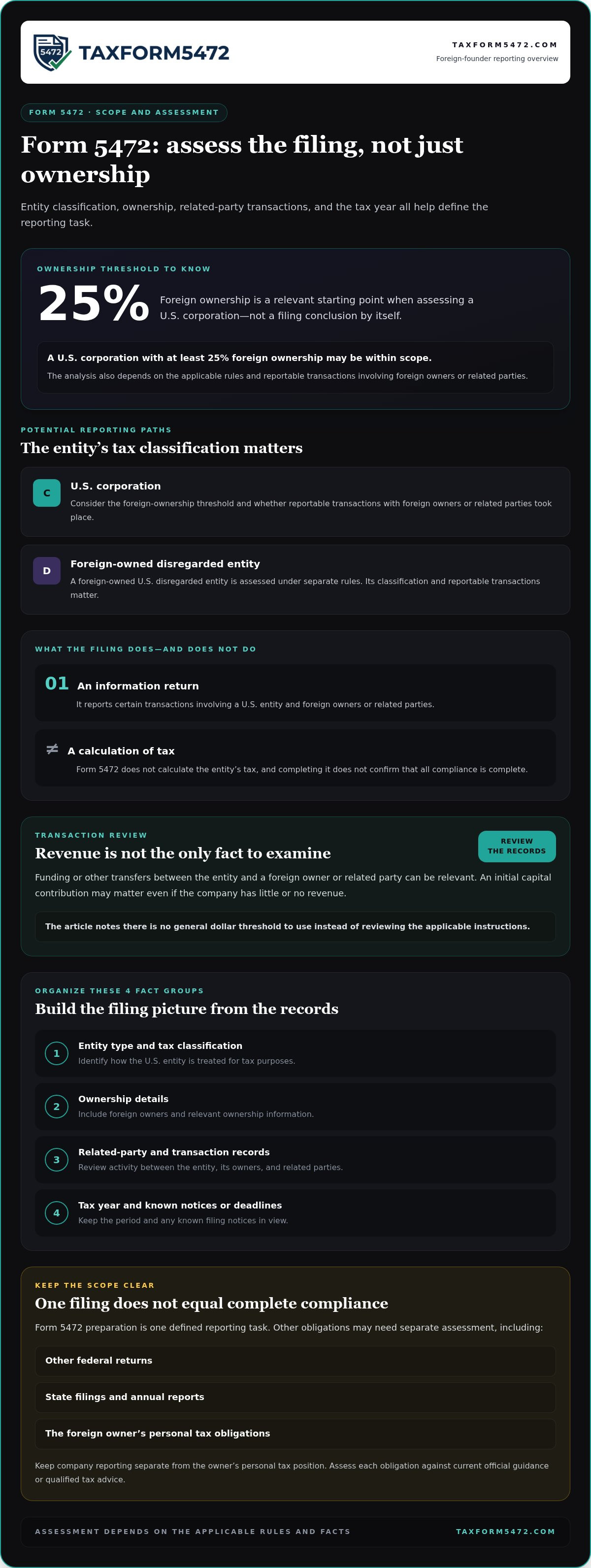
A practical decision path for foreign founders comparing compliance options
Choose a service after defining the filing task. This sequence turns a broad search for Stripe Atlas tax compliance alternatives for foreign founders into a comparison based on the company’s records and needs. It doesn’t determine whether a filing is legally required.
- Identify the entity. Note its legal form and tax classification. An LLC’s legal label alone may not show how it is treated for federal tax purposes.
- Map ownership. Record who owns the entity, each owner’s country or place of organization, and ownership changes during the tax year. Keep the underlying company records available.
- Review transactions. List payments, contributions, loans, reimbursements, and other transfers between the company and foreign owners or related parties. Preserve dates, descriptions, and supporting records.
- Set the tax year. Identify the period under review and any filing dates or notices already received. Deadlines can depend on entity type and filing circumstances, so verify the applicable date and rules against official guidance.
- Name the task. Decide whether you need to assess Form 5472 applicability, prepare that form, address a different business filing, or consider several obligations together.
Information to organize before selecting a service
Gather formation documents, tax classification records, ownership details, and transaction records for the relevant year. Note known deadlines and prior filings. These are facts you can organize; deciding how they affect a filing requirement may call for current IRS instructions or professional tax guidance. Don’t post sensitive personal, banking, or financial information in a public forum or article comment.
Keep evidence distinct from conclusions. A record may show that an owner contributed funds, for example, but whether that transaction triggers a particular reporting requirement depends on the entity’s classification and applicable rules. Organizing the details first makes it easier to describe the question accurately and identify what kind of help is relevant.
Match the task to the right service category
If the unresolved questions span multiple returns, entity treatment, or broader company tax matters, a broader tax-professional engagement may be the appropriate category. If the task is preparing Form 5472 for a foreign-owned U.S. corporation, focused preparation can address that specific form. It doesn’t establish that other federal, state, or owner-level duties are complete.
Make a short scope note before comparing options: entity type, ownership, tax year, known transactions, and the filing question. Then compare each service against that defined task, rather than assuming formation support includes every later filing.
If Form 5472 preparation is the specific task you’ve identified, review online Form 5472 preparation.
A focused Form 5472 option for foreign-owned US corporations
Once the filing task is clear, the right kind of support is easier to identify. TaxForm5472 provides an online service focused on Form 5472 preparation for foreign-owned U.S. corporations. It is a specific compliance option, not company formation or an all-purpose tax platform. For founders comparing Stripe Atlas tax compliance alternatives for foreign founders, that distinction helps match the service to the task instead of assuming one provider covers every obligation.
What a focused digital preparation service is designed to do
A focused digital workflow supports Form 5472 preparation and facilitates submission of required tax documentation to the IRS. Its value is scope: the process centers on one identified reporting task rather than bundling company setup, broad tax planning, or unrelated filings. This can help organize the work when the entity and filing need are understood.
That focus also sets a boundary. Form 5472 preparation does not, by itself, address other federal or state filings, the company’s full tax position, or an owner’s personal tax matters. Broader questions need separate consideration. Assess the form’s applicability using current IRS guidance and the company’s facts; preparation is not a substitute for that determination.
How to proceed with a clearly defined filing need
Before beginning, assemble the records that describe the reporting period and the entity’s situation. Organize the information by tax year, and use current IRS instructions to confirm the filing requirements that apply. This preparation helps distinguish missing records from unresolved tax questions.
- Entity formation and tax classification records.
- Foreign ownership details and any relevant ownership changes.
- Records of transactions with owners or related parties.
- The tax year and any known filing deadline or IRS notice.
With these facts in hand, identify whether your next step is to assess Form 5472 applicability, prepare the form, or address broader tax obligations. If Form 5472 preparation for a foreign-owned U.S. corporation is the defined need, use a focused service for that task and track other filings separately. Review current IRS guidance if the filing analysis is unresolved.
Start Form 5472 preparation online.
Turn your compliance review into a clear next step
Use the service comparison as a starting point, then record who will handle each identified filing and when the relevant tax-year review should happen. Revisit the plan when ownership, entity classification, or transactions change. A short record of those decisions helps keep formation documents, reporting tasks, and unresolved questions distinct.
The right choice among Stripe Atlas tax compliance alternatives for foreign founders depends on the task you’ve identified. If your next step is broader tax analysis, define those questions separately. If it’s Form 5472 preparation for a foreign-owned U.S. corporation, choose a focused workflow for that filing and track other obligations separately.
taxform5472.com focuses on Form 5472 preparation through a digital workflow designed to facilitate preparation and submission of required documentation. Start Form 5472 preparation online for this specific task.
Frequently Asked Questions
Is Stripe Atlas a tax-compliance service for foreign founders?
Not by default. Atlas is commonly considered for U.S. company formation, but formation and recurring reporting are separate tasks. Before relying on a package for a filing, compare its current official service description with the specific deliverable you need. Then review the company’s entity classification, ownership, and activity. Form 5472 may be relevant to some foreign-owned U.S. entities, but applicability depends on the facts and current rules.
Can foreign founders use a service other than Stripe Atlas for U.S. tax compliance?
Yes. Stripe Atlas tax compliance alternatives for foreign founders include tax professionals, tax software, and services focused on a specific filing. Their scope varies. A company needing help with several returns may need broader support, while a founder with an identified Form 5472 task may consider focused preparation. Compare the work covered and what remains outside scope, rather than assuming one category handles every obligation.
Does forming a U.S. company automatically satisfy ongoing IRS reporting requirements?
No. Completing incorporation doesn’t establish that all later reporting is complete. A founder may receive formation documents but still need to determine which returns apply to the entity for a particular tax year. Keep formation records and tax-filing records as separate items in the company’s compliance file. Check current IRS instructions for the relevant entity and year before deciding which forms are required.
What information should a foreign founder gather before comparing compliance options?
Gather formation and tax-classification records, ownership information, transaction records, the tax year, and a clear description of the task. A simple index can help: list each record, the period it covers, and any gaps. For example, note whether a transaction record includes its date, amount, parties, and purpose. Don’t share sensitive personal or financial details through unsecured channels while comparing services.
Is Form 5472 required for every foreign-owned U.S. business?
No. Foreign ownership by itself doesn’t establish that Form 5472 is required. The analysis can differ for a U.S. corporation and a foreign-owned entity treated as disregarded for tax purposes, and relevant transactions may also matter. Don’t use a general online checklist as a final filing determination. Review the current IRS instructions alongside the company’s classification and records for the tax year in question.
Can Form 5472 software replace a tax professional for every issue?
No. A focused Form 5472 preparation service addresses that defined filing task, not every question about the company’s tax position. If you also need to assess another federal return, state requirements, entity classification, or personal tax matters, those issues may call for broader professional support. Before selecting a tool, write down the questions it must resolve and confirm that its stated scope matches them.