
Could your startup need to file Form 5472 before it earns revenue? Yes. For a form 5472 for startup assessment, ownership and founder transactions can matter from formation, even when the business has no sales or taxable income.
It’s easy to focus on launch tasks and overlook reporting activity behind the scenes. A foreign founder’s capital contribution, a loan to the company, or payments for services may be relevant when a related party is involved. The analysis can also differ depending on whether the startup is a corporation or a foreign-owned U.S. disregarded entity.
This guide explains which ownership structures may bring Form 5472 into scope, what early-stage transactions to review, and which records to gather. It also lays out a practical path from checking the company’s structure and transaction history to preparing the filing. The goal is to build readiness into your startup’s setup, rather than raise the question only when a deadline approaches.
Key Takeaways
- Assess your startup’s ownership and entity classification to determine which Form 5472 reporting path may apply.
- No revenue alone doesn’t settle whether a form 5472 for startup filing is required. Review the applicable rules alongside the company’s transactions.
- Gather formation records, ownership details, and transaction documents, including records of founder funding, loans, and payments.
- Keep source documents separate from decisions about how each transaction should be reported.
- A focused online Form 5472 preparation workflow can help organize the information needed for the filing.
Why Form 5472 Can Matter Before a Startup Makes Revenue
Can reporting matter before your startup earns revenue? Yes, it may. A company can have relevant ownership and transaction activity during formation or pre-launch, before it sells a product or records income. Revenue alone doesn’t determine whether a filing obligation exists.
Form 5472 is an IRS information return used to report certain transactions between a reporting corporation and a foreign related party. It discloses information; it doesn’t calculate the startup’s income tax. Whether it applies depends on the company’s entity classification, ownership facts, and reportable activity under current IRS rules. The Form 5472 Wikipedia entry provides background on the form’s purpose and related tax code provisions.
What Form 5472 does in a startup context
For startups, the form can be relevant when a U.S. business has a qualifying foreign ownership structure and engages in transactions that the rules require it to report. The analysis differs by entity type. A domestic corporation and a foreign-owned U.S. disregarded entity may follow different procedures, so don’t assume an LLC is outside the rules or that incorporation resolves the question.
This is a reporting question, not simply a measure of whether the business owes tax. A startup with no taxable income may still need to assess its reporting position. The form discloses specified related-party activity, while the applicable IRS instructions determine which entity files and how.
Why founders should assess reporting during formation
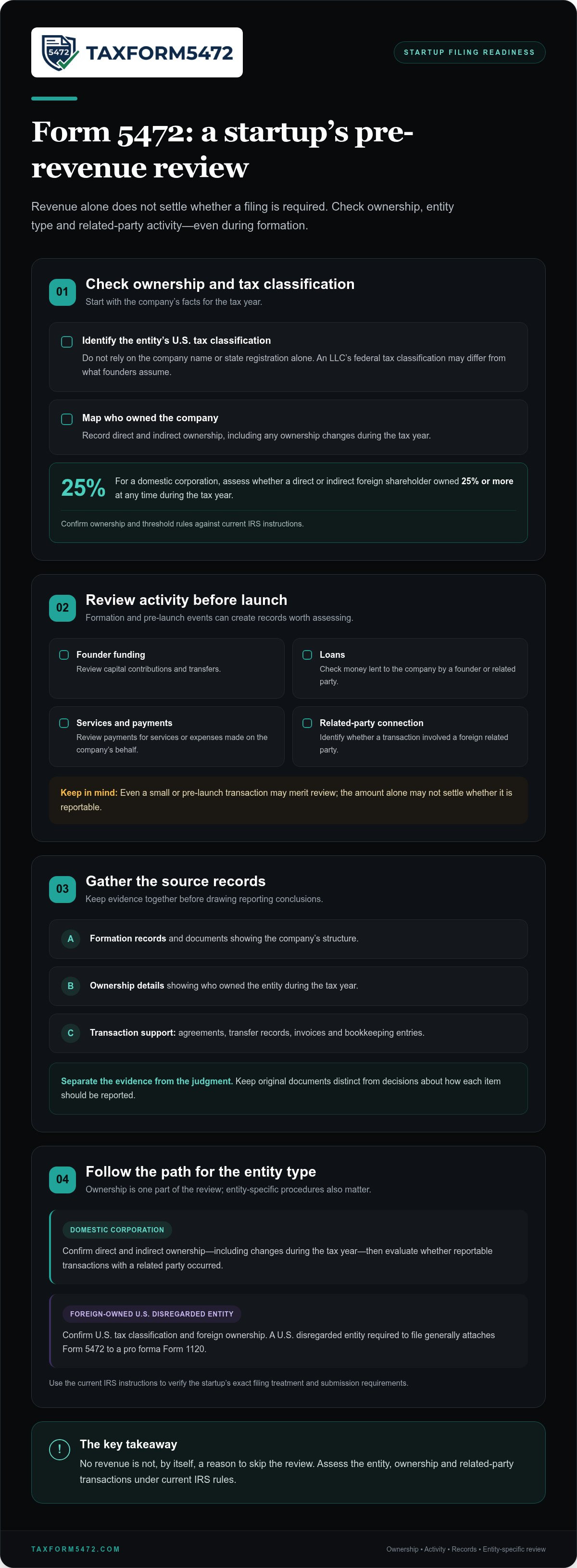
Formation creates more than legal documents. It can also create a transaction record. A foreign founder may contribute funds, lend money to the company, or pay for services or expenses on its behalf. Document and review these events, even if the startup hasn’t launched. Keep agreements, transfer records, invoices, and bookkeeping entries together so the facts can be assessed later.
Don’t use “no revenue” as a shortcut for “no filing.” Instead, identify the entity’s classification, record its ownership, and review activity involving founders and other related parties. Then compare those facts with the current IRS instructions. Even a small or pre-launch transaction can merit review; the amount alone may not settle whether it’s reportable.
- Record who owned the entity during the tax year.
- Keep support for founder funding, loans, payments, and transfers.
- Separate original documents from conclusions about how each item should be reported.
These early checks help founders identify questions before filing preparation begins. For a broader overview of reporting requirements and filing mechanics, see the IRS Form 5472 filing guide. Use the current IRS instructions to assess the startup’s specific entity type and facts.
How Startup Ownership and Entity Type Shape Form 5472 Analysis
Start with two facts: how the startup is classified for U.S. tax purposes and who owns it. A foreign founder’s involvement alone doesn’t mean every startup has the same Form 5472 obligation. Ownership thresholds, related-party transactions, and entity-specific filing rules all matter. These are the central questions in a form 5472 for startup review.
Map the company’s legal structure and ownership for the tax year, then assess its activity under the current IRS instructions. The IRS International Business Tax Guidance provides broader context for U.S. businesses with international ownership. For additional ownership background, see this foreign-owned U.S. corporation tax guide.
Foreign-owned domestic corporations
A domestic corporation generally falls within the foreign-owned corporation analysis if it has at least one direct or indirect foreign shareholder owning 25% or more at any time during the tax year. Confirm the threshold and ownership rules against current IRS instructions, especially if ownership is indirect or changes during the year.
Ownership status is only one part of the analysis. The corporation must also assess whether it had reportable transactions with a related party. For example, a foreign shareholder’s ownership stake and a separate loan to the corporation are distinct facts to document and evaluate. This example is illustrative, not an individual filing conclusion.
Foreign-owned U.S. disregarded entities
A U.S. single-member LLC may be classified as a disregarded entity for federal tax purposes, yet foreign ownership can bring it into a distinct Form 5472 reporting procedure. A foreign-owned U.S. disregarded entity required to file generally attaches Form 5472 to a pro forma Form 1120. Follow the current IRS instructions for the entity’s exact filing treatment and submission requirements.
Use this high-level comparison to guide your review:
- Domestic corporation: Confirm direct and indirect ownership, including changes during the tax year, then evaluate related-party transactions.
- Disregarded entity: Confirm its U.S. tax classification and foreign ownership, then review the separate Form 5472 and pro forma Form 1120 procedure.
Don’t decide the filing path from a company’s name or state registration alone. An LLC’s federal tax classification may differ from what founders assume, and a corporation’s ownership can involve indirect interests. Keep formation documents, ownership records, and transaction support available for review. Then apply the current IRS rules to the startup’s facts, rather than treating foreign ownership by itself as a final answer.
Once the entity path is clear, organize the supporting information before preparing the form. taxform5472.com provides an online Form 5472 preparation workflow for this step.
Does a Startup Need Form 5472 Without Revenue?
Possibly. A startup’s lack of sales or income doesn’t, by itself, answer whether it must file Form 5472. The analysis depends on the entity’s classification and ownership, along with whether it had transactions that fall within the reporting rules. Review these facts together using the current IRS instructions.
Revenue alone is not a complete test for whether a startup must file Form 5472. A pre-launch company may have no customers but still have financial activity involving a foreign owner or another related party. That activity warrants review, not an automatic conclusion that a filing is required.
Early-stage activity founders should review
Look beyond sales records. Gather documents for funding, capital contributions, reimbursements, and expenses paid by a founder or related party on the company’s behalf. Note who provided the funds or services, how the transaction was recorded, and whether the company later repaid or reclassified an amount.
These are review prompts, not transactions that always require reporting. Treatment depends on the applicable rules and the facts, including the relationship between the parties and the entity’s classification. Keep source documents intact, then assess how each item should be treated under the current IRS instructions.
- Match bank transfers to contribution, loan, or reimbursement records.
- Retain receipts and invoices for startup costs paid by founders.
- Document the parties, purpose, date, and accounting treatment for each transaction.
For a closer look at transaction categories and how they may be analyzed, consult the Form 5472 reportable transactions guide.
How to correct the no-revenue assumption
Separate four questions: Did the startup earn revenue? What is its U.S. tax classification? Who owned it during the relevant year? Did it have activity with a related party that may be reportable? The first answer doesn’t resolve the other three.
For example, imagine a foreign-owned startup that hasn’t launched. Its founder pays a software invoice for the company, and the business records the amount as payable to the founder. That entry doesn’t automatically establish a Form 5472 filing obligation. It does give the company a specific transaction, related-party relationship, and supporting records to evaluate under the rules for its entity type.
Use the same disciplined review for transfers made during formation, including amounts founders may have informally described as “setup money.” The label in a bank memo or spreadsheet isn’t a substitute for the underlying agreement, accounting entry, and applicable tax treatment. Include ownership or classification changes during the year in the review too.
For a form 5472 for startup assessment, start with the ownership and entity facts, then trace the year’s related-party activity through source records. Confirm the filing analysis against current IRS guidance before concluding that a pre-revenue year has no reporting requirement.
A Startup Workflow for Preparing Form 5472 Information
Build the preparation file in a clear sequence. Start with facts and source documents, then organize transactions for review. Keep evidence separate from conclusions about what must be reported. This makes gaps easier to spot and helps prevent a bookkeeping label from becoming the sole basis for a tax treatment.
Information to assemble before preparation
Start with records that establish the company’s structure and activity. Depending on the entity and its facts, these may include formation documents, ownership records, EIN information, accounting reports, bank statements, agreements, invoices, and transfer records. The document set will depend on the startup. Include records that explain the ownership, classification, and related-party activity relevant to the year under review.
A practical first-year review sequence
Use the steps below to move from entity facts to an organized transaction file. This sequence supports preparation; it doesn’t replace applying current IRS instructions to the startup’s circumstances.
- Confirm the entity details. Record the legal entity name, formation date, EIN, and federal tax classification. Check the classification rather than relying only on the company’s state registration or the label used in internal records.
- Map ownership for the year. Gather ownership records and note changes during the tax year. Capture the direct and indirect ownership details needed to assess the applicable reporting rules.
- Collect source documents. Assemble relevant accounting records and supporting documents for transactions under review. Keep original agreements, statements, invoices, and receipts available rather than relying only on a summary spreadsheet.
- Build a transaction log. Organize each item by date, counterparty, amount, and transaction type. Add a short description of its business purpose and a reference to its supporting document. Use a consistent format for transfers, payments, loans, and other activity under review.
- Separate facts from reporting decisions. Preserve what the documents show, then record any analysis of how the item may be treated separately. A bank transfer proves that funds moved, for example, but doesn’t alone establish whether it was a contribution, loan, reimbursement, or another transaction.
- Check filing instructions and timing. After identifying the entity’s filing path, review the current IRS instructions for the applicable procedure. Confirm the relevant tax year’s due-date guidance separately; don’t rely on a prior-year calendar without checking whether it applies.
Before preparation, compare the transaction log against bank activity and accounting records. Follow up on unmatched entries, missing support, unclear counterparties, or inconsistent descriptions. Mark unresolved items for review instead of silently assigning a treatment. This gives the preparer a clearer record of what is known and what still needs analysis.
For a form 5472 for startup filing, an organized source file is a practical starting point. Use taxform5472.com’s online Form 5472 preparation workflow to prepare the form using the company information and transaction records you’ve gathered.
Prepare a Startup's Form 5472 Filing with a Focused Online Workflow
Once you’ve reviewed the startup’s entity facts and organized its records, the next task is preparing the required Form 5472 information. A focused online process keeps the work centered on the form rather than mixing it with unrelated tax tasks. taxform5472.com prepares and files Form 5472 for U.S. corporations with foreign ownership through its digital platform.
The platform supports a digital preparation workflow, while the filing analysis still depends on the company’s ownership, entity classification, and transactions. Make sure the information entered matches the company’s records. Treat preparation as a handoff from organized source documents to a carefully reviewed form.
When a focused preparation platform fits a startup
A focused platform suits a startup that wants an online process dedicated to Form 5472. Keeping the preparation task specific can be useful when founders are coordinating U.S. business records and foreign ownership information. Gather the company’s relevant entity details and transaction support before starting so you can provide accurate information.
Digital preparation still depends on reliable inputs. Check names, identification details, ownership facts, dates, amounts, and transaction descriptions against source records. If a detail is uncertain or documents conflict, resolve the issue before treating the entry as final. A platform supports preparation, but incomplete or inaccurate records remain a problem.
Move from records to preparation
Use a simple handoff. Confirm the entity facts and filing path first. Organize ownership and transaction records next. Then enter the required information in the online workflow and review it against your documentation. Keep source records available while preparing so you can trace each entry to its supporting evidence.
Entity-specific procedures and submission steps can differ. Follow the current IRS instructions for the applicable entity type, and confirm the filing deadline for the relevant tax year separately. The automated Form 5472 preparation guide explains how a digital workflow fits into the preparation process.
For a form 5472 for startup filing, begin with accurate company information and supporting records. Then use a preparation process focused on Form 5472, rather than assuming the same steps apply to every entity. Review the completed information carefully before proceeding with the filing method required by current IRS guidance.
Start your Form 5472 preparation.
Build Form 5472 Readiness Into Your Startup’s Routine
Make reporting readiness part of how your startup manages its records. Keep ownership documents and transaction support organized as the company grows, and revisit them when its structure or activity changes. This creates a clear starting point for each year’s review, rather than requiring founders to reconstruct early decisions later.
A focused process can also help keep preparation on track. taxform5472.com provides a digital platform focused on Form 5472 preparation and filing for U.S. corporations with foreign ownership. The information you provide still matters. Use accurate company details and records, then review the completed information against your documents.
If you’re ready to move from initial review to preparation, take the next step with a workflow built around form 5472 for startup needs. Start your Form 5472 preparation and put your records to work. A clear process now can support more confident compliance planning as your startup develops.
Frequently Asked Questions
Can a startup with a foreign founder be required to file Form 5472?
Yes, a startup with a foreign founder may have a filing requirement, but foreign ownership alone doesn’t settle the question. The analysis depends on the entity’s U.S. tax classification, applicable ownership rules, and relevant transactions. A domestic corporation and a foreign-owned U.S. disregarded entity can follow different filing procedures. Review the startup’s specific facts against the current IRS instructions before deciding whether to file.
Does a startup need a separate Form 5472 for each related party?
The filing count depends on the startup’s transactions and the applicable IRS instructions. The rules generally call for a separate Form 5472 for each related party with reportable transactions, but don’t assume that one form covers every counterparty or that every relationship requires a form. Track each party and transaction separately, then confirm the reporting treatment. The Form 5472 transaction guidance can help frame that review.
What happens if a startup's foreign ownership changes during the tax year?
An ownership change becomes part of the year’s reporting analysis, but it doesn’t automatically create or remove a filing obligation. Keep dated records showing when shares or ownership interests transferred, who held them before and after, and the documents supporting the change. For example, a signed transfer agreement and updated ownership ledger can help establish the timeline. Review the complete ownership history under current IRS instructions before preparing the return.
Can a founder prepare Form 5472 without a tax professional?
A founder can use a focused preparation workflow if they can supply and verify accurate entity and transaction information. The founder remains responsible for the facts entered and for reviewing the result against source records. Unfamiliar ownership arrangements, uncertainty about tax classification, or complex related-party activity may require individualized tax judgment. A digital tool can support preparation, but it doesn’t guarantee compliance or replace legal advice.
Is Form 5472 filed with Form 1120?
Form 5472 is generally associated with a Form 1120 filing process, but the package depends on the entity’s classification. A foreign-owned U.S. disregarded entity may use a distinct procedure involving a pro forma Form 1120 with Form 5472 attached. Don’t assume the same filing method applies to a corporation and an LLC. Follow the current IRS instructions for your entity type, tax year, and submission method.
Can a startup have reportable activity before it opens for business?
Yes, pre-launch activity can warrant review if it involves relevant parties and transactions under the applicable rules. For instance, a founder might pay a vendor invoice on the startup’s behalf before the company has customers. That payment isn’t automatically reportable, but its records and treatment should be assessed. Keep invoices, payment evidence, and related agreements, then evaluate the facts against current IRS instructions before reaching a filing conclusion.
Does a Form 5472 filing obligation continue if a startup becomes inactive?
Possibly. Stopping sales or pausing operations doesn’t by itself end an entity’s reporting responsibilities. Its legal and tax status, ownership, and activity during the tax year may still matter. For example, an inactive company could retain its entity status or have a transaction involving an owner. Document operational changes and any closure steps, then review the current IRS instructions for that year before deciding whether a filing is required.