
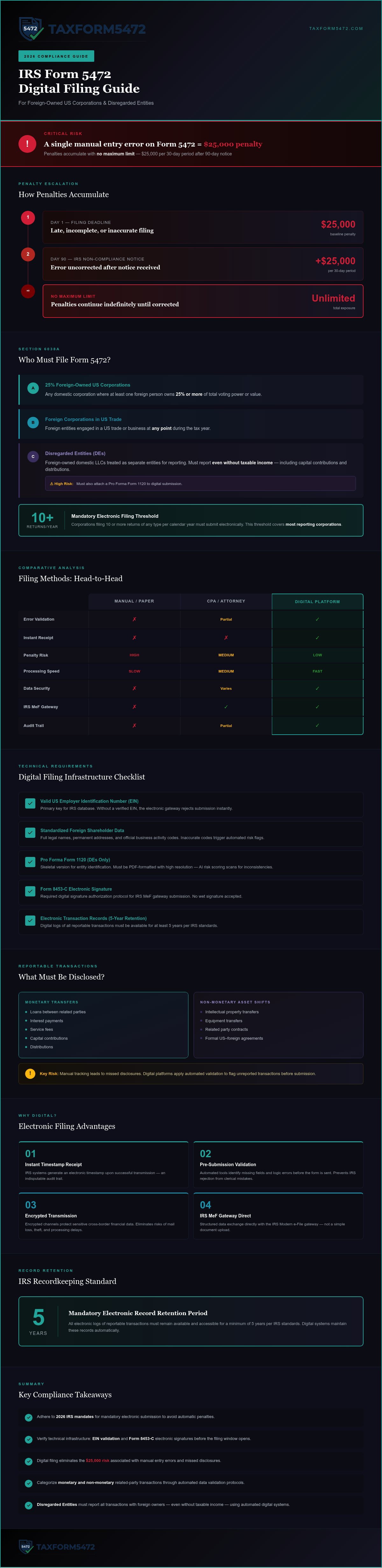
A single manual entry error on Form 5472 now carries a $25,000 price tag. For foreign-owned US corporations, the margin for error has disappeared. Traditional paper filing is no longer a viable strategy for 2026 compliance. It's slow. It's prone to transcription mistakes. It lacks immediate validation. Utilizing irs form 5472 digital filing is the only way to secure a definitive submission receipt and eliminate ambiguity.
You already understand that reportable transaction definitions are complex. Manual tracking leads to missed disclosures and avoidable audits. This guide provides the technical framework to execute a precise electronic submission. You'll learn how to leverage automated validation to reach a zero-error state. We'll examine the 2026 digital requirements, clarify transaction categories, and outline the workflow for a successful IRS transmission. Replace manual uncertainty with digital precision. Secure your compliance status today. Focus on accuracy. Eliminate risk. Ensure your business meets every federal standard without delay.
Key Takeaways
- Adhere to 2026 IRS mandates for mandatory electronic submission and automatic penalty avoidance.
- Verify technical infrastructure requirements including EIN validation and Form 8453-C electronic signatures.
- Execute irs form 5472 digital filing to eliminate the $25,000 risk associated with manual entry errors.
- Categorize monetary and non-monetary related-party transactions through automated data validation protocols.
- Compare the utility of automated preparation platforms against traditional manual or high-cost filing methods.
2026 Digital Filing Mandates and Standards
The IRS has transitioned to a digital-first environment for the 2026 tax year. Under the Section 6038A regulatory framework, international ownership triggers specific reporting duties that are now strictly enforced. Executing an accurate irs form 5472 digital filing is the primary method to ensure compliance. The IRS now mandates electronic submission for corporations filing 10 or more returns of any type during the calendar year. This threshold effectively covers most reporting corporations. Precision is mandatory. The penalty landscape has shifted toward higher enforcement. A baseline $25,000 penalty applies to late, incomplete, or inaccurate filings. If the IRS issues a notice of non-compliance and the error remains uncorrected after 90 days, an additional $25,000 is assessed for every 30-day period. These costs accumulate without a maximum limit.
Reporting Corporation Criteria
Identification of the reporting entity is the first step in the compliance workflow. Three primary categories define these corporations:
- 25% Foreign-Owned US Corporations: Any domestic corporation where at least one foreign person owns 25% of the total voting power or value.
- Foreign Corporations in US Trade: Foreign entities engaged in a US trade or business at any point during the tax year.
- Disregarded Entities (DEs): Domestic limited liability companies (LLCs) that are foreign-owned and treated as entities separate from their owners for reporting purposes.
Disregarded entities face unique challenges. Even without taxable income, a DE must report transactions with its foreign owner. This includes capital contributions and distributions. Failure to identify these reportable transactions is a leading cause of the $25,000 penalty. Digital systems flag these requirements automatically. It's a critical safeguard for international owners who don't have a physical US presence.
Digital Submission Advantages
Electronic filing provides a streamlined alternative to legacy paper processes. The most significant benefit is the instant receipt confirmation. IRS systems generate an electronic timestamp immediately upon successful transmission. This provides an indisputable audit trail. Efficiency is built into the digital model. Automated validation tools identify missing fields and logic errors before the form is sent. This prevents the IRS from rejecting the filing due to simple clerical mistakes. Data security is also a priority. Encrypted transmission channels protect sensitive cross-border financial data. Physical mail carries risks of loss, theft, and processing delays that digital pathways eliminate. For 2026, the digital route is the only professional choice for risk management.
Core Electronic Filing Infrastructure
Successful irs form 5472 digital filing depends on a precise technical foundation. It's not a simple document upload. It's a structured data exchange between your systems and the IRS modern e-file (MeF) gateway. You must establish this infrastructure before the filing window opens. This includes verifying identification numbers and preparing specific digital attachments that meet current federal standards. Precision at the infrastructure level eliminates the friction that leads to rejection.
EIN and Identifying Information
Every reporting corporation must possess a valid US Employer Identification Number (EIN). This is the primary key for the IRS database. Without a verified EIN, the electronic gateway will reject the submission instantly. You must also standardize foreign shareholder data. This includes full legal names and permanent addresses. Use the official business activity codes from the IRS instructions. Inaccurate codes trigger automated risk flags. If a foreign owner lacks a US taxpayer ID, you must use the specific "Foreign" identification protocols. Precision here prevents immediate rejection. Using a specialized preparation tool like TaxForm5472 ensures your data matches these strict IRS formatting rules.
Digital Attachment Requirements
Foreign-owned Disregarded Entities (DEs) face a unique technical hurdle. They must attach a Pro Forma Form 1120 to their digital submission. This is not a full tax return; it's a skeletal version used purely for identifying the entity. PDF formatting is critical here. The IRS utilizes AI-driven risk scoring to scan these attachments for inconsistencies. Low-resolution scans or non-searchable PDFs increase the likelihood of an audit. Ensure all supplemental statements are clear and properly indexed.
Digital record-keeping is the final pillar. Maintain electronic logs of all reportable transactions. The IRS standards require these records to be available for at least five years. Core records include:
- Monetary transfers: Loans, interest, and service fees.
- Non-monetary asset shifts: Intellectual property or equipment transfers.
- Related party contracts: Formal agreements between the US entity and foreign owners.
Electronic signature protocols also apply. Form 8453-C serves as the signature authorization for the e-filed return. Complete this form and store it digitally. It's your proof of authorization. This infrastructure creates a defensible compliance trail. It protects your business from the $25,000 penalty. Focus on these technical details now to avoid processing delays. The irs form 5472 digital filing process is a tool for accuracy. Use it to secure your corporate standing.
Comparative Analysis: Filing Methods
Selection of a filing method dictates the baseline risk for your US entity. Manual paper filing, traditional CPA engagement, and automated SaaS platforms represent the three primary paths. Each varies in cost, speed, and accuracy. For foreign owners, the choice impacts the probability of incurring the $25,000 penalty described in previous sections. Precision is the goal. Legacy methods often fail to deliver it.
Manual paper filing is the highest-risk method. Paper forms are subject to physical loss during transit. Transcription errors by IRS staff are common. There's no immediate confirmation of receipt. Processing times extend into months. It's an outdated approach that lacks the validation checks necessary for 2026 standards. It leaves your compliance status in a state of uncertainty for far too long.
CPA preparation offers professional oversight but at a high cost. Traditional workflows involve manual document back-and-forth. This creates a bottleneck. While accurate, the high hourly rates or fixed fees for a standard reporting form are often disproportionate to the task complexity. Human error remains a factor in manual data entry, even within a professional firm. The process is slow and often opaque.
Automated SaaS platforms provide a utilitarian alternative. These tools use logic-based validation to catch errors before submission. Filing is finalized in minutes rather than days. It's a direct, efficient path to compliance.
Cost and Efficiency Metrics
Cost efficiency is a primary driver for the shift toward automation. CPA firms often charge significant premiums for manual review. In contrast, SaaS models utilize flat filing fees. This provides cost predictability for your annual budget. Turnaround time is another critical metric. Electronic submission provides an instant timestamp. Mail-in forms leave the corporation in a state of compliance limbo for weeks. Automated workflows remove the human element. This reduces the risk of missed deadlines or forgotten attachments. It's a faster, more reliable system.
Scalability for Multiple Entities
Foreign owners often manage multiple US LLCs. Managing these through separate manual filings is inefficient and invites oversight. A digital dashboard allows for centralized compliance monitoring. You can view the status of every entity in one interface. Bulk data import capabilities further streamline the process for complex corporate structures. This ensures that every subsidiary meets the irs form 5472 digital filing requirements simultaneously. One platform handles the entire portfolio. This centralized approach prevents entities from falling through the cracks. It turns a complex administrative burden into a manageable digital task. Choose the method that prioritizes speed and verifiable results. Automation is the standard for professional 2026 compliance.
Digital Preparation and Validation Steps
Precise preparation is the core of irs form 5472 digital filing. It transforms raw financial data into a compliant federal return. The process moves through three phases: aggregation, validation, and transmission. Each phase must be error-free to avoid the $25,000 penalty risk mentioned previously. Digital tools facilitate this by applying hard logic to every entry. Accuracy is the only priority. You don't need a tax degree to use a specialized tool; you need organized data.
Related party verification is a technical safeguard. You must confirm the legal status and tax residency of every foreign owner. Inaccurate shareholder data is a primary cause of return rejection. Digital preparation platforms cross-reference this data against IRS formatting standards. Real-time error checking identifies missing business activity codes or invalid address structures. This proactive validation ensures the return meets the 2026 standards before the transmission starts. It's a binary outcome. The data is either correct or it isn't.
Reportable Transaction Identification
Categorization is mandatory. You must identify all monetary exchanges between the US entity and its foreign owners. This includes loans, sales, and rents. Non-monetary exchanges are equally critical. Intellectual property transfers or equipment swaps require reporting at fair market value. Small transactions aren't exempt. The IRS applies a zero-tolerance policy for missing data, regardless of the dollar amount. Digital tools apply logic validation to these entries. They flag inconsistencies before you finalize the form. This prevents simple math errors from becoming expensive compliance failures.
Threshold management is also automated. Systems track cumulative totals to ensure all reportable events are captured. You don't have to guess which transactions qualify. The software applies the current Section 6038A rules to your data set. This removes the ambiguity that often leads to incomplete filings.
The Submission Workflow
The workflow concludes with the creation of a technical transmission file. For Disregarded Entities, this includes the digital attachment of the Pro Forma Form 1120. Ensure this attachment is a high-resolution, machine-readable PDF. Low-quality scans trigger automated IRS risk flags. The digital signature process follows. Use Form 8453-C to authorize the e-file transmission. This is a paperless, efficient step. Once authorized, the system generates the IRS-specific XML file. This is the only format the modern e-file gateway accepts.
Transmission is instantaneous. You'll receive a time-stamped confirmation from the IRS gateway once the file is accepted. Archive this file immediately. It's your primary defense in a compliance audit. You can prepare your Form 5472 using an automated interface designed for these specific digital requirements. This workflow replaces manual uncertainty with a repeatable, professional standard. Secure your submission receipt today. Avoid the risks of delayed processing.
The taxform5472.com Solution
Efficiency is the primary objective. TaxForm5472 operates as a precise tool for irs form 5472 digital filing. It removes the friction of manual entry. It eliminates the need for expensive, slow CPA back-and-forth. The platform is a dedicated utility. It focuses exclusively on Form 5472 preparation. This specialization ensures every technical requirement for 2026 is met. You get direct access to a streamlined interface. It's built for international owners who value time and accuracy. Successful irs form 5472 digital filing should be a routine administrative task, not a source of corporate risk.
Platform Features
Guided workflows define the user experience. You input data; the system applies the logic. It handles complex monetary and non-monetary transaction categories automatically. For Disregarded Entities, the system performs the automatic generation of Pro Forma Form 1120. This is a critical technical requirement often missed in manual filings. You can learn more about these workflows in our Automated Form 5472 Preparation: 2026 Efficiency and Compliance Guide. Secure digital infrastructure protects your data. Every transmission uses encrypted channels. Reliability is built into the architecture. It's a professional standard for cross-border reporting.
Compliance Assurance
Accuracy is the only defense against IRS scrutiny. The platform utilizes built-in logic to prevent error-based rejections. These errors often trigger the $25,000 baseline penalty mentioned in earlier sections. Our system validates EINs, addresses, and transaction totals in real-time. It's a proactive compliance shield. Review the technical standards in our IRS Form 5472 Filing: 2026 Compliance and Automation Guide. Once the submission is complete, you receive a definitive filing receipt. This receipt is your proof of submission. It's your record of federal compliance.
Predictability is essential for international business operations. TaxForm5472 uses a flat SaaS filing fee structure. You know the cost before you start. There are no hourly surprises. No hidden administrative fees. It's a utilitarian model designed for the modern corporation. The 2026 filing window is active. Don't risk manual delays or transcription errors. Use a tool designed specifically for the task. Secure your corporate standing with a platform that prioritizes precision. Start your filing process now. Eliminate the risk of $25,000 penalties today.
Secure 2026 Compliance Status
Digital mandates for 2026 are now in effect. Manual processing is a liability. Precision is the only standard that eliminates the $25,000 penalty risk. You've seen how automated validation creates a defensible compliance trail. Transitioning to irs form 5472 digital filing replaces manual uncertainty with a repeatable, professional workflow. It's an essential shift for every foreign-owned US corporation. The IRS gateway requires specific XML formatting and secure transmission protocols that manual forms cannot provide.
Utilize a tool designed for this purpose. Focus on your core business while our purpose-built SaaS interface handles the technical requirements. Benefit from automated IRS compliance and secure data processing. The filing window is active. Don't wait for a notice of non-compliance. Take control of your federal reporting duties today. File Form 5472 Online Now. Complete your submission with confidence. Your corporate standing depends on precise action.
Frequently Asked Questions
Can I file Form 5472 online without a CPA?
Yes. You can execute irs form 5472 digital filing using automated SaaS platforms like TaxForm5472. These tools provide the necessary logic and validation without high hourly CPA fees. The system guides you through data entry and ensures every entry meets federal standards. It's a utilitarian alternative to traditional consultancies. It prioritizes speed, accuracy, and professional results. Use this tool to manage your annual compliance duties efficiently and securely.
Is digital filing mandatory for foreign-owned LLCs in 2026?
Yes, for most entities. The IRS mandates electronic submission for corporations filing 10 or more returns of any type during the calendar year. This threshold includes information returns and W-2s. Even if your entity falls below this limit, digital filing remains the professional standard for 2026. It provides an instant receipt confirmation. It eliminates the risks of physical mail delays and manual processing errors that cause penalties.
How much does it cost to file Form 5472 digitally?
Costs vary by provider, but TaxForm5472 employs a predictable SaaS filing fee model. This replaces the expensive hourly rates associated with traditional CPA firms. It's a flat cost for each preparation. This allows for clear annual budgeting and financial planning. You pay for the utility of a specialized tool. There are no hidden administrative charges or manual document fees. It's an economical and direct path to compliance.
What happens if I miss the digital filing deadline?
Missing the deadline triggers an immediate $25,000 penalty. This penalty applies to late, incomplete, or inaccurate filings. If the failure continues after IRS notification, additional $25,000 charges accrue every 30 days. There's no maximum limit on these penalties. Digital filing helps avoid these risks by providing faster preparation and instant submission verification. It's the most reliable way to meet strict federal deadlines and protect your business from loss.
Do I need a separate Form 5472 for each related party?
Yes. A reporting corporation must file a separate Form 5472 for each foreign or domestic related party with which it had a reportable transaction. This requirement is absolute and non-negotiable. Missing even one related party can lead to the $25,000 penalty. Automated dashboards simplify this by managing multiple filings in one interface. They ensure no related party transactions are overlooked during the annual reporting cycle. Efficiency is the goal.
Can I file Form 5472 if I do not have an SSN or ITIN?
Yes. Foreign shareholders often lack a US Social Security Number or ITIN. In these instances, you must follow specific IRS identification protocols. This involves using "Foreign" identifiers and providing the owner's foreign tax identification number. Precise data entry is required for acceptance. Digital tools ensure these specific fields are formatted correctly to meet federal submission standards. It's a technical requirement that automation handles with total precision for users.
How do I attach Form 5472 to my digital Form 1120?
Digital systems handle this integration automatically. For Disregarded Entities, the process includes attaching a Pro Forma Form 1120 as a high-resolution, machine-readable PDF. The electronic gateway accepts these components as part of a single XML transmission file. It's a streamlined digital workflow. It eliminates the need for physical attachments or manual mailing of supplemental statements. You receive one confirmation for the entire submission package. This ensures your records remain complete.
Is the $25,000 penalty avoidable through digital filing?
Yes. Utilizing irs form 5472 digital filing reduces the risk of clerical errors and transcription mistakes. Automated validation checks for missing data or logical inconsistencies before submission. This ensures the filing meets all IRS requirements on the first attempt. An instant receipt confirms the filing was accepted on time. This provides a defensible record of compliance that manual paper methods cannot match. Secure your business status with digital precision.