
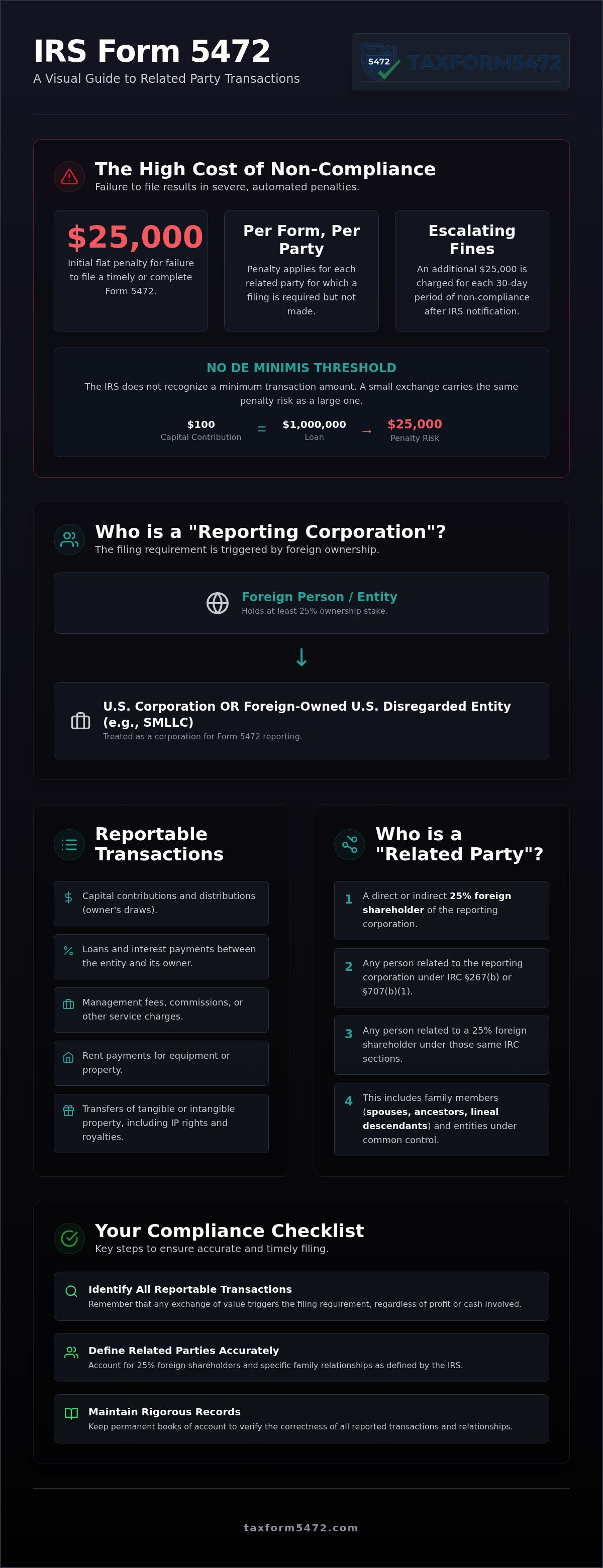
A $100 capital contribution carries the same $25,000 penalty risk as a million-dollar loan. The IRS does not recognize a de minimis threshold for reporting. Even small, non-monetary exchanges trigger the filing requirement. For the 2026 tax year, the IRS uses automated data matching to identify undisclosed form 5472 related party transactions with high accuracy.
Compliance for foreign-owned U.S. entities is intentionally broad and punitive. It's natural to feel uncertain about which cross-border movements require disclosure. Accuracy is your only defense against the flat $25,000 non-compliance fee. This guide ensures your reporting is precise and complete. You'll gain a clear list of reportable items to file with total confidence.
We provide a definitive list of reportable transactions for 2026. This includes monetary payments, property transfers, and owner's draws. We also detail the specific April 15 deadlines and the requirements for foreign-owned disregarded entities. Focus on compliance now to eliminate the risk of automated IRS penalties later.
Key Takeaways
- Identify all reportable form 5472 related party transactions. Value exchanges trigger filing requirements regardless of profit or cash flow.
- Define related parties accurately. Filing obligations include 25% foreign shareholders and specific family relationships under IRS guidelines.
- Distinguish between monetary and non-monetary transfers. Reporting applies to services, goods, and capital contributions without de minimis thresholds.
- Establish rigorous record-keeping protocols. Maintain permanent books of account to verify the correctness of all reported transactions.
- Adopt automated preparation tools. Minimize manual filing risks and secure compliance against the $25,000 non-compliance penalty.
Defining Form 5472 Related Party Transactions
Form 5472 is a mandatory information return. It tracks specific financial activities between a U.S. reporting corporation and its foreign related parties. The IRS requires this filing for any U.S. corporation with at least 25% direct or indirect foreign ownership. This includes domestic corporations and, critically, foreign-owned U.S. disregarded entities. The definition of form 5472 related party transactions is broad. It encompasses any exchange of value between the U.S. entity and its foreign owners or affiliates.
A common misconception involves the tax status of Single-Member LLCs (SMLLCs). While these entities are often "disregarded" for federal income tax purposes, the IRS treats them as corporations for Section 6038A reporting. If you own a U.S. LLC as a non-resident, you must file to disclose these movements. There is no de minimis threshold. Even a $100 capital contribution triggers the requirement. The IRS prioritizes the visibility of the relationship over the net income of the transaction.
Reportable transactions aren't limited to cash sales. They include any transfer of tangible or intangible property. Common examples include:
- Capital contributions and distributions (owner's draws).
- Loans and interest payments between the owner and the LLC.
- Management fees, commissions, or service charges.
- Rent payments for equipment or office space.
- Transfer of intellectual property rights or royalties.
The Purpose of Section 6038A Compliance
The IRS uses Form 5472 to monitor transfer pricing. This ensures that cross-border entities don't shift profits to low-tax jurisdictions through artificial pricing. Transparency in international ownership structures is the primary goal. Maintaining foreign owned us corporation tax compliance requires a full disclosure of these relationships. For a broader perspective on the regulatory framework, see this Form 5472 overview. This data helps the IRS identify potential tax avoidance and ensures U.S. entities pay tax on income earned within the country.
The Consequences of Non-Reporting
The cost of non-compliance is high. The IRS assesses a standard $25,000 penalty for failure to file a timely or complete return. This penalty applies per related party. If your corporation has three foreign related parties and fails to report transactions with any of them, the total penalty reaches $75,000. Penalties also apply if the form is filed but considered "incomplete" due to missing transaction details.
The risk doesn't end with the initial fine. If the IRS notifies you of a failure and you don't correct it within 90 days, additional fines apply. The IRS adds $25,000 for each 30-day period the failure continues. There is no upper limit on these cumulative penalties. Every field must be accurate to avoid these assessments.
Identifying Related Parties under IRS Guidelines
Reporting begins with the precise identification of a "Related Party." A U.S. entity must file if it engages in form 5472 related party transactions with a 25% foreign shareholder. This threshold applies to any person or entity holding at least 25% of the total voting power or value of all stock classes. The IRS provides authoritative definitions on the About IRS Form 5472 page. This status is determined at any time during the taxable year.
The definition extends beyond simple shareholders. It includes family members such as spouses, ancestors, and lineal descendants. It also covers any person related to the reporting corporation under Section 267(b) or 707(b)(1) of the Internal Revenue Code. These sections flag relationships between corporations and individuals owning more than 50% of the stock, or partnerships with common ownership. Entities under common control or ownership are also considered related parties.
Direct vs. Indirect Ownership
Ownership classification is rarely linear. Direct ownership occurs when an individual or entity holds the interest in the U.S. company directly. Indirect ownership applies when the interest is held through intermediary holding companies, trusts, or partnerships. Constructive ownership rules are the most complex. These rules attribute shares owned by one party to another based on their relationship. For example, shares owned by a foreign parent company are often attributed to its foreign subsidiaries for reporting purposes. You must look through layers of ownership to identify the ultimate foreign owners.
Common Related Party Examples
Identifying these relationships is critical for compliance. Each missed relationship represents a separate filing failure. Standard scenarios include:
- A foreign parent company owning a U.S. subsidiary.
- A non-U.S. individual owning 100% of a U.S. Single-Member LLC.
- Brother-sister relationships, where two companies are owned by the same foreign parent.
- A foreign partnership with a 25% interest in a U.S. corporation.
Misidentifying a related party leads to omitted forms. Each omitted form triggers a $25,000 penalty. Using an automated IRS Form 5472 preparation tool helps map these relationships accurately. This ensures no reportable transaction is missed due to ownership complexity. Precision in these definitions is the first step toward avoiding automated IRS enforcement actions.
Reportable Monetary vs. Non-Monetary Transactions
The IRS requires disclosure of all value exchanges. Reporting isn't limited to traditional sales or bank transfers. Many filers overlook activities that don't involve an invoice. These omissions lead to an "incomplete" return status. Any form 5472 related party transactions must be categorized correctly on the form. The Official Instructions for Form 5472 provide a granular breakdown of these categories. Precision here prevents the standard $25,000 penalty assessment.
Transactions are generally divided into monetary and non-monetary categories. Both require disclosure if they occur between the U.S. reporting corporation and a foreign related party. There is no minimum dollar threshold for these disclosures. Even a nominal exchange of value must be recorded. Accuracy depends on your ability to identify these movements within your accounting records.
Common Monetary Transactions
Monetary transactions involve direct cash flow. These are usually visible in your ledger. You must report the total gross dollar value for the taxable year. If a transaction occurs in a foreign currency, you must convert it to U.S. dollars. Use a consistent exchange rate throughout the year. Key examples include:
- Inventory sales: Purchases or sales of raw materials and finished goods.
- Rents and Royalties: Payments for the use of tangible property or intellectual rights.
- Interest: Cash payments on loans between the U.S. entity and its foreign owners.
- Service Fees: Commissions, management fees, and technical assistance charges.
Capital movements are also reportable. This includes cash capital contributions from the foreign owner to the U.S. entity. It also includes distributions or "draws" taken by the owner. Even if the corporation has no taxable income, the movement of cash remains a reportable event.
Significant Non-Monetary Transactions
Non-monetary transactions involve the exchange of value without cash. These are high-risk areas for IRS audits. The IRS considers these "deemed" transactions. You must report the fair market value of the items or services exchanged. Common examples include:
- Intangible Property: Transferring patents, trademarks, or copyrights without payment.
- Unpaid Services: Work performed by a foreign parent for the U.S. entity without an invoice.
- Debt Assumption: A foreign related party paying off a debt owed by the U.S. corporation.
- Property Use: Using a foreign owner's equipment or office space without a formal lease.
Reporting corporations must maintain records for these exchanges. The IRS assumes that form 5472 related party transactions occur at "arm's length." If value is transferred without payment, you must justify the valuation used on the form. This requires documenting the basis for the fair market value assigned to the transaction. Automated tools help categorize these items to ensure no non-monetary exchange is missed during the filing process.
Documentation and Record Maintenance Requirements
The IRS mandate for record maintenance is absolute. Reporting corporations must keep permanent books of account. These records must establish the correctness of all form 5472 related party transactions. Sufficiency is measured by the ability to verify the gross value reported. Documentation must be ready for immediate inspection. If the IRS requests records and you don't provide them, the $25,000 penalty applies instantly. This penalty is assessed per form and per related party. Maintaining a clear audit trail is your primary defense against automated enforcement. The IRS often matches these records against bank statements and international wire transfers during routine reviews.
Essential Records for Related Party Exchanges
Every transaction requires a detailed paper trail. The IRS expects these documents to reflect "arm's length" pricing. This means the price should mirror what an unrelated third party would pay.
- Invoices and receipts: Must show the date, amount, and nature of the exchange.
- Loan documentation: Requires signed agreements and proof of interest payments.
- Lease agreements: Must document the fair market value of the rental for property or equipment.
- Transfer Pricing: Large transactions require a study to justify the price and prevent profit shifting.
Without these records, the IRS may reallocate income or disallow deductions. This leads to higher tax liabilities and additional interest charges. Every non-monetary exchange also requires a valuation memo to justify the reported amount.
Retention Periods and Best Practices
Standard retention is three years from the filing date. A seven-year period is safer for complex cross-border activities. Digital storage provides a searchable database. This is critical for high-volume transactions. Accessibility is a key metric for the IRS. If records are stored in a foreign country, you must produce them within 60 to 90 days of a formal request. Using a form 5472 checklist ensures your digital archive is complete before each filing season. Consistent annual reviews prevent data gaps that trigger penalties. Digital backups should be encrypted and stored in a secure cloud environment for immediate retrieval.
Precision in record-keeping is non-negotiable for foreign-owned entities. Use automated IRS Form 5472 preparation to maintain a compliant filing history and secure your documentation trail.
Streamlining Form 5472 Preparation and Filing
Manual filing is a high-risk strategy. Small errors in reporting form 5472 related party transactions lead to an "incomplete" return status. The IRS interprets missing data as non-compliance. This triggers the $25,000 penalty automatically. Modern digital platforms eliminate these risks by standardizing data entry. Automated Form 5472 preparation ensures every required field is populated correctly. It guides users through the logic of complex ownership structures. This approach saves time and secures your filing status. Electronic submission is the final step. It provides a digital timestamp for your records. This is your proof of timely compliance.
The IRS transition toward automated enforcement makes precision vital. Data matching between bank records and tax filings is now standard. Any discrepancy in reported transactions flags the return for review. Digital platforms use built-in logic to identify these gaps. They ensure that your disclosure matches your financial reality. This reduces the need for manual cross-referencing. It's a streamlined process built for the modern professional. You spend less time on paperwork and more time on business operations.
Choosing Between a CPA and Software
Traditional CPAs provide high-touch consulting. This service comes at a significant cost. It's often unnecessary for standard form 5472 related party transactions. Software is more efficient. It removes the back-and-forth of manual document sharing. You can compare form 5472 cpa vs software to see which fits your business model. Software solutions offer precise, rule-based preparation. This reduces the likelihood of human oversight. It's a utilitarian choice for results-oriented professionals. Software also scales easily as your number of related parties grows. You maintain control over the data and the deadline.
Efficiency in 2026 Compliance
Compliance in 2026 requires speed and accuracy. Modern platforms integrate directly with your bookkeeping data. This allows for faster identification of reportable events. Automatic validation checks are essential. They flag missing transactions before you submit. This prevents the "incomplete" return penalties mentioned in previous sections. Finalizing your IRS Form 5472 filing securely online provides immediate confirmation. Electronic submission is the standard for 2026. It ensures the IRS receives your data by the April 15 deadline. Secure digital storage keeps your history accessible for the required retention period. This is the most efficient path to total IRS compliance.
Secure Your 2026 Compliance Status
Reporting form 5472 related party transactions is a non-negotiable requirement for foreign-owned U.S. entities. The IRS enforces a strict $25,000 penalty for every missing or incomplete form. Success in 2026 depends on the accurate identification of both monetary and non-monetary exchanges. You must maintain permanent books of account to verify every figure reported. Even small capital contributions trigger this mandatory disclosure. It's a binary requirement: you're either compliant or you're at risk.
Automation is the most effective way to secure your standing. Digital platforms eliminate the errors common in manual filing and CPA-led processes. Our tool is designed specifically for foreign-owned corporations and disregarded LLCs. It guides you through complex ownership rules with precision. You can file your Form 5472 securely online today to ensure automated IRS compliance. Avoid the $25,000 penalty and protect your business from automated enforcement actions. Take control of your international tax obligations now. Precise reporting saves time and eliminates financial risk. Your compliance journey is straightforward with the right tools in place.
Frequently Asked Questions
What is the $25,000 penalty for Form 5472?
The IRS assesses a flat $25,000 fee for failing to file a timely or complete return. This penalty applies to each required form and related party separately. If the failure continues for more than 90 days after notification, additional $25,000 fines accumulate every 30 days. There's no upper limit on these cumulative penalties. Accuracy is essential to avoid these automated assessments and protect your business from significant financial loss.
Do I need to report zero-dollar transactions on Form 5472?
Reporting is required for any exchange of value, even without immediate cash flow. Zero-dollar transactions often refer to non-monetary exchanges like property transfers or services performed without an invoice. You must report the fair market value of these exchanges. If no value is exchanged and no transaction occurs, a filing might not be required. Always verify the nature of the relationship and any underlying value transfers before skipping a filing.
Is a loan from a foreign owner considered a reportable transaction?
Yes. Loans between a U.S. corporation and its foreign owner are high-priority reportable events. You must disclose the principal amount borrowed or repaid during the year. Interest payments are also reportable in a separate category. Ensure you maintain signed loan agreements and interest rate documentation. These records establish the correctness of your form 5472 related party transactions and serve as your primary defense during an IRS audit.
Who is considered a 25% foreign shareholder?
A 25% foreign shareholder is any non-U.S. person or entity owning at least 25% of the voting power or total stock value. This includes direct, indirect, and constructive ownership. Constructive rules attribute shares from family members or related entities to the primary owner. Identifying these individuals is the first step in determining your filing obligations for 2026. You must look through holding companies to find the ultimate beneficial owners.
Can I file Form 5472 without a related party transaction?
No. The IRS only requires Form 5472 when a reporting corporation has at least one reportable transaction with a foreign related party. If your foreign-owned U.S. entity had no financial or non-monetary exchanges during the year, you don't need to file this specific form. However, even a small capital contribution or an owner's draw counts as a transaction. Most active foreign-owned entities will trigger a filing requirement through these common activities.
What happens if I forget to report a non-monetary transaction?
The IRS treats an omitted non-monetary exchange as an incomplete filing. This triggers the standard $25,000 penalty. Automated data matching between bank records and tax returns helps the IRS identify these omissions. Non-monetary items like the use of property or unpaid services carry the same compliance weight as cash payments. Precision in identifying all form 5472 related party transactions is vital to ensure your return is considered complete.
How do I amend Form 5472 for a missed transaction?
To correct a mistake, you must file an amended return. Submit a new Form 1120 with the corrected Form 5472 attached. Ensure the Amended Return box is checked on both forms. You should include a statement explaining the changes made. Filing an amendment promptly may help mitigate additional penalties if the IRS hasn't yet issued a non-compliance notice. Speed is critical once an error is discovered to limit your liability.
Is an LLC capital contribution a reportable transaction?
Yes. Any movement of capital into a foreign-owned U.S. LLC is a reportable event. This includes initial investments and subsequent contributions made during the tax year. There is no de minimis threshold for these disclosures. Even a $100 contribution triggers the requirement. You must report the gross value of the contribution to maintain compliance and avoid the $25,000 non-filing penalty. Documentation of these transfers should match your bank records exactly.