
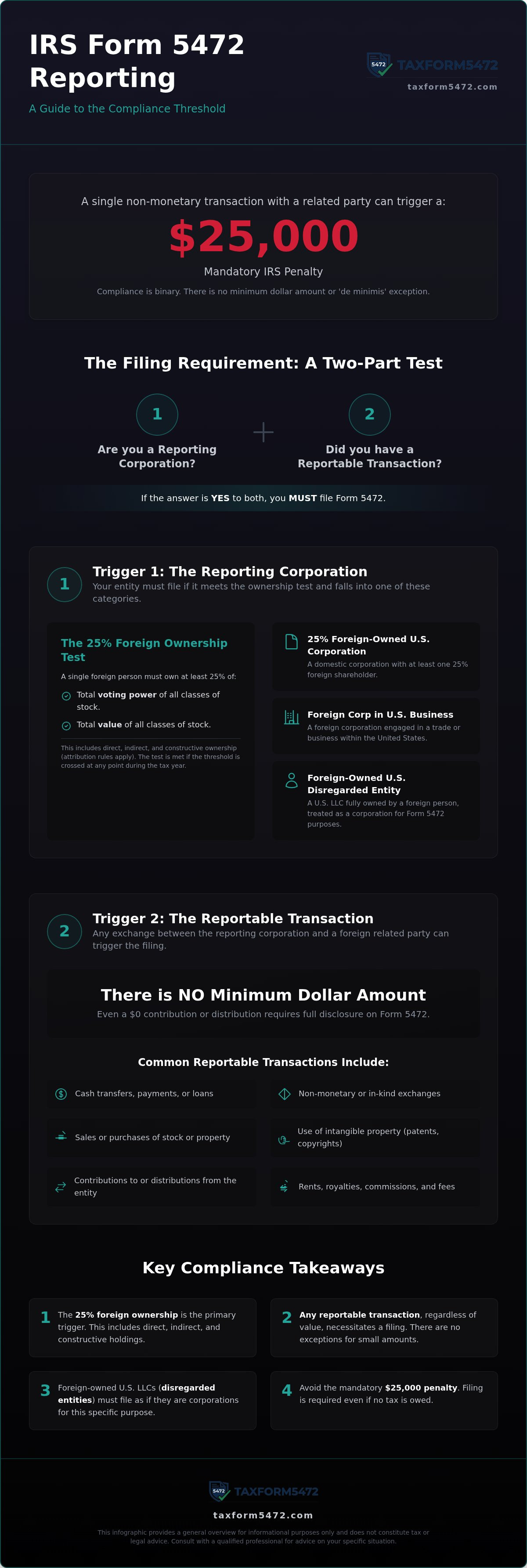
A single non-monetary transaction can trigger a $25,000 IRS penalty. Many foreign owners mistakenly look for a high dollar value before filing. The form 5472 reporting threshold is binary. If you meet the ownership criteria and engage in any reportable transaction, you must file. There is no minimum dollar limit for foreign-owned disregarded entities. Even a $0 contribution or distribution requires disclosure.
You likely find the "disregarded entity" status confusing. It's common to feel uncertain about whether indirect ownership counts toward the 25% limit. This guide eliminates that ambiguity. You will learn the specific ownership and transaction triggers that mandate a 2026 filing. We provide a definitive yes or no framework for your compliance requirements.
We analyze the 25% ownership rule, including direct and indirect holdings. We list every reportable transaction type, from cash transfers to entity formation. This review ensures you avoid the $25,000 non-compliance penalty. Use these facts to secure your 2026 IRS standing.
Key Takeaways
- Identify if a foreign person holds 25% of voting power or stock value. This is the primary trigger for the form 5472 reporting threshold.
- Recognize that any reportable transaction necessitates a filing. There is no minimum dollar limit or de minimis exception for related-party exchanges.
- Treat foreign-owned U.S. LLCs as domestic corporations for reporting purposes. Disregarded status for income tax does not exempt these entities from information returns.
- Avoid the mandatory $25,000 penalty for non-compliance. Filing is required even if the transaction is non-monetary or no tax is owed.
- Utilize automated software to identify reportable events. Digital tools eliminate human error when managing complex international ownership structures.
Defining the Form 5472 Reporting Threshold
The form 5472 reporting threshold is a mandatory regulatory trigger. It consists of two specific components. First, the entity must qualify as a reporting corporation. Second, the entity must engage in at least one reportable transaction during the tax year. Both conditions must be present. If either is absent, the filing requirement does not exist. However, the IRS maintains a broad interpretation of these triggers. Even minor interactions can mandate a filing. Compliance is not optional.
A Form 5472 Overview clarifies that the IRS uses this data to monitor international tax compliance. It serves as a tool for transparency. Missing this threshold leads to an immediate $25,000 penalty. This penalty applies per form. Multiple related parties often require multiple forms. The cost of non-compliance is high.
Who is a Reporting Corporation?
Identification is the first step. Three specific entity types qualify as reporting corporations. U.S. corporations with at least 25% foreign ownership meet the criteria. This ownership is measured by voting power or total stock value. Foreign corporations engaged in a U.S. trade or business also qualify. Finally, domestic disregarded entities, such as single-member LLCs owned by a foreign person, are included. These entities are treated as corporations specifically for Form 5472 purposes. Even if an LLC pays no income tax, it must still meet reporting standards.
The Role of Section 6038A
Section 6038A provides the statutory foundation for these rules. It gives the IRS authority to demand information from foreign-owned entities. The law requires these corporations to maintain specific records. These records must verify the accuracy of every reportable transaction. For 2026, Section 6038A's primary compliance objective is to provide the IRS with sufficient data to identify and audit cross-border transactions that may impact U.S. tax revenue.
The form 5472 reporting threshold applies to any single foreign person owning 25% of the entity. This ownership can be direct or indirect. The IRS looks through layers of holding companies to find the ultimate owner. If that owner is foreign, the threshold is met. Transactions are equally scrutinized. They include cash payments, property transfers, and the use of intangible assets. There is no minimum dollar amount for these transactions. A $1 transfer triggers the requirement. Non-monetary exchanges also count.
Entity status is permanent for the tax year. Ownership at any point during the year triggers reporting status. Compliance is binary. You either file or face the $25,000 fine. No "de minimis" exception exists for the ownership portion of the threshold. Precision is required to avoid IRS scrutiny.
The 25% Foreign Ownership Requirement
The form 5472 reporting threshold centers on ownership. A U.S. corporation qualifies as a reporting corporation if a foreign person owns at least 25% of its equity. This measurement includes total combined voting power or the total value of all stock classes. The rule applies if the threshold is met at any point during the tax year. Even a single day of 25% ownership triggers the requirement.
Foreign persons include individuals, partnerships, and corporations. Estates and trusts also fall under this definition. Attribution rules are comprehensive. You may trigger the requirement without holding physical certificates. The IRS Form 5472 Information page defines these categories strictly. The IRS employs a wide lens for ownership to ensure transparency.
Direct vs. Indirect Ownership
Direct ownership involves shares registered in the entity's name. Indirect ownership occurs through a chain of other businesses. If a foreign entity owns a holding company that owns the U.S. corporation, the foreign entity is an indirect owner. The IRS looks through these layers to identify the reporting obligation.
Constructive ownership is a third category. Shares are attributed from family members or related interests. This prevents the use of complex structures to hide control. The IRS aggregates these holdings to determine if you meet the form 5472 reporting threshold. Precision in these calculations is essential. Overlooking a related-party interest leads to non-compliance.
Identifying the 25% Foreign Shareholder
Calculation requires two checks. You must assess voting power. You must also assess total stock value. Exceeding 25% in either category triggers the filing. Ownership percentages often fluctuate during a fiscal year. Mid-year acquisitions change status instantly. You cannot average ownership over twelve months.
The Ultimate Beneficial Owner (UBO) is the primary focus. The IRS seeks the individual who controls the assets. Complex international structures do not hide this responsibility. The agency tracks the flow of influence to the top level. Identifying every 25% shareholder is a prerequisite for a complete return.
Manual ownership tracking is inefficient. It increases the risk of a $25,000 penalty. Utilizing automated IRS Form 5472 Preparation ensures accuracy. It manages attribution rules and ownership shifts without manual entry. This efficiency protects your entity from avoidable IRS scrutiny.
The criteria remain strict for 2026. Every foreign person holding 25% must be identified. This includes their tax identification numbers and legal addresses. Failure to disclose these details results in an incomplete filing. An incomplete filing is treated as a failure to file. The $25,000 penalty applies immediately after the deadline passes.
Identifying Reportable Transactions: No Minimum Dollar Amount
The form 5472 reporting threshold is absolute. Unlike many tax filings, no "de minimis" or minimum dollar limit exists for reportable transactions. A $1 transfer carries the same $25,000 penalty risk as a $1 million exchange. Filing is mandatory once the ownership criteria are met and any interaction occurs. The Official Instructions for Form 5472 confirm that even non-monetary value transfers trigger this requirement. Precision is the only way to ensure compliance.
Related parties include the direct 25% foreign owner. They also include any other entity controlled by that owner. Transactions between these related parties must be disclosed. The IRS uses this data to track the movement of capital and assets across borders. It isn't a suggestion; it is a regulatory demand. Failure to report a single minor event results in an immediate $25,000 fine.
Common Monetary Transactions
Monetary exchanges are the most visible triggers. These include the sale or purchase of inventory and tangible property. Payments for rents, royalties, and service fees also qualify. If your U.S. entity pays a foreign owner for administrative support, you've met the form 5472 reporting threshold. Interest paid on loans or advances between the U.S. corporation and the foreign related party must be documented. Every dollar moving between these entities requires an entry on the form.
- Inventory: Purchases or sales of goods.
- Services: Consulting, management, or technical fees.
- Financing: Interest payments or loan repayments.
- Rents: Leasing office space or equipment.
Non-Monetary and 'Deemed' Transactions
Non-monetary transfers are frequently overlooked by foreign owners. The exchange of intangible property is a major trigger. This includes patents, trademarks, and trade secrets. Capital contributions and distributions are also reportable events. This is particularly critical for disregarded entities and LLCs. A simple bank transfer from an owner to an LLC counts as a reportable transaction because the IRS classifies it as a capital contribution or a loan.
Deemed transactions involve value shifts where no physical cash moves. Forgiveness of debt is a primary example. If a foreign owner cancels a debt owed by the U.S. entity, a reportable event has occurred. The IRS treats the "value" of that forgiven debt as a transaction. You must assign a fair market value to these events and report them accurately. Automated systems are necessary to track these non-cash movements and avoid the $25,000 non-compliance penalty.
Reporting Thresholds for Disregarded Entities and LLCs
Foreign-owned U.S. LLCs face strict IRS scrutiny. These entities are treated as domestic corporations for information reporting purposes. This classification applies even if the LLC is a "disregarded entity" for federal income tax. The form 5472 reporting threshold for these businesses is effectively zero. Any movement of value between the owner and the entity creates a filing obligation. Owners must recognize that "disregarded" does not mean "exempt" from transparency requirements.
This reporting requirement ensures the IRS can track foreign capital. Even if your entity generates no income, the reporting rules apply. For a comprehensive look at corporate obligations, see our Foreign Owned US Corporation Tax: 2026 Compliance Guide. The agency uses Form 5472 to monitor cross-border activity regardless of the entity's tax-paying status. Precision in identifying these triggers is mandatory to avoid the $25,000 penalty.
The 'Small LLC' Misconception
Many owners assume zero revenue equals zero reporting. This is a costly error. The form 5472 reporting threshold is met through simple administrative actions. Common triggers for new LLCs include:
- Payment of state incorporation or annual franchise fees.
- Fees for registered agent services.
- Legal or accounting costs paid by the owner on behalf of the entity.
- Initial cash deposits to open business bank accounts.
These are "deemed" transactions under IRS rules. They must be disclosed even if the LLC bank account remains empty. The initial capital contribution is often the first trigger. Opening a bank account with $100 creates a reportable event. Paying for a business domain or hosting on behalf of the LLC also qualifies. These small expenses are frequently overlooked. However, the IRS treats them with the same weight as a million-dollar dividend. If your LLC existed for any part of the tax year, you likely met the threshold. Documentation of these minor expenses is required for 2026 compliance.
Exceptions to the Filing Requirement
Exceptions are extremely narrow and rare. An LLC is exempt only if no reportable transactions occurred during the entire tax year. This includes no contributions, no distributions, and no payments of expenses by the owner. Maintaining a "no activity" status is difficult. Even an annual report fee paid to the Secretary of State counts as a transaction. If the foreign owner pays this fee to keep the entity in good standing, the threshold is triggered. Consequently, almost every registered U.S. entity will have at least one reportable event per year.
Foreign corporations with no U.S. trade or business and no U.S. permanent establishment may also qualify for exemptions. These situations usually involve passive holding structures with zero annual activity. Treaty-based exemptions exist but have specific limitations. They don't automatically waive the Form 5472 requirement. You must still evaluate every related-party interaction. Protect your business by using automated IRS Form 5472 Preparation to verify your filing status. This tool identifies hidden transactions that manual reviews often miss.
Automated Solutions for Form 5472 Compliance
Manual determination of the form 5472 reporting threshold is high-risk. Human error often leads to $25,000 penalties. Digital platforms eliminate this volatility by automating the identification of reportable events. For 2026, precision is the expected standard. Every related party interaction must be captured without fail. Our IRS Form 5472 Filing: 2026 Compliance and Automation Guide provides a technical roadmap for this transition.
Efficiency defines modern tax compliance. Manual spreadsheets often fail to track complex attribution rules or indirect ownership chains. SaaS solutions verify 25% ownership across multiple tiers of holding companies. They ensure no transaction, however small, is missed. The $25,000 penalty is an avoidable cost. Professional software provides the security that manual reviews cannot match. It's a precise tool for a high-stakes requirement.
Reducing the Risk of the $25,000 Penalty
Software validates 25% ownership structures instantly. It scans for both voting power and stock value across all classes. This prevents the accidental omission of 25% shareholders. Automated categorization of form 5472 related party transactions ensures every event is labeled according to IRS categories. This includes monetary payments and non-monetary value shifts. It doesn't matter if the transaction is $1 or $1 million; the software captures it.
Filing deadlines for 2026 are strict. Calendar year entities must submit their returns by April 15, 2026. Automation ensures you hit these targets with time to spare. It removes the stress of last-minute manual data entry. You get a clear status of your filing readiness at any time. This proactive approach eliminates the fear of non-compliance notifications.
Simplifying International Compliance
Centralized reporting is essential for entities with multiple foreign owners. Digital platforms consolidate data from various jurisdictions into a single interface. It's a unified view of all reportable activity for the tax year. It handles the complexity of different currencies and accounting standards automatically. This consolidation reduces the workload for international teams.
Digital audit trails satisfy the record maintenance requirements under Section 6038A. You can retrieve documentation instantly during an IRS inquiry or audit. This level of organization signals professional management to regulatory bodies. It reduces the time spent on administrative overhead. You don't have to search through paper files or old emails to find transaction proof.
Compliance doesn't have to be complex. It just needs to be accurate and timely. You can prepare your Form 5472 online to maintain 2026 compliance. This streamlined approach secures your U.S. entity against unnecessary IRS scrutiny. Focus on your business while the tool manages the reporting logic.
Secure Your 2026 Compliance Status
The 2026 tax year requires absolute precision. Meeting the form 5472 reporting threshold is a binary event. If you hold 25% foreign ownership and engage in any reportable transaction, you must file. There is no minimum dollar limit to protect you from the $25,000 penalty. Even minor administrative fees paid by a foreign owner trigger this mandatory disclosure. Disregarded entities and LLCs are not exempt from these information reporting standards. Reliance on manual tracking is inefficient and increases the risk of IRS scrutiny.
Digital platforms provide the necessary validation for complex international structures and indirect ownership chains. Our system offers automated IRS compliance specialized for foreign-owned U.S. entities. You can manage every requirement through a secure digital filing interface that ensures accuracy across all related-party transactions. This approach eliminates the errors common in manual preparation. Efficiency is the standard for professional entities. Start your 2026 Form 5472 filing now to eliminate compliance risk. Secure your entity's standing with professional tools designed for global ownership.
Frequently Asked Questions
Is there a minimum dollar amount for Form 5472 reporting?
No. There is no de minimis dollar limit for reportable transactions. Any transaction with a related party triggers the filing requirement. This applies to both monetary and non-monetary exchanges. A $1 transfer or a $0 value transfer like a capital contribution meets the criteria. The form 5472 reporting threshold is strictly binary. You either have a transaction or you don't. Missing a minor event leads to an immediate $25,000 penalty. Ensure you track every penny to remain compliant.
What happens if I own exactly 25% of a U.S. corporation?
You meet the reporting corporation definition. The threshold is at least 25% ownership of the total voting power or total value of all stock classes. Owning exactly 25% makes you a reporting corporation. This triggers the need to disclose all reportable transactions with related parties. Ownership is measured at any point during the tax year. You don't need to exceed 25% to qualify; reaching the number is sufficient. Check your cap table for any shifts in voting rights.
Do I need to file Form 5472 if my LLC had zero income in 2026?
Yes, you must likely file. Income levels don't determine the filing requirement. The form 5472 reporting threshold depends on transactions, not revenue. For foreign-owned U.S. LLCs, reportable transactions include capital contributions or the payment of entity expenses by the owner. If you paid a $50 registration fee or deposited $100 to open a bank account, you must file. Most entities engage in at least one reportable event during their setup phase. Zero income doesn't mean zero reporting.
Are capital contributions considered reportable transactions?
Yes. Capital contributions are explicitly listed as reportable transactions for foreign-owned U.S. disregarded entities. This includes cash deposits into the business bank account or property transfers to the LLC. The IRS treats these as shifts in value between the related party and the entity. Even if the contribution occurs during the formation of the company, it counts. You must assign a dollar value to these contributions and report them on the form. Use precise accounting to track these deposits.
Can the $25,000 penalty be waived if I am below a certain threshold?
No. There is no threshold for the penalty itself. If you meet the ownership and transaction criteria but fail to file, the $25,000 fine applies automatically. The IRS doesn't waive penalties based on low transaction values. You may request abatement only if you prove reasonable cause for the failure. Ignorance of the rules or low dollar amounts isn't considered reasonable cause. Compliance is mandatory for every entity that hits the reporting triggers. Don't risk the fine over a small oversight.
Does the reporting threshold apply to indirect owners?
Yes. The reporting threshold applies to direct, indirect, and constructive owners. The IRS uses attribution rules to identify the ultimate beneficial owner. If a foreign person holds 25% of a U.S. corporation through a chain of other entities, they are a reporting corporation. You cannot use holding companies to bypass the disclosure requirements. Identifying the top-level foreign shareholder is a critical step in the 2026 compliance process. Every layer of ownership must be analyzed to ensure the form is complete.
What is the difference between Form 5472 and Form 5471 thresholds?
The direction of ownership differs. Form 5472 applies to inbound situations where a foreign person owns a U.S. entity. Form 5471 applies to outbound situations where a U.S. person owns a foreign corporation. The thresholds also vary. Form 5472 triggers at 25% foreign ownership. Form 5471 generally triggers at 10% U.S. ownership. Both forms carry high penalties for non-compliance. You must evaluate your specific ownership structure to determine which form is required. One tracks foreign money entering; the other tracks U.S. money exiting.
How do I report non-monetary transactions on Form 5472?
Assign a fair market value to the exchange. Non-monetary transactions include the use of trademarks, patents, or trade secrets without a cash payment. You must also report the transfer of tangible property or the performance of free services. These events are documented in the appropriate category on Form 5472. The IRS monitors these value shifts to prevent hidden profit transfers. Accuracy in valuation is necessary to avoid an incomplete filing and the associated $25,000 penalty. Document your valuation methodology for future audits.