
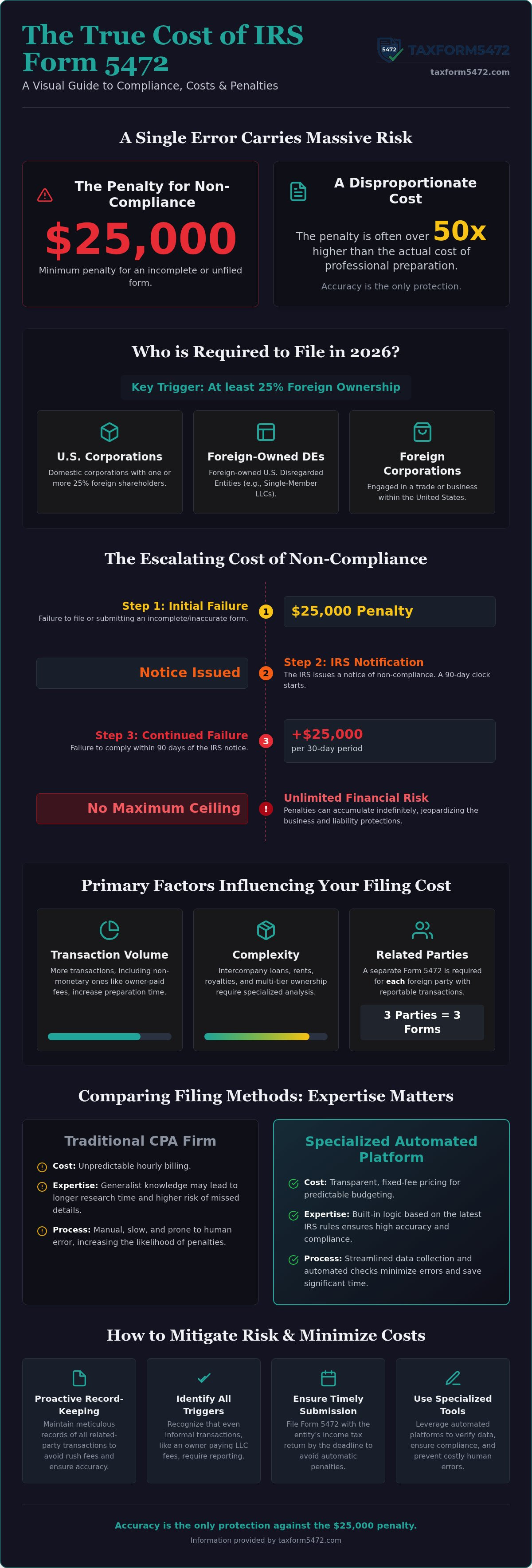
A single missing document triggers a $25,000 IRS penalty. For many foreign-owned U.S. entities, the cost of a filing error is 50 times higher than the actual form 5472 filing cost. The financial risk is absolute. Incomplete filings receive the same penalty as total non-compliance. Accuracy is the only protection.
IRS instructions are dense and difficult to navigate. Hidden CPA fees often make annual budgeting impossible. You need a transparent view of 2026 compliance requirements to safeguard your operations. Predictable expenses are essential for international business stability. Managing these costs requires a data-driven approach rather than guesswork.
This guide analyzes direct and indirect compliance costs. We break down professional fee structures and the specific requirements for verified IRS submission. You'll find a comparison of traditional CPA services versus specialized digital preparation tools. We focus on penalty avoidance and efficient reporting. Learn to manage your 2026 filing obligations with precision and financial clarity. The following sections detail current market rates and the true price of accuracy.
Key Takeaways
- Identify reporting triggers for foreign-owned U.S. corporations and the 25% ownership threshold.
- Evaluate how transaction volume and related party counts determine your total form 5472 filing cost.
- Contrast traditional CPA firm fees with the efficiency and standardized accuracy of automated preparation platforms.
- Adopt proactive record-keeping strategies to eliminate rush fees and ensure timely IRS submission.
- Utilize specialized automation to mitigate the $25,000 penalty risk through verified data entry.
IRS Form 5472 Filing Requirements and Financial Risks
IRS Form 5472 serves as a critical disclosure document. It monitors transactions between reporting corporations and foreign related parties. For a comprehensive Form 5472 overview, the requirement triggers when a U.S. entity has at least 25% foreign ownership. This includes direct or indirect ownership through a chain of entities. The primary form 5472 filing cost centers on the risk of error. The IRS uses this data to enforce transfer pricing regulations and identify potential tax evasion. Precise reporting is a mandatory operational standard for international entities.
Transactions triggering the form include more than just sales or loans. They include any transfer of money or property. Even paying for a registered agent or LLC formation costs from a personal account qualifies as a reportable transaction. These small, often overlooked events create a filing obligation. Ignoring these informal transactions is a common cause for the $25,000 penalty assessment. Every related party transaction must be documented and reported with precision.
Who Must File in 2026?
Compliance is mandatory for three specific entity types. Domestic corporations with 25% foreign shareholders must file. Foreign corporations engaged in a U.S. trade or business are also included. Most importantly, foreign-owned disregarded entities, such as single-member LLCs, must now comply. These LLCs are treated as corporations for reporting purposes. This applies even if they are disregarded for federal income tax. Many owners miss this requirement because they don't file a standard corporate return. The reporting obligation exists regardless of whether the entity generated income during the tax year.
Cost of Non-Compliance
The financial stakes are rigid. The initial penalty for failure to file is $25,000. This amount applies per form and per year. An incomplete form carries the same $25,000 penalty as a total failure to file. Accuracy is not optional; it's a prerequisite for submission. A high form 5472 filing cost is often the result of reactive compliance rather than professional preparation. If the IRS issues a notice and the entity does not comply within 90 days, the cost escalates rapidly. The IRS adds $25,000 for every subsequent 30-day period. There is no maximum ceiling for these cumulative fines. Beyond direct monetary loss, persistent non-compliance can jeopardize limited liability protections. This exposes owners to personal financial risk and legal complications. Proactive preparation is the only way to neutralize these threats.
Primary Factors Influencing Form 5472 Filing Costs
The total form 5472 filing cost is not a fixed expense. It scales based on the complexity of your financial activity. Preparation hours depend heavily on how many distinct interactions occurred between the U.S. entity and its foreign related parties. Precise documentation is the only way to manage these variables effectively.
Transaction Volume and Complexity
Reporting requirements extend beyond simple cash transfers. The IRS demands disclosure of both monetary and non-monetary exchanges. For example, if a foreign owner pays for a U.S. LLC's formation costs or registered agent fees from a personal account, this is a reportable transaction. Intercompany loans require specific interest rate reporting and balance tracking. Each unique transaction type increases the analytical depth required for a valid submission. Referencing Official IRS Form 5472 Information ensures that all categories, from tangible property sales to rents and royalties, are accounted for. High transaction volumes correlate directly with increased professional billable hours.
The number of related parties is another primary cost driver. A separate Form 5472 is required for every foreign person or entity that engaged in a reportable transaction with the reporting corporation. If your U.S. company interacts with three different foreign subsidiaries, you must file three separate forms. This multiplies the administrative burden. Multi-tiered ownership structures further complicate this by requiring a look-through analysis to identify ultimate beneficial owners.
Professional Expertise Requirements
Generalist CPAs often lack the specific focus needed for international tax compliance. They may charge lower hourly rates but take longer to interpret the tax reporting for us companies with foreign owners. Specialists provide efficiency through repetition. They understand the nuances of the December 2024 revised instructions and current 2026 filing standards. This expertise reduces audit risk and prevents the $25,000 penalty. Effective specialists identify reportable transactions that generalists might overlook, such as "deemed" transactions involving shared resources.
Organized digital ledgers minimize the form 5472 filing cost by reducing manual labor. When records are fragmented, professionals spend hours reconciling data. Centralizing your transaction history before the tax season starts prevents expensive rush fees. Using a specialized preparation platform allows for direct data entry and eliminates the manual overhead of traditional accounting. Clean data is the most effective tool for lowering professional fees.
Comparing Filing Methods: CPA vs. Software vs. DIY
Choosing a filing method determines your immediate form 5472 filing cost and long-term audit risk. Three primary paths exist for 2026 compliance. Each balances speed, accuracy, and liability differently. Decision-makers must evaluate these factors against their internal transaction volume. Precision is the priority in every scenario.
Traditional CPA Fee Structures
CPA firms provide high-touch, personalized advisory. This approach is the most expensive. Fees typically involve initial setup costs for new foreign-owned entities. Most firms utilize hourly rates for preparation and review. Complex structures with multiple related parties drive these billable hours higher. While effective for bespoke tax planning, the cost is often prohibitive for standard compliance. Firms often charge extra for the "disregarded entity" trap where single-member LLCs require unexpected corporate reporting. Review the specific risk trade-offs at form 5472 cpa vs software to determine if manual review is necessary for your specific entity.
Efficiency of Automated Preparation
Automated software offers a streamlined alternative. These platforms focus on standardized data entry to minimize human error. Speed is a primary advantage. Digital tools process information faster than manual accounting cycles. They ensure all required fields align with the latest IRS Form 5472 Requirements. This method provides a predictable form 5472 filing cost through specialized SaaS models. Specialized tools are built specifically for this form, reducing the overhead associated with generalist accounting software. Many systems now offer automated validation checks that flag missing "related party" data before submission.
DIY filing carries the highest risk profile. Direct preparation costs are zero. The potential for a $25,000 penalty is maximum. The IRS treats incomplete forms the same as non-filing. Most self-prepared forms fail due to missing "deemed" transactions or incorrect entity classifications. Professional or automated preparation acts as an insurance policy against these automated IRS assessments. Secure your compliance through verified systems rather than manual guesswork. Turnaround times for software-assisted filings are often measured in days, while traditional CPA firms may require weeks during peak tax season. Efficiency reduces the risk of missing the April 15, 2026 deadline.
Strategies to Minimize Form 5472 Compliance Expenses
Compliance expenses consist of preparation fees and the inherent risk of the $25,000 penalty. Shifting from reactive to proactive management is the only way to lower the total form 5472 filing cost. Early data collection prevents expensive rush fees. Specialized firms often increase rates by 50% or more for last-minute requests. Start the process at the close of the fiscal year to ensure your data is ready for the 2026 season.
Batch filing is a strategic efficiency measure. If a reporting corporation interacts with multiple foreign related parties, consolidate the data entry process. Use automated form 5472 preparation to handle high-volume filings. Automation reduces the per-form cost by eliminating redundant manual reviews. It ensures consistency across all related party disclosures. This approach is more cost-effective than engaging a generalist for each individual form.
Record Maintenance for Cost Reduction
Clean ledgers are a prerequisite for low-cost compliance. Track all monetary transactions in real-time. These include:
- Sales of inventory and tangible property.
- Rents and royalties paid or received.
- Interest on intercompany loans.
- Commission payments and service fees.
Documenting non-monetary exchanges is equally critical. These often include cost-sharing arrangements or the use of shared intellectual property. Accurate valuation prevents IRS challenges that lead to higher tax liabilities. Refer to the form 5472 instructions to categorize these exchanges correctly. Organized records allow professionals to focus on verification rather than expensive data reconstruction. This meticulousness reduces the hidden form 5472 filing cost of IRS audits.
Meeting the Filing Deadline
Timing is a financial variable. For 2026, Form 5472 must align with the Form 1120 due date, which is typically April 15. For foreign-owned U.S. disregarded entities, this requires attaching the form to a pro forma Form 1120. Missing this date triggers the $25,000 penalty immediately. If you can't meet the deadline, file Form 7004 for a six-month extension. This moves the filing date to October 15, 2026.
An extension provides additional time for accuracy but doesn't eliminate the need for detailed record-keeping. Use this period to reconcile intercompany accounts and verify related party EINs. Inaccurate data on an extended return still triggers the full penalty. Learn more about filing form 5472 with form 1120 to ensure your entity remains in good standing. Accurate, timely filing is the most effective way to protect your U.S. operations from automated IRS assessments.
Prepare your Form 5472 today to secure predictable compliance costs.
Automated IRS Form 5472 Preparation with TaxForm5472
Managing the form 5472 filing cost requires a departure from manual accounting. Traditional methods are slow. They introduce human error. TaxForm5472 provides a specialized platform for foreign-owned U.S. corporation compliance. It's built for speed. The digital interface streamlines reportable transaction entry. This focus on automation ensures that every data point aligns with IRS standards. Modern international businesses need this level of precision to maintain operational stability. Accuracy is the most effective cost-control measure available.
The TaxForm5472 Advantage
The platform's utilitarian design prioritizes functionality. It supports both standard domestic corporations and foreign-owned U.S. disregarded entities. This is critical for single-member LLCs that often fall into the reporting trap described in previous sections. TaxForm5472 acts as a precise tool rather than a generalist service. It removes the ambiguity found in complex IRS instructions. Professional submission is integrated directly into the workflow. By focusing exclusively on Form 5472, the platform eliminates the overhead costs associated with full-service CPA firms. This specialization lowers the total form 5472 filing cost while increasing data integrity. The system is updated for 2026 requirements. It reflects the latest revisions to ensure total compliance.
Getting Started with Electronic Filing
The submission process is direct. Users begin with simple data input for all related party information. The system then handles the automated generation of the required tax documentation. This includes the pro forma Form 1120 for disregarded entities. Accuracy is the primary defense against the $25,000 penalty. Automated validation checks flag inconsistencies before the IRS receives the file. Secure submission protocols ensure that your federal tax reporting is handled with professional care. Each step is designed to minimize the time spent on administrative tasks.
Efficiency defines the modern compliance landscape. Don't rely on fragmented spreadsheets or manual entry. Centralize your reporting on a platform designed for the 2026 tax year. Verified submission is the final step in securing your U.S. entity. Predictable costs and accurate filings are now accessible through a streamlined digital interface. Start your preparation now to ensure your business remains compliant and penalty-free. The risk of a $25,000 assessment is too high for guesswork. Use a tool built for the specific demands of international tax reporting.
Secure Your 2026 Compliance Status
Managing international tax obligations requires absolute precision. Your total form 5472 filing cost represents a critical investment in your entity's financial security. Transaction complexity and the count of related parties remain the primary drivers of professional fees. Manual preparation methods significantly increase the risk of automated IRS assessments. Specialized automation provides the most reliable path to accuracy and penalty avoidance.
Our platform delivers a specialized IRS reporting solution with global accessibility. It functions as an automated compliance tool designed for modern efficiency. You can eliminate the financial uncertainty of generalist accounting fees. Use a system engineered specifically for the requirements of foreign-owned U.S. corporations. Predictable expenses and verified submissions are essential for the 2026 tax year. Digital tools ensure standardized data entry and automated validation at every step.
This proactive approach secures your entity's standing. It allows you to focus on business growth rather than penalty resolution. Accuracy is the only defense against regulatory risk. Start Your Form 5472 Preparation now. Protect your U.S. operations with verified data. Efficient compliance is within reach.
Frequently Asked Questions
What is the average cost to file Form 5472?
Professional fees vary by service type. Online preparation services for single-member LLCs typically range from $199 to $448. CPA firms generally charge between $599 and $1,500 based on transaction volume and entity complexity. The total form 5472 filing cost depends heavily on the volume of your intercompany activity. Specialized digital platforms offer more predictable pricing structures compared to the hourly billing models used by traditional accounting firms.
Can I file Form 5472 myself to save money?
You can technically file without professional assistance. However, the IRS treats incomplete or incorrect forms as non-filed. This triggers an immediate $25,000 penalty. Most DIY attempts fail to identify "deemed" transactions or satisfy specific pro forma requirements for disregarded entities. The risk of error far outweighs the initial savings. Using a specialized preparation tool ensures your submission meets all current 2026 reporting standards and protects your business from automated assessments.
Are there hidden costs in Form 5472 compliance?
Hidden expenses often arise from poor record-keeping. If your data is unorganized, a CPA will charge additional billable hours for reconciliation. Rush fees are another common hidden cost for filings submitted near the April 15 deadline. Additionally, the cost of an IRS audit resulting from an incomplete form can reach thousands in legal fees. Maintaining a clean ledger throughout the year is the most effective way to minimize your total form 5472 filing cost.
Does the $25,000 penalty apply to small businesses?
The IRS does not provide a small business exemption for Form 5472 penalties. The $25,000 fine applies to any reporting corporation, including single-member LLCs with zero revenue. If you meet the 25% foreign ownership threshold and have reportable transactions, you must file. Small businesses are often targeted for automated penalty assessments because they frequently miss these specific international reporting obligations. Compliance is mandatory regardless of entity size or the amount of income generated.
Why do CPAs charge more for Form 5472 than other forms?
Form 5472 requires specialized knowledge of international tax law and transfer pricing. CPAs must analyze every interaction between the U.S. entity and foreign related parties. This includes non-monetary exchanges and informal loans. The high liability associated with the $25,000 penalty also increases professional fees. Generalist accountants often spend significant time researching the latest instructions, which leads to higher billable hours compared to standard domestic tax forms. Accuracy requires a level of repetition specialists provide.
Is software cheaper than a CPA for Form 5472 filing?
Automated software is generally more cost-effective. It replaces manual hourly labor with standardized digital processes. While a CPA firm may charge over $1,000 for a complex filing, specialized platforms offer preparation at a fraction of that rate. Software also provides faster turnaround times and built-in validation checks. This reduces the risk of human error while maintaining a lower overall compliance expense for foreign-owned entities. Speed and accuracy are the primary benefits of this method.
Does the filing cost increase if I have multiple foreign owners?
Costs increase if multiple related parties are involved in transactions. You must file a separate Form 5472 for each foreign person or entity that meets the reporting criteria. If you have three foreign owners and each had reportable transactions with the U.S. company, you need three individual filings. Most professionals charge per form. Consolidating your data through an automated platform can help manage these scaling costs more efficiently than the manual labor required by traditional accounting.
What happens to the filing fee if I file an extension?
Filing an extension through Form 7004 does not typically increase the base filing fee. However, waiting until the extension deadline of October 15 can lead to higher preparation costs if you require a rush service. An extension only moves the due date; it doesn't change the complexity of the reporting requirements. Securing your filing early in the year prevents the need for expedited processing fees and ensures your data is accurate. Timely submission is always the most economical choice.