
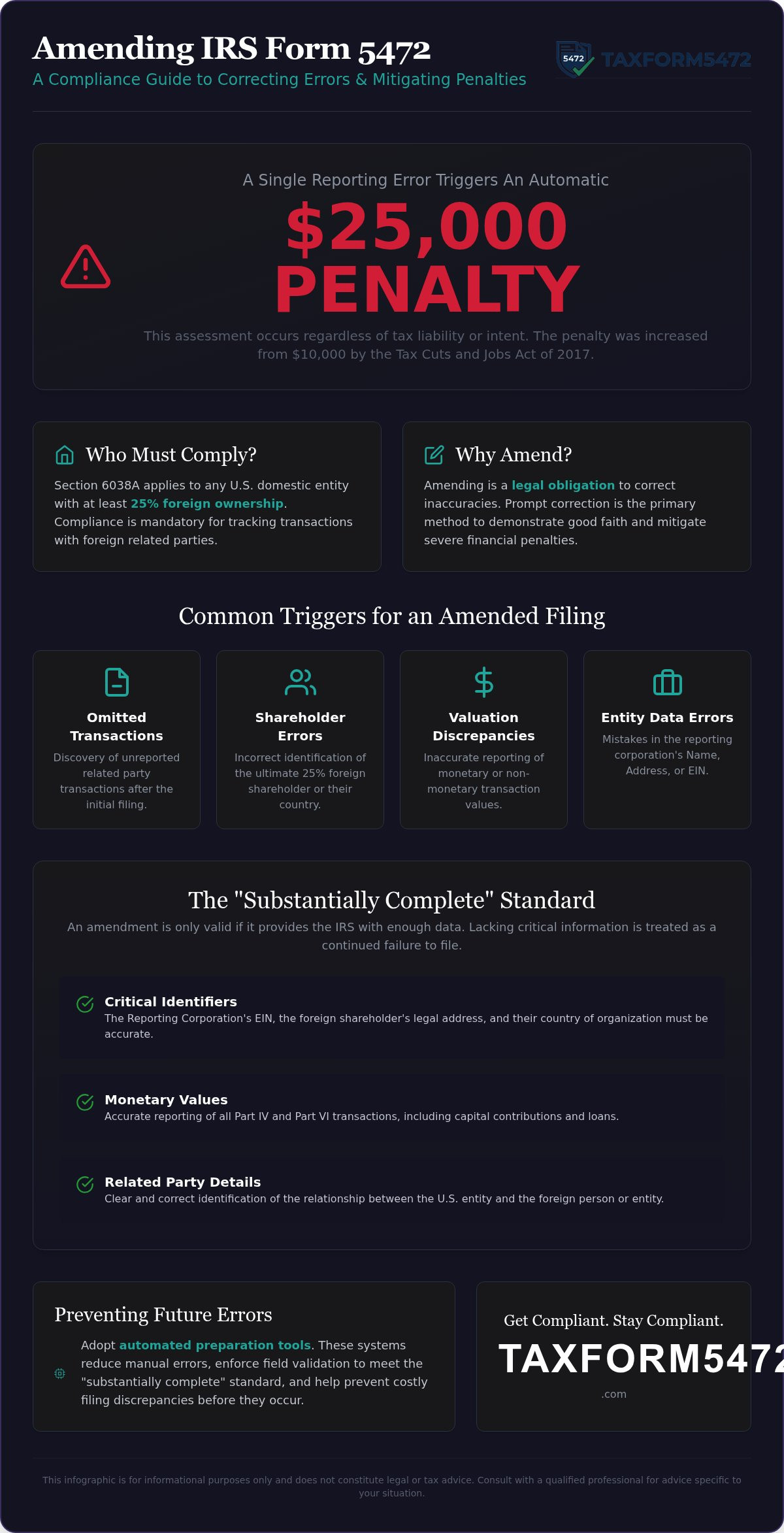
A single reporting error on Form 5472 now triggers an automatic $25,000 penalty. This assessment occurs regardless of tax liability or intent. For foreign-owned U.S. entities, knowing how to amend form 5472 is the primary mechanism for penalty mitigation and Section 6038A compliance.
IRS regulations are rigorous. Correcting a previously submitted return is a technical necessity that often causes administrative strain. This guide provides the specific protocols required to update your records and meet federal standards. We prioritize accuracy and efficiency in the amendment process.
We'll examine the "substantially complete" legal threshold. This preview includes the correct use of Form 1120-X, instructions for paper-filing via the Ogden, Utah unit, and methods for documenting reasonable cause. You'll find the exact steps needed to resolve filing discrepancies for the 2026 tax year. This is a functional resource for maintaining regulatory standing.
Key Takeaways
- Define Section 6038A requirements for 25% foreign-owned entities. Maintain accurate reporting standards.
- Follow the technical process for how to amend form 5472. Select the "Amended" box on the corrected filing.
- Reach the "substantially complete" threshold. Stop automatic penalty accrual immediately.
- Distinguish between C-Corporation and Disregarded Entity procedures. Use Form 1120-X or pro-forma filings.
- Adopt automated preparation tools. Reduce manual errors and prevent future filing discrepancies.
Section 6038A Compliance and the Requirement to Amend
Internal Revenue Code Section 6038A governs the information reporting requirements for foreign-owned U.S. corporations. It applies to any domestic entity with at least 25% foreign ownership. Compliance is mandatory. The IRS uses this data to track transactions between U.S. companies and their foreign related parties. When a previously filed return contains errors, the taxpayer must submit a correction. Learning how to amend form 5472 is the standard procedure for maintaining regulatory standing and avoiding severe financial consequences.
The requirement to amend is triggered by any inaccuracy that renders the original filing "substantially incomplete." This isn't a suggestion. It's a legal obligation. Prompt correction is the primary method to demonstrate good faith compliance. If the IRS identifies an error before you do, the opportunity for voluntary correction disappears. Delays in amending increase exposure to the $25,000 failure-to-file penalty. This penalty can be assessed automatically and applies to each form that remains uncorrected.
The Role of Section 6038A in International Tax
Section 6038A regulations ensure transparency in cross-border financial flows. These rules target transactions that might otherwise bypass federal scrutiny. Compliance requires full disclosure of all reportable transactions form 5472. This includes capital contributions, loans, and sales of tangible property. The IRS utilizes this data to monitor transfer pricing. It helps the agency detect tax avoidance strategies. Without accurate reporting, the IRS cannot verify if transactions occurred at arm's length. Accurate data is the foundation of international tax enforcement.
Triggers for an Amended Form 5472
Certain discrepancies necessitate an immediate revised filing. Identifying these triggers early prevents automated penalty assessments. Common reasons to research how to amend form 5472 include the following:
- Omitted Transactions: Discovery of unreported related party transactions after the initial filing deadline.
- Shareholder Errors: Incorrect identification of the ultimate indirect 25% foreign shareholder or their country of residence.
- Valuation Discrepancies: Inaccurate reporting of monetary or non-monetary transaction values.
- Entity Data: Errors in the U.S. reporting corporation's name, address, or Employer Identification Number (EIN).
A proactive amendment signals a commitment to transparency. It's the most effective way to stop the clock on penalty accrual. The $25,000 penalty was increased from $10,000 by the Tax Cuts and Jobs Act of 2017. Current enforcement trends show that the IRS has moved toward an automated assessment model. If you discover an error, you don't wait for a notice. You file the amendment to protect the entity's status.
The Substantially Complete Standard for Corrected Returns
The IRS does not consider a form "filed" simply because it was submitted. It must meet the "substantially complete" threshold. When researching how to amend form 5472, you must focus on data accuracy. Filing a corrected form with missing critical data does not stop penalty accrual. The IRS evaluates the significance of omitted information relative to the whole return. If the correction lacks essential details, the agency treats it as a continued failure to file.
Compliance requires strict adherence to form 5472 record maintenance rules. Your amendment is only as valid as the documentation supporting it. The IRS uses this standard to prevent taxpayers from filing "placeholder" forms to avoid deadlines. A valid amendment must provide the agency with enough information to identify related parties and quantify transactions. Anything less keeps the entity in a state of non-compliance.
Defining Substantial Completeness
A return is substantially complete only when it includes specific identifiers and financial data. The IRS prioritizes certain fields during its review process. Missing any of the following often results in a rejected amendment:
- Critical Identifiers: The Reporting Corporation's EIN, the foreign shareholder's legal address, and their country of organization.
- Monetary Values: Accurate reporting of all Part IV and Part VI transactions. This includes capital contributions and loans.
- Related Party Details: Clear identification of the relationship between the U.S. entity and the foreign person.
Omissions in these areas constitute a "failure to file" despite the physical submission of the form. To ensure your data meets these standards, consider using a professional IRS Form 5472 preparation tool that enforces field validation.
Consequences of Incomplete Amendments
The risks of submitting an incomplete correction are high. The IRS can assess continuation penalties if the "substantially complete" standard isn't met. These penalties amount to $25,000 for every 30-day period of non-compliance. This clock starts 90 days after the IRS issues a notice of failure. An incomplete amendment does not reset this timeline.
Beyond financial costs, an invalid amendment leads to the loss of eligibility for penalty abatement programs. The IRS typically grants relief only to those who show reasonable cause and a good-faith effort to comply. A poorly prepared correction suggests the opposite. Furthermore, errors on Form 5472 often trigger increased scrutiny of the associated Form 1120. This expands the scope of potential audits. Accuracy is the only protection against these cascading enforcement actions.
Procedural Differences: C-Corporations vs. Disregarded Entities
Entity classification determines the filing mechanics. C-Corporations and Domestic Disregarded Entities (DDEs) utilize distinct administrative channels. Understanding these differences is essential when determining how to amend form 5472. Consistency between the primary tax return and the information return is mandatory. Discrepancies between these documents often trigger automated IRS audits. Review our technical guide on how to amend form 5472 for detailed penalty avoidance strategies.
The IRS requires a unified filing approach. You cannot submit an amended information return in isolation. It must be paired with the appropriate income tax form for the reporting period. Failure to follow the correct procedural path results in a rejected filing. This leaves the entity exposed to the $25,000 non-compliance penalty. Accuracy in form selection is the first step toward successful mitigation.
Amending for US C-Corporations
U.S. C-Corporations must utilize Form 1120-X. This is the Amended U.S. Corporation Income Tax Return. You don't file a standalone Form 5472 for corrections. Attach the corrected form to the 1120-X. Ensure the "Amended" box is selected on the new Form 5472. All related party data must align perfectly with the updated financial statements. The IRS cross-references Part IV and Part VI transactions against the corporate balance sheet. Any mismatch suggests a "substantially incomplete" filing.
Amending for Foreign-Owned Single-Member LLCs
Foreign-owned U.S. Single-Member LLCs follow a pro-forma protocol. These entities are disregarded for tax purposes but maintain independent Section 6038A reporting duties. They don't use Form 1120-X. Instead, they must file a new pro-forma Form 1120 with the corrected Form 5472 attached. This ensures the IRS links the correction to the correct entity record.
Administrative requirements for DDE amendments include:
- Labeling: Write "Foreign-owned U.S. DE" across the top of the Form 1120.
- Attachment: Securely attach the corrected Form 5472 with the "Amended" box checked.
- Identification: Ensure the EIN and entity name match the original filing exactly.
Submission methods are restricted. Electronic filing is unavailable for these entities as of September 2026. Submit the amendment via fax to 855-887-7737 or mail it to the IRS unit in Ogden, Utah. Use trackable services. Proof of delivery is a core compliance record. This documentation serves as a defense if the IRS claims a failure to file. Accuracy in the submission process is as important as the data itself.
Technical Steps to Amend Form 5472
Executing a correction requires a methodical approach. Follow these technical steps to resolve filing errors. Accuracy in this phase is the primary defense against the $25,000 penalty. If you are uncertain about how to amend form 5472, prioritize the sequence below to ensure the IRS accepts the corrected data.
- Step 1: Identify all discrepancies. Review original accounting records. Compare them to the previously filed Form 5472. Audit all related party transactions in Part IV and Part VI. Verify the legal name, address, and country of the foreign related party.
- Step 2: Prepare the corrected form. Use the latest IRS revision. Select the "Amended" box in Part I. Prepare a separate Form 5472 for each related party requiring a correction. Ensure the Reporting Corporation's EIN is accurate.
- Step 3: Draft an explanatory statement. This document is a mandatory attachment. It provides the factual basis for the amendment.
- Step 4: Attach to the amended return. Link the corrected form to Form 1120-X for C-Corporations. For disregarded entities, attach it to a pro-forma Form 1120.
The amendment process is time-sensitive. The IRS moved toward an automated assessment model for late or incomplete filings. Submitting a correction before the agency issues a notice is the most effective way to demonstrate a good-faith effort. Use an automated IRS Form 5472 preparation platform to ensure your amended data meets current validation standards.
Drafting the Explanatory Statement
Describe the nature of the error or omission clearly. State the specific cause of the discrepancy. Detail the corrective action taken to ensure Section 6038A compliance. This statement shouldn't be an apology. It's a factual record. Maintain a professional tone. This document supports a "reasonable cause" defense during penalty abatement reviews. Focus on administrative facts rather than narrative excuses. The IRS evaluates these statements to determine if the taxpayer exercised ordinary business care.
Submission and Verification
Verify the correct IRS service center. Foreign-owned U.S. disregarded entities must send amended filings to the IRS unit in Ogden, Utah. Use trackable mailing services. Certified mail with a return receipt provides physical proof of filing. This receipt is a core compliance document. Confirm the amendment covers all form 5472 reporting thresholds. If you miss a reportable transaction category, the IRS may still deem the return substantially incomplete. Learning how to amend form 5472 correctly means verifying every field before dispatch.
Automated Compliance: Preventing Filing Errors
Manual preparation remains the leading cause of filing discrepancies. Human error in data entry often triggers the automatic $25,000 penalty. These mistakes force taxpayers to research how to amend form 5472 after the original deadline has passed. Digital platforms mitigate this risk. They use strict data validation protocols. Logic checks prevent the submission of incomplete forms. This ensures every entry meets the "substantially complete" threshold required by the IRS for Section 6038A compliance.
Automation identifies all reportable transactions based on current 2026 standards. It categorizes capital contributions, loans, and tangible property sales across Part IV and Part VI correctly. Manual tracking often misses these specific categories. Digital systems enforce the 25% foreign ownership threshold logic. This prevents unnecessary filings while ensuring required ones are accurate. Centralized record-keeping facilitates easier future audits. It allows for rapid internal reviews. This proactive approach is superior to reactive corrections.
Benefits of SaaS-Based Filing
SaaS-based filing removes the burden of administrative oversight. It eliminates common clerical errors. Missing identifiers like foreign addresses or entity EINs are flagged instantly. The software integrates automated updates. As IRS regulations change, the platform adjusts its logic. This keeps the entity aligned with Section 6038A standards without manual intervention. Secure digital storage is also provided. All filed documentation stays organized. This accessibility is critical during IRS inquiries or when documenting reasonable cause.
Maintaining Long-Term Compliance
Long-term compliance is a continuous process. It's not a one-time event. Foreign ownership structures frequently shift. Related party transactions require consistent, standardized reporting. Regular reviews prevent the accumulation of small errors. A digital audit trail provides transparency. It demonstrates the entity's commitment to good-faith reporting. Maintaining digital records also meets IRS record retention requirements. Most entities must keep these documents for several years. Automation simplifies this storage and retrieval process.
Managing these requirements manually is inefficient. It increases the probability of future amendments. Streamlining the process through automation is the most effective way to maintain regulatory standing. Use our automated platform for accurate Form 5472 preparation. This final step ensures your data is correct from the initial submission. It removes the technical complexity of learning how to amend form 5472 after a penalty has been assessed.
Secure Your Section 6038A Regulatory Standing
IRS enforcement focuses on inbound international transactions. The $25,000 penalty for non-compliance applies to each incomplete or late filing. Achieving the "substantially complete" threshold is mandatory for valid corrections. Understanding how to amend form 5472 is the first step toward mitigating financial exposure. C-Corporations must use Form 1120-X; foreign-owned disregarded entities follow a specific pro-forma path. These technical distinctions determine the success of your submission.
Proactive corrections demonstrate good-faith compliance. Reactive responses to IRS notices often limit your abatement options. Accuracy in Part IV and Part VI data is essential for long-term standing. Manual errors remain the primary driver of administrative rework. Our specialized Section 6038A compliance tool provides user-friendly digital submission designed specifically for foreign-owned U.S. entities. It enforces data validation to prevent future discrepancies. Streamline your compliance with automated Form 5472 filing. Maintain your professional focus while we handle the technical reporting requirements. Accurate data ensures business continuity.
Frequently Asked Questions
What is the penalty for filing an incorrect Form 5472?
The penalty for failing to file a substantially complete Form 5472 is $25,000. This amount applies per related party and per year. If the failure continues for more than 90 days after IRS notification, additional $25,000 penalties accrue every 30 days. These assessments occur automatically. Accurate reporting is the only method to prevent these financial liabilities.
Can I amend Form 5472 without amending Form 1120?
No. Form 5472 is a mandatory attachment to an income tax return. C-Corporations must file the corrected form with Form 1120-X. Foreign-owned U.S. disregarded entities must attach it to a pro-forma Form 1120. Submitting the information return in isolation results in a rejected filing. The IRS requires the primary return to establish the reporting context.
How far back can I amend a Form 5472 filing?
Information returns usually follow the three-year statute of limitations for the associated tax return. However, if a Form 5472 was never filed or was filed as substantially incomplete, the statute of limitations remains open indefinitely. This allows the IRS to assess penalties for any prior tax year. Researching how to amend form 5472 early prevents long-term exposure to these retroactive assessments.
What does the IRS consider a substantially incomplete Form 5472?
A return is substantially incomplete if it lacks critical identifiers or transaction data. This includes a missing Reporting Corporation EIN, foreign shareholder address, or country of organization. Part IV and Part VI must accurately reflect all reportable transactions. The IRS treats these omissions as a failure to file. Even a physically submitted form triggers the $25,000 penalty if these fields are blank.
Is there a specific form for amending Form 5472?
There is no separate form for amendments. You must use the standard Form 5472 and select the "Amended" box in Part I. This indicates to the IRS that the submission replaces a previous filing. Ensure you use the revision of the form that corresponds to the tax year you are correcting. Attach this corrected document to the appropriate amended income tax return.
Does amending Form 5472 automatically waive penalties?
No. An amendment does not provide an automatic waiver. It stops the accrual of continuation penalties by reaching the "substantially complete" threshold. To remove previously assessed penalties, you must submit a written statement establishing reasonable cause. The IRS evaluates if the taxpayer exercised ordinary business care. Amending the form is a prerequisite for requesting this administrative relief.
Where do I mail an amended Form 5472 for a foreign-owned LLC?
Foreign-owned U.S. disregarded entities must mail amended filings to the IRS unit in Ogden, Utah. These entities cannot utilize electronic filing for amendments as of September 2026. Alternatively, you may submit the package via fax to 855-887-7737. Use trackable mailing services to maintain a record of delivery. This documentation is essential for verifying your compliance timeline.
How long does the IRS take to process an amended Form 5472?
Processing times for amended paper returns typically range from 16 to 20 weeks. This timeline fluctuates based on IRS inventory levels and seasonal demand. You won't receive an immediate confirmation of acceptance. Maintain copies of your trackable mailing receipts and the explanatory statement. These records serve as proof of filing while the agency updates the entity's master file.