
A single missing invoice can trigger an immediate $25,000 IRS penalty. The agency treats inadequate documentation with the same severity as a failure to file. For foreign-owned U.S. corporations, form 5472 record maintenance is the primary defense against these automatic assessments. You recognize the risk. Manual document management is exhausting. It's prone to error. The fear of a $25,000 penalty for a simple administrative oversight is a legitimate business concern.
This guide provides a definitive roadmap to master IRS recordkeeping requirements. You'll gain a clear checklist of mandatory documents and a repeatable workflow for long-term retention. We'll examine the specific rules for disregarded entities and how to prepare for 2026 compliance. This article covers everything from bank records to transfer pricing support. Move from manual fatigue to absolute audit confidence. Follow this framework to protect your corporation from unnecessary financial exposure. Secure your records now.
Key Takeaways
- Understand the Section 6038A mandate to prevent the $25,000 penalty for inadequate recordkeeping.
- Identify specific documentation requirements for both monetary and non-monetary related party transactions.
- Implement a structured 5-step workflow for form 5472 record maintenance to ensure audit readiness.
- Evaluate the IRS Safe Harbor method to simplify document retention and compliance strategies.
- Leverage automated preparation tools to transform organized records into accurate IRS submissions.
The Section 6038A Record Maintenance Mandate
Section 6038A mandates that reporting corporations keep permanent books of account. This isn't a suggestion. It's a statutory requirement. These records must support every figure on your annual information return. Effective form 5472 record maintenance serves as the legal foundation for your tax filings. It ensures that the IRS can verify the nature and value of every transaction between your U.S. entity and its foreign related parties. Without these records, your filing is considered incomplete.
Disregarded entities face specific risks. Many owners assume their LLC status simplifies compliance. It doesn't. For the purposes of Section 6038A, these entities are treated as corporations. They must file Form 5472 and maintain a complete audit trail. If you own a U.S. LLC as a non-resident, your recordkeeping obligations are identical to those of a major multinational. Being "disregarded" for tax purposes doesn't grant an exemption from these rules. You must document every reportable transaction with precision.
The link between the form and your books is direct. Form 5472 reports the numbers, while Section 6038A requires the proof. For a comprehensive Form 5472 Overview, one should review the statutory requirements for international transparency. These regulations are designed to prevent profit shifting through internal transactions. Proper documentation proves that your business operates within legal boundaries. It's your primary defense against aggressive IRS scrutiny.
Why the IRS Requires Record Maintenance
The IRS demands these records to establish the "correctness" of your return. They want to see the underlying data for every entry. Audits of related party dealings rely entirely on your documentation. Without it, the IRS can't verify the legitimacy of cross-border capital flows. Transparency is the priority. Documentation ensures that transactions between a U.S. entity and its foreign owners reflect market reality. It proves your transfer pricing strategy is valid and that your capital movements are not disguised dividends or hidden income.
The Cost of Non-Compliance in 2026
The price for failure is high. The initial penalty is $25,000. This applies if you fail to file, file an incomplete form, or fail to maintain records. The IRS assesses this per form, per year. If the failure continues 90 days after notification, the cost spikes. You'll face an additional $25,000 for every 30-day period of continued non-compliance. There's no statutory cap on these continuation penalties. The financial risk is cumulative and severe. Failing to maintain records for 2026 filings exposes your entity to an immediate $25,000 assessment and potential uncapped continuing penalties.
Automated risk scoring is now a reality. The IRS utilizes advanced systems to flag inconsistencies in reported transactions. Organized records are your only defense when these systems trigger an inquiry. Prepare for 2026 by centralizing your data today. Efficiency starts with organization.
Identifying Essential Records for Form 5472 Compliance
Compliance requires more than just filling out a form. It demands a verified paper trail. Every figure reported to the IRS must correspond to a specific source document. Effective form 5472 record maintenance involves categorizing these items by transaction type and legal significance. This structure prevents confusion during an audit. It ensures you can produce evidence quickly if the agency requests proof of your cross-border activities. Organized records are the only way to validate your tax position.
Financial and Banking Documentation
Bank statements provide the primary evidence for cash movements. You must retain monthly statements for all U.S. accounts held by the reporting corporation. Wire receipts and deposit slips confirm the timing and source of funds for every transfer. These documents validate reportable transactions form 5472. If your entity carries debt with a foreign owner, keep signed loan agreements and interest payment schedules. The IRS requires proof that these aren't just capital contributions. Review the official IRS Form 5472 Information for specific definitions of reportable events. Documentation must prove the actual flow of money matches your reported totals.
Legal and Corporate Records
Ownership documentation establishes who controls the entity. Keep your Articles of Organization and Operating Agreements updated. If the ownership structure changes, document it immediately through stock certificates or membership ledgers. Corporate records must include formal contracts for all form 5472 related party transactions. Service agreements, licensing contracts, and sales invoices are essential. Meeting minutes should reflect significant financial decisions and approval of intercompany deals. These records prove the entity operates as a distinct legal person. They demonstrate that transactions weren't arbitrary but followed corporate governance protocols.
Pricing evidence is the final pillar of form 5472 record maintenance. You must show that prices charged to related parties match what you'd charge an unrelated customer. This "arm's length" proof includes market research, price lists, or comparable sales data. It's not enough to report the price. You must justify it. When your records are organized by category, automated preparation becomes a simple task of data verification. Centralizing these documents now protects your business from future penalties. Start your digital archive today.
Safe Harbor vs. Standard Maintenance Strategies
Choosing a strategy is a matter of risk management. Standard accounting records focus on general profit and loss. They often miss the granular details required for form 5472 record maintenance. The IRS offers a Safe Harbor method to provide certainty. This method lists specific document categories that, if maintained, satisfy the agency's requirements. It removes the guesswork from compliance. Standard maintenance is more flexible but carries higher audit risk. You must decide if the convenience of standard bookkeeping outweighs the security of the Safe Harbor checklist.
The Safe Harbor Provision Explained
The Safe Harbor provision requires specific documentation categories to be readily available. These include original entry books, profit and loss statements, and pricing documents. You must also keep records regarding ownership and related party transactions. Location is a key factor. You can store records outside the U.S. if you agree to produce them upon request. Translation is mandatory. Any foreign-language document must be translated into English within 30 days of an IRS inquiry. Consult the Official Form 5472 Instructions for the full list of mandatory Safe Harbor categories. This method ensures you meet the strict standards of Section 6038A without ambiguity.
Choosing the Right Method for Your LLC
Most foreign-owned LLCs operate with minimal administrative staff. Standard maintenance seems easier. It uses your existing bookkeeping to support tax filings. However, the form 5472 reporting threshold only triggers the filing requirement. It doesn't define the quality of the records you must keep. Safe Harbor provides a prescriptive checklist for compliance, while standard maintenance relies on the subjective adequacy of existing financial ledgers. If an auditor finds your standard records insufficient, the $25,000 penalty applies immediately. Safe Harbor protects you from this subjectivity.
Retention rules are strict. You must keep records as long as they're material to tax administration. This usually means six years from the date you file the return. Some documents are permanent. This includes organizational charts, entity formation papers, and long-term intercompany agreements. Effective form 5472 record maintenance treats all related party contracts as permanent assets. Don't delete digital archives prematurely. Keep your 2026 documentation accessible until at least 2032. Data integrity is your best defense.
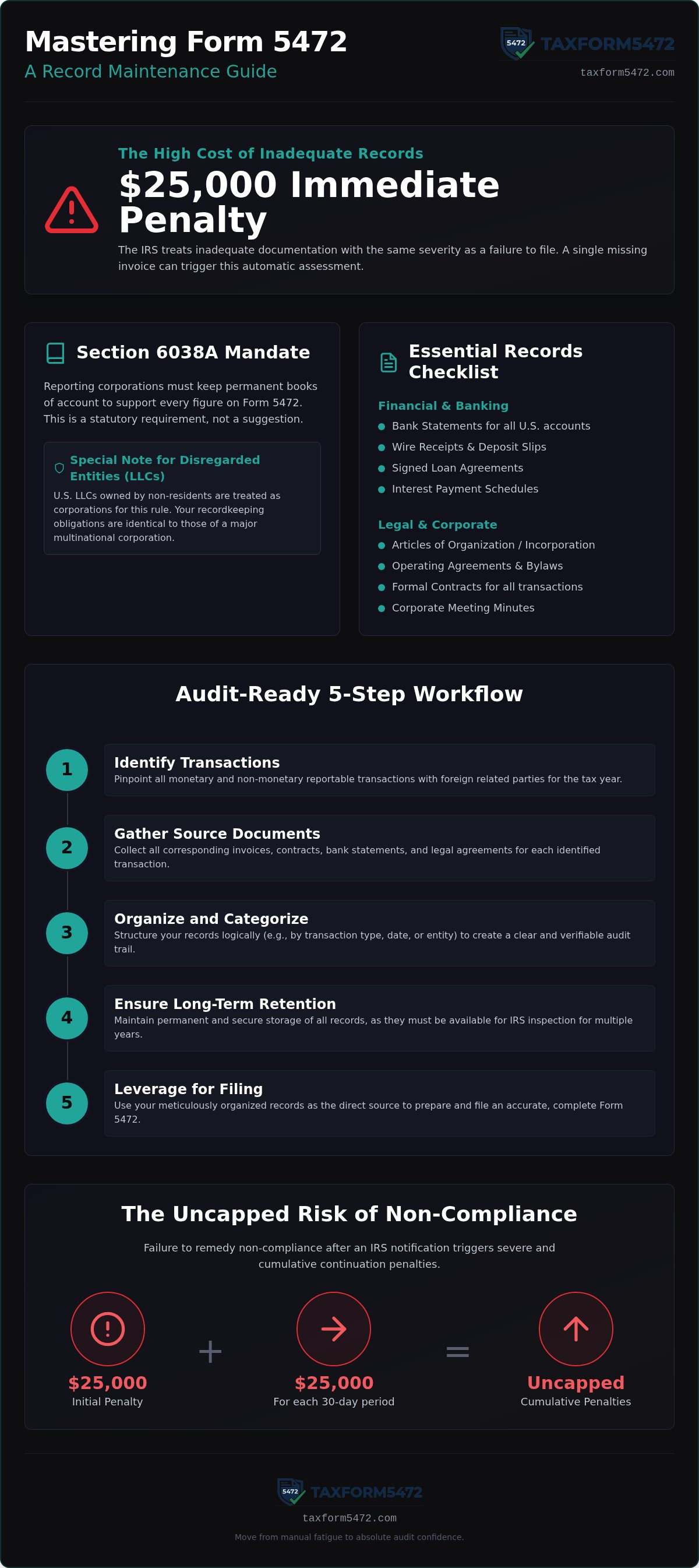
Establishing a 5-Step Record Maintenance Workflow
Efficiency requires a standardized system. Manual tracking often collapses during an IRS audit. Implementing a repeatable workflow for form 5472 record maintenance ensures your entity stays audit-ready throughout the year. You must first centralize all related party transaction data into a single, secure environment. Categorize every document according to the specific parts of the form. Use Part IV for monetary transactions, Part V for reporting corporation details, and Part VI for non-monetary exchanges. This mapping simplifies the final IRS Form 5472 filing by aligning your internal books with specific agency requirements. A structured approach eliminates the stress of searching for misplaced invoices at the last minute.
Digital Organization Best Practices
Adopt a rigid digital 'Compliance Folder' structure. Use consistent naming conventions like "YYYY-MM-DD_EntityName_TransactionType" for every file. This makes retrieval instant during an IRS inquiry. Store all sensitive tax data in encrypted cloud environments with multi-factor authentication. Always attach verified English translations directly to the original foreign-language documents. This practice satisfies the 30-day production rule. Digital precision reduces the risk of administrative gaps and ensures your team follows a uniform standard. High-quality document images are essential for clarity.
Quarterly Compliance Check-ups
Don't wait for year-end to review your data. Perform quarterly reconciliations to identify new related parties mid-year. Business structures change. You might add a new foreign shareholder or enter a new intercompany service agreement. Verify every transaction amount against your actual bank statements to ensure dollar-for-dollar accuracy. This process flags missing contracts or unsigned agreements before the tax season rush begins. It's much easier to secure a signature in July than in April. Consistent oversight prevents the accumulation of errors that lead to the $25,000 failure-to-maintain penalty.
Your workflow should end with a final validation. Cross-reference your categorized digital folders against your general ledger one last time. This double-check confirms that no reportable event was overlooked. When your form 5472 record maintenance is complete, the transition to filing is seamless. You can use automated preparation tools to transform your organized records into a compliant IRS submission. Precision in maintenance leads to confidence in filing. Start your digital archive today.
Streamlining Compliance with Automated Preparation
Automated preparation is the logical conclusion of a successful compliance cycle. It transforms your organized data into a verified IRS submission. Effective form 5472 record maintenance provides the raw material for these systems. Manual data entry is slow. It's prone to transposition errors. Digital interfaces eliminate these risks by mapping data directly from your digital folders to the required fields. This ensures that the numbers on your return match your bank records exactly. Consistency across multiple years becomes a standard, not a struggle. When your records are digital, the transition to a completed form takes minutes, not days.
Efficiency is the primary benefit of modern tax tools. You've already done the hard work of centralizing your contracts and bank statements. Automation simply harvests that effort. It reduces the chance of missing a reportable event that could trigger an audit. By linking your records to a digital filing platform, you create a permanent audit trail. This trail is your insurance policy. It proves that every figure on Form 5472 is backed by a specific, maintained document. Accuracy is no longer a variable.
The Role of SaaS in Modern Tax Compliance
SaaS platforms simplify the submission of complex international ownership data. They provide built-in validation checks for every reportable transaction. This prevents the submission of "substantially incomplete" forms that the IRS treats as unfiled. You can centralize historical filings for instant access during future inquiries. Digital systems track changes in related party structures automatically. This reduces the administrative burden on your internal team. A professional interface ensures that your corporation's data is organized according to the latest 2026 standards. Security is built-in, protecting sensitive tax IDs and financial totals.
Finalizing Your 2026 Filing
Moving from organized records to automated preparation is the final step in protecting your entity. Ensure all Part VI non-monetary transactions are captured during this phase. These often include cost-sharing arrangements, platform usage rights, or zero-interest loans. Automated tools flag these items based on your categorized records. This final check prevents the $25,000 penalty for missing disclosures. Your 2026 submission is only as strong as your recordkeeping foundation. Once your digital folders are reconciled, the filing process is a simple matter of data verification. Don't leave your compliance to chance. Start your automated Form 5472 preparation today and secure your corporation's standing with the IRS.
Success requires a shift in perspective. View form 5472 record maintenance as an active component of your business operations. It isn't a year-end chore. It's a continuous process that feeds into your filing strategy. Organized records lead to automated accuracy. Automated accuracy leads to audit immunity. Complete your workflow now.
Secure Your Compliance Foundation
Section 6038A requirements are rigid. Failure is expensive. Effective form 5472 record maintenance is the only way to shield your entity from the $25,000 IRS assessment. You've identified the essential records and compared Safe Harbor strategies. You've established a repeatable workflow. Now, you must execute. Digital precision is no longer optional for foreign-owned U.S. corporations; it's the standard for 2026 audit readiness. Centralized data ensures your filings remain accurate and consistent across multiple tax years. Organized records are your primary defense against automatic penalties.
Efficiency starts with the right tools. Our platform is specialized for foreign-owned U.S. corporations and disregarded entities. It features an automated compliance workflow designed to streamline your reporting. You can manage international ownership structures through a secure digital platform. Don't let administrative fatigue lead to costly errors. Transition your organized records into a finished return with confidence. Prepare and file your Form 5472 online today. Protect your business. Stay compliant.
Frequently Asked Questions
How long must I keep records for Form 5472?
You must maintain records for as long as they're material to tax administration. This usually means at least three years from the date you file the return. many professionals recommend a six-year retention period to account for the extended statute of limitations on international reporting. Permanent records like articles of organization and operating agreements must never be destroyed. Keep your 2026 documentation accessible until at least 2032.
Do I need to keep records if my LLC had no transactions this year?
Yes. You must still maintain documentation that substantiates the lack of activity. This includes bank statements showing no transfers and internal ledgers. The IRS requires proof that no reportable transactions occurred between the U.S. entity and its foreign related parties. Disregarded entities aren't exempt from these rules. Maintaining these records prevents the IRS from assuming transactions were hidden or simply unreported during a routine compliance check.
What happens if I lose my records before an IRS audit?
Loss of records results in an immediate $25,000 penalty for failure to maintain. The IRS treats missing data with the same severity as a failure to file the form. You must attempt to reconstruct your books using bank records, vendor invoices, and correspondence. If you can't produce the required documentation within the requested timeframe, the penalty applies. Digital backups are the most effective way to prevent this specific compliance failure.
Do records for foreign-owned U.S. corporations need to be in English?
No. Records can be kept in a foreign language, but you must provide a translation upon request. The IRS requires an English translation within 30 days of a formal inquiry. Including translations in your form 5472 record maintenance process is a best practice. It ensures you meet the strict 30-day production deadline. Waiting until an audit begins to translate complex legal contracts often leads to administrative delays and potential fines.
Does the $25,000 penalty apply to each missing record or the whole form?
The $25,000 penalty is assessed per form for each tax year. It's not per individual record. However, the financial risk is cumulative. If you have three foreign-owned entities and fail to maintain records for all three, the total penalty is $75,000. If the failure continues 90 days after an IRS notice, an additional $25,000 accrues every 30 days. There's no maximum limit on these continuing penalties for non-compliance.
Can digital copies replace physical paper records for the IRS?
Yes. Digital copies are fully acceptable for form 5472 record maintenance. The IRS requires that digital systems produce legible, searchable, and accurate reproductions of original documents. Transitioning to a digital "Compliance Folder" structure improves organization and retrieval speed. Use encrypted cloud storage to protect sensitive ownership data. Digital records are easier to reconcile quarterly and simpler to transfer to automated preparation tools during the annual filing season.
What is the 'Safe Harbor' for Form 5472 recordkeeping?
Safe Harbor is a prescriptive list of records that the IRS deems sufficient for Section 6038A compliance. It includes original entry books, profit and loss statements, and pricing documents. Following this method removes the risk of an auditor deciding your standard bookkeeping is "insufficient." It provides a clear checklist for businesses to follow. While not mandatory, it offers the highest level of protection against the $25,000 failure-to-maintain penalty.
Is a bank statement enough to prove a related party transaction?
No. A bank statement only confirms that money moved between accounts. It doesn't prove the nature of the transaction or its "arm's length" pricing. You must pair bank statements with invoices, signed contracts, or service agreements. These documents explain the purpose of the payment and the relationship between the parties. Without this context, the IRS may reclassify the payment, leading to unexpected tax liabilities and documentation penalties.