
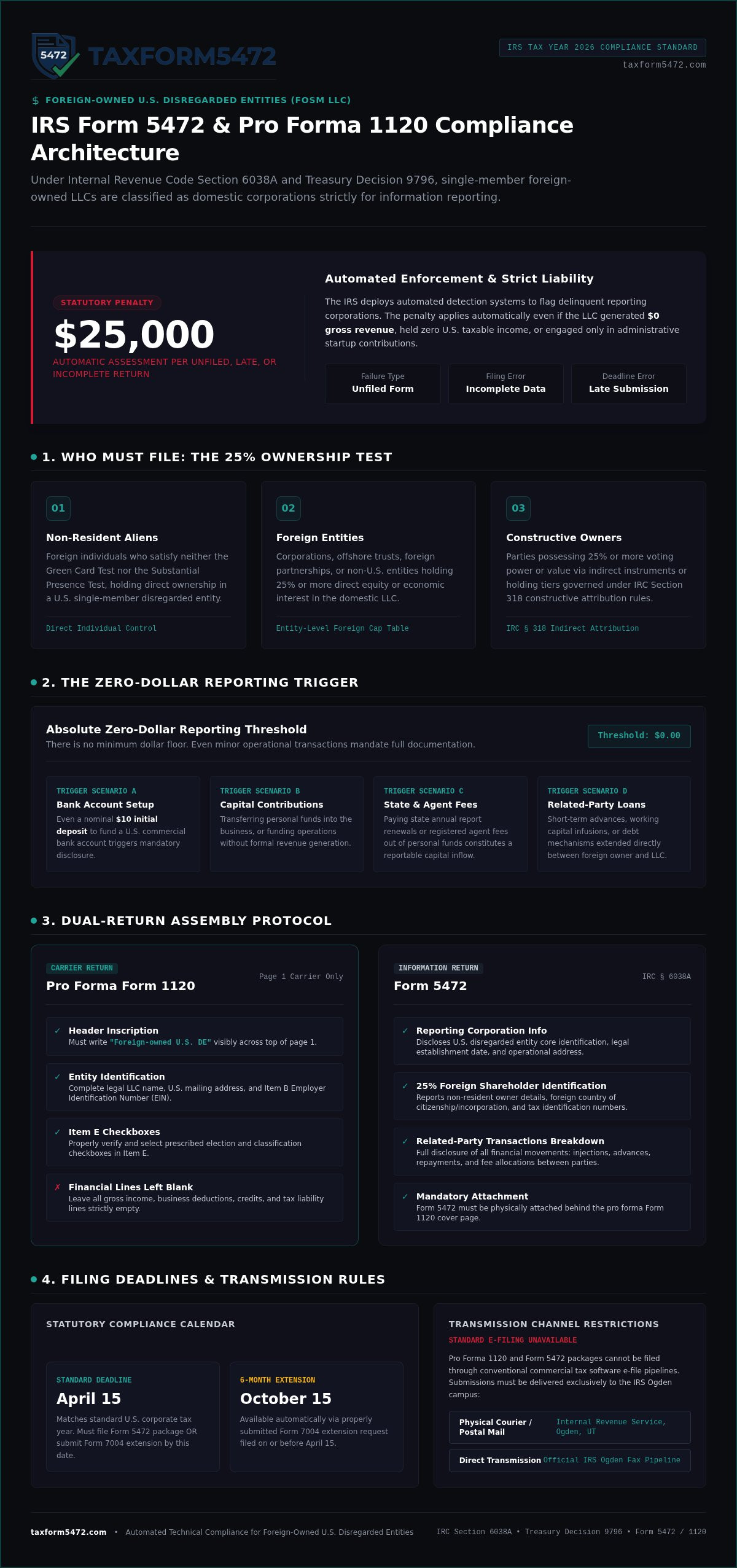
An automatic $25,000 penalty applies to every unfiled, late, or incomplete Form 5472. This fine triggers even if your entity generated zero revenue or conducted only nominal capital contributions. For international founders, mastering foreign owned llc irs requirements is a critical operational priority. You likely expected a simple administrative path. Instead, you face complex tax forms and the high costs of traditional CPA firms. The IRS now uses automated systems to identify non-compliance. A single error creates a significant financial liability.
Compliance is a technical reporting obligation. This guide identifies every mandatory IRS requirement for the 2026 tax year. You'll find a clear list of necessary forms and precise filing deadlines. We explain the pro forma 1120 rules and the zero-threshold reporting triggers. It also details an automated filing solution designed for speed and precision. Use this information to protect your U.S. business. Avoid the $25,000 failure-to-file penalty. Ensure your entity remains in good standing. The following sections provide the technical roadmap for your 2026 compliance strategy.
Key Takeaways
- Identify reporting triggers for foreign-owned disregarded entities.
- Understand the specific pro forma Form 1120 attachment rules.
- Document reportable transactions to satisfy foreign owned llc irs requirements.
- Avoid the automatic $25,000 failure-to-file penalty.
- Utilize automated filing tools for streamlined compliance.
Understanding Foreign-Owned LLC IRS Reporting Obligations
A Foreign-Owned Single Member LLC (FOSM LLC) is a U.S. entity with one owner who isn't a U.S. person. Under standard federal rules, these entities are "disregarded." This means the IRS ignores the entity for income tax purposes. The owner usually reports income directly. However, reporting obligations differ from tax liability. Even if the entity owes zero tax, it must satisfy specific information disclosure rules. The IRS prioritizes data over revenue.
The legal basis for this is Internal Revenue Code Section 6038A. This regulation mandates transparency for foreign-controlled domestic corporations. While an LLC is usually transparent, the IRS treats it as a domestic corporation solely for these reporting duties. Failure to understand Form 5472 reporting rules leads to immediate financial exposure. Meeting foreign owned llc irs requirements is mandatory for every entity that falls under this classification, regardless of its profitability or U.S. tax status.
The Disregarded Entity Reporting Trap
Many founders believe "tax-free" means "reporting-free." This is a dangerous assumption. Since 2017, Treasury Decision 9796 has classified foreign-owned disregarded entities as corporations for Section 6038A purposes. You don't need U.S. source income to trigger a filing. You don't even need a profit. This regulatory shift ensures the government can track capital movements and related-party activities. If your entity exists and engages in reportable transactions, you have a filing duty. The IRS uses these filings to map international financial flows.
Who is Considered a Foreign Owner?
The IRS applies a specific test to determine ownership status. A "reporting corporation" includes any U.S. entity with at least 25% foreign ownership. This threshold applies to several categories of owners:
- Non-resident aliens: Individuals who don't meet the green card or substantial presence tests.
- Foreign entities: Corporations, partnerships, or trusts formed outside the U.S.
- Constructive owners: Parties holding 25% of voting power or value through indirect means.
Ownership isn't just direct. The IRS uses constructive ownership rules under Section 318. If a foreign person holds 25% of the total voting power or value through other entities, the reporting duty remains. The 2026 compliance landscape demands a clear look at your cap table. Whether you own the LLC directly or through an offshore holding company, the disclosure requirements are mandatory. Precision in identifying the foreign owner is the first step in avoiding the $25,000 penalty.
Mandatory Filings: Form 5472 and Pro Forma 1120
Compliance requires a specific document pair. You must file Form 5472 and a pro forma Form 1120 together. The IRS uses Form 1120 as a carrier return for the information disclosure. Even without U.S. tax liability, these documents are mandatory. Properly navigating foreign owned llc irs requirements prevents the automatic assessment of penalties. The IRS treats the LLC as a corporation solely for this administrative purpose. This dual-form requirement ensures transparency for foreign-owned assets within the U.S. financial system.
Form 5472 Filing Triggers
A "reporting corporation" includes any domestic disregarded LLC with at least 25% foreign ownership. Filing triggers upon any reportable transaction. This includes capital contributions, loans, or payment of formation fees by the owner. There is no minimum dollar threshold. Even a $10 deposit to open a U.S. bank account creates a filing obligation. Detailed IRS Form 5472 filing guidance ensures you identify these triggers early. Common scenarios for non-resident owners involve paying state annual report fees or registered agent costs from personal funds. The IRS classifies these as capital contributions, making the form mandatory.
The Pro Forma 1120 Requirement
The pro forma 1120 serves as a cover page. You don't fill out the entire return. Complete only the name, address, Item B (EIN), and specific checkboxes in Item E. Write "Foreign-owned U.S. DE" across the top of page 1. Leave all income, deduction, and tax liability lines blank. Many owners fail here by trying to report income or leaving the specific header blank. Following the IRS Form 5472 instructions is critical for correct formatting. The IRS requires this specific presentation to process the information return without generating an income tax bill. Errors in these identifying sections often result in processing delays or clerical rejections.
Submission occurs via mail or fax to the IRS Ogden campus. Standard e-filing isn't available for these specific packages. The deadline matches the U.S. corporate tax year, typically April 15 of the following year. You can request a six-month extension to October 15 using Form 7004. Filing this extension must also occur by the April 15 deadline. Managing foreign owned llc irs requirements involves high administrative precision. Missing the deadline or submitting an incomplete package triggers the $25,000 penalty immediately. An automated filing solution simplifies this process. It ensures your 5472 and pro forma 1120 are correctly paired and formatted for 2026 standards. Efficiency reduces risk.
Identifying Reportable Transactions and Related Parties
Reportable transactions trigger the mandatory filing requirement. The IRS defines these exchanges broadly under Treasury Regulation § 1.6038A-2. A "related party" includes any 25% foreign shareholder or any entity under common direct or indirect control. You must track every exchange between the LLC and these parties. Precision is required. Small oversights lead to the $25,000 penalty. Understanding reportable transactions Form 5472 ensures full compliance for the 2026 tax year. The IRS uses these disclosures to monitor international capital movements and prevent tax evasion.
Identifying related parties involves looking beyond direct ownership. Constructive ownership rules apply. If a foreign person holds 25% of the voting power through a holding company, they are a related party. This status extends to family members and affiliated corporations. Every transaction with these individuals or entities must appear on Form 5472. Fulfilling foreign owned llc irs requirements starts with a complete map of your corporate structure. Do not assume a transaction is exempt because the amount is small.
Common Monetary Transactions
These are the most visible exchanges. Capital contributions include any funds moved into the LLC. Even a $50 deposit to cover initial bank fees counts. Distributions involve moving money out to the owner. Loans are also reportable. This includes both the principal amount and any interest payments. Management fees, rents, and commissions must be documented. The IRS applies a zero-dollar de minimis threshold. Every cent matters for foreign owned llc irs requirements. Ledger entries must match your bank statements exactly to avoid discrepancies during a review.
Non-Monetary and Deemed Transactions
Competitors often ignore non-cash exchanges. This is a critical error. The IRS tracks intangible property transfers. This includes trademarks, patents, and domain names. If the owner pays a state formation fee or registered agent fee personally, it is a "deemed" capital contribution. Services performed without immediate payment also count. Using business assets for personal use triggers reporting. These "deemed" exchanges carry the same $25,000 risk as cash transfers. Report these in Part V of Form 5472 to maintain compliance.
Maintain permanent records for all transactions. The IRS requires a minimum six-year retention period for books and records. This includes bank statements, contracts, invoices, and digital receipts. Your documentation must support every value entered on Form 5472. Systematic tracking simplifies the filing process and provides a robust defense during an audit. Compliance is a continuous data management task. Use digital tools to categorize transactions as they occur. This proactive approach ensures your 2026 filing is accurate and defensible.
The $25,000 Penalty: Risks of Non-Compliance
The IRS assesses a $25,000 penalty for every late or missing Form 5472. This is a per-form, per-year assessment. If you own three LLCs and miss the deadline, the initial fine is $75,000. These are assessable penalties. This means the IRS issues them automatically without a prior audit. The system identifies the missing disclosure and generates a notice. Managing foreign owned llc irs requirements requires zero tolerance for administrative errors. Compliance is not optional.
If the failure persists, the costs escalate. After an initial 90-day notification window, the IRS adds an additional $25,000 for every 30-day period of non-compliance. There is no statutory maximum cap for these continuation penalties. This creates uncapped financial exposure for international founders. Understanding foreign owned us corporation tax risks is essential to protect your assets. The "strict liability" nature of these rules means the IRS rarely grants leniency for simple mistakes.
Failure to File vs. Substantially Incomplete Filing
Accuracy is as important as timing. The IRS treats a "substantially incomplete" filing as a total failure to file. Leaving Part IV (related party information) or Part V (reportable transactions) blank triggers the full $25,000 fine. Errors in the foreign tax identification number (FTIN) or owner address also create risk. The IRS prioritizes data integrity. Omitting even a nominal $100 capital contribution makes the return legally incomplete. Penalty abatement is rare. You must prove "reasonable cause," which requires demonstrating extreme, unavoidable circumstances. Standard clerical errors or ignorance of the law don't qualify for relief.
Statute of Limitations Risks
Filing starts the clock. If you fail to file, the statute of limitations for that tax year never begins. The IRS can assess penalties ten or twenty years later. This exposure follows the foreign owner personally and creates a permanent cloud over your U.S. business interests. Non-compliance often surfaces during bank account reviews or future visa applications. Federal agencies share data. A history of tax delinquency complicates your immigration status and may lead to the revocation of business licenses. Failing to meet foreign owned llc irs requirements today creates long-term financial and legal barriers.
Maintain clean records and validate every data point before submission. The IRS system is designed for automated enforcement, not manual interpretation. Precision is your only defense against these assessments. Prepare your Form 5472 now to eliminate these risks and secure your entity's standing for 2026.
Streamlining Compliance with Automated Preparation
Traditional accounting engagements are often slow and expensive. CPA firms prioritize high-value advisory work over information reporting. This leaves foreign owners with high hourly bills for simple data entry. Automated solutions remove this friction. Utilizing automated Form 5472 preparation ensures your data aligns with IRS standards. Digital validation identifies errors that humans often miss. This precision is essential for satisfying foreign owned llc irs requirements. The IRS uses automated matching. Your filing must be equally precise.
The Digital Filing Workflow
The transition from data to submission is seamless. First, input your entity details and transaction history into a secure digital interface. This removes the need for paper ledgers or messy spreadsheets. Second, the platform performs automated validation. It checks for missing foreign tax identification numbers and ensures all Part V transactions are categorized correctly. This step prevents the "substantially incomplete" trap mentioned earlier. Finally, the system generates a ready-to-file package. You review the output and initiate the submission. This workflow cuts preparation time from days to minutes. It provides an audit trail for every entry.
Why Automation Wins for Foreign Owners
Predictability is a core advantage. Traditional firms often provide vague estimates. SaaS platforms use standardized models. This makes compliance a predictable line item in your budget. Speed is also a deciding factor. You don't have to wait for a professional's schedule to clear. You file on your timeline. Centralized record-keeping is the final piece. The IRS requires you to maintain books for six years. Digital platforms store your history securely. This simplifies future filings and provides immediate access during a review. You stay organized without physical storage. It's a utilitarian approach to a complex administrative burden.
Automation isn't just a convenience. It's a risk management strategy. Manual drafting leads to clerical errors in the pro forma 1120 header or transaction totals. These small mistakes trigger the $25,000 penalty. A specialized platform focuses exclusively on these forms. It handles the technical requirements that generalist accountants might overlook. Meeting foreign owned llc irs requirements requires a precise, results-oriented tool. Efficiency is your best defense against IRS assessments. Start your automated filing today to secure your entity's 2026 compliance status.
Secure Your 2026 Compliance Status
Managing foreign owned llc irs requirements demands high precision to avoid systemic enforcement. The IRS assesses the $25,000 penalty automatically for missing or incomplete disclosures. You must pair Form 5472 with a correctly formatted pro forma Form 1120. Even nominal transactions, like state formation fees, trigger these obligations. Errors in reporting related parties or capital contributions create immediate financial exposure. Don't rely on manual processes or slow CPA firms for these technical filings.
Efficiency is your best protection. This specialized Form 5472 platform ensures your data meets 2026 standards. A streamlined digital interface identifies potential errors before submission. Automated IRS compliance saves time and eliminates the risk of uncapped continuation penalties. Take control of your U.S. reporting now. File Your Form 5472 Online to maintain your entity's standing. Your business deserves a precise, professional defense.
Frequently Asked Questions
Does a foreign-owned LLC need to file if it has no income?
Yes, a foreign-owned LLC must file even with zero income. The IRS treats these entities as domestic corporations for information reporting purposes under Section 6038A. Any reportable transaction, such as a small capital contribution to open a bank account, triggers the filing. Meeting foreign owned llc irs requirements is about data transparency, not tax liability. If your entity exists and moves any value, you likely have a 2026 filing obligation.
What is the penalty for not filing Form 5472 in 2026?
The standard penalty is $25,000 for each late, unfiled, or substantially incomplete Form 5472. This fine is assessed automatically by IRS systems. If you fail to file within 90 days of receiving a notice, the IRS adds another $25,000 for every 30-day period thereafter. There's no maximum cap on these continuation penalties. Accuracy in every section of the form is required to avoid being flagged for an incomplete return.
Can I file Form 5472 online without a CPA?
You don't need a CPA to file Form 5472. Specialized SaaS platforms like taxform5472.com provide an automated alternative to traditional accounting firms. These tools use digital validation to ensure your data matches current IRS formatting rules. This reduces the risk of human error while providing a faster, more affordable solution. You enter your data, and the platform generates the compliant filing package for submission, bypassing the high hourly rates of CPA firms.
What is the deadline for foreign-owned LLC IRS requirements?
The deadline matches the U.S. corporate tax year. For calendar-year entities, the filing is due on April 15. You can obtain an automatic six-month extension to October 15 by submitting Form 7004 by the original April deadline. Note that foreign-owned disregarded entities don't receive the automatic June 15 extension available to some international filers. You must act by April 15 to ensure your entity remains in good standing for the 2026 cycle.
Do I need an EIN to file Form 5472?
Yes, an Employer Identification Number (EIN) is mandatory for the filing process. You cannot submit Form 5472 or the pro forma Form 1120 without a valid EIN. If you're a foreign owner without a Social Security Number (SSN) or ITIN, you must apply for an EIN by faxing or mailing Form SS-4 to the IRS. This number identifies your business entity within the federal tax system and is required for all formal communications.
Is Form 5472 required for every foreign owner of the LLC?
A separate Form 5472 is required for each "related party" that engaged in a reportable transaction with the LLC. This includes any foreign person or entity owning 25% or more of the business. If your LLC has two foreign owners who both contributed capital, you must file two separate forms. Identifying every related party is a core component of foreign owned llc irs requirements. Overlooking an owner leads to the same $25,000 penalty.
What counts as a reportable transaction for a disregarded entity?
For a disregarded entity, reportable transactions include any exchange of value between the LLC and its foreign owner. Common examples are capital contributions, owner draws, and loans. Deemed transactions also count, such as the owner paying state formation fees or registered agent costs from personal funds. There's no minimum dollar threshold for these events. Every transaction, regardless of size, must be disclosed in Part V of Form 5472 to satisfy federal transparency rules.
How do I avoid the $25,000 late filing penalty?
The most effective way to avoid the $25,000 penalty is to file a complete and accurate return by the April 15 deadline. Use automated preparation tools to validate your data against IRS requirements. Ensure that your pro forma Form 1120 includes the mandatory "Foreign-owned U.S. DE" header. Maintain precise records of all transactions throughout the year. Proactive documentation prevents the clerical errors that often trigger automated IRS assessments and ensures your 2026 compliance is defensible.