
Is your single-member LLC truly a disregarded entity in the eyes of the IRS? For foreign owners, the answer is no. Filing form 5472 for single member llc is a mandatory transparency requirement. Failure to comply results in a minimum $25,000 penalty. You likely chose a US entity for its global reach and administrative ease. However, the IRS applies strict corporate reporting standards to these structures, often creating confusion for international owners.
Anxiety over compliance is a rational response to complex federal forms. Navigating these requirements from abroad requires precision and updated information. This guide provides the clarity you need for the 2026 tax year. You will understand your specific filing obligations, identify reportable transactions, and secure a cost-effective preparation strategy. We detail the necessary steps to maintain your standing and protect your business from avoidable financial loss.
Key Takeaways
- Verify reporting status. Foreign-owned SMLLCs are classified as domestic corporations for tax transparency purposes.
- Define reportable transactions. Identify monetary and non-monetary exchanges to ensure complete IRS disclosure.
- Prevent financial penalties. Accurate filing is necessary to avoid the $25,000 non-compliance fine.
- Prepare form 5472 for single member llc. Organize your US EIN and entity details for the 2026 cycle.
- Optimize filing efficiency. Use digital tools to eliminate manual errors and streamline the preparation process.
Is Form 5472 Required for Single Member LLCs?
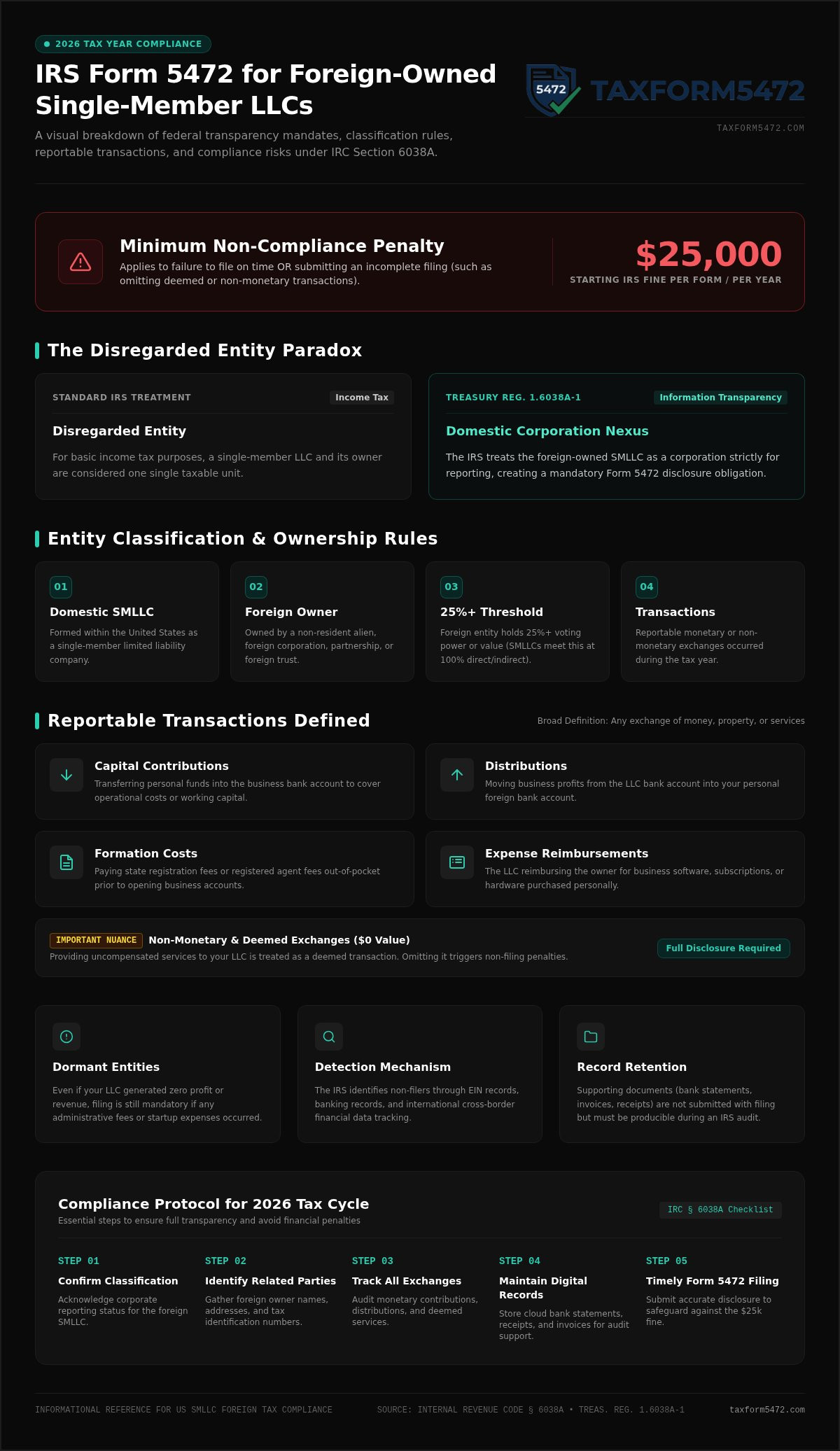
Internal Revenue Code Section 6038A mandates disclosure from "reporting corporations." Traditionally, this applied only to entities incorporated as companies. Current regulations now include any domestic entity that is foreign-owned and disregarded for tax purposes. If a foreign person owns 100% of a US LLC, that LLC is a reporting corporation. The IRS uses this mechanism to maintain transparency in cross-border commerce. Filing form 5472 for single member llc is a federal requirement for these structures. It's a tool for the IRS to monitor the movement of funds into and out of the United States.
The Disregarded Entity Reporting Nexus
The "disregarded" label often leads to compliance errors. For most IRS purposes, the LLC and the owner are one unit. Treasury Regulation 1.6038A-1 breaks this unit for reporting. It forces the LLC to act as a corporation for information disclosure. This is a transparency tool. It doesn't change your income tax liability, but it does change your reporting workload. You can find more Form 5472 background and rules regarding these specific Treasury classifications and how they target foreign-owned entities. Even a dormant LLC may have filing requirements if certain administrative costs were paid by the owner. The obligation is mandatory regardless of whether the business generated profit during the tax year.
Who is Considered a Foreign Owner?
A foreign owner is any person who isn't a US citizen or resident. This category includes foreign corporations, partnerships, and trusts. The IRS applies a 25% ownership threshold to trigger reporting. In a single-member structure, you meet this threshold by default. Both direct and indirect ownership count toward this total. If a foreign entity owns your LLC, the IRS traces the ownership back to the foreign parent. You must provide names, addresses, and tax identification numbers for these related parties. Compliance for 2026 requires precise identification of these entities. Consider these criteria for your entity:
- The entity is a domestic single-member LLC.
- The owner is a non-resident alien or foreign entity.
- The owner holds at least 25% of the total voting power or value.
- Reportable transactions occurred during the tax year.
Failure to recognize these ownership rules doesn't excuse the filing requirement. The IRS identifies non-filers through EIN records and cross-border payment data. Maintaining compliance starts with acknowledging your status as a reporting corporation. It's the first step in avoiding the significant penalties associated with non-disclosure.
Identifying Reportable Transactions for SMLLCs
A reportable transaction is any exchange of value between the LLC and its foreign owner or other related parties. This includes any movement of money, property, or services. For a form 5472 for single member llc, the definition is broad. You must report transactions even if they don't involve cash. The IRS monitors these events to ensure fair market value and proper tax treatment. You can review the IRS Form 5472 overview and instructions for a full list of specific transaction codes and reporting categories.
Accuracy in reporting is critical. Even zero-dollar transactions often require disclosure. For instance, if you provide services to your LLC without charging a fee, this is a non-monetary reportable transaction. The IRS treats these as "deemed" exchanges. Failure to list these items constitutes an incomplete filing. This omission triggers the same $25,000 penalty as failing to file the form entirely. Accuracy is mandatory. Every transaction must reflect its actual economic impact.
Common SMLLC Transaction Examples
Solopreneurs often overlook small administrative actions. These are frequently reportable. Common examples for single-member structures include:
- Capital Contributions: Moving personal funds into the business bank account to cover operational costs.
- Distributions: Transferring business profits to your personal account.
- Formation Costs: Paying state filing fees or registered agent costs using personal funds before the business bank account is open.
- Expense Reimbursements: The business paying you back for equipment or software purchased personally.
Maintenance of Record Standards
The IRS requires you to maintain records that support the amounts reported on Form 5472. You don't submit these documents with your filing, but you must produce them during an audit. Digital record retention is the standard for foreign owners. Store bank statements, invoices, and receipts in a secure cloud environment. Understanding the specifics of reportable transactions form 5472 helps you categorize these records throughout the year. Accurate preparation of form 5472 for single member llc depends on these records. Store records securely. Precise documentation reduces the risk of errors during the final preparation phase.
Efficient record-keeping ensures a smooth filing process. If you're managing multiple transactions, using a specialized Form 5472 preparation tool can simplify your 2026 compliance. It's an effective way to organize data and verify that every mandatory field is addressed correctly.
Form 5472 Penalties and Compliance Risks
The IRS enforces a strict $25,000 penalty for non-compliance. This amount applies per form, per year. If you own multiple entities, the financial risk multiplies. Under the 26 U.S. Code § 6038A penalty provisions, the IRS has the authority to assess these fines without a prior audit. Simple oversight is not a valid defense. Filing form 5472 for single member llc is a mandatory disclosure. Incomplete forms are treated as non-filed. This means missing a single reportable transaction or providing an incorrect address can trigger the full penalty amount. Substantial compliance is the minimum standard required to avoid these costs.
How does the IRS detect non-filers? The process starts with the Employer Identification Number (EIN). When you apply for an EIN via Form SS-4, you disclose the "responsible party." The IRS cross-references these records with annual information returns. If an EIN is active but no Form 5472 is received for a foreign-owned entity, the system flags the account. Automated tracking has increased enforcement efficiency significantly. Data sharing between international tax authorities also helps identify foreign owners who fail to meet their US obligations. Your entity is visible to the IRS from the moment of formation.
The Cost of Late Filing
Late filing penalties are assessed automatically. The IRS sends a notice of assessment as soon as the deadline passes. Beyond the initial $25,000 fine, the IRS adds $25,000 for every 30 days the failure continues. There's no upper limit to these additions. Unpaid penalties can lead to the loss of legal standing for your LLC. This jeopardizes your ability to maintain bank accounts or conduct business. Understanding foreign owned us corporation tax rules is essential to protecting your US assets. Non-compliance is an expensive operational risk.
Mitigating Compliance Exposure
Proactive management is the only way to avoid these costs. Establish a filing calendar for the 2026 tax year. Ensure all transaction data is ready before the deadline. Electronic submission is the most reliable method for foreign owners. It provides an immediate receipt and reduces the risk of mail delays. Accuracy is as important as timing. Verify every field on your form 5472 for single member llc before submission. A precise, timely filing eliminates the threat of automatic IRS assessments. Focus on early preparation to maintain your business's financial health.
Filing Requirements and Instructions for 2026
Filing form 5472 for single member llc requires specific prerequisites. First, obtain a US Employer Identification Number (EIN). This unique identifier is mandatory for all reporting corporations. Without it, the IRS cannot process your information return. Part II of the form requires the LLC's legal name, address, and principal business activity code. Use the code that best describes your primary source of revenue. Part III focuses on the 25% foreign shareholder. You must provide their full legal name, permanent address, and foreign or US tax identification number. Accuracy here is vital. Discrepancies between these parts and the owner's personal records often lead to processing delays or automated inquiries.
The Pro-Forma Form 1120 Requirement
Single-member LLCs are disregarded for income tax but treated as corporations for reporting. This requires a pro-forma Form 1120. It acts as a mandatory cover sheet. You don't complete the entire document. Focus on the entity's name, address, and the specific checkbox identifying the LLC as a foreign-owned domestic disregarded entity. Most lines concerning income and deductions remain blank. A common error is submitting Form 5472 as a standalone document. The IRS rejects these filings. Always attach the reporting form to the pro-forma 1120. Ensure the tax year dates at the top of both forms match exactly to avoid system errors.
2026 Deadlines and Extensions
The standard filing deadline is April 15, 2026, for calendar year entities. This date aligns with the US individual tax season. If you need more time, file Form 7004. This provides an automatic six-month extension, moving the deadline to October 15, 2026. You must file the extension request on or before the original April due date. Missing this window triggers the $25,000 penalty for failing to file form 5472 for single member llc. Late filings without an extension are considered non-compliant. The IRS does not grant leniency for international mail delays or technical issues.
Manual preparation of these combined forms is time-consuming and prone to clerical errors. You can prepare your Form 5472 online to ensure your pro-forma attachments and transaction codes meet current standards. Precise automation is the most efficient way to maintain your LLC's standing and avoid administrative friction.
Streamlining Compliance with Automated Preparation
Manual filing creates unnecessary friction. Traditional paper forms invite clerical errors. For form 5472 for single member llc, a single mistake triggers a $25,000 penalty. Automated preparation removes this risk. Digital systems validate data in real-time. taxform5472.com provides a specialized SaaS platform for these specific IRS mandates. It's a precise tool for results-oriented owners. Secure data handling is our standard. We use high-level encryption for all international business data. This ensures your sensitive entity details remain protected. Automation provides a reliable audit trail. It's the most efficient way to manage federal transparency requirements from abroad.
CPA vs. Automated Software
CPA firms often charge high hourly rates for routine forms. These costs are often excessive for single-member entities. Automated software offers a flat-fee alternative. It eliminates the communication lag found in traditional firms. You maintain total control over your filing timeline. Consider the benefits of automated form 5472 preparation for your 2026 cycle. Digital tools don't miss deadlines. They don't overlook mandatory checkboxes. You receive a completed, ready-to-file package in minutes. This speed is essential for busy founders. It's a utilitarian choice for modern compliance.
Getting Started with Digital Filing
Our interface is minimalist and direct. It's built for global users. You don't need advanced tax knowledge to complete the process. The system guides you through the mandatory data entry for form 5472 for single member llc. You enter your EIN, ownership details, and reportable transaction values. The platform automatically generates the pro-forma 1120 and the 5472. This unified workflow prevents mismatched information errors. A final review protocol allows you to verify all inputs before completion. It's a no-nonsense path to IRS compliance. The software stores your data for future years. This makes recurring filings even faster. Focus on your business. Let the tool handle the administrative weight.
Securing Your 2026 Compliance Status
IRS transparency requirements for foreign-owned entities are non-negotiable. A successful filing of form 5472 for single member llc depends on identifying every reportable transaction and meeting the April 15 deadline. The $25,000 penalty for non-compliance represents a significant operational risk. You can avoid this with precise, proactive preparation. You've established your US entity for global growth. Don't let administrative oversight or complex manual forms jeopardize your professional standing.
Our specialized SaaS platform offers a secure, automated solution tailored for foreign owners. It eliminates manual entry errors. It ensures your pro-forma attachments meet the latest IRS standards for the 2026 cycle. Maintain your focus on business operations. Our tool manages the technical reporting mandates. Prepare your Form 5472 online now to protect your business assets and ensure total compliance. Efficient, secure reporting is within your reach.
Frequently Asked Questions
Do I need to file Form 5472 if my LLC had zero transactions?
Yes, you may still have a filing obligation. If the owner paid formation fees or registered agent costs personally, these are reportable capital contributions. Even a dormant entity must disclose these exchanges of value to avoid the non-compliance fine. Filing form 5472 for single member llc is mandatory whenever a reportable transaction occurs. This includes zero-dollar "deemed" services provided by the owner to the business entity.
Can I file Form 5472 online for a single-member LLC?
Yes, digital filing is the most efficient method for international owners. While the IRS provides raw PDF instructions, specialized SaaS platforms offer a streamlined interface for electronic submission. These tools generate the mandatory pro-forma Form 1120 and the 5472 simultaneously. This prevents the common error of submitting a standalone document. Using a digital platform ensures your data meets federal validation standards and provides an immediate submission receipt.
What is the deadline for Form 5472 in 2026?
The standard deadline is April 15, 2026, for LLCs operating on a calendar year. If your fiscal year differs, the form is due with your annual information return. You can secure a six-month extension by filing Form 7004 before the April deadline. This moves your final submission date to October 15, 2026. Missing these windows results in an automatic $25,000 assessment from the IRS for non-compliance.
Is there a penalty for an incorrectly filed Form 5472?
Yes, the IRS applies a $25,000 penalty for incomplete or inaccurate information. Errors in Part II or Part III are treated as a failure to file. This includes incorrect tax identification numbers, misspelled names, or omitted reportable transactions. Accuracy is mandatory for federal compliance. If the IRS identifies a substantial omission, they assess the full penalty amount regardless of whether the form was submitted on time.
Do I need a Social Security Number to file Form 5472?
No, a US Social Security Number isn't required for foreign owners. You must have an Employer Identification Number (EIN) for the LLC itself. For the 25% foreign shareholder, you can use a US Individual Taxpayer Identification Number (ITIN) or their foreign tax identification number from their home country. Accurate identification is essential for the IRS to track cross-border value transfers and ensure transparency in international business structures.
Can I file Form 5472 myself without a CPA?
Yes, you can complete the filing process without hiring a traditional CPA. Digital preparation tools are designed specifically for owners to manage their own form 5472 for single member llc requirements. These platforms provide step-by-step guidance through the reporting categories. This approach is more cost-effective than hourly accounting fees. It allows you to maintain direct control over your entity's compliance status while ensuring all mandatory fields are addressed correctly.
How much does it cost to file Form 5472 through taxform5472.com?
The platform operates on a flat SaaS fee model for each prepared return. This fee covers the automated generation of both Form 5472 and the required pro-forma Form 1120. Unlike traditional accounting services that charge by the hour, this digital solution provides a predictable cost for international owners. You pay only for the specific preparation services you use. This makes it a utilitarian choice for small entities with straightforward reporting needs.
Does Form 5472 apply to Wyoming and Delaware LLCs?
Yes, federal reporting requirements apply to all US entities regardless of the state of incorporation. Whether your LLC is registered in Wyoming, Delaware, or any other state, foreign ownership triggers the Section 6038A mandate. The IRS monitors these entities at the federal level to ensure global tax transparency. State-level privacy laws don't exempt you from these mandatory IRS disclosures. Compliance is a federal obligation for every foreign-owned domestic disregarded entity.