
A single missing document can trigger a $25,000 IRS penalty, even if your business generated zero revenue last year. This is the financial reality for international founders navigating the non resident llc form 5472 mandate. The IRS does not offer leniency for ignorance of foreign status reporting. It demands precision. For most owners, U.S. tax compliance feels like a high-stakes minefield designed to invite error.
Traditional CPA fees are high. Manual faxing is slow. We provide the clarity needed to secure your 2026 compliance. This guide protects your business from five-figure assessments and delivers a professional, low-cost path to a successful IRS submission. Our focus is on efficiency and verifiable compliance status. We prioritize functionality over complex narratives.
We will detail specific reporting triggers for disregarded entities, the mandatory 300 DPI fax standards, and the statute of limitations trap that keeps unfiled years open for audit indefinitely. Follow this framework to confirm your status and eliminate the threat of late filing penalties. Your compliance starts here.
Key Takeaways
- Understand the IRS classification of a foreign-owned disregarded entity and its specific reporting obligations.
- Identify the monetary and non-monetary triggers that require a non resident llc form 5472 submission.
- Secure your 2026 compliance by mastering IRS deadlines and the Form 7004 extension process.
- Mitigate the risks of manual filing errors through automated, professional preparation tools.
Non-Resident LLC Form 5472: Mandatory Reporting Basics
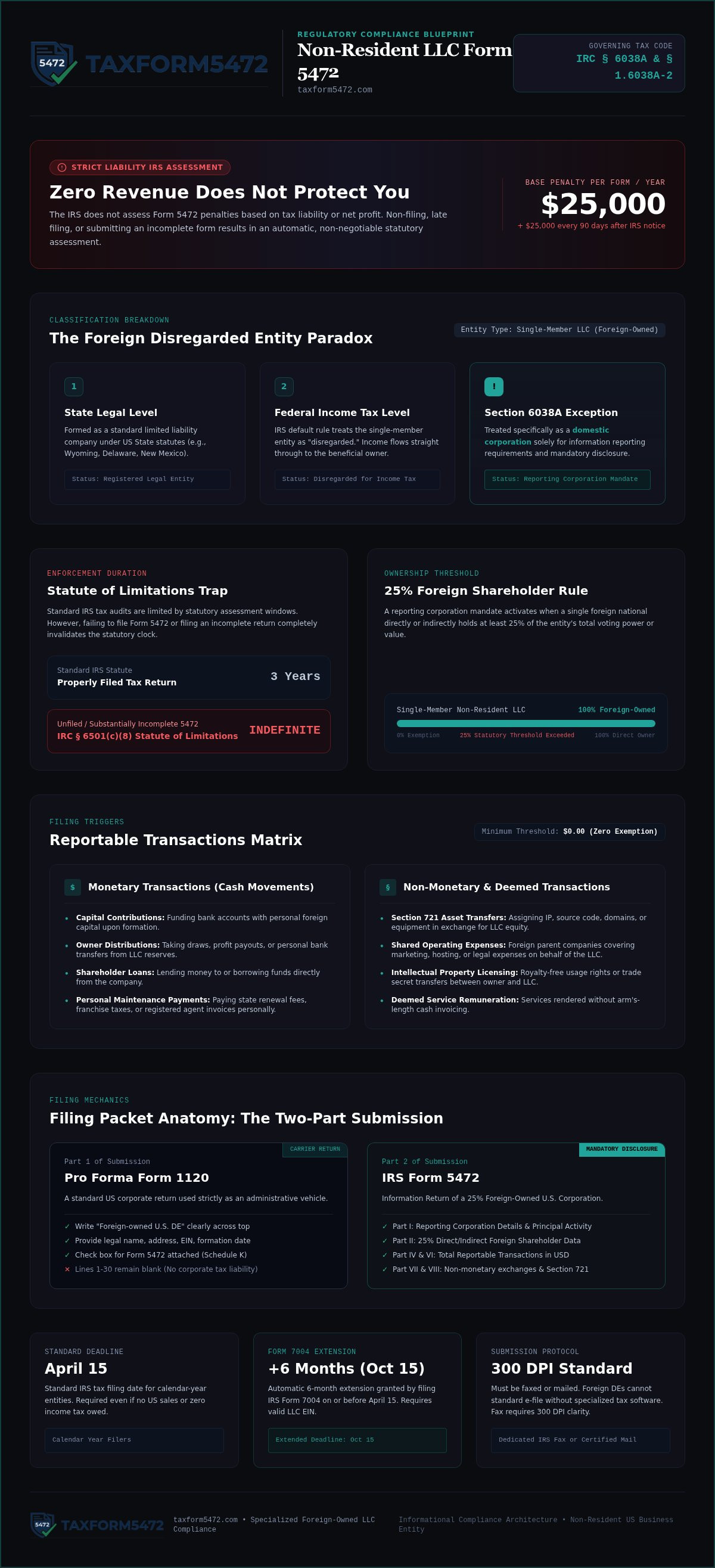
A foreign-owned single-member LLC is typically a disregarded entity for U.S. federal tax purposes. This means the entity's activity usually flows through to the owner's personal tax return. However, federal regulations under Section 6038A create a specific exception. For information reporting purposes, the IRS treats these entities as domestic corporations. This classification triggers the requirement to file a non resident llc form 5472. It's a critical distinction. Failure to recognize this status leads to non-compliance and immediate financial exposure. Informational reporting is separate from income tax liability.
The Reporting Corporation Requirement
An LLC becomes a reporting corporation if it has at least one direct or indirect 25% foreign shareholder. For a single-member LLC owned by a non-resident, this threshold is always met. The disregarded label often confuses international founders. It suggests the entity is invisible to the IRS. While it remains disregarded for income tax liability, it's highly visible for informational purposes. This reporting mandate exists to track transactions between the U.S. entity and its foreign owner. You can find more Form 5472 background and rules regarding these specific statutory obligations. The reporting requirement is absolute. It applies regardless of where the business operates or where the owner resides.
EIN and Pro Forma Form 1120
Compliance requires an Employer Identification Number (EIN). You cannot file without one. Even if your LLC has no employees or U.S. bank account, the EIN is the primary identifier for your tax records. The filing process is unconventional. A non resident llc form 5472 is not filed alone. It must be attached to a pro forma Form 1120. This is a standard corporate income tax return where most lines remain blank. You only complete basic identifying information and write "Foreign-owned U.S. DE" across the top. This administrative step signals to the IRS that the entity is reporting under the disregarded entity rules.
Zero income doesn't provide a safe harbor. Many owners believe that no U.S. sales equals no filing obligation. This is incorrect. Any reportable transaction triggers the form. This includes capital contributions to open a bank account or paying state registration fees from personal funds. These are considered economic exchanges. If these occur, the filing is mandatory. The IRS assesses the $25,000 penalty based on the failure to report the transaction, not the amount of tax owed. Compliance is about transparency, not just revenue.
Identifying Reportable Transactions for Foreign-Owned LLCs
A reportable transaction is the primary trigger for a non resident llc form 5472. The IRS defines these transactions broadly. It's not limited to revenue or profit. Any economic movement between the LLC and its foreign owner, or a related party, requires disclosure. This includes both monetary and non-monetary exchanges. Understanding these triggers is vital. Many founders miss the filing requirement because they haven't generated sales. They overlook the deemed transactions that occur during entity setup and maintenance.
- Capital contributions: Depositing funds into a U.S. bank account.
- Distributions: Withdrawing funds or taking an owner's draw.
- Loan activity: Borrowing from or lending to the owner.
- Maintenance fees: Paying state franchise taxes or registered agent fees from personal accounts.
The IRS tracks these events to monitor capital flow across borders. If you funded your LLC formation personally, you've already engaged in a reportable transaction. There's no minimum dollar threshold. Even a small state fee payment can trigger the mandate. Precise tracking is the only way to ensure compliance.
Monetary Reportable Transactions
Direct cash movements are standard triggers. This category covers sales and purchases of tangible property. If the LLC buys stock or equipment from the foreign owner, it's reportable. Rents and royalties paid to the owner for use of property or IP also count. Interest payments on shareholder loans are common. Commissions paid for services rendered must be disclosed as well. These movements are recorded by dollar value using specific codes. You can find technical definitions in the IRS Form 5472 resources portal. Every dollar must be accounted for to avoid an incomplete filing status.
Non-Monetary and Deemed Transactions
Non-cash exchanges carry the same weight as cash transactions. The Section 721 trap is a frequent oversight. It occurs when a foreign owner transfers property, such as software code or equipment, to the LLC in exchange for ownership interest. The IRS views this as a reportable exchange. Shared expenses also fall into this category. If a foreign parent company pays for the LLC's marketing or legal costs, the benefit is reportable. These are deemed transactions where no cash actually moves through the LLC bank account.
Identifying these hidden triggers is essential for 2026 compliance. For a comprehensive list of scenarios, review our Reportable Transactions Form 5472: A 2026 Compliance Guide. If you're unsure about your specific transactions, using taxform5472.com ensures your preparation is accurate and efficient.
Compliance Risks: The $25,000 Penalty and Filing Methods
The $25,000 penalty for a missing or late non resident llc form 5472 is mechanical. The IRS applies it automatically when a deadline passes without a submission. There's no sliding scale based on revenue. A zero-income entity pays the same $25,000 as a multi-million dollar corporation. This assessment is per form, per year. If you have multiple related parties, your financial exposure multiplies quickly. The IRS doesn't need to prove intent; they only need to prove the form is missing or substantially incomplete.
Manual filing methods increase your risk. Foreign-owned disregarded entities are prohibited from electronic filing via standard MeF systems. You must use fax or physical mail to the IRS Ogden PIN Unit. Paper submissions are vulnerable to transit delays and manual processing backlogs. A lost letter or a low-resolution fax results in a failure-to-file status. Digital record-keeping provides the necessary proof of transmission. Without a timestamped confirmation, you have no defense against an automated notice. Also, an unfiled form means the three-year statute of limitations never starts. The IRS can audit that tax year indefinitely.
Manual vs. Automated Preparation
Manual data entry is prone to clerical error. Transposing an EIN or missing a checkbox on the pro forma Form 1120 renders the submission invalid. This triggers the same $25,000 penalty as not filing at all. Automated validation checks eliminate these risks by ensuring data integrity before transmission. Traditional CPA services often rely on manual workflows that increase costs without proportional accuracy. A SaaS-based approach offers higher precision and efficiency. It ensures every field meets the requirements of the non resident llc form 5472. For a detailed comparison, see our analysis on Form 5472 CPA vs. Software: Evaluating Compliance Risks and Costs.
Penalty Abatement Realities
Achieving penalty abatement is difficult and rare. The IRS requires proof of "reasonable cause" to waive a fine. This is a high legal standard. Claims of ignorance regarding U.S. tax law are routinely rejected. The IRS expects international owners to seek professional guidance. Under 26 CFR § 1.6038A-2 reportable transactions, the burden of proof rests entirely on the filer. If you've already missed a deadline, you must act quickly to limit continuation penalties. These add $25,000 every 30 days after an initial 90-day grace period. There's no statutory cap on these accumulated fines. Learn How to Amend Form 5472: Avoiding the $25, 000 Late Filing Penalty to mitigate further damage.
2026 Filing Deadlines and Procedural Requirements
For most founders, the 2026 filing cycle follows the standard U.S. tax calendar. Calendar-year entities must file their 2025 reports by April 15, 2026. Fiscal-year entities must file by the 15th day of the 4th month after their year ends. Precision is the priority. Missing these dates triggers the $25,000 assessment automatically. Form 7004 allows for a six-month extension. You must submit it by the original due date to move the deadline to October 15, 2026. This extension only applies to the information return. It doesn't cover tax payments if the entity has elected corporate taxation.
The submission requires a pro forma Form 1120 attached to the non resident llc form 5472. You must write "Foreign-owned U.S. DE" at the top of the Form 1120. Most lines on this form will remain blank. Section 6038A also imposes strict record maintenance rules. You must keep all documents related to the reported transactions. The IRS requires these records to be available for inspection at any time. Failure to maintain these files is legally equivalent to failing to file the form itself.
Critical Dates for the 2026 Tax Year
The 2026 calendar year involves two distinct cycles. For activity conducted in 2025, the initial deadline was April 15, 2026. Filing Form 7004 by this date moved the deadline to October 15, 2026. For activity occurring during the 2026 calendar year, your initial deadline is April 15, 2027. Late submissions result in the immediate assessment of the $25,000 penalty. Review our Foreign Owned US Corporation Tax: 2026 Compliance Guide for a full calendar breakdown. Extensions only delay the filing requirement. They don't waive the $25,000 baseline fine if the extension itself is filed late.
Submission Procedures
Disregarded entities have limited submission channels. You cannot use the IRS Modernized e-File (MeF) system. Physical mail must go to the Internal Revenue Service, 1973 Rulon White Blvd, M/S 6112 Attn: PIN Unit, Ogden, UT 84201. Faxing is permitted at 855-887-7737. The IRS mandates a resolution of 300 DPI or higher. Low-quality transmissions are often rejected without notice. Digital gateways provide a time-stamped confirmation receipt. This is your only defense in a penalty dispute. Automate your 2026 filing to secure a verifiable submission record.
Automated Form 5472 Filing for Non-Resident Owners
Efficiency in tax compliance requires purpose-built tools. Manual workflows invite the errors that lead to $25,000 penalties. TaxForm5472 provides a specialized SaaS platform to eliminate these risks. It streamlines the reporting process for international founders by focusing exclusively on the non resident llc form 5472 mandate. The interface is utilitarian. It removes the complexity of standard tax software, prioritizing functionality for non-tax professionals. You get a direct path to compliance without the overhead of traditional CPA services.
The platform handles the technical specifics mentioned in previous sections. It manages the dual requirement of the information return and the pro forma filing. Security is a core component. Your data is processed through a secure digital environment designed for international users. This approach ensures that foreign-owned disregarded entities meet federal standards with minimal administrative friction. It's a precise tool for a specific regulatory requirement.
Precision Compliance Technology
Accuracy is the primary defense against IRS scrutiny. Our technology utilizes automated error detection to categorize reportable transactions correctly. It identifies potential omissions before they become liabilities. The system automatically generates the required pro forma Form 1120, ensuring the "Foreign-owned U.S. DE" notation is placed correctly. This level of automation removes human error from the data entry phase. For a deeper look at these technical advantages, read our Automated Form 5472 Preparation: 2026 Efficiency and Compliance Guide. Precision is built into every step of the preparation.
Getting Started with TaxForm5472
The setup process is fast. International users can create an account and begin data entry immediately. You don't need a U.S. background to navigate the requirements. The system uses step-by-step prompts to collect necessary LLC details and transaction history. It's designed for clarity. Once your data is entered, the platform prepares the complete filing package, including the non resident llc form 5472 and all supporting schedules. Professional filing support is available to ensure your submission meets IRS standards. This structured workflow provides peace of mind. You move from a state of non-compliance to a confirmed filing status quickly. Focus on your business while the platform handles the regulatory mechanics.
Secure Your 2026 Compliance Status
The $25,000 penalty for a missing or incomplete non resident llc form 5472 is a permanent risk for foreign owners. Revenue totals are irrelevant to this mandate. As detailed throughout this guide, any economic interaction with your entity requires precise disclosure. Manual paper filing and traditional CPA workflows often lack the speed and verification required to defend against automated IRS notices. In the 2026 tax environment, verifiable transmission is your primary protection.
TaxForm5472 provides the specialized infrastructure needed to secure your compliance. Our platform eliminates the clerical errors that trigger high-value assessments. You can file your Form 5472 automatically at TaxForm5472 to ensure your submission is accurate and timely. This utilitarian tool is designed specifically for the unique reporting obligations of international founders. Take control of your U.S. tax status today. Proper compliance is the foundation of a successful international business. Start your automated submission now to protect your assets from unnecessary penalties.
Frequently Asked Questions
Is Form 5472 mandatory for a non-resident LLC with no income?
Yes, filing is mandatory even if your business generated zero revenue. The requirement for a non resident llc form 5472 is triggered by reportable transactions, not profit. These include capital contributions to open a bank account or paying state formation fees. If any economic exchange occurred between the owner and the LLC, you must file. Ignoring this because of zero income results in the same $25,000 penalty as a high-revenue corporation.
What is the penalty for failing to file Form 5472 in 2026?
The failure-to-file penalty is $25,000 per entity, per form, per year. This assessment is automatic for late or substantially incomplete returns. If the IRS notifies you of a failure and you don't comply within 90 days, additional $25,000 penalties apply every 30 days. There's no upper limit on these continuation fines. Precision in your initial submission is the only way to avoid these significant financial assessments for your business.
Does a single-member LLC need an EIN to file Form 5472?
Yes, every reporting corporation must have a U.S. Employer Identification Number (EIN). You cannot submit the required documentation without this identifier. While the foreign owner doesn't necessarily need an ITIN or SSN, the LLC itself must be registered with the IRS. The EIN serves as the primary link for your non resident llc form 5472. Obtaining an EIN is a prerequisite for opening a U.S. bank account and achieving full tax compliance.
Can I file Form 5472 online as a foreign owner?
Standard electronic filing through the IRS Modernized e-File system is prohibited for foreign-owned disregarded entities. You must submit your documents via physical mail or fax. The IRS Ogden PIN Unit is the dedicated processing center for these filings. Automated platforms facilitate this process by generating the necessary digital transmission records. These systems ensure your submission meets the mandatory 300 DPI resolution standards. Using a digital interface provides the timestamped confirmation needed for audit protection.
What counts as a reportable transaction for a disregarded entity?
A reportable transaction includes any movement of money or property between the LLC and its foreign owner. Common examples are initial capital deposits, owner distributions, and loans. Deemed transactions also count, such as when an owner pays for business expenses like state franchise taxes from a personal account. Non-monetary exchanges, including property transfers for ownership interest, are also reportable. Any economic interaction requires disclosure to maintain compliance and avoid the baseline penalty.
How do I request an extension for my Form 5472 filing?
You must file Form 7004 by the original filing deadline to request an extension. For calendar-year entities, this date is April 15. A successful submission provides an automatic six-month extension to October 15. You must write "Foreign-owned U.S. DE" at the top of the form and submit it to the Ogden PIN Unit. An extension only delays the filing requirement. It doesn't waive penalties if you fail to submit the 7004 on time.
Do I need to file Form 1120 if my LLC is disregarded?
Yes, you must file a "pro forma" Form 1120. This is not a full corporate tax return. You only complete the entity's name, address, and EIN. You must write "Foreign-owned U.S. DE" across the top to signal your status. No tax computation or financial statements are required on this specific form. It acts as a necessary administrative attachment for your non resident llc form 5472. Without it, the IRS considers your filing incomplete.
What is the deadline for non-resident LLC Form 5472 filing?
The initial deadline is April 15 for entities operating on a calendar year. If you file a valid extension using Form 7004, the deadline moves to October 15. Fiscal-year entities must file by the 15th day of the fourth month after their tax year ends. Missing these specific dates triggers the automatic $25,000 assessment. We recommend preparing your documentation well in advance to account for potential fax transmission or postal mail delays.