
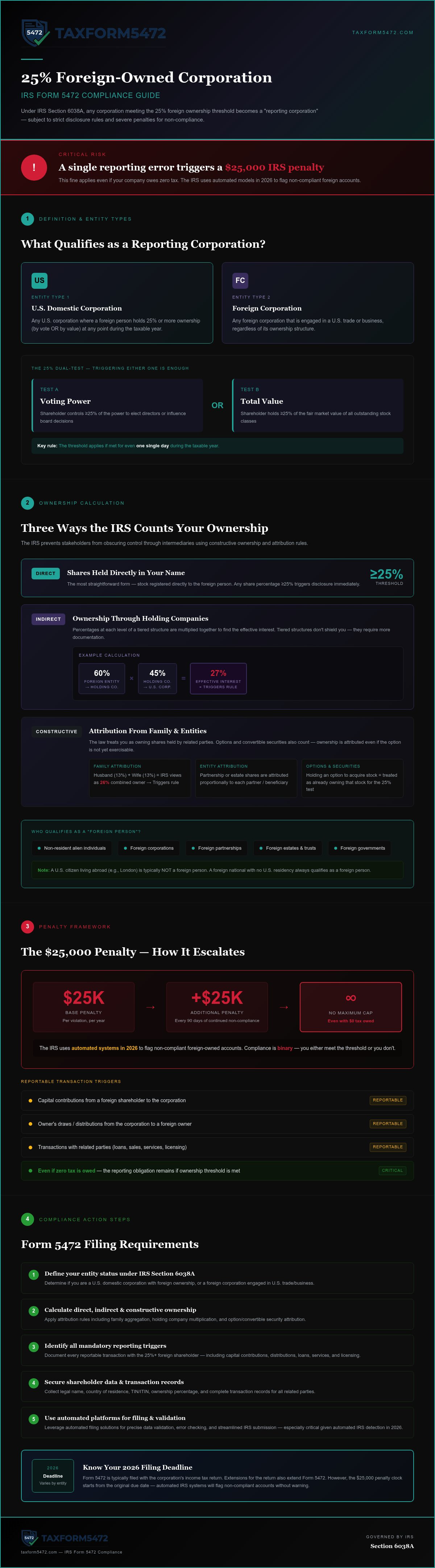
A single reporting error triggers a $25,000 IRS penalty. This fine applies even if your company owes zero tax. For a 25 percent foreign owned corporation, compliance is binary. You either meet the threshold or you don't. The IRS uses automated models in 2026 to flag non-compliant foreign accounts. Ambiguity regarding indirect ownership is a significant risk for your business. Direct and constructive ownership rules are often confusing. Tax terminology typically obscures simple requirements. You need clear confirmation of your filing status to protect your entity from unnecessary enforcement.
This guide explains the 25% ownership threshold for IRS Form 5472 compliance. It clarifies how to calculate your percentage accurately and identifies what constitutes a reportable transaction. Even simple actions like capital contributions or owner's draws trigger these requirements. You will learn the specific filing deadlines for 2026 and the steps for automated preparation. We provide a direct path to understanding your reporting obligations. Verify your status now to avoid costly penalties and maintain your corporate standing.
Key Takeaways
- Define entity status under IRS Section 6038A for U.S. and foreign corporations.
- Calculate direct and constructive ownership using attribution rules and holding company structures.
- Identify mandatory reporting triggers for a 25 percent foreign owned corporation to prevent $25,000 penalties.
- Secure required shareholder data and transaction records for accurate Form 5472 preparation.
- Utilize automated filing platforms for precise data validation and streamlined IRS submission.
Defining the 25 Percent Foreign Owned Corporation
IRS Section 6038A establishes the legal framework for international tax transparency. Under these regulations, a 25 percent foreign owned corporation is classified as a "reporting corporation." This designation subjects the entity to strict disclosure requirements. Two primary entity types fall under this rule. The first is any U.S. domestic corporation with the requisite foreign ownership. The second is any foreign corporation engaged in a U.S. trade or business. Compliance is not optional. Managing a 25 percent foreign owned corporation requires constant monitoring of shareholder percentages to ensure reporting accuracy.
The 25% threshold applies at any point during the taxable year. If a foreign shareholder reaches this level for even one day, the reporting requirement remains. The IRS uses these disclosures to track transactions between the corporation and its related parties. This Form 5472 Overview details how these rules prevent base erosion and profit shifting. Understanding your status as a reporting corporation is the foundation of your tax strategy. Failure to identify this status leads directly to enforcement actions and significant financial penalties.
Voting Power vs. Total Value
Ownership isn't determined by a single number. The IRS evaluates two distinct metrics: voting power and total value. Voting power measures the shareholder's ability to participate in corporate governance. It specifically looks at the power to elect directors or influence board decisions. Total value accounts for the fair market value of all outstanding stock classes. You don't need to meet both criteria. Hitting the 25% mark in either category triggers the filing requirement. This dual-test approach ensures that both influential and high-value owners are disclosed to federal authorities.
The Role of the Foreign Shareholder
The definition of a "foreign person" is broad. It includes non-resident alien individuals and foreign corporations. It also encompasses foreign partnerships, estates, and trusts. Even foreign governments can be classified as foreign persons under Section 6038A. There's a clear distinction between U.S. residents and foreign-based owners. A U.S. citizen living in London is typically not a foreign person for these purposes. Conversely, a foreign national with no U.S. residency always meets the definition. For a broader perspective on these rules, see the Foreign Owned US Corporation Tax: 2026 Compliance Guide. Identifying the legal nature of each 25% owner is essential. It dictates the specific data points required for your filing and the scope of your documentation.
Calculating Ownership: Direct, Indirect, and Constructive
Ownership calculations are rarely linear. The IRS employs constructive ownership and attribution rules to define a 25 percent foreign owned corporation. These guidelines prevent stakeholders from obscuring control through intermediaries. You must evaluate direct, indirect, and constructive interests. Constructive ownership means the law treats you as owning shares held by others. This includes shares held by family members or entities you control. Options and convertible securities are critical variables. If a foreign person holds an option to acquire stock, they're considered the owner of that stock for the 25% test. This rule applies regardless of whether the option is currently exercisable.
Indirect Ownership via Holding Companies
Indirect ownership occurs through tiered structures. Ownership percentages at each level are multiplied to find the effective interest. For example, if a foreign entity owns 60% of a holding company that owns 45% of a U.S. corporation, the foreign entity holds a 27% indirect interest. This triggers the reporting status. You must identify the "Ultimate Indirect 25% Foreign Shareholder" in these scenarios. This is the individual or entity at the top of the chain. Identifying this party is mandatory for the Official IRS Form 5472. Tiered structures don't shield you from disclosure. They require more rigorous documentation of the entire ownership path.
Family and Related Party Attribution
Family attribution rules aggregate ownership among close relatives. Shares held by a spouse, children, or parents are attributed to the taxpayer. If a husband and wife each own 13% of a U.S. entity, the IRS views them as a single 26% owner. Attribution also flows from entities to individuals. Shares owned by a partnership are attributed proportionately to the partners. Shares owned by an estate are attributed to the beneficiaries. This ensures that a 25 percent foreign owned corporation cannot hide behind fragmented family holdings. Beyond ownership, being a "Related Party" creates additional reporting duties for specific transactions. Use an automated filing interface to calculate these complex relationships accurately. Precision here prevents the $25,000 penalty associated with incomplete disclosures.
Form 5472 Filing Requirements for 25% Owners
Every 25 percent foreign owned corporation must submit Form 5472 annually. This is an information return, not a tax payment document. It must be attached to the corporation's federal income tax return, typically Form 1120. If your entity is a foreign-owned disregarded LLC, you must still file a pro forma Form 1120 to carry the 5472. Reporting is not aggregate. You must file a separate Form 5472 for each related party that engaged in a reportable transaction during the tax year. If you have multiple foreign owners at the 25% threshold, your filing volume increases accordingly. Precision in these filings is mandatory to avoid automated IRS flags.
Data accuracy is the primary requirement for compliance. You must provide the related party's legal name and permanent physical address. The country of citizenship, organization, or incorporation is also required. Taxpayer Identification Numbers (TINs) are mandatory for all U.S. related parties. For foreign entities or individuals, you must provide the foreign TIN if one has been issued. The Official Instructions for Form 5472 provide the specific codes required for different entity types. Incomplete data fields are treated as a failure to file. This triggers the same $25,000 penalty as a missing form.
Common Reportable Transactions
Filing obligations arise when a 25 percent foreign owned corporation engages in reportable transactions. Monetary transactions include the sale of inventory, rent payments, and royalty fees. Interest paid or received on business debts must also be disclosed. Non-monetary transactions are equally critical. These include the transfer of intangible property or services performed without a cash exchange. Capital contributions and business loans between the corporation and the owner are frequent triggers. Even minor expenses, such as reimbursing an owner for software subscriptions or filing fees, require disclosure. For a comprehensive list of 2026 transaction categories, review the Reportable Transactions Form 5472: A 2026 Compliance Guide.
Record Maintenance Obligations
Reporting is only the first step. The IRS requires specific record-keeping standards for 25% foreign-owned entities. You must maintain books and records within the United States that support the values reported on your forms. These records must be sufficient to determine the correct U.S. tax treatment of related-party transactions. If the IRS issues a summons for these documents, you must produce them within the specified timeframe. Failure to maintain or produce these records results in a separate $25,000 penalty. Generally, keep these records for at least three years from the date the tax return was filed. However, maintaining digital archives for six years is a safer professional standard for international corporate structures.
Compliance Risks: The $25,000 Penalty Framework
The 25 percent foreign owned corporation is a high-priority target for IRS enforcement. The 2017 Tax Cuts and Jobs Act increased the base penalty from $10,000 to $25,000. This fine applies to every late or incomplete Form 5472. If your entity has three foreign owners at the 25% threshold, a single missed year costs $75,000. There is no de minimis exception. A $50 transaction triggers the same penalty as a $5 million transaction. Reporting is binary. You are either compliant or you are subject to the full penalty framework. Precision is the only way to protect your corporate capital.
If the IRS issues a notice of failure, you have a 90-day grace period. This window allows you to file the missing forms without further escalation. Once the 90 days expire, the penalty increases by $25,000. This additional fine is assessed for each 30-day period of continued non-compliance. There is no maximum cap on these cumulative penalties. In 2026, the IRS uses bank data sharing to flag foreign-owned accounts that lack corresponding tax filings. Detection is automated and rapid. The cost of non-compliance can easily exceed the total value of the transactions being reported.
Late Filing and Incomplete Returns
Filing Form 1120 without Form 5472 is a common error. The IRS treats this as a failure to file. Your return must be "substantially complete" to stop the penalty clock. This requires accurate names, addresses, and transaction amounts for every related party. Estimates or missing fields result in rejection. If you identify a mistake after submission, you must file an amendment. See How to Amend Form 5472: Avoiding the $25, 000 Late Filing Penalty for the correct process. Timely corrections demonstrate a good-faith effort to comply and may limit further exposure.
Reasonable Cause Defense
Penalty abatement is possible but difficult. You must establish reasonable cause for your non-compliance. The IRS rarely accepts "ignorance of the law" as a defense. Foreign shareholders are expected to know U.S. reporting rules. You must prove you acted with ordinary business care. This usually requires showing that factors beyond your control prevented filing. Relying on a tax professional who made an error is often rejected as a defense. Use an automated IRS Form 5472 preparation tool to minimize human error. Digital validation provides a higher standard of care than manual entry and ensures your data meets IRS specifications.
Automated Solutions for 25% Foreign-Owned Corporations
Manual compliance for a 25 percent foreign owned corporation is inefficient. Traditional CPA methods rely on billable hours and manual entry. This creates delays and increases the risk of human error. TaxForm5472 provides a minimalist SaaS platform designed for precision. It's a utilitarian tool for modern corporate entities. The software automates complex ownership math and validates every data field instantly. It removes the ambiguity of indirect ownership rules. You get a direct interface that prioritizes your time and focus. Digital preparation is significantly faster than traditional methods. It's built for professionals who value results. Start your preparation now to ensure you meet the 2026 reporting deadlines.
Streamlining the 2026 Filing Cycle
The 2026 filing environment requires higher accuracy. The IRS uses automated models to flag accounts that lack corresponding filings. Managing a 25 percent foreign owned corporation requires constant data precision. Digital interfaces solve this by simplifying shareholder data collection. You enter names, physical addresses, and tax IDs into a structured system. The platform identifies missing information before submission. This reduces the margin of error for reportable transactions. Whether you're tracking royalties, rents, or interest payments, the system ensures data consistency. It's a high-focus approach to federal reporting. You won't struggle with confusing terminology or decorative filler. The system guides you through every mandatory data point with quiet confidence. See the Automated Form 5472 Preparation: 2026 Efficiency and Compliance Guide for more on maximizing filing efficiency.
Next Steps for Corporate Compliance
Compliance is a binary status. Your next steps are immediate. Gather the corporation's EIN and all relevant foreign tax identification numbers. Verify the ownership percentages for every stakeholder. Remember that the 25% threshold applies to both voting power and total value. Check your internal records for any monetary or non-monetary transactions. Even a small capital contribution or owner's draw counts as a reportable event. Once you have these details, use the automated platform to generate your forms. It's the most direct path to IRS submission. Don't risk the $25,000 penalty by delaying your filing. Organized data leads to a faster, safer experience. File your Form 5472 online today and protect your corporate standing.
Secure Your 2026 Compliance Status
Managing a 25 percent foreign owned corporation requires constant vigilance. The IRS penalty framework is rigid and punitive. A single missing or incomplete form results in an immediate $25,000 fine. This cost increases every 30 days for continued non-compliance. Ownership calculations must account for direct, indirect, and constructive interests to be valid. Every reportable transaction, from capital contributions to owner's draws, triggers these mandatory filing duties. Protecting your corporate assets starts with accurate, timely data submission.
Efficiency is the professional standard for modern international business. Automated IRS compliance replaces slow, error-prone manual CPA workflows. Our specialized Form 5472 platform provides professional digital preparation through a focused interface. It's designed to validate your data to meet current 2026 standards. This eliminates the ambiguity of complex tax terminology. You can streamline your reporting process and focus on your core operations. Take control of your federal obligations immediately. Start your 2026 Form 5472 filing now to maintain your standing and operate with quiet confidence.
Frequently Asked Questions
What defines a 25 percent foreign owned corporation for IRS purposes?
Under IRS Section 6038A, a reporting corporation is any U.S. entity or foreign corporation in U.S. trade with at least one 25% foreign shareholder. This ownership is measured by either total voting power or the total value of all stock classes. The threshold applies if the foreign person holds this interest at any time during the tax year. It includes direct, indirect, and constructive ownership through family or related entities.
Does an inactive corporation still need to file Form 5472?
Yes, inactivity doesn't automatically exempt you from reporting. A filing is required if the entity engaged in any reportable transaction with a related party. Common examples for inactive companies include the owner paying for annual registered agent fees or renewing a business license. The IRS considers these capital contributions. Even if the business isn't generating revenue, these small financial movements trigger the mandatory $25,000 penalty framework if not reported.
How do I calculate indirect ownership for the 25% threshold?
Calculations use a multiplication method across tiered structures. If a foreign person owns 50% of a holding company that owns 50% of the reporting entity, their indirect interest is 25%. You must also consider constructive ownership rules. These attribute shares held by spouses, children, or controlled partnerships to the individual. Tracing the ownership chain to the ultimate foreign shareholder is necessary to confirm if you meet the reporting threshold.
What is the penalty for a 25% foreign-owned corp failing to file?
Failure to file results in an initial $25,000 penalty per form. This fine also applies to late or substantially incomplete filings. If you don't correct the failure within 90 days of an IRS notice, the penalty increases by $25,000 for each subsequent 30-day period. These penalties accumulate without a maximum cap. In 2026, the IRS uses automated bank reporting to identify non-compliant entities, making detection much faster than in previous years.
Can multiple 25% owners trigger multiple Form 5472 requirements?
Yes, reporting is required for each related party that has a reportable transaction with the company. If your 25 percent foreign owned corporation has two foreign owners who both provided business loans, you must file two separate forms. Filing a single form for one owner while omitting the other is a compliance failure. Each foreign person or entity meeting the 25% threshold requires their own dedicated disclosure to satisfy IRS regulations.
Is a foreign-owned LLC treated as a 25% foreign-owned corporation?
Yes, foreign-owned single-member LLCs are treated as domestic corporations for Form 5472 purposes. While these entities are disregarded for federal income tax, they are strictly defined as reporting corporations for information returns. You must file the form alongside a pro forma Form 1120. This requirement applies even if the LLC has no U.S. source income. Ignoring this rule is a frequent cause of the $25,000 failure-to-file penalty for international entrepreneurs.
How has the 25% ownership rule changed for the 2026 tax year?
The 25% ownership threshold remains unchanged, but the 2026 enforcement landscape is more aggressive. The IRS has implemented automated assessment models that flag foreign-owned bank accounts without corresponding tax filings. This is facilitated by increased data sharing between U.S. financial institutions and the government. While the law is consistent, the likelihood of detection for non-compliance has increased. Digital preparation is now the professional standard to ensure data matches these automated IRS records.
Do I need a Form 5472 if there were no transactions this year?
Filing is only mandatory if a reportable transaction occurred during the tax year. If the corporation was entirely dormant with no money moving in or out, you don't need to file. However, most owners inadvertently trigger the rule through capital contributions for software, legal fees, or office expenses. Even a small owner's draw or a business loan counts as a transaction. You should carefully review all bank activity before assuming no filing is necessary.