
A single reporting error triggers an immediate $25,000 IRS penalty. For international stakeholders, managing form 5472 for foreign owned c corporation requirements is a high-stakes precision task. The IRS now uses automated systems to identify non-compliance, leaving no room for manual oversight or late submissions. You're likely aware that the line between simple record-keeping and mandatory federal reporting is thin. The complexity of these regulations often creates unnecessary friction for global entities operating within the United States.
It's frustrating to manage shifting thresholds while attempting to avoid the risk of a federal audit. This guide provides a professional breakdown of the 2026 reporting requirements, ownership definitions, and specific filing procedures for C Corporations. We'll cover exactly which transactions trigger a filing and how to distinguish C Corp obligations from general LLC rules. You'll gain a clear understanding of the April 15, 2026, deadline and the digital methods available to ensure total compliance. This breakdown ensures your entity remains organized, focused, and ready for the upcoming tax year.
Key Takeaways
- Identify 25% foreign ownership thresholds. Distinguish domestic C Corp requirements from foreign entity obligations.
- Categorize monetary and non-monetary reportable transactions. Determine which asset transfers or service fees trigger mandatory disclosure.
- Secure 2026 filing deadlines. Avoid the $25,000 penalty by ensuring form 5472 for foreign owned c corporation attachments are complete.
- Align reporting with Form 1120 cycles. Understand the direct impact of foreign ownership on Schedule K.
- Shift to automated preparation. Use digital tools to eliminate manual errors and streamline IRS documentation.
Defining the Reporting Corporation: Does Your C Corp Qualify?
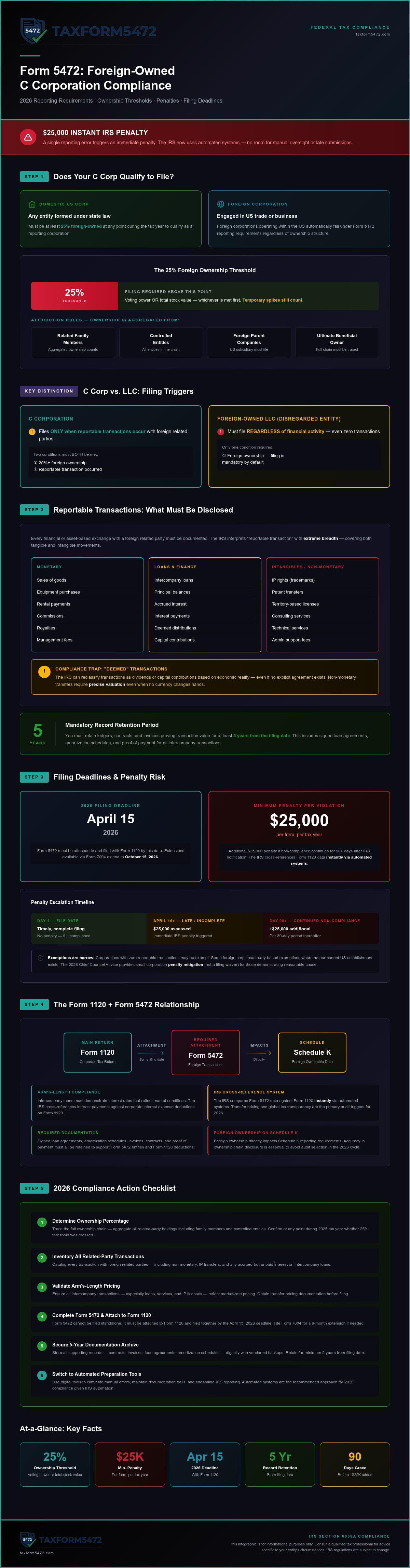
A reporting corporation is a specific legal designation. Section 6038A defines it. For 2026 tax compliance, a domestic US corporation qualifies if it's at least 25% foreign-owned. This includes any entity formed under state law. Foreign corporations engaged in a US trade or business also fall under this requirement. Review this Form 5472 overview for historical context on these transparency rules. Status determination is binary. You meet the threshold or you don't. The IRS uses this data to monitor transfer pricing and ensure global tax transparency.
C Corporations face unique triggers compared to other structures. Foreign-owned disregarded entities (LLCs) must file regardless of financial activity. C Corporations only file when reportable transactions occur. The distinction is vital. It prevents unnecessary paperwork and reduces administrative burden. Compliance for a form 5472 for foreign owned c corporation depends on both ownership and financial movement. The IRS prioritizes these structures for audit selection in 2026. The digital shift means the IRS cross-references this data against Form 1120 instantly.
Determining the 25% Foreign Ownership Threshold
Calculation involves direct and indirect assets. A '25% Foreign Shareholder' holds 25% of voting power or total stock value. This applies at any point during the tax year. Attribution rules are rigid. Ownership by related family members or controlled entities is aggregated. You must trace the ownership chain to the ultimate beneficial owner. Temporary ownership spikes still trigger reporting status. If a foreign parent company holds a US subsidiary, that subsidiary is a reporting corporation. Accuracy in these calculations is essential to avoid the $25,000 penalty.
Exemptions from Reporting Requirements
Exemptions are narrow and strictly defined. A corporation with zero reportable transactions is generally exempt. Some foreign corporations use treaty-based exemptions. These apply when no permanent US establishment exists. The 2026 Chief Counsel Advice provides a path for small corporation penalty relief. This is not a filing waiver. It's a penalty mitigation strategy for those who demonstrate reasonable cause. Most active entities with international shareholders will find they must file. Don't assume an exemption exists without a technical review of Section 6038A standards.
Reportable Transactions: What C Corporations Must Disclose
Reportable transactions extend beyond simple cash transfers. A reporting corporation must document every financial or asset-based exchange with a foreign related party. This includes sales of goods, equipment purchases, and rental payments. Commissions and royalties also fall under this mandate. The IRS interprets the term "reportable transaction" with extreme breadth. Review the Official IRS Form 5472 Information to stay current on these evolving definitions. For a form 5472 for foreign owned c corporation, the scope covers both tangible and intangible asset movements.
Non-monetary transfers require precise valuation. Intellectual property rights, such as trademarks or patents, must be disclosed even if no currency is exchanged. This includes the transfer of rights for use in specific geographic territories. 'Deemed' distributions are a frequent compliance trap. These occur when the IRS reclassifies a specific transaction as a dividend or capital contribution based on economic reality. Maintaining rigorous record standards is a legal requirement. You must retain ledgers, contracts, and invoices that prove the transaction's value. The IRS typically requires these records for at least five years from the filing date. Utilizing automated preparation tools helps maintain this documentation trail without manual errors.
Intercompany Loans and Interest Payments
Loans between the US C Corp and its foreign owners trigger immediate reporting. This includes both the principal balance and any accrued interest. The IRS evaluates these transactions for arm's-length compliance. You must demonstrate that the interest rate reflects market conditions. Documentation is non-negotiable. Keep signed loan agreements, amortization schedules, and proof of payment. Interest is reportable even if it's accrued but not yet disbursed. Failure to disclose these loans is a primary cause for the $25,000 penalty assessment in 2026. The IRS cross-references these interest payments against corporate interest expense deductions.
Services and Shared Costs
Management fees are a core reporting category. This includes administrative support, technical services, or consulting provided by the foreign parent. These fees must be reported even if they represent a simple reimbursement of actual costs. Cost-sharing arrangements with international affiliates require a granular breakdown of R&D or overhead expenses. You must report intangible property transfers, including copyrights and trade secrets. The IRS monitors these to prevent profit-shifting strategies that erode the US tax base. Accuracy in these disclosures ensures the form 5472 for foreign owned c corporation aligns with your Form 1120 filing. Every shared cost must be backed by a clear business purpose and supporting documentation that justifies the allocation method used.
Filing Deadlines and the $25,000 Penalty Risk
Form 5472 is an attachment. It's not a standalone return. For a form 5472 for foreign owned c corporation, the filing timeline aligns exactly with Form 1120. If your corporate return is late, your Form 5472 is late. The IRS now uses automated systems to assess the $25,000 penalty immediately upon detecting a missed or incomplete filing. Precision is mandatory. A 'substantially incomplete' filing is treated as a total failure to file. This means minor omissions in reporting transaction amounts or related party details trigger full penalties. Review the Instructions for Form 5472 to ensure every field meets federal standards before submission.
The $25,000 penalty applies per required form. If a corporation interacts with three different foreign related parties, it must file three separate forms. Failure to do so results in a $75,000 initial penalty. Penalties stack quickly. Once the IRS issues a notice of failure, a 90-day window opens to correct the error. If the corporation remains non-compliant after this period, the IRS assesses an additional $25,000 for every 30-day period. There's no ceiling on these compounding fines. This structure makes manual tracking high-risk for modern global entities.
2026 Tax Year Deadlines for C Corps
The deadline for calendar year corporations is April 15, 2026. Fiscal year entities must file by the 15th day of the 4th month following their year-end. You can obtain a six-month extension to October 15, 2026. This requires filing Form 7004 by the original April 15 due date. File Form 7004 early. It's a common misconception that an extension for Form 1120 doesn't cover Form 5472. Since the form is an attachment, the extension applies to both. Early action prevents automated penalty triggers and secures your compliance status for the 2026 cycle.
Mitigating Penalty Risks
Penalty relief requires establishing 'Reasonable Cause'. You must demonstrate that the failure occurred despite exercising ordinary business care. The IRS may grant relief if you can prove reliance on incorrect professional advice or unexpected system failures. Small corporations should review the 2026 Chief Counsel Advice for specific guidance on penalty mitigation. Organizing your form 5472 for foreign owned c corporation data months before the deadline reduces the risk of 'substantially incomplete' filings. Maintaining a digital audit trail is the only certain way to avoid disputes. For more on these risks, see Form 5472 Penalties: Managing Compliance Risks.
The Relationship Between Form 1120 and Form 5472
Form 5472 is an integral component of the Form 1120 tax package. It's not a standalone submission. For a form 5472 for foreign owned c corporation, the IRS requires the form as a mandatory attachment to the annual return. Schedule K of Form 1120 serves as the primary trigger. Question 4 specifically asks about 25% foreign ownership. A "Yes" response necessitates the inclusion of Form 5472. Consistency is critical. Financial data on Form 5472 must align perfectly with the figures reported on Form 1120. Mismatched interest expenses or cost of goods sold (COGS) invite immediate scrutiny. Use this IRS Form 5472 Filing: 2026 Compliance and Automation Guide to verify your data alignment.
Discrepancies between these forms suggest poor internal controls. The IRS automated systems cross-reference these values instantly. If you report an intercompany loan on Form 5472, the corresponding interest expense must appear on Form 1120 Schedule M-1 or M-3. Precision in these links prevents manual reviews. You can automate your Form 5472 preparation to ensure cross-form data integrity. The IRS uses these attachments to verify that your US entity isn't shifting profits offshore through inflated expenses or understated income.
Common Filing Errors to Avoid
Errors often occur in basic identification fields. Mismatched EINs or outdated addresses trigger processing delays. You must file a separate Form 5472 for every related party involved in reportable transactions. Filing a single consolidated form is a common, costly mistake. Correctly identifying the 'Related Party' type is also essential. Distinguish between foreign corporations, partnerships, and individuals. Incorrect classification renders the filing 'substantially incomplete'. This status triggers the $25,000 penalty even if the form was submitted on time.
Record Maintenance Requirements
Section 6038A mandates specific record-keeping standards. You must maintain transaction records within the United States. This includes ledgers, journals, and original source documents like bank statements or invoices. Safe harbor provisions exist for corporations that follow standard accounting practices. However, these provisions require the corporation to provide records promptly upon IRS request. Retain all corporate tax documentation for at least five years from the filing date. Some records, like property basis or long-term loan agreements, require permanent retention. Organized records are your primary defense during an audit. They prove that transactions occurred at arm's-length prices.
Streamlining C Corp Compliance with Automated Filing
Manual preparation is a legacy risk. It's slow. It's prone to error. In 2026, professional entities prioritize speed and accuracy. Filing form 5472 for foreign owned c corporation via a SaaS platform eliminates the friction of traditional accounting. You avoid the back-and-forth of manual CPA reviews. Digital tools offer direct electronic filing capabilities. This ensures the IRS receives your documentation instantly. It removes the uncertainty of postal delays or manual processing queues. Efficiency is the new compliance standard.
Human error is the leading cause of "substantially incomplete" filings. Calculations for reportable transactions require absolute precision. One decimal error or a missing related party address triggers the $25,000 penalty. Automation applies rigid validation rules to every field. It flags inconsistencies before you submit. This is vital for complex C Corp structures with multiple international shareholders. You gain a reliable, digital audit trail. Review this Automated Form 5472 Preparation: 2026 Efficiency and Compliance Guide for a detailed workflow analysis.
Why Automation Wins for Professional Entities
Efficiency is the primary driver for modern officers. Software provides instant validation against 2026 IRS requirements. You don't wait for a consultant's schedule or billable hours. Secure digital storage keeps your filing history accessible in one location. This is essential for responding to future IRS inquiries or audits. Cost-efficiency is another factor. Digital platforms provide professional results without the high overhead of traditional tax firms. It's a utilitarian choice for results-oriented businesses.
Next Steps for Compliance
Gathering data is the first priority. You need foreign owner details, EINs, and all 2025 transaction records. Organize your financial data now to avoid the April 15, 2026, deadline rush. Once your data is ready, you can initiate the automated filing process immediately. This ensures your form 5472 for foreign owned c corporation is attached correctly to your Form 1120. Ongoing compliance requires a repeatable, scalable process. Automation provides that structure. It prepares your entity for 2026 and every tax year that follows.
Securing 2026 Corporate Compliance
Precision is your primary defense. Accuracy in reportable transactions is non-negotiable. Deadlines align strictly with Form 1120. IRS automated systems now detect omissions instantly. The $25,000 penalty risk remains a constant factor for international stakeholders. Manual errors often lead to "substantially incomplete" status. This status triggers full penalties even with timely submissions. Managing form 5472 for foreign owned c corporation requirements requires a specialized digital approach. You must maintain US records. You must ensure cross-form consistency. Streamlining this process reduces administrative friction. Our specialized online tool is built for foreign-owned corporations. It offers a streamlined digital compliance process. It focuses exclusively on $25,000 penalty avoidance. Focus on your core business operations. Let automation manage the technical reporting requirements. It's efficient. It's precise. It's ready for the 2026 tax cycle.
Take action before the April deadline. Start Your Automated Form 5472 Filing and secure your entity's compliance status today. Maintain your professional standing with accurate reporting.
Frequently Asked Questions
What is the penalty for not filing Form 5472 for a C Corp in 2026?
The initial penalty is $25,000 for each failure to file or for filing a substantially incomplete form. This fine applies per required form. If the failure continues for more than 90 days after IRS notification, an additional $25,000 penalty applies. This additional fine repeats for every 30-day period of non-compliance. There is no maximum limit on these compounding penalties. Digital precision is required to avoid these automated IRS assessments.
Does a foreign-owned C Corp need to file Form 5472 if it had no transactions?
C Corporations only file when reportable transactions occur during the tax year. This differs from foreign-owned LLCs, which must file regardless of activity. If your C Corp had zero monetary or non-monetary exchanges with foreign related parties, a filing is generally not required. You must verify that no "deemed" distributions or intercompany loans existed. Even a small transaction triggers the full reporting requirement for a form 5472 for foreign owned c corporation.
Can I file Form 5472 separately from my Form 1120?
No, Form 5472 is a mandatory attachment to your corporate income tax return. You must file it with Form 1120 or Form 1120-F. It is not a standalone document. Submitting it separately can lead to the IRS treating the return as incomplete. This triggers the $25,000 penalty. Ensure the form is bundled correctly with your main return to maintain compliance and facilitate automated processing. Digital filing ensures all components arrive together.
Who is considered a 25% foreign shareholder for Form 5472?
A 25% foreign shareholder is any foreign person owning at least 25% of the total voting power or 25% of the total value of all stock classes. This ownership can be direct or indirect. Attribution rules apply to related family members and entities. You must evaluate the ownership structure at any point during the tax year. If the 25% threshold is met for even one day, the corporation qualifies as a reporting corporation.
What are examples of reportable transactions for a C Corporation?
Reportable transactions include a wide range of exchanges with foreign related parties. Common examples are the sale or purchase of inventory, equipment, and real estate. Rental payments, royalties, and commissions are also included. You must disclose intercompany loans and interest payments. Non-monetary transactions, such as the transfer of intellectual property or technical services, are equally important. These disclosures ensure the form 5472 for foreign owned c corporation remains accurate and complete.
How do I request an extension for Form 5472?
You request an extension by filing Form 7004. This provides a six-month extension for both Form 1120 and its attached Form 5472. For calendar year entities, this moves the deadline from April 15, 2026, to October 15, 2026. You must file Form 7004 by the original due date of the return. There is no separate extension form for Form 5472. Timely filing prevents automated late penalties. Use digital tools to ensure accuracy.
Is Form 5472 required for every foreign shareholder?
No, you only file for foreign related parties that engaged in reportable transactions with the corporation. A foreign shareholder owning less than 25% might still be a related party under Section 482 rules. You must file a separate Form 5472 for each qualifying related party. If you have three foreign owners with reportable transactions, you must submit three forms. Filing a single consolidated form is a common error that leads to penalties.
What records must a reporting corporation maintain?
You must maintain original books of account and transaction records within the United States. This includes journals, ledgers, and bank statements. You need documentation for every reportable transaction, such as contracts and invoices. These records must support the arm's-length nature of your pricing. The IRS generally requires you to retain these documents for at least five years. Organized record-keeping is your primary defense during a federal tax audit. Digital storage facilitates this requirement.