
A single $500 transfer between your foreign-owned LLC and your personal bank account triggers a $25,000 IRS penalty if left unreported. Profit is irrelevant to this disclosure requirement. Determining who needs to file form 5472 is a binary decision based on ownership structures and specific transactions. Even a dormant company faces these steep penalties if the owner paid formation costs. Compliance is mandatory. Tax liability is not a factor.
IRS instructions for Section 6038A are dense. You likely feel the pressure of steep non-compliance fines and the ambiguity of "disregarded entity" status. This guide provides a definitive framework for your 2026 filing obligations. You'll learn exactly which transactions trigger a report. We'll cover the April 15 deadline and how to utilize automated preparation to eliminate manual errors. We'll clarify the specific requirements for foreign-owned U.S. corporations and LLCs. Risk mitigation starts with clear data. Your compliance roadmap begins here.
Key Takeaways
- Identify the 25% foreign ownership threshold for U.S. reporting corporations and foreign-owned LLCs.
- Determine who needs to file form 5472 by auditing both monetary payments and non-monetary asset transfers.
- Confirm filing status for foreign-owned single-member LLCs, which the IRS treats as corporations for these reporting purposes.
- Secure compliance by aligning Form 5472 with your annual Form 1120 submission before the April deadline.
- Avoid the $25,000 failure-to-file penalty through precise disclosure of all related-party service exchanges.
Defining the Form 5472 Filing Requirement
IRS Form 5472 is an information return. It doesn't calculate tax liability. Instead, it serves as a disclosure mechanism for the federal government. The IRS uses it to monitor financial interactions between domestic companies and their foreign owners. If your company has significant foreign investment, you must determine who needs to file form 5472 to avoid severe administrative sanctions. This IRS Form 5472 overview clarifies that the obligation persists regardless of whether the business is profitable. Even a company with zero income must report if it engaged in a reportable transaction with a related party.
The form captures data on "Related Parties." This includes any 25% foreign shareholder or any person related to the reporting corporation. The IRS tracks these connections to ensure that international transactions occur at arm's length. Reporting isn't optional. It's a prerequisite for maintaining a compliant U.S. entity. Failure to disclose these relationships creates an immediate audit risk. Profit is irrelevant. Reporting is mandatory.
The Purpose of Section 6038A
Section 6038A provides the legal basis for these disclosures. Its primary objective is transparency in international business structures. By requiring detailed reporting, the IRS prevents companies from shifting profits offshore through inflated costs or artificial loans. It applies strictly to any U.S. corporation with at least 25% foreign ownership. This threshold includes both direct and indirect ownership. If a foreign parent company owns a U.S. subsidiary, Section 6038A mandates a clear paper trail of all capital movement. It's a tool for tax enforcement. Every dollar crossing borders must be accounted for and properly characterized.
The $25,000 Non-Compliance Risk
The financial consequences of non-compliance are rigid. The IRS assesses a minimum penalty of $25,000 for each failure to file a timely or complete Form 5472. This isn't a one-time fee. If the failure continues for more than 90 days after IRS notification, the agency adds another $25,000 for every 30-day period. There's no upper limit on these cumulative fines. Common triggers for these penalties include:
- Missing the filing deadline entirely.
- Filing a form with incomplete transaction data.
- Failing to maintain the required supporting records.
- Omitting a separate form for each foreign related party.
IRS enforcement has reached record levels for foreign-owned entities. The agency uses automated systems to flag missing forms. Because there's no statute of limitations for unfiled returns, the IRS can assess these penalties years after the tax year ends. Precise digital preparation is the only way to mitigate this $25,000 risk effectively. Efficiency is key. Accuracy is the only defense.
Criteria for Reporting Corporations
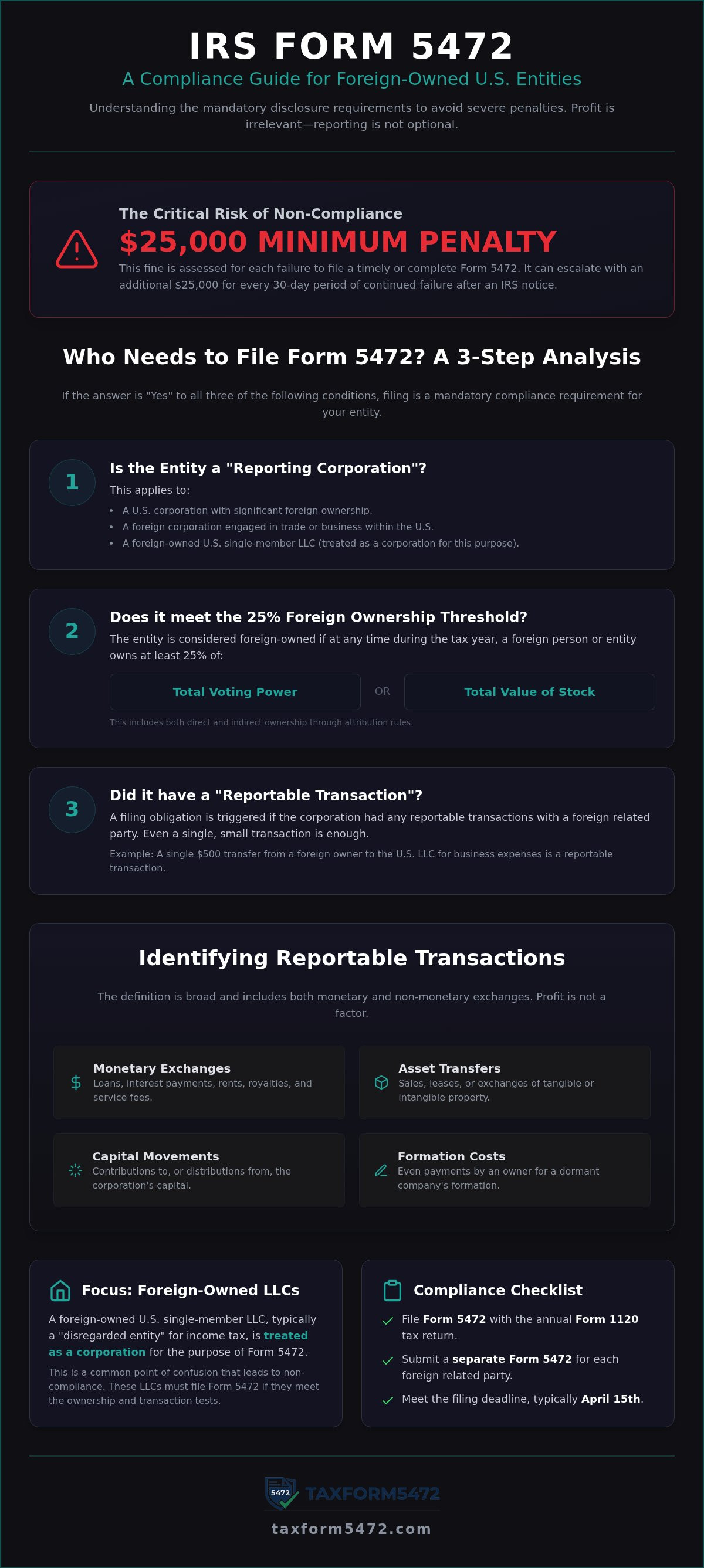
Determining who needs to file form 5472 requires a three-step analysis. The IRS classifies an entity as a "reporting corporation" based on its legal structure, its ownership, and its activities during the tax year. If an entity meets all three criteria, filing becomes a mandatory compliance step. It's not a suggestion. It's a requirement for maintaining legal standing in the U.S. market. Accuracy in this phase prevents the $25,000 penalty from being assessed later.
The 25% Foreign Ownership Threshold
The 25% foreign ownership threshold is the primary filter for compliance. This limit applies to any foreign person, foreign partnership, or foreign corporation. Ownership is measured by either the total voting power of all classes of stock or the total value of all classes of stock. If a foreign party hits the 25% mark in either category at any point during the year, the threshold is met. This includes both direct and indirect ownership structures.
Attribution rules make this calculation complex. The IRS looks through layers of ownership to find the ultimate beneficial owner. If a foreign parent company owns a U.S. entity through multiple holding companies, the 25% rule still applies. You can't bypass these rules by creating indirect ownership chains. For a complete breakdown of these definitions, consult the Official IRS Instructions for Form 5472. These rules ensure that the IRS can track the true controllers of U.S. assets.
Domestic vs. Foreign Reporting Corporations
Domestic reporting corporations are entities incorporated within the 50 U.S. states or the District of Columbia. This includes standard C-corporations and entities that have elected corporate status. Identifying who needs to file form 5472 is critical for entities registered in popular jurisdictions like Delaware or Wyoming. Foreign reporting corporations are entities formed outside the U.S. that are engaged in a trade or business within the U.S. Both must comply if they meet the ownership and transaction triggers.
Entity-specific nuances often cause confusion for international investors. You must verify your specific classification before the filing season begins. Reviewing tax reporting for us companies with foreign owners helps clarify these distinctions. If you're unsure of your status, automated tools can streamline the determination process. Precision at this stage is the only way to avoid administrative friction with the IRS.
The final trigger is the reportable transaction. A company can be 100% foreign-owned, but if it has zero reportable transactions with related parties, it doesn't file Form 5472 for that year. However, the definition of a transaction is broad. It includes loans, sales, and even non-monetary exchanges. Most foreign-owned entities trigger this requirement through standard operational activities. You can simplify this complex process by using automated Form 5472 preparation to ensure every trigger is captured accurately.
Identifying Reportable Transactions
Identifying who needs to file form 5472 is not a revenue-based assessment. Many owners incorrectly assume that a dormant company or a startup with zero sales is exempt. This is false. The filing trigger is the "reportable transaction," which the IRS defines broadly. If any exchange occurs between the U.S. reporting corporation and its foreign related parties, the obligation is active. Profitability does not matter. The movement of value is the only metric that determines your 2026 compliance status.
Common Monetary Transactions
Monetary transactions are the most visible category. These include the purchase or sale of inventory, rents, and royalties. Management fees or technical service charges paid to a foreign parent are common examples. Interest paid on loans from a foreign shareholder is particularly scrutinized. Every dollar must be categorized. Even small, recurring payments for software subscriptions or shared administrative costs count as reportable events. The IRS tracks these to ensure that cross-border payments are not used to artificially reduce U.S. taxable income.
Non-Monetary and Deemed Transactions
Non-monetary exchanges often create compliance gaps for international businesses. The transfer of intangible property, such as patents, trademarks, or proprietary software, must be disclosed. If a foreign owner allows the U.S. company to use office space or equipment without cash payment, it's a "deemed" transaction. A reportable transaction is any exchange of value between related parties. These "in-kind" transfers are frequently missed during manual preparation. They carry the same $25,000 penalty risk as cash transfers.
Startups face high risks during their first year. Formation costs paid by the foreign owner are reportable capital contributions. If you paid your registered agent or Delaware filing fees from a personal foreign bank account, you have a reportable transaction. Dissolution costs follow the same logic. The IRS Instructions for Form 5472 list these as essential disclosures. Ignoring these "small" items leads directly to IRS enforcement actions. The agency uses these data points to build a profile of the company's financial structure.
Loans and capital injections are standard reporting items. Any cash infusion from the foreign owner to the U.S. company is a reportable event. This includes formal loans and informal advances used to cover operating expenses. Repayments of principal or interest back to the foreign owner require separate disclosure. The IRS uses this data to ensure companies aren't using debt to shift profits untaxed. Accurate reporting of these capital movements is the foundation of your 2026 filing strategy. Use automated systems to capture every transfer, regardless of the amount.
Foreign-Owned Disregarded Entities and LLCs
Single-member LLCs (SMLLCs) represent the most significant compliance risk for international founders. Under standard U.S. tax law, these entities are "disregarded." This means the IRS ignores the LLC for income tax purposes and treats the owner and the business as a single unit. However, this status does not apply to international information reporting. For the purpose of Section 6038A, the IRS treats a foreign-owned SMLLC as a domestic corporation. This classification is the primary reason why many entrepreneurs fail to realize who needs to file form 5472 until they receive a penalty notice.
This requirement is a frequent trap for Amazon FBA sellers and digital nomads. Many of these business owners operate without a U.S. bank account or significant physical presence. They assume that no U.S. tax liability equals no filing obligation. This is a critical error. The filing requirement is triggered by ownership and transactions, not by profit or local presence. If you own 100% of a U.S. LLC and you aren't a U.S. citizen or resident, you're likely a reporting corporation. Determining who needs to file form 5472 is the first step toward avoiding the $25,000 non-compliance penalty.
Why Disregarded Status Does Not Exempt You
Disregarded status is limited to income tax reporting. It provides no relief from the transparency requirements of Form 5472. To comply, the LLC must first obtain an Employer Identification Number (EIN). You can't file this return using a personal tax ID or a foreign registration number. The process involves specific procedural steps that differ from standard corporate filings. For a detailed breakdown of these requirements, refer to the irs form 5472 instructions for SMLLCs. Failure to follow these specific protocols results in an incomplete filing, which carries the same financial risk as not filing at all.
Reporting for Inactive or "Shell" Companies
Dormant or "shell" companies are not exempt. Even if your company had zero sales in 2025, it may still have reportable transactions. Common examples include the owner paying the annual state franchise fee or registered agent costs from personal funds. These are considered capital contributions or related-party transactions. The IRS requires these entities to file a pro-forma Form 1120. This is a simplified version of the corporate tax return where most lines remain blank. Form 5472 must be attached to this document. Without the pro-forma 1120, the Form 5472 isn't legally filed. You can secure your compliance status today by using automated IRS Form 5472 preparation to handle these complex attachments.
Compliance Deadlines and Filing Strategy
Timing is the final hurdle in the reporting process. Form 5472 is not a standalone document. It's an attachment to your corporate income tax return. For most entities, this means filing alongside Form 1120 or a pro-forma Form 1120 for disregarded LLCs. If you've identified who needs to file form 5472 based on the triggers discussed, your next step is synchronizing with the federal tax calendar. Compliance requires simultaneous submission. A missing attachment is treated as an unfiled return.
Filing extensions offer a temporary reprieve but require proactive steps. You must file Form 7004 before the original deadline to secure an additional six months. This extension applies to the entire tax package, including the information return. However, an extension for who needs to file form 5472 doesn't extend the time to pay any underlying taxes. Accuracy remains the priority. Late filings trigger the $25,000 assessment automatically. The IRS doesn't provide a grace period for international transparency requirements.
2026 Filing Calendar
Calendar year entities must submit their 2025 filings by April 15, 2026. This is the standard deadline for most U.S. corporations and foreign-owned LLCs. If you utilize a timely extension, the final deadline moves to October 15, 2026. Fiscal year entities face different requirements. Their due date is the 15th day of the 4th month following the close of their tax year. A company with a June 30 year-end must file by October 15. Consult the irs form 5472 instructions for precise fiscal date calculations. Missing these windows leads to irreversible penalties.
Streamlining Compliance with taxform5472.com
Manual preparation is the leading cause of Section 6038A errors. A single typo or a missing related-party address renders the form incomplete. taxform5472.com provides a specialized SaaS solution for foreign-owned U.S. corporations. The platform uses automated data validation to catch inconsistencies before submission. It's built for efficiency. The digital interface guides you through reportable transaction categories, ensuring every loan and service fee is captured. This prevents the $25,000 failure-to-file penalty. You can prepare your Form 5472 online to secure your 2026 compliance roadmap. Streamlined filing is the only defense against IRS administrative friction.
Secure Your 2026 Compliance Status
The IRS maintains a zero-tolerance policy for missing international disclosures. Compliance isn't tied to profit; it's tied to structure and activity. Correctly identifying who needs to file form 5472 is the only way to protect your U.S. entity from the $25,000 failure-to-file penalty. Whether you operate a Delaware C-corp or a foreign-owned SMLLC, the disclosure obligation remains the same. Precise reporting of every related-party transaction ensures your business remains in good standing with federal regulators.
Our specialized platform simplifies this complex requirement. We provide IRS compliance automation tailored for foreign owners through a secure digital interface. This system eliminates the friction of manual entry and the high risk of administrative errors. You can start your automated Form 5472 filing today to ensure an accurate submission before the 2026 deadlines. Efficiency is the best defense against regulatory risk. Your compliance roadmap is ready.
Frequently Asked Questions
Who is a related party for Form 5472?
A related party includes any 25% foreign shareholder of the reporting corporation. It also encompasses any person related to the corporation or its 25% foreign shareholder under specific Internal Revenue Code sections. This includes family members, partnerships, and other corporations within a controlled group. Identifying these relationships is the first step in determining who needs to file form 5472 for the 2026 tax year. Precise relationship mapping prevents reporting gaps.
Do I need to file Form 5472 if my US LLC had zero income?
Yes, filing is mandatory if a reportable transaction occurred. Profitability and revenue are not the triggers for this requirement. A foreign-owned LLC with zero income must file if the owner paid formation costs, state franchise fees, or registered agent expenses from personal funds. These payments are considered capital contributions or related-party transactions. Ignoring this obligation results in a $25,000 penalty. Compliance depends on activity, not income levels.
What is the penalty for filing Form 5472 late in 2026?
The base penalty for a late or incomplete filing is $25,000. This amount applies per form, per year. If the failure continues for more than 90 days after IRS notification, an additional $25,000 is assessed for every 30-day period. There is no maximum cap on these cumulative fines. Timely submission is the only way to mitigate this financial risk. Automated preparation tools help ensure deadlines are met with accurate data.
Can I file Form 5472 without a US bank account?
Yes, a U.S. bank account is not a prerequisite for filing. The IRS requires the disclosure of transactions, regardless of where the funds originated or were deposited. Many international founders use personal foreign accounts to pay U.S. business expenses. These payments constitute reportable transactions between the related party and the U.S. entity. You must document these exchanges on Form 5472 even if the company has no domestic banking footprint.
Does a foreign-owned LLC need an EIN to file?
Yes, an Employer Identification Number (EIN) is mandatory for the filing process. The IRS uses the EIN to track the reporting corporation's compliance history. A foreign-owned LLC cannot submit Form 5472 using a foreign tax ID or the owner's personal identification. Obtaining an EIN is a foundational step for any international owner determining who needs to file form 5472. Without this number, the IRS cannot process the required documentation.
What happens if I forget to report a transaction on Form 5472?
Omitting a reportable transaction renders the form incomplete. The IRS treats an incomplete Form 5472 the same as a failure to file. This oversight triggers the standard $25,000 penalty. Accuracy is critical because the IRS uses automated systems to cross-reference data from other tax documents. If an audit reveals undisclosed transfers, the agency assesses fines immediately. Use digital validation to ensure all monetary and non-monetary exchanges are captured correctly.
Is Form 5472 required for every foreign shareholder?
No, the requirement only applies to foreign shareholders with at least 25% ownership. A separate Form 5472 must be filed for each 25% foreign shareholder that engaged in a reportable transaction with the company during the tax year. If multiple related parties were involved in transactions, you must submit multiple forms. Ownership alone does not trigger the filing; it must be combined with an exchange of value to create a reporting obligation.
How do I request an extension for Form 5472?
You must file IRS Form 7004 to request an automatic six-month extension. This form must be submitted on or before the original due date of the corporate return. Since Form 5472 is an attachment to Form 1120, extending the main return also extends the information return. For calendar year entities, a timely extension moves the final deadline to October 15, 2026. Proactive filing prevents the immediate assessment of late fees.