
A single overlooked capital contribution can trigger a $25,000 penalty instantly. The IRS now uses automated systems to cross-reference bank data with information filings. This shift makes form 5472 audit risk a matter of data logic rather than random selection. It's no longer about if the IRS sees your data, but how they interpret it.
You recognize the complexity of related-party transaction rules. The fear of escalating fines and indefinite audit windows is a valid concern for foreign-owned U.S. corporations. You need a compliance strategy that replaces anxiety with precision. Precision protects your capital and ensures long-term operational stability.
This guide identifies specific IRS audit triggers and provides data-driven mitigation strategies for 2026. You'll gain a clear understanding of reportable transaction logic and an audit-proof record-keeping checklist. We'll examine how to streamline your filing process to eliminate manual errors, satisfy IRS data-matching requirements, and secure your corporate standing.
Key Takeaways
- Assess form 5472 audit risk by evaluating IRS data-matching capabilities and Section 6038A authority.
- Identify reporting inconsistencies and zero-value transaction omissions that trigger automatic IRS flags.
- Establish statutory record maintenance and domestic agent protocols to ensure regulatory compliance.
- Implement internal shadow audits to verify related-party transaction logic and ownership accuracy.
- Use automated digital interfaces to eliminate manual entry errors and synchronize data across filings.
Understanding the Form 5472 Audit Landscape in 2026
The form 5472 audit risk refers to the statistical probability of an IRS examination. This risk stems from reporting discrepancies between your information filings and bank records. Section 6038A grants the IRS broad authority to gather information from foreign owners. It creates a mandatory reporting bridge between U.S. entities and international stakeholders. For a foundational summary, see this Form 5472 Overview.
Foreign-owned disregarded entities are current high-priority targets. The IRS views these structures as high-risk due to potential undisclosed cross-border transfers. The lack of a separate tax return for these entities increases the reliance on Form 5472 accuracy. Even minor errors suggest a lack of internal control, prompting further investigation. Managing your form 5472 audit risk requires understanding that the IRS prioritizes data consistency over transaction volume.
The Cost of Non-Compliance
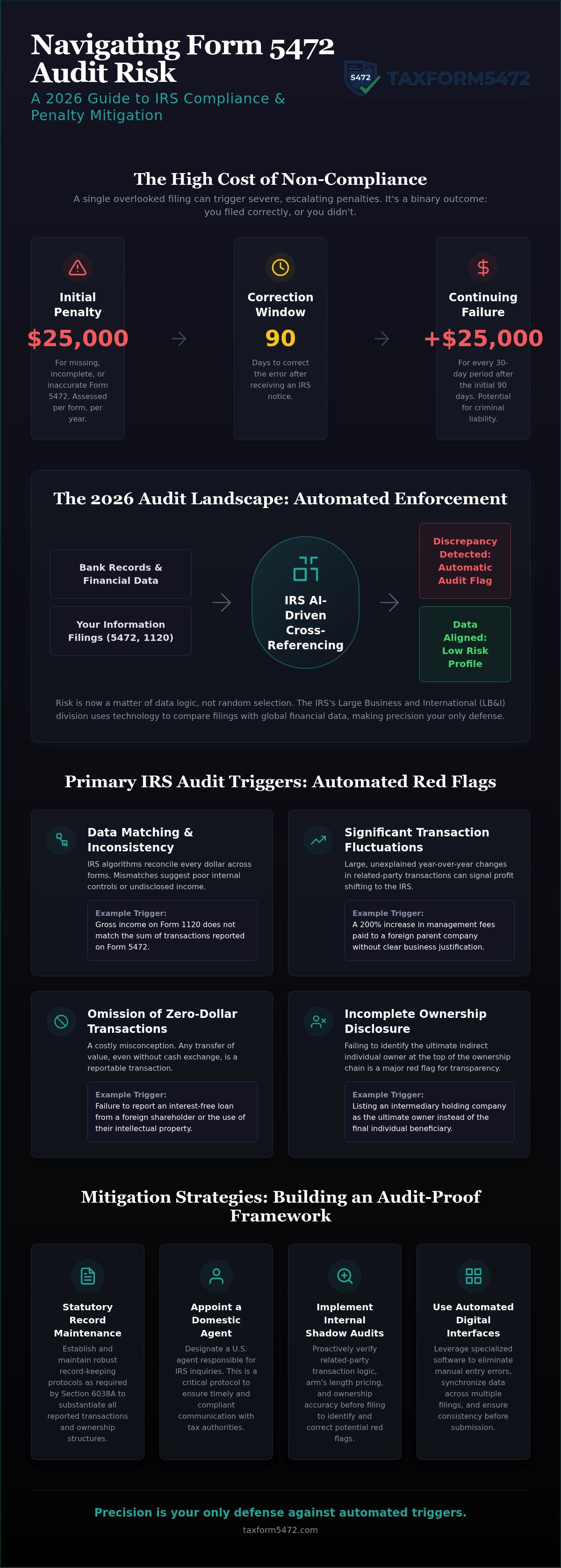
The financial impact of a filing failure is immediate. The base penalty for a missing, incomplete, or inaccurate Form 5472 is $25,000. This is not a maximum; it's the starting point. The IRS assesses this per form, per year. If multiple related parties are involved, these costs scale rapidly. The IRS doesn't need to prove tax evasion to assess this fine. A simple reporting omission is sufficient.
- Initial failure penalty: $25,000.
- 90-day compliance window: Period to correct the error after notice.
- Continuing failure: $25,000 for every 30-day period after the initial 90 days.
- Criminal liability: Possible for willful failure to report or providing false information.
Static penalties are a primary enforcement priority. They require minimal IRS resources to assess but generate significant revenue. This makes non-compliance a high-yield target for automated enforcement divisions. It's a binary outcome: you filed correctly or you didn't.
IRS Enforcement Trends for 2026
Enforcement in 2026 relies on technological integration. The IRS now uses advanced AI-driven data matching across international tax treaty networks. These systems compare filed forms with global financial data shared through automated exchange protocols. Discrepancies trigger automatic flags without human intervention. Your bank records and your tax filings must align perfectly.
The Large Business and International (LB&I) division leads these campaigns. Their focus remains on information reporting rather than just income tax. Late-filed returns are now flagged for immediate assessment. There is no statute of limitations on an unfiled Form 5472. The IRS can open an audit into a 2026 filing indefinitely if the form was never submitted. Precision is your only defense against these automated triggers.
Primary Triggers for a Form 5472 Audit
The IRS identifies form 5472 audit risk through data-matching algorithms. These systems detect inconsistencies between your information filings and the pro-forma Form 1120. A mismatch between total gross income and the sum of reported transactions creates an immediate red flag. The IRS views these discrepancies as indicators of undisclosed income or improper expense allocation.
Significant fluctuations in transaction volumes also invite scrutiny. A 200% increase in management fees or business loans year-over-year suggests profit shifting. The IRS monitors these shifts to ensure arm's length pricing. Incomplete disclosure of the ultimate indirect owner is another high-priority trigger. Failing to identify the individual at the top of the ownership chain signals a lack of transparency and often initiates a manual review. Precision in identifying all related parties is the only way to maintain a low risk profile.
Data Matching and Inconsistency
IRS systems reconcile every dollar reported across multiple international forms. If you file Form 5471 for a foreign corporation, the data must align with your U.S. company's Form 5472. Conflicting information suggests poor internal controls. The IRS compares your business expenses to the related-party payments reported. This cross-referencing identifies taxpayers who claim deductions without corresponding information reporting. Maintaining high-quality documentation is necessary to satisfy Section 6038A record maintenance requirements. Using a dedicated platform like taxform5472.com helps align these data points before submission.
The Risk of Zero-Dollar Transactions
A common misconception is that $0 transactions don't require disclosure. This is a costly mistake. The IRS definition of reportable transactions form 5472 includes non-monetary exchanges and "free" services. Even if no cash changes hands, the transfer of value is reportable. Common zero-dollar triggers include:
- Interest-free loans from a foreign shareholder to the U.S. corporation.
- The use of intellectual property or trademarks without a licensing fee.
- Cost-sharing arrangements for shared administrative or marketing staff.
- Capital contributions or owner's draws from a single-member LLC.
Audit focus has shifted toward these intangible transfers. The IRS uses these reports to track the movement of value that could impact future tax liabilities. Assuming $0 equals no reporting required is a primary driver of form 5472 audit risk. Every interaction with a foreign related party must be evaluated, categorized, and disclosed regardless of its monetary value.
Section 6038A and Record Maintenance Requirements
Section 6038A establishes strict protocols for document storage. You must maintain records that support the arm's length nature of all transactions. These documents must be accessible within the United States. If you store records abroad, you must produce them within 30 days of an IRS request. Failure to comply increases your form 5472 audit risk and triggers immediate financial penalties.
Safe harbor provisions exist for corporations with less than $10 million in U.S. gross receipts. However, these entities are not exempt from the underlying requirement to provide records during an examination. The IRS prioritizes the ability to verify the "true taxable income" of the U.S. entity. If you cannot produce the requested data, the IRS can unilaterally disallow deductions. This results in significant tax assessments beyond the initial fine.
The Agency Appointment Risk
The foreign related party must legally authorize the U.S. corporation to act as its agent. This appointment is strictly for Section 6038A and 6038C purposes. It allows the IRS to serve summons for records or testimony directly to the U.S. entity. It's a mandatory administrative step. If the foreign owner fails to provide this authorization, the IRS can invoke the "non-compliance penalty." The lack of an authorized agent makes the U.S. corporation vulnerable to aggressive IRS adjustments.
Documentation Standards for Related Parties
The IRS expects a comprehensive audit trail for every reported transaction. You must maintain specific categories of records to satisfy an examiner. Ownership structure charts must show both direct and ultimate indirect owners. Financial statements are required for all involved parties. Pricing logic is equally critical. You must document how you determined the rates for services, loans, or transfers.
- Translation: You must provide English translations of foreign documents within 30 days.
- Pricing: Detailed records of how transfer prices were set are necessary.
- Retention: Keep records indefinitely if Form 5472 isn't filed; otherwise, retain them for three years.
Digital records are acceptable but must be searchable and organized. High-speed retrieval is expected. Poorly organized data suggests a lack of compliance and can expand the scope of an audit. Your form 5472 audit risk depends on your ability to prove the economic reality of your business structure instantly.
Strategies to Mitigate Audit Exposure
Mitigation requires a proactive stance. You should conduct internal shadow audits to verify transaction logic before the IRS does. These audits simulate IRS scrutiny to identify inconsistencies in reportable transactions. Standardize your identification process for all related parties. You must verify ownership percentages and ultimate indirect owners quarterly to ensure data accuracy. This systematic approach reduces form 5472 audit risk by addressing discrepancies before they reach the IRS.
A centralized digital repository is essential for compliance. You must store all Section 6038A records in a single, secure location for rapid retrieval during an examination. Use automated filing systems to eliminate manual entry errors. Software ensures mathematical accuracy and form completeness. This removes human error from the equation and stabilizes your corporate standing. For precise results, use IRS Form 5472 Preparation software to automate your data entry and validation.
Proactive Transaction Mapping
Categorize transactions as monetary or non-monetary early in the fiscal year. You should reconcile intercompany accounts monthly. Waiting for year-end increases the likelihood of omissions or miscategorization. Verify that EINs and physical addresses for all foreign entities are current. The IRS flags entities with outdated or mismatched registration data. Monthly mapping creates a clean audit trail and ensures your filings reflect the economic reality of your business.
Timely Filing and Extensions
Form 5472 is an attachment to Form 1120. Their deadlines are linked. Filing an extension for Form 1120 automatically extends the Form 5472 deadline. However, an extension does not decrease form 5472 audit risk; it merely provides more time to ensure precision. Late filing is the primary "low hanging fruit" for IRS penalty assessments. Automated systems identify late returns instantly. The $25,000 penalty applies the moment the deadline passes without a filed return or a valid extension. Timely filing is the most basic mitigation step you can take.
- Monitor Form 1120 deadlines alongside Form 5472 requirements.
- File extensions early to avoid automated penalty triggers.
- Ensure all attachments are included in the initial submission.
- Verify delivery receipts for all digital filings.
Automated Compliance: Reducing Human Error
Manual data entry is the leading cause of form 5472 audit risk. Spreadsheets lack the validation logic required to catch discrepancies between Form 1120 and Form 5472. Specialized software eliminates these manual mistakes by enforcing strict data entry protocols. A digital interface designed specifically for IRS Form 5472 filing ensures that every reportable transaction is accounted for. Compliance logic for 2026 is integrated directly into the filing workflow to account for the latest IRS enforcement priorities.
Professional platforms provide a level of oversight that generic accounting tools cannot match. Most generic AI tools focus on broad bookkeeping rather than the technical requirements of Section 6038A. Transitioning to a dedicated compliance platform moves your organization toward a "zero-error" filing model. This transition is a strategic requirement for foreign-owned corporations operating in an era of automated IRS enforcement. The IRS now uses high-speed data matching; your internal systems must be equally sophisticated to maintain compliance.
Precision in Reporting
Validation rules prevent the submission of incomplete or logically inconsistent forms. These rules check for missing EINs, incorrect ownership percentages, and unrounded figures. Standardizing the input of foreign addresses is critical. Automated systems format this data according to IRS specifications to prevent processing delays. The use of automated form 5472 preparation reduces the risk of data-matching flags. Precision at the input stage eliminates the need for reactive audit representation. Automated systems also ensure that zero-dollar transactions, which are often missed by human preparers, are flagged for inclusion.
Next Steps for Foreign Owners
Review your current year transactions for reporting triggers immediately. Identify all monetary and non-monetary exchanges with related parties as they occur. Transitioning to a digital-first compliance model is the most effective way to manage form 5472 audit risk. Don't wait for an IRS notice to verify your data. Professional tools provide the speed and accuracy necessary for modern international tax compliance. The cost of automation is a fraction of the $25,000 penalty for a single filing error. Secure your business by moving away from manual spreadsheets today.
Prepare your filing with precision at taxform5472.com.
Secure Your 2026 Compliance Strategy
IRS enforcement in 2026 relies on algorithmic precision. Discrepancies in related-party transactions or missing Section 6038A records trigger automatic penalties. You've seen that shadow audits and proactive transaction mapping are essential defenses. These steps move your organization from a reactive stance to a position of quiet confidence. Maintaining an organized digital repository ensures your data is ready for immediate retrieval during an examination.
Managing form 5472 audit risk requires a shift toward digital-first compliance. Manual entry is no longer viable in an environment of automated data-matching. You need a specialized tool that synchronizes your data with current IRS requirements. Relying on generic accounting software often leads to the very omissions that flag your entity for review. Precision is your only defense against automated IRS triggers.
File Form 5472 accurately with our automated platform. Our interface is built for 2026 IRS standards and designed specifically for foreign owners. It streamlines international ownership structures and eliminates the human error inherent in spreadsheets. You can fulfill your reporting obligations with speed and total accuracy. Take control of your corporate compliance today.
Frequently Asked Questions
Does a zero-dollar transaction still trigger a Form 5472 audit?
Yes, zero-dollar transactions are primary drivers of form 5472 audit risk. The IRS defines reportable transactions broadly to include non-monetary exchanges such as interest-free loans, shared administrative services, and intellectual property transfers. Omitting these because no cash changed hands is a common error. Automated IRS data-matching systems flag these omissions by cross-referencing operational expenses and ownership structures. Precision in reporting all value transfers is mandatory for compliance.
How far back can the IRS audit a Form 5472 filing?
The IRS can audit a correctly filed Form 5472 for up to three years from the filing date. However, if you fail to file the form or submit a substantially incomplete return, the statute of limitations never begins. This allows the IRS to assess the $25,000 penalty and open an examination indefinitely. Maintaining a digital repository of Section 6038A records for at least three years is a standard requirement for foreign-owned entities.
Can I avoid an audit by filing Form 5472 separately from my tax return?
You cannot file Form 5472 separately to avoid scrutiny; it must be attached to a pro-forma Form 1120. Filing these documents separately or missing the attachment is a procedural failure that triggers automated penalties. The IRS identifies form 5472 audit risk by verifying that the information return and the corporate return are submitted as a single, synchronized package. Modern filing platforms ensure these documents are linked correctly before digital submission to the IRS.
What is the "Agency" requirement under Section 6038A?
The "Agency" requirement mandates that a foreign related party authorize the U.S. corporation to act as its legal agent. This appointment is limited to IRS summons for records or testimony related to reportable transactions. Failure to provide this authorization upon request allows the IRS to unilaterally determine the value of transactions. This often results in the disallowance of deductions and significant tax adjustments. It's a critical administrative step for maintaining international corporate structures.
Is a foreign-owned LLC more likely to be audited than a C-Corp?
Foreign-owned single-member LLCs face higher scrutiny than standard C-Corps in 2026. The IRS views these disregarded entities as high-priority targets for undisclosed cross-border transfers. Because these entities often don't file a standard income tax return, Form 5472 is the primary tool for IRS oversight. Automated systems prioritize these filings to ensure that all capital contributions and owner's draws are fully disclosed. This focus increases the specific form 5472 audit risk for LLC structures.
What happens if I discover an error after filing Form 5472?
You must file an amended Form 5472 immediately upon discovering an error. Correcting mistakes before an IRS notification can mitigate the risk of the $25,000 non-compliance penalty. However, an amended return doesn't guarantee immunity from an examination. It demonstrates a commitment to accurate reporting and helps establish internal control during a potential audit. Using automated tools for the initial filing is the most effective way to prevent these corrective actions and stabilize your status.
How does the IRS find out if I failed to file Form 5472?
The IRS identifies filing failures through automated data-matching with international banking records and tax treaty partners. Systems cross-reference U.S. bank account activity with filed information returns. If a U.S. corporation receives funds from a foreign owner without a corresponding Form 5472, a flag is generated instantly. The IRS also uses information from foreign governments to identify U.S. entities with significant foreign ownership that haven't met their annual reporting obligations for the year.
Does filing an extension increase my risk of an IRS audit?
Filing a valid extension for Form 1120 doesn't inherently increase your risk of an audit. It's a standard administrative procedure that provides additional time to ensure data precision. The IRS prioritizes accuracy over the specific date of submission within the legal window. However, failing to file by the extended deadline triggers immediate automated penalties. Use the extra time to verify all related-party transaction logic and finalize your Section 6038A documentation to ensure total compliance.