
A single administrative oversight on Form 5472 now carries a $25,000 price tag. For foreign owners of U.S. corporations, the reporting window is narrow. The stakes are high. Securing a form 5472 extension is the most effective way to buy time. It's a critical insurance policy against aggressive IRS enforcement. Accurate reporting requires focus. Avoid the rush. Ensure every reportable transaction is documented correctly.
Managing international compliance across different time zones is difficult. You need more than just a few weeks to gather complex transaction data. This guide provides the exact steps to secure an additional six months to file. It ensures your entity remains compliant and avoids the $25,000 non-compliance fee. We cover Form 7004 submission requirements, the confirmed October 15, 2026 deadline, and specific strategies to protect your business from administrative penalties. Follow these professional protocols to maintain your standing with the IRS. Stay organized. Stay protected.
Key Takeaways
- Confirm the April 15, 2026 filing deadline. Secure six additional months to ensure reporting accuracy.
- File a form 5472 extension to mitigate the $25,000 penalty risk. Protect the entity from immediate administrative enforcement.
- Submit Form 7004 by the original due date. This move extends the filing window to October 15, 2026.
- Verify EIN and entity legal name. Precise information is required to confirm the new deadline.
- Leverage automated preparation tools. Reduce manual errors in complex 2026 international reporting.
Form 5472 Deadline and Extension Fundamentals
Form 5472 isn't a tax return itself. Instead, it serves as a disclosure for transactions between a U.S. reporting corporation and foreign related parties. For foreign-owned U.S. disregarded entities, the reporting process involves filing a pro-forma Form 1120. Form 5472 must be attached to this filing. The Internal Revenue Service (IRS) mandates this for all 25% foreign-owned entities. For the 2025 calendar year, the standard filing deadline is April 15, 2026.
Securing a form 5472 extension is the primary method for maintaining compliance when data collection is delayed. This extension's managed through Form 7004. It provides a standardized six-month window. This additional time's vital for entities operating across multiple jurisdictions and time zones. Without it, the risk of administrative penalties increases significantly.
2026 Critical Tax Dates for Foreign Owners
The filing calendar for 2026 is rigid. Foreign owners must monitor three specific milestones to avoid administrative friction. Missing any of these dates can trigger expensive enforcement actions.
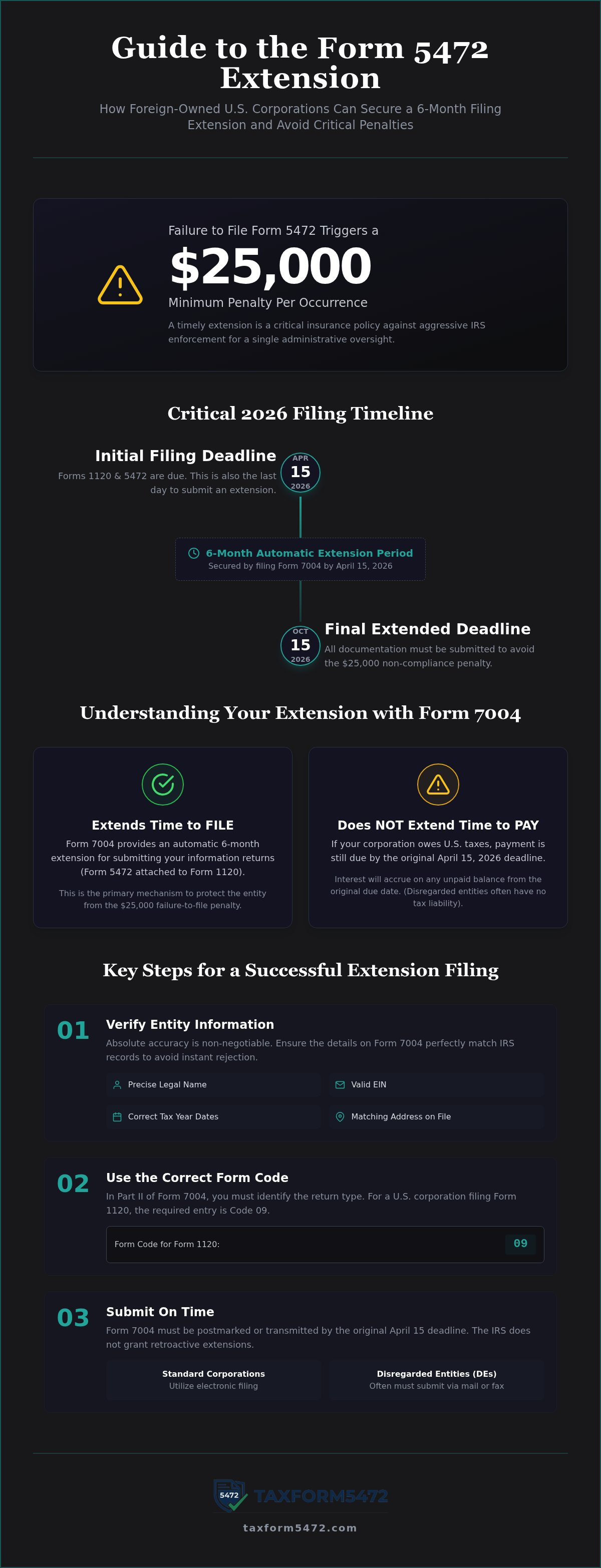
- April 15, 2026: The initial deadline for Form 1120 and Form 5472. This is also the final day to submit an extension request.
- Form 7004 Submission: The application must be postmarked or transmitted by the original April 15 deadline. The IRS doesn't grant retroactive extensions for late filings.
- October 15, 2026: The final deadline for entities with a valid extension. All documentation must be submitted by this date to avoid the $25,000 non-compliance penalty.
Consistency is required. The IRS tracks these dates with automated systems. Late submissions are flagged instantly.
Automatic vs. Discretionary Extensions
The form 5472 extension is classified as automatic. Unlike some tax relief measures, the taxpayer doesn't need to justify the request. Form 7004 requires no signature. It requires no detailed explanation of why the extension's needed. If the form's completed correctly and filed on time, the six-month period is granted without manual review.
Distinguish between the time to file and the time to pay. Form 7004 only extends the filing deadline. If the corporation owes U.S. taxes, those funds must be paid by April 15, 2026. Interest accrues on any unpaid balance from the original due date. Disregarded entities often have no tax liability, but the information reporting requirement remains absolute. A correctly filed extension protects the entity from the $25,000 failure-to-file penalty. This protection's the primary goal of the extension process.
Filing Form 7004 for Form 5472 Compliance
Form 7004 is the official Application for Automatic Extension of Time To File. It serves as the primary instrument for securing a form 5472 extension. For 25% foreign-owned U.S. corporations, this filing is mandatory if the standard April deadline cannot be met. The form provides a bridge between the initial tax deadline and the final reporting date. It is a procedural necessity for entities with complex international transaction histories.
Foreign-owned disregarded entities (DEs) face specific procedural constraints. While standard U.S. corporations typically utilize electronic filing, DEs often must submit Form 7004 via mail or fax. This requirement stems from the pro-forma nature of their Form 1120 filing. Consult the IRS Form 5472 Information page for the most current mailing addresses and fax numbers. For the 2026 filing season, the IRS continues to prioritize digital submissions for standard corporations. However, the manual processing requirement for disregarded entities remains a critical hurdle. Plan for transit time if mailing paper documents.
Reporting Corporations and Form 7004
Accuracy in the reporting corporation's legal name and Employer Identification Number (EIN) is non-negotiable. Discrepancies lead to immediate rejection. Align these details with the records held by the IRS. Understanding tax reporting for us companies with foreign owners helps clarify these administrative requirements. Ensure the tax year beginning and ending dates on Form 7004 match your internal accounting records exactly. The EIN must be active and valid. If the entity recently obtained an EIN, ensure it is fully registered in the IRS database before attempting to e-file. Inconsistent address formatting is another common trigger for administrative delays. Use the exact address on file with the IRS.
Code Requirements for Extension Applications
Part II of Form 7004 requires an entry for the "Form Code." This code identifies the type of return for which the extension is requested. For a U.S. corporation filing Form 1120, use Code 09. If the reporting corporation is a foreign corporation engaged in a U.S. trade or business filing Form 1120-F, a different code applies. Misidentifying the return type is a frequent cause for extension rejection. Confirm the entity's tax classification before finalizing the form. A form 5472 extension is only valid if the underlying return code is accurate.
Once the extension is secured, the next step is preparation. You can use automated Form 5472 preparation to ensure your final filing is accurate and timely.
Extension vs. Late Filing: The $25,000 Penalty Risk
The IRS enforces Section 6038A with strict financial assessments. For foreign investors, the cost of a missed deadline is immediate. A $25,000 initial penalty applies per form. This isn't a discretionary fee; it's a mandatory penalty for late filings. Securing a form 5472 extension is the most direct way to eliminate this financial risk. It shifts the compliance window from April to October. This shift provides the necessary time to audit cross-border transactions and verify related-party data. Accuracy is the priority.
Penalties aren't limited to missing the calendar date. Filing an incomplete return triggers the same $25,000 fine. The IRS views "substantially incomplete" forms as a failure to file. If the non-compliance continues, the costs escalate quickly. After an IRS notification, a 90-day grace period begins. If the form remains unfiled after this window, the IRS assesses an additional $25,000 for every 30-day period. There's no ceiling on these continuation penalties. Proactive filing is the only logical defense for a U.S. entity with foreign ownership.
Substantial Incompleteness and Compliance
Filing a placeholder form is a high-risk strategy. Some entities submit forms with zeros or "to be determined" labels just to meet the deadline. The IRS explicitly rejects this practice. A form must contain all reportable transaction data to be valid. Review the IRS Form 5472 instructions to understand specific disclosure requirements for 2026. An extension provides the time required for accurate data gathering. It allows for the reconciliation of intercompany loans, sales, and service fees. Refer to the Official Instructions for Form 5472 for technical definitions of reportable transactions. Accuracy ensures the return isn't flagged for incompleteness. Use the extra six months to verify every dollar amount.
Penalty Abatement and Reasonable Cause
Obtaining penalty abatement is difficult for foreign-owned entities. The IRS maintains an exceptionally high standard for "reasonable cause." Claiming ignorance of U.S. tax law isn't a valid defense. Relying on an agent who failed to file is also rarely accepted. The IRS expects foreign owners to exercise active oversight of their U.S. compliance obligations. A form 5472 extension serves as documented proof of compliance intent. It shows the IRS that the entity's aware of its obligations and is taking steps to meet them. Proactive management is always more cost-effective than reactive litigation. Penalty abatement requests often require expensive professional intervention and can take years to resolve. Avoid the process entirely. File the extension. Secure the additional time. Eliminate the $25,000 threat.
Step-by-Step Guidance: Filing the 2026 Extension
Securing a form 5472 extension requires a methodical approach. Precision prevents administrative rejection. Follow this sequence for the 2026 filing season to ensure your entity remains in good standing. Accuracy at this stage eliminates the risk of the $25,000 penalty described in previous sections.
Step 1: Gather entity information. Locate your SS-4 confirmation or the most recent tax return. Use the legal name exactly as recorded by the IRS. Verify the Employer Identification Number (EIN). Address formatting must be consistent. Discrepancies here are the leading cause of extension delays.
Step 2: Determine the applicable tax year. Identify if the entity operates on a calendar or fiscal year. For most, the tax year ends December 31. This makes April 15, 2026, the critical deadline. Fiscal year filers must calculate the 15th day of the fourth month after their year ends. Document this date clearly.
Step 3: Complete Form 7004. Fill out Part I and Part II of the Application for Automatic Extension. Ensure the tax year beginning and ending dates are accurate. This form serves as your formal request for an additional six months.
Step 4: Calculate estimated tax due. Form 7004 is not an extension to pay. If the parent Form 1120 has a tax liability, calculate the balance now. Pay this amount by April 15 to avoid interest. Disregarded entities often report zero liability but must still file the extension to protect against information reporting penalties.
Step 5: Submit to the IRS. Use the e-file system for standard corporations. Disregarded entities must often use designated mailing addresses or fax numbers. Submit the form on or before the original deadline. Late submissions are not accepted.
Identifying the Correct Form 7004 Codes
Part I of Form 7004 requires a specific code to identify the return type. Selection errors lead to immediate rejection. Use the following codes for the 2026 season:
- Code 12: Form 1120 (U.S. Corporation).
- Code 25: Form 1120-F (Foreign Corporation).
Always verify these codes against the most recent IRS revisions. The IRS occasionally updates form codes for new tax years. A form 5472 extension is only valid if the underlying return code is correct. Cross-reference your entity classification before final submission.
Submission Methods and Confirmation
E-filing is the preferred method for standard corporations. It provides immediate receipt confirmation. This digital trail is essential for compliance records. If your entity requires paper filing, use the specific IRS mailing address based on your entity's location. Retain proof of mailing. Use Certified Mail with a Return Receipt. This documentation provides audit protection if the IRS claims the extension was not received. Stay organized. Keep digital and physical copies of every submission.
After securing your extension, focus on the final report. Use automated Form 5472 preparation to ensure your 2026 filing is accurate and professional.
Streamlining 2026 Compliance with Automation
Securing a form 5472 extension is only the initial phase of the compliance cycle. The focus now shifts to final reporting. Manual data entry increases the risk of the $25,000 penalty. Automation provides a professional alternative. Use the additional six months to implement automated form 5472 preparation. This ensures the October 15, 2026 deadline is met with verified data. Digital platforms eliminate transcription errors. They bridge the gap between foreign accounting records and U.S. reporting standards.
Digital compliance platforms manage the complexities of filing form 5472 with form 1120. They link the pro-forma return to the information disclosure. This reduces manual reconciliation. Record keeping is centralized. Data is ready for future IRS inquiries. Centralized documentation is the best defense during a routine audit. It provides a clear audit trail for every reportable transaction.
Why Software Outperforms Manual Filing
Manual filing lacks validation. Software applies built-in validation rules. It flags missing reportable transactions instantly. It verifies the 25% foreign ownership threshold automatically. The interface is optimized for international users. It handles jurisdictional differences in currency and date formats. It ensures strict compliance with Section 6038A. Efficiency is the standard for 2026 international reporting.
Managing Multiple Reporting Corporations
Portfolio managers often handle multiple U.S. entities. Tracking separate deadlines is difficult. A single dashboard monitors every form 5472 extension status. It tracks every filing window. It prevents administrative oversights across the entire entity group. Use the form 5472 filing cost guide to plan compliance budgets. Automation reduces the per-entity labor cost. It ensures consistency across all filings. Stay organized. Stay compliant.
Secure Your 2026 Compliance Status
Managing international reporting requirements demands absolute precision. A form 5472 extension is your primary defense against the $25,000 non-compliance penalty. By filing Form 7004 on time, you secure six additional months to audit your cross-border transactions. This window is essential for gathering accurate data from foreign related parties. It ensures your entity remains in good standing with the IRS without the pressure of the April deadline.
The transition from an extension to a final filing should be seamless. Automation eliminates the risks associated with manual entry and complex ownership calculations. Our specialized platform provides IRS-ready documentation tailored for foreign owners of U.S. entities. It's a utilitarian tool designed for maximum efficiency in a complex regulatory environment. Focus on your business growth while maintaining a perfect compliance record.
Prepare your Form 5472 with taxform5472.com to benefit from automated compliance and specialized reporting. Secure your status today. Stay organized. Stay protected.
Frequently Asked Questions
Is the Form 5472 extension automatic?
Yes, the extension is automatic if you file Form 7004 on or before the original due date of the return. The IRS doesn't require a signature or a detailed explanation to grant the additional time. However, the form must contain accurate entity information to be valid. If the application's rejected due to clerical errors, the automatic status is lost. Always verify legal names and EINs before final submission.
How long is the extension for Form 5472 in 2026?
The IRS grants an automatic six-month extension for filing Form 5472. For calendar year filers, this moves the deadline from April 15, 2026, to October 15, 2026. This extra time's intended for data collection and reconciliation of international transactions. It doesn't apply to the payment of taxes. Entities must still estimate and pay any tax liability by the original April deadline to avoid interest and late fees.
Can I file Form 7004 electronically?
Most U.S. corporations can file Form 7004 electronically through the Modernized e-File (MeF) system. This provides immediate confirmation of receipt. However, foreign-owned disregarded entities filing a pro-forma Form 1120 often must submit their form 5472 extension via mail or fax. The IRS processing systems for these specific entity types aren't always compatible with standard e-filing protocols. Check the current IRS instructions for the correct mailing address or fax number.
What happens if I miss the extension deadline?
Missing the extension deadline triggers an immediate $25,000 penalty for failure to file on time. The IRS enforces this strictly for foreign-owned entities under Section 6038A. If you miss the April 15, 2026, window, you can't apply for a retroactive extension. Continued failure to file after IRS notification results in additional penalties of $25,000 for every 30-day period. Proactive filing's the only way to mitigate these significant and escalating financial risks.
Do I need to explain why I need an extension?
No explanation is required for an automatic extension via Form 7004. You don't need to provide reasons for delays or proof of hardship to the IRS. As long as the form's filed correctly by the original deadline, the extension is granted. This streamlined process allows entities to focus on gathering transaction data rather than justifying administrative delays. Simply select the correct form code, verify your entity information, and submit the application before the window closes.
Does extending Form 5472 also extend my tax payment deadline?
No, a form 5472 extension only provides more time to file the information return. It doesn't extend the deadline for paying taxes owed. Any tax liability for the 2025 tax year must be paid by April 15, 2026. Failure to pay by this date results in interest and potential late-payment penalties. Disregarded entities often have no tax due, but corporations must estimate their liability accurately before filing Form 7004 to stay compliant.
Which IRS code should I use on Form 7004 for a foreign-owned LLC?
Foreign-owned disregarded entities (LLCs) must file a pro-forma Form 1120 to report Form 5472 data. On Form 7004, you should use Code 12, which corresponds to Form 1120. Using the wrong code's a common reason for extension rejection. Always cross-reference the return type you're extending with the codes listed in the Part I instructions of Form 7004. Accurate code selection ensures the IRS system routes your request correctly and grants the additional time.
How do I confirm the IRS received my extension request?
Electronic filers receive a digital acknowledgement or receipt immediately after transmission. This is the most reliable confirmation method. If you're filing by mail, use Certified Mail with a Return Receipt requested. The postmarked receipt serves as legal proof of timely filing. Retain these documents in your permanent tax records. The IRS doesn't typically send a separate approval letter for automatic extensions, so your submission proof is your only confirmation of compliance.