
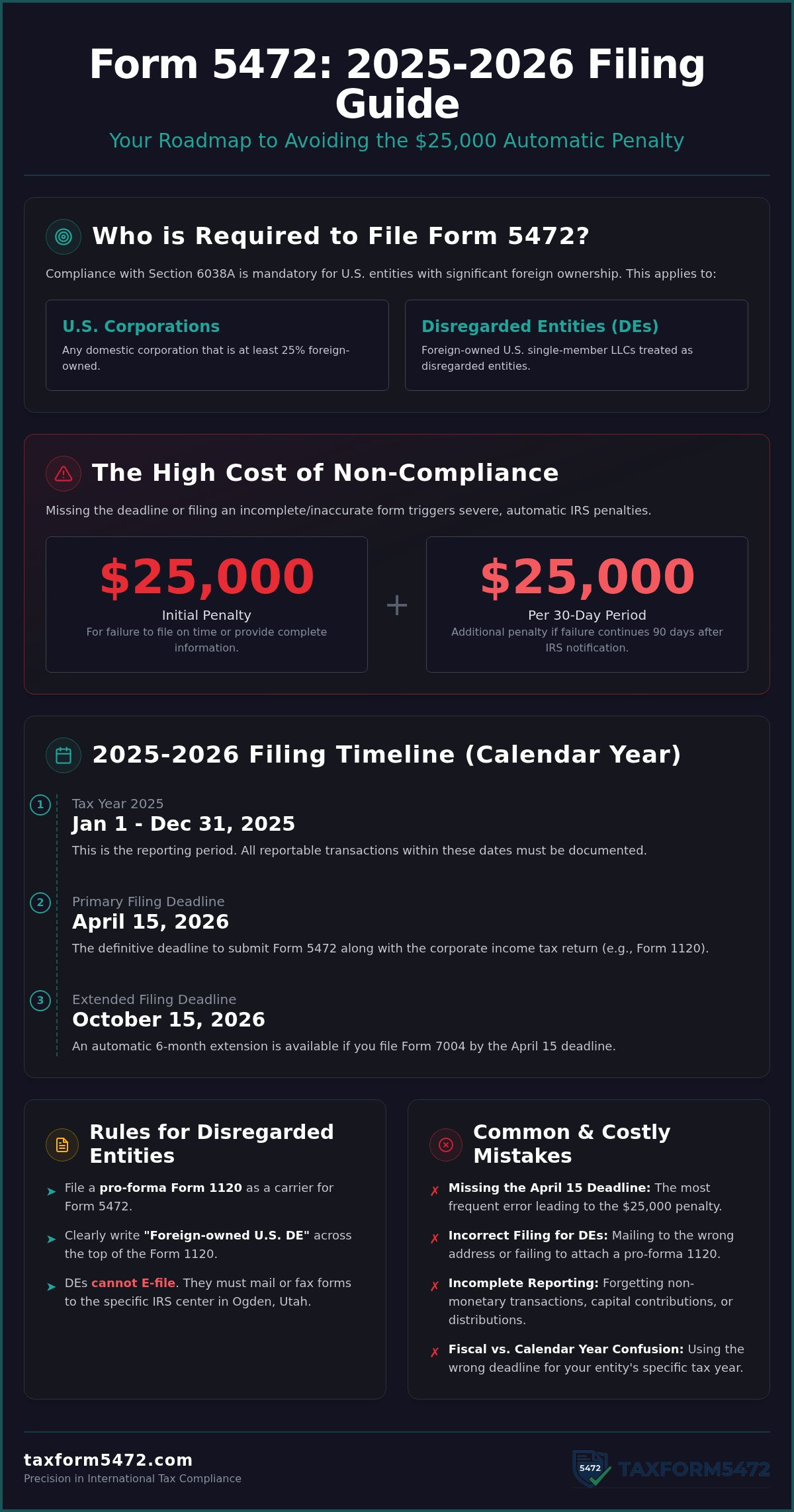
A single administrative oversight triggers an immediate $25,000 IRS penalty. For foreign-owned U.S. corporations, missing the April 15 deadline is among the most common form 5472 mistakes. The IRS treats these information returns with high priority. Compliance isn't optional. It's a mandatory requirement for every 25% foreign-owned entity. Precision is the only way to protect your U.S. operations from unnecessary financial exposure. If a failure continues for 90 days after notification, the IRS assesses an additional $25,000 every 30 days.
Tracking specific dates is difficult when managing international operations. It's easy to confuse calendar year deadlines with fiscal year requirements. This guide identifies every essential deadline and extension date for the 2025 tax year. We provide a clear list of dates and detailed extension procedures. You'll learn how to satisfy Section 6038A. You'll understand how to avoid the escalating costs of non-compliance. We'll also address the specific mailing requirements for disregarded entities. This is your roadmap for the upcoming filing cycle. Use these facts to ensure your entity remains in good standing.
Key Takeaways
- Confirm the April 15, 2026, primary deadline for all calendar year 2025 reporting.
- Secure an automatic six-month extension until October 15, 2026, by filing Form 7004.
- Prevent the mandatory $25,000 penalty for late, missing, or incomplete submissions.
- Analyze common form 5472 mistakes to mitigate audit risks and escalating IRS fines.
- Adopt digital automation to streamline Section 6038A compliance for foreign-owned entities.
Understanding the 2025 Tax Year Reporting Cycle
The 2025 reporting cycle covers all transactions from January 1 to December 31, 2025. Filing occurs during the 2026 calendar year. Entities with at least 25% foreign ownership must comply. This includes U.S. corporations and foreign-owned U.S. Disregarded Entities (DEs). These entities must disclose specific financial activities to the IRS. Failing to identify reportable entities is one of the most common form 5472 mistakes. The IRS uses this data to track cross-border capital movement. Accuracy is vital. Don't assume your entity is exempt.
The Scope of Section 6038A Compliance
Section 6038A is the governing tax code for information reporting by 25% foreign-owned domestic corporations. It mandates strict tax reporting for us companies with foreign owners. Reportable transactions include more than sales and purchases. Capital contributions, owner distributions, and formation costs are included. Even non-monetary transactions require disclosure. For a foundational IRS Form 5472 overview, filers should review the Internal Revenue Code. International owners must maintain permanent books of account. These records must support all figures reported. The IRS may request these documents during an audit. Proper record maintenance is a regulatory necessity.
Calendar Year vs. Fiscal Year Reporting
Most entities follow the standard January-December calendar cycle. Some corporations utilize a custom fiscal year. The fiscal year end-date determines the Form 5472 deadline. The form is due when the entity's income tax return is due. Misconceptions about tax year alignment result in missed deadlines. A fiscal year ending in June requires a September filing. Short-period tax years also impact obligations. If an entity closes or changes ownership mid-year, the reporting window shifts. This shift requires immediate attention to avoid the $25,000 penalty. Short-period returns are often neglected by manual filers. Understanding your specific tax year is the first step toward compliance.
Key Filing Deadlines for Calendar Year 2025
April 15, 2026, is the definitive deadline for the 2025 calendar tax year. This date applies to all 25% foreign-owned U.S. corporations and disregarded entities. In 2026, April 15 falls on a Wednesday. No federal holidays or weekends delay this requirement. Missing this window is among the most common form 5472 mistakes. The IRS requires these forms to be filed alongside the entity’s income tax return. Ensuring you are filing form 5472 with form 1120 correctly prevents immediate processing rejections. You can consult Official Form 5472 Information to verify form versions and submission standards. Accuracy at this stage is the only way to avoid the $25,000 penalty.
2025-2026 Tax Compliance Timeline
The filing season for the 2025 tax year opens on January 1, 2026. Early preparation allows for the identification of all reportable transactions before the rush. The standard due date remains April 15, 2026. This is the final day to submit your return or request an extension. If you file Form 7004 by this date, your deadline moves to October 15, 2026. It’s important to remember that an extension only applies to the filing deadline, not the payment of taxes. Compliance for the 2025 tax year requires action by January 1, April 15, or October 15, 2026.
Deadlines for Disregarded Entities
Foreign-owned U.S. disregarded entities (DEs) follow the same April 15 deadline but use distinct methods. These entities don't file a standard corporate tax return. Instead, they must file a pro-forma Form 1120. This document acts as a carrier for Form 5472. You must write "Foreign-owned U.S. DE" across the top of the pro-forma return. DEs cannot use standard electronic filing systems. They must mail or fax their forms to the IRS service center in Ogden, Utah. This manual requirement makes following form 5472 instructions critical. One of the most common form 5472 mistakes is sending DE filings to the wrong IRS address. Corporations and DEs have separate filing destinations. Verifying the correct address ensures your document is recorded before the deadline expires.
Form 5472 Extensions and Fiscal Year Variations
Securing an automatic 6-month extension requires filing Form 7004. For the 2025 calendar year, this submission is due by April 15, 2026. A successful filing moves the final deadline to October 15, 2026. Managing a form 5472 extension digitally reduces the risk of manual processing errors and provides immediate confirmation. One of the most common form 5472 mistakes is assuming an extension for the corporate income tax return automatically covers the information return without a specific Form 7004 submission. If the parent Form 1120 is extended, the attached Form 5472 is generally included; however, disregarded entities must follow specific manual extension procedures to ensure compliance.
Steps to Request a 2025 Filing Extension
Accuracy is paramount during the extension process. Verify that the entity name and Employer Identification Number (EIN) exactly match IRS records. Even minor typographical discrepancies lead to immediate rejection of the extension request. Submit Form 7004 on or before the original due date of April 15, 2026. Retain a digital timestamp, electronic filing receipt, or certified mail documentation as proof of timely filing. It's critical to understand that Form 7004 only extends the filing window for the information return. It does not extend the deadline for any tax payments due to the IRS. Failure to settle tax liabilities by the original date results in interest charges and late-payment penalties.
Fiscal Year Reporting Nuances
Non-calendar year corporations follow a schedule based on their specific accounting period. The filing deadline is the 15th day of the 4th month following the close of the corporation's tax year. For example, a fiscal year ending March 31 requires a filing by July 15. Short-period returns occur during entity formation, ownership changes, or dissolution. These periods also trigger a Form 5472 requirement if reportable transactions occurred within that timeframe. Refer to the Official IRS Instructions for Form 5472 for specific transaction codes and line-by-line requirements. One of the common form 5472 mistakes in fiscal reporting is miscalculating the four-month window after a short-period close. The fiscal year deadline is calculated by identifying the final day of the entity's chosen tax year and adding three full calendar months plus fifteen days. Proactive tracking of these dates is essential for entities that do not operate on a standard January to December cycle.
Consequences of Missing 2025 Filing Dates
Failure to file results in a mandatory $25,000 penalty. This assessment applies to late submissions and substantially incomplete forms. The IRS assesses the penalty per form, not per corporation. If an entity is required to file three separate Form 5472s and misses the deadline, the initial penalty is $75,000. Submitting a form with missing transaction data or incorrect ownership percentages is among the most common form 5472 mistakes. Precision is required to avoid these automatic fines. If you discover an error after submission, you must learn how to amend form 5472 immediately to demonstrate a good-faith effort at compliance.
The Cost of Non-Compliance
The form 5472 filing cost is a minor operational expense compared to the risks of neglect. After an IRS notification of failure to file, a 90-day grace period begins. Once this period expires, the IRS assesses an additional $25,000 for every 30-day period of continued non-compliance. There is no upper limit on these escalating charges. If the failure continues for 120 days after the initial IRS notification, the total penalty for a single form reaches $50,000. Intentional disregard for reporting rules can lead to criminal penalties. Avoid financial exposure by using automated IRS Form 5472 Preparation to ensure timely delivery.
Reasonable Cause Defense
The IRS may abate penalties if the filer demonstrates reasonable cause. This requires proving the entity acted with ordinary business care and prudence. Ignorance of filing requirements or complex international structures is rarely accepted as a valid defense. You must provide a written statement made under penalties of perjury. This document should detail the facts supporting your claim. Documenting your internal compliance procedures and third-party advice can help establish a defense. Reliable record-keeping prevents the need for abatement requests. Focus on proactive filing to maintain entity standing.
Streamlining 2025 Compliance with Automation
Digital systems are replacing manual tax preparation for foreign-owned entities. The IRS is intensifying its focus on international transparency. Relying on spreadsheets or paper files increases the likelihood of common form 5472 mistakes. Automation ensures your 2025 data is captured accurately before the April 15, 2026 deadline. Modern SaaS platforms provide a centralized environment for cross-border reporting. This shift minimizes the risk of the $25,000 penalty. TaxForm5472 facilitates secure filing by removing the ambiguity of manual forms. Efficiency is the new standard for international tax compliance. You don't have to track shifting regulations manually when using a dedicated digital utility.
Digital vs. Manual Preparation
Traditional CPA timelines often conflict with tight filing windows. Manual calculation of reportable transactions leads to frequent data discrepancies. Automated data entry validates every field against current IRS standards instantly. System alerts notify filers of upcoming 2025 tax year dates. This proactive approach eliminates last-minute submission stress. SaaS platforms offer faster turnaround times than legacy accounting firms. Instant validation prevents the IRS from rejecting returns due to simple formatting errors. You can focus on business operations while the software handles technical compliance requirements. The system identifies missing EINs or incomplete Part IV transaction details before submission. This level of scrutiny is impossible to replicate with manual review processes.
Secure Filing for International Entities
Security is a primary concern for international owners. Enterprise-grade encryption protects all foreign ownership documentation. Filers receive instant confirmation once the system processes the submission. The platform generates a permanent digital audit trail for every 2025 return. This record is essential for future IRS inquiries or internal compliance reviews. Automating the pro-forma 1120 attachment process ensures disregarded entities meet specific requirements without manual oversight. The software prepares the necessary pro-forma documents with the correct headers. It ensures the physical filing packet is ready for the Ogden, Utah service center. This precision is difficult to maintain through manual preparation. Secure, automated systems provide the quiet confidence needed to manage global tax obligations. You'll maintain a professional distance from the complexities of the tax code while ensuring total compliance.
Secure Your 2025 Filing Compliance
Compliance for the 2025 tax year requires strict adherence to the April 15, 2026, deadline. Foreign-owned entities must track reportable transactions with absolute precision. Relying on manual processes often leads to common form 5472 mistakes that trigger immediate IRS scrutiny. The $25,000 penalty is a significant risk for any corporation or disregarded entity. Proactive management of these dates ensures your U.S. operations remain in good standing. You've identified the critical deadlines. Now you must execute the filing.
Digital tools offer the most reliable path to meeting Section 6038A requirements. Eliminate the uncertainty of manual tracking and mailing errors. Professional compliance is accessible through streamlined SaaS interfaces. This approach protects your business from escalating fines and audit triggers. Automate your 2025 Form 5472 filing now to avoid the $25,000 late filing penalty through secure digital preparation. Maintain your focus on growth while the system handles the technical filing details. Your 2025 tax year reporting is ready for submission. Start your preparation today.
Frequently Asked Questions
What is the exact deadline for Form 5472 for the 2025 tax year?
The primary deadline is April 15, 2026. This date applies to all entities operating on a calendar year basis. You must submit the form along with your income tax return by this date. Missing this window triggers an immediate penalty assessment. Early submission prevents last-minute technical errors. Verify your entity’s accounting cycle before assuming the April date is correct. Secure your filing status early to maintain compliance.
Can I get an extension for my 2025 Form 5472 filing?
You can obtain an automatic six-month extension by filing Form 7004. This moves your 2025 tax year deadline to October 15, 2026. You must file the extension request on or before April 15, 2026. Failing to file Form 7004 by the original due date is one of the most common form 5472 mistakes. An extension only applies to the information return filing, not to any tax payments.
What happens if I miss the April 15, 2026 filing date?
Missing the April 15, 2026 filing date results in a $25,000 IRS penalty. This fine applies even if no tax is owed. If the failure continues for 90 days after IRS notification, additional $25,000 penalties are assessed every 30 days. There's no maximum limit for these escalating fines. Promptly amending or filing late returns may help in requesting penalty abatement under specific reasonable cause guidelines.
Does a foreign-owned LLC have different deadlines than a corporation?
Foreign-owned U.S. LLCs follow the same April 15 deadline as corporations. However, the filing method differs significantly. LLCs must file a pro-forma Form 1120 and attach Form 5472. These entities cannot use electronic filing systems and must mail or fax their documentation. Sending these forms to the wrong IRS service center is one of the common form 5472 mistakes that leads to late-filing penalties.
Is there a penalty if my 2025 reportable transactions were zero?
You don't file Form 5472 if there were zero reportable transactions during 2025. However, the definition of a reportable transaction is broad. It includes capital contributions, loans, and even small formation costs paid by the foreign owner. Many owners incorrectly assume that no business income means no filing requirement. Check your records for any movement of funds between the owner and the entity to confirm your status.
How do I file Form 5472 for a fiscal year ending in 2025?
Fiscal year filers must submit Form 5472 by the 15th day of the 4th month following their year-end. If your fiscal year ended on June 30, 2025, your deadline was October 15, 2025. For a fiscal year ending in late 2025, calculate the four-month window accurately. Miscalculating this specific date is a frequent error. Always align your information return with the due date of your corporate income tax return.
Do I need to file Form 5472 if my US company was inactive in 2025?
Inactive status does not automatically exempt a company from filing requirements. If an inactive U.S. company had any reportable transaction, such as a maintenance fee paid by the foreign owner, a filing is mandatory. The IRS focuses on the transaction, not the level of business activity. Review all bank statements and owner contributions from 2025. Even a single transaction triggers the full reporting obligation and the potential $25,000 penalty.
Can I file Form 5472 electronically for the 2025 tax year?
Electronic filing is available for U.S. corporations filing a standard Form 1120. Foreign-owned U.S. disregarded entities are currently prohibited from e-filing. These entities must submit paper forms via mail or fax to the IRS center in Ogden, Utah. Ensure your pro-forma return includes the required "Foreign-owned U.S. DE" notation at the top. Using an automated platform can help prepare these documents correctly for manual submission.