
A single missing form costs $25,000. This penalty applies even if your business owes zero tax. The IRS prioritizes data over profit margins. One reporting error triggers an immediate financial hit. Efficiency is mandatory for international founders.
Operating a foreign controlled us corporation requires precise reporting. IRS Form 5472 is complex. Compliance risks are high. Many owners face high accounting fees for basic annual filings. You need a direct path to regulatory safety without the overhead of traditional firms.
This guide simplifies 2026 reporting requirements. You'll master the filing process and protect your entity from steep penalties. We provide a clear compliance roadmap. Learn to identify your reporting status. Follow our step-by-step instructions. Use an efficient, affordable filing method to secure your status. This is your blueprint for total IRS compliance.
Key Takeaways
- Define 'Reporting Corporation' status for 2026. Identify scrutiny triggers for domestic entities with foreign shareholders.
- Calculate 25% ownership thresholds. Map direct and indirect foreign structures to determine filing obligations.
- Categorize reportable transactions. Include all monetary and non-monetary exchanges with related parties to maintain compliance.
- Prevent the $25,000 penalty. Secure your foreign controlled us corporation against late or incomplete filing risks.
- Optimize filing with digital automation. Use software-driven validation to ensure IRS data accuracy and reduce costs.
Defining the Foreign Controlled US Corporation
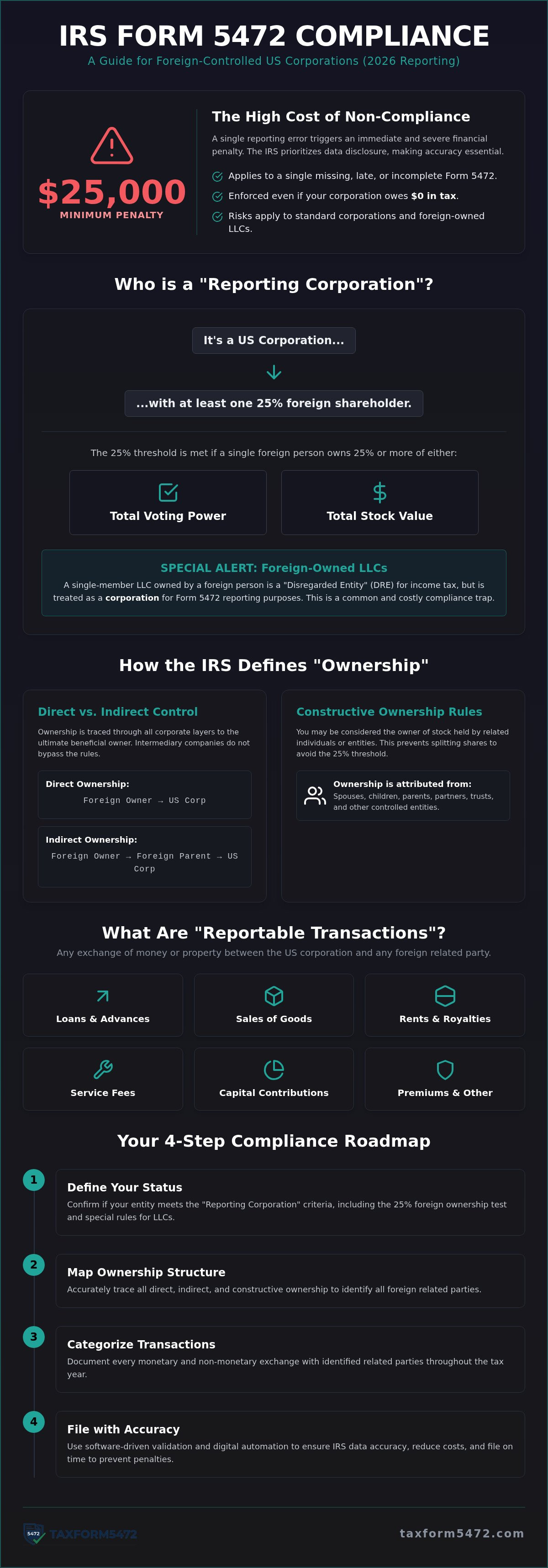
The IRS definition of a "Reporting Corporation" for 2026 is precise. It covers any foreign controlled us corporation with at least 25% foreign ownership. This threshold applies to either voting power or total stock value. Ownership can be direct or indirect. This regulatory focus stems from a need for transparency in cross-border financial activity. The IRS monitors these entities to ensure proper tax treatment of all international transactions.
High scrutiny is the standard for a foreign controlled us corporation. The government tracks capital moving between the U.S. entity and its foreign owners. This oversight helps prevent profit shifting and tax base erosion. Reporting obligations exist regardless of financial performance. An entity with zero sales still must file if reportable transactions occurred. Compliance is a matter of data disclosure. It's not just about tax payment.
Section 6038A and 6038C Compliance
Sections 6038A and 6038C form the legal framework for international reporting. These statutes require specific, rigorous record-keeping. A Reporting Corporation must document all dealings with related parties. This includes loans, capital contributions, and service fees. While a Controlled Foreign Corporation (CFC) often involves outbound reporting, these sections focus on inbound foreign investment. The Reporting Corporation acts as the central point for IRS data collection. It must provide clear evidence that transactions meet arm's-length standards.
Foreign Disregarded Entities (DREs)
Foreign-owned single-member LLCs face a unique classification. The IRS treats these as Disregarded Entities (DREs) for income tax purposes. However, for 2026 reporting, they're classified as "deemed corporations." This status triggers the same Form 5472 requirements as a standard C-Corp. Misconceptions about LLC transparency often lead to non-compliance. Owners mistakenly assume the "disregarded" status applies to all IRS forms. It doesn't. For information reporting, the LLC is a corporation.
This classification ensures the IRS has visibility into foreign-related transactions. Even if the LLC doesn't have a tax liability, the filing requirement remains active. Transactions such as the initial formation costs or simple owner contributions trigger the need for a return. Ignoring these rules because the company is small or pre-revenue is a costly mistake. The $25,000 penalty applies to DREs just as strictly as it does to large multinationals.
The 25% Foreign Ownership Threshold
The 25% threshold is a binary compliance trigger. A business is a foreign controlled us corporation when a single foreign person owns at least 25% of the total voting power or value. This calculation isn't limited to direct stock certificates. The IRS applies strict attribution rules to identify the true owners behind the entity.
Direct vs. Indirect Control
Direct control is visible on the share registry. Indirect control is often hidden within holding company layers. The IRS traces ownership through every tier of a corporate structure. If a foreign individual owns a parent company that owns a US subsidiary, that individual is the beneficial owner. It's impossible to bypass reporting by adding intermediary companies.
Consider a US corporation owned by a French holding company. If a single foreign person owns 25% of that French parent, the US entity must report. Voting power and total value are evaluated separately. If either metric reaches 25%, the filing requirement is active for 2026. You must evaluate the highest percentage held at any point during the tax year.
Constructive Ownership Rules
Ownership math includes family members and business partners. Stock held by a spouse, child, or parent is often attributed to the primary filer. This prevents owners from splitting shares to stay below the 25% limit. Trusts and estates also pass ownership to their beneficiaries. These relationships can turn a minority stakeholder into a 25% foreign shareholder instantly.
Constructive ownership is the legal attribution of stock from one person or entity to another based on specific familial or business relationships defined by Section 318.
A "Foreign Related Party" is any 25% foreign shareholder or any person related to that shareholder. This definition is broad. It includes entities under common control and family members. Identifying these parties is the first step in completing IRS Form 5472. Mistakes in identifying these relationships lead to "substantially incomplete" filings. You can use software-driven validation to map your corporate structure accurately. Accurate mapping ensures every reportable transaction is captured before the deadline.
Identifying Reportable Transactions for 2026
Reporting is a data-driven requirement. A reportable transaction is any exchange between a foreign controlled us corporation and its related parties. This includes any movement of value, whether cash or property. The IRS requires disclosure even if the entity generated zero profit. Filing is mandatory for every year a transaction occurs. Non-compliance leads to immediate financial consequences.
The IRS monitors these exchanges to ensure tax transparency. It's not enough to report income. You must report the movement of capital. This applies to startups and established firms alike. A company with no sales still has reporting duties if it received owner funding. Compliance is about visibility into cross-border activity.
Common Monetary Transactions
Monetary exchanges involve direct cash or credit movements. These are standard business operations. The IRS Instructions for Form 5472 list specific categories for these payments. Accuracy in these figures is essential for 2026 compliance. Common examples include:
- Sales and purchases of inventory or tangible property.
- Rents, royalties, and license fees paid to foreign owners.
- Service fees for management, marketing, or administration.
- Interest paid on intercompany loans and credit lines.
- Commissions and technical fees.
Non-Monetary and Capital Transactions
Non-monetary exchanges are often overlooked. This is the "Small LLC" trap. Owners of a foreign controlled us corporation often assume personal contributions don't count. They're wrong. Capital contributions, owner draws, and loan repayments are all reportable events. Even if no money leaves the U.S. bank account, the transaction must be documented.
The IRS also tracks intangible property. Patents, trademarks, and trade secrets transferred between related parties must be disclosed. These transactions often lack a clear market price but require reporting. Use a Reportable Transactions Form 5472 guide to categorize these complex exchanges properly. Loans require similar care. Any credit line from a foreign owner is a reportable event. The principal amount and any interest paid must be documented. Failure to report these non-revenue items triggers the $25,000 penalty.
Compliance Risks: The $25,000 Penalty Regime
The penalty for non-compliance is severe. For a foreign controlled us corporation, the IRS assesses an automatic $25,000 fine for late filings. This penalty isn't limited to missing forms. Filing a "substantially incomplete" return triggers the same financial hit. The IRS views missing data as a failure to file. Accuracy is as critical as timing in the 2026 tax year.
Unresolved issues lead to compounding fines. If the failure continues for more than 90 days after IRS notification, additional penalties apply. The IRS assesses an extra $25,000 for each 30-day period or fraction thereof. There's no upper limit on these continuation penalties. In 2026, IRS enforcement is increasingly automated. Internal systems now cross-reference foreign-owned bank accounts with tax records to identify missing information returns instantly.
Penalty Triggers and Deadlines
Filing deadlines are strict. Form 5472 must be attached to the corporate tax return, Form 1120. For calendar-year entities, the deadline is April 15, 2026. A timely Form 7004 extension moves this date to October 15, 2026. Missing this window by even one day results in the full $25,000 assessment. The IRS doesn't offer a grace period for international information returns.
Many founders ignore "zero-transaction" years. This is a dangerous mistake. Even without revenue, specific administrative events or capital movements require reporting. Refer to our Foreign Owned US Corporation Tax Guide to verify your specific filing status. Don't assume inactivity equals safety from the penalty regime.
Mitigating Risk and Abatement
Avoiding the penalty is easier than removing it. The IRS allows for "Reasonable Cause" abatement, but the threshold is exceptionally high. Ignorance of the law isn't a valid defense for international business owners. You must prove you exercised ordinary business care and prudence. Contemporaneous record-keeping is your best defense. Document every transaction as it happens to avoid data gaps during the filing season.
If you discover an error after submission, act immediately. You can follow our guide on How to Amend Form 5472 to correct previous filings before an audit begins. Voluntary disclosure often leads to better outcomes with the IRS. To eliminate filing errors entirely, use a specialized digital preparation tool. Automated systems catch missing fields that manual filers often overlook. This proactive approach is the only way to guarantee compliance in a high-risk enforcement environment.
Filing Solutions for Foreign Owned Entities
Manual filing is a legacy approach. It's slow. It's prone to human error. For a foreign controlled us corporation, traditional CPA fees often exceed the value of the reporting task. Manual data entry increases the risk of a "substantially incomplete" filing. As established in previous sections, this oversight triggers the $25,000 penalty. Digital automation replaces manual workflows with software-driven validation.
Accuracy is a binary outcome. Software ensures every field aligns with IRS logic. Digital tools cross-reference your ownership data with reportable transaction categories. This eliminates the guesswork inherent in paper forms. For the 2026 tax season, efficiency is a competitive advantage. SaaS platforms provide a centralized hub for recurring annual compliance. This continuity ensures your historical data remains accessible for future filings. You avoid the "start from scratch" mentality every April.
Benefits of Automated Preparation
Automation removes the friction from compliance. You don't need a tax degree to navigate the interface. The system guides you through the 25% ownership calculation and transaction mapping. This process eliminates manual data entry errors that often lead to IRS audits. It's a cost-effective solution for small-to-medium corporations. You get professional-grade results without the hourly billing of a global firm. Review our guide on Automated Form 5472 Preparation for a deeper dive into these efficiencies. The platform handles the complexity, letting you focus on operations.
Next Steps for Foreign Owners
Prepare for 2026 now. Compliance starts with organized data. Gather your transaction records, including capital contributions and intercompany loans. Identify all 25% foreign shareholders in your structure. Once your data is ready, use a digital interface to facilitate your submission. This method ensures your foreign controlled us corporation meets all federal requirements before the April 15 deadline. Don't wait for the extension period to begin your data collection.
The IRS is modernizing its enforcement. Your filing method should match this digital shift. Automated tools provide the validation necessary to avoid the $25,000 penalty. Transitioning to a SaaS model simplifies your annual obligations. It turns a complex regulatory burden into a routine administrative task. You gain peace of mind through precise, validated data entry. Start your IRS Form 5472 filing today to secure your entity's standing.
Secure Your 2026 Compliance Status
Reporting requirements for a foreign controlled us corporation are binary. You're either compliant or you're not. The $25,000 penalty for 2026 is an automatic consequence of data gaps or filing delays. Success requires precise identification of 25% shareholders and exhaustive transaction logging. Capital contributions and intercompany loans demand the same level of scrutiny as standard revenue. These non-monetary exchanges often trigger the most significant compliance risks.
Efficiency is the only defense against high accounting fees and regulatory risk. Manual filing is no longer viable in an automated enforcement environment. Use a specialized tool to validate your records instantly and eliminate human error. Prepare and file your Form 5472 online to ensure worldwide digital compliance. Our platform provides specialized Form 5472 automation. This focused approach is designed to help you avoid the $25,000 IRS penalty through streamlined digital submission.
Take control of your reporting today. Streamlined systems make complex federal requirements manageable and predictable. Your 2026 filing status is a priority. Secure your business with confidence and focus on your growth.
Frequently Asked Questions
What is a foreign-controlled US corporation?
A domestic corporation is foreign-controlled if at least 25% of its total voting power or stock value is owned by a single foreign person. This ownership can be direct or indirect through holding companies. The IRS classifies these entities as "Reporting Corporations." They must disclose transactions with foreign related parties annually to ensure transparency in cross-border financial movements.
Does a single-member LLC owned by a non-resident have to file Form 5472?
Yes. The IRS treats foreign-owned single-member LLCs as "deemed corporations" for information reporting purposes. Even if the LLC is a disregarded entity for income tax, it remains a reporting entity for Form 5472. This requirement applies regardless of whether the LLC has a US office or active business operations. Failure to file results in the standard penalty regime.
What happens if I miss the Form 5472 filing deadline in 2026?
You face an immediate $25,000 penalty for a late or missing filing. This fine applies even if the corporation owes zero tax. If non-compliance continues for 90 days after IRS notification, an additional $25,000 penalty is assessed every 30 days. There is no maximum limit on these continuation fines. Timely filing or a valid extension is mandatory to avoid these costs.
Do I need to file Form 5472 if my US company had no income?
Yes. Filing is triggered by reportable transactions, not profit or revenue. A foreign controlled us corporation must file if it received capital contributions, paid organizational expenses, or engaged in intercompany loans. Many pre-revenue startups trigger this requirement during their formation year. Inactivity does not exempt you from information reporting duties. Every reportable exchange requires a separate disclosure.
Can I file Form 5472 online without a CPA?
Yes. You can use an automated SaaS platform to prepare and file Form 5472 digitally. These tools guide you through the data entry process and validate your information against IRS requirements. This method is often faster and more cost-effective than traditional manual accounting services. It ensures data accuracy without the high overhead of a full-service firm. Digital submission is the standard for 2026.
Is there a penalty for an incomplete Form 5472?
Yes. The IRS treats a "substantially incomplete" Form 5472 as a failure to file. This triggers the same $25,000 penalty as a missing return. Common errors include missing related party details or failing to categorize reportable transactions correctly. Validation through specialized software helps identify missing fields before submission. Accurate data is the only way to prevent these automated fines.
How do I determine if I own 25% of a US corporation?
Calculate your total voting power or the total value of all stock classes. You are a 25% foreign shareholder if you meet either metric at any point during the tax year. The IRS also applies constructive ownership rules. This means stock owned by family members or related entities is often attributed to you. Evaluate your direct and indirect holdings carefully to confirm your status.