
A single reporting error can trigger a $25,000 IRS penalty. For foreign owners of a U.S. LLC, filing a disregarded entity form 5472 is a non-negotiable requirement. The process is rigid. It demands precision. You're likely concerned about complex terminology and the high cost of non-compliance. It's understandable. IRS mandates for foreign-owned entities are notoriously strict and unforgiving.
This guide provides a professional protocol for meeting 2026 reporting standards. It's designed for efficiency and accuracy. We cover the specific pro-forma Form 1120 requirement, reportable transaction categories, and essential filing deadlines. You'll learn exactly how to document intercompany transfers and maintain clean records. This resource eliminates the guesswork. It focuses on the essential data needed for a successful submission. Proper preparation reduces human error. It ensures your entity remains in good standing. Follow this guide to secure your status and avoid unnecessary financial risk. Compliance is a task of accuracy. Let's begin the process.
Key Takeaways
- Define "Reporting Corporation" status for foreign-owned U.S. LLCs under Section 1.6038A-1.
- Confirm the 25% foreign ownership threshold that triggers mandatory IRS reporting.
- Categorize monetary and non-monetary reportable transactions for precise documentation.
- Execute the mandatory disregarded entity form 5472 and pro-forma Form 1120 filing protocol.
- Adopt automated preparation to mitigate human error and ensure 2026 compliance.
Understanding Foreign-Owned Disregarded Entities and Form 5472
A U.S. Limited Liability Company (LLC) with a single owner is frequently classified as a disregarded entity for federal tax purposes. The IRS treats the entity as separate for liability but identical for income tax. For domestic owners, this simplifies filing. For foreign owners, the rules change. The primary purpose of the disregarded entity form 5472 is transparency. It tracks transactions between the U.S. entity and its foreign owner. It's an information return. It's not a tax return.
The Definition of a Disregarded Entity
A DRE differs from a multi-member LLC. Multi-member entities are partnerships by default. Single-member LLCs are DREs. The default tax treatment is pass-through. The IRS ignores the entity's existence for income tax. A specific exception exists for foreign-owned domestic DREs. They remain disregarded for income tax but are corporations for reporting. This distinction is vital. It creates a filing obligation. It applies to any domestic LLC owned by a single foreign person. This includes individuals and foreign corporations.
The Intersection of DREs and Section 6038A
Treasury Regulations Section 1.6038A-1 defines the "Reporting Corporation" status. The intent is international tax enforcement. Labeling DREs as corporations grants the IRS visibility. The 2017 regulatory shift under T.D. 9796 removed anonymity for foreign-owned LLCs. These entities must now comply with Section 6038A. This requires the LLC to obtain a U.S. Taxpayer Identification Number, typically an EIN. It must also identify a responsible party. The reporting window aligns with the U.S. tax year. Even if the entity has no income, the filing requirement persists.
Compliance requires specific actions:
- Identifying all 25% foreign shareholders.
- Disclosing reportable transactions with related parties.
- Maintaining records to justify transaction values.
The disregarded entity form 5472 is the specific mechanism for this transparency. It bridges the gap between tax status and data requirements. This is a priority for IRS enforcement in 2026. Efficiency is the only path to compliance.
IRS Reporting Requirements for Foreign-Owned DREs
Compliance for the 2026 tax year is mandatory for all foreign-owned domestic disregarded entities. The IRS classifies these entities as reporting corporations under Section 6038A. This status triggers the requirement to file a disregarded entity form 5472. Failure to comply leads to the $25,000 penalty. Filing is required if the entity had at least one reportable transaction during the tax year. Even if the LLC generated no profit, specific movements of capital require disclosure. Review the IRS Form 5472 official instructions for technical specifications on filing windows. Precision is required. Compliance is absolute. It's a tool for global enforcement used by the IRS to cross-reference data with foreign tax authorities.
The 25% Foreign Ownership Threshold
A filing obligation exists if a foreign person owns 25% or more of the entity's total voting power or value. This includes direct or indirect ownership. Indirect ownership refers to interests held through a chain of entities, trusts, or specific family members. The IRS uses constructive ownership rules to determine these percentages. If your LLC has multiple foreign owners, each holding 25% or more, separate filings are necessary for each related party. Determining the ultimate beneficial owner is the first step in this protocol. You must verify ownership structures annually. Changes in equity can trigger new reporting duties. Accuracy at this stage prevents downstream filing errors. If ownership is held by a foreign corporation, that corporation is the related party.
The Role of the Employer Identification Number
The IRS requires a dedicated Employer Identification Number (EIN) for every reporting corporation. A disregarded entity form 5472 cannot be processed using a personal Social Security Number or an Individual Taxpayer Identification Number. The EIN identifies the business entity specifically for federal tax administration. This is distinct from personal tax obligations. Obtaining an EIN involves filing Form SS-4. It requires a responsible party with a valid tax ID. If you don't have a U.S. tax ID, the process involves manual submission to the IRS. This step must be completed well before the filing deadline. Without an EIN, the pro-forma Form 1120 cannot be generated. It's the foundational identifier for all communications with the Department of the Treasury.
Understanding these requirements is part of a broader foreign owned us corporation tax strategy. The relationship between the DRE and its owner must be documented clearly. Every transaction must be identifiable and supported by records. If you need to secure your compliance status, consider using an automated preparation platform to streamline the process. This reduces the risk of administrative rejection. It ensures all technical fields are populated correctly for the 2026 cycle. Efficient filing starts with clean data and a valid EIN.
Identifying Reportable Transactions for Form 5472
A reportable transaction is any exchange of value between a U.S. disregarded entity and its foreign owner or related parties. The IRS uses these disclosures to monitor transfer pricing. Precision is mandatory. Under Section 482, the IRS can reallocate income or deductions if transactions don't reflect arm’s-length terms. Identifying these events requires a thorough audit of the entity's ledger. Every transfer, whether cash or asset-based, must be categorized. Consult the IRS Form 5472 official guidance for a complete list of technical definitions. Compliance depends on the accurate identification of these events during the 2026 tax year. It's a data-driven process.
Monetary Transactions Protocol
Monetary transactions involve the actual transfer of funds. These are the most common triggers for filing. Common examples include sales of tangible property, rents paid for office space, and royalties for intellectual property use. Interest payments on debt also fall into this category. Service fees paid to a foreign owner for administrative or technical support are often overlooked. They must be reported. Each transaction type corresponds to a specific line on the form. For a comprehensive list of filing codes, refer to the reportable transactions guide. Accurate coding ensures the IRS can process the data without manual intervention. It's about data integrity.
Loans and capital movements are critical. Any loan between the DRE and the foreign owner must be disclosed. This includes the principal balance and interest rates. Capital contributions and distributions are also reportable. If the owner injects cash into the LLC, it's a transaction. If the LLC pays a distribution to the owner, it's a transaction. These movements define the financial relationship. They are the primary focus of the disregarded entity form 5472 filing. Documentation must support every figure reported. Keep receipts. Maintain bank statements. The IRS requires proof for every dollar declared.
Non-Monetary and Deemed Transactions
Non-monetary transactions are often missed. These involve the exchange of property or services without a cash payment. For example, if a foreign owner provides a proprietary software license to the U.S. LLC for free, a transaction has occurred. The IRS assigns a fair market value to these events. "Zero-dollar" transactions are not exempt. They require disclosure to satisfy transparency mandates. Deemed transactions under Section 482 occur when the IRS determines that a transaction should have happened to reflect market realities. Cost-sharing arrangements also fall under this umbrella. If multiple related parties share the development costs of an asset, the U.S. entity's portion must be reported. This prevents the shifting of profits to low-tax jurisdictions. Every interaction has a reporting consequence. Ignorance of non-monetary rules isn't a defense against penalties.
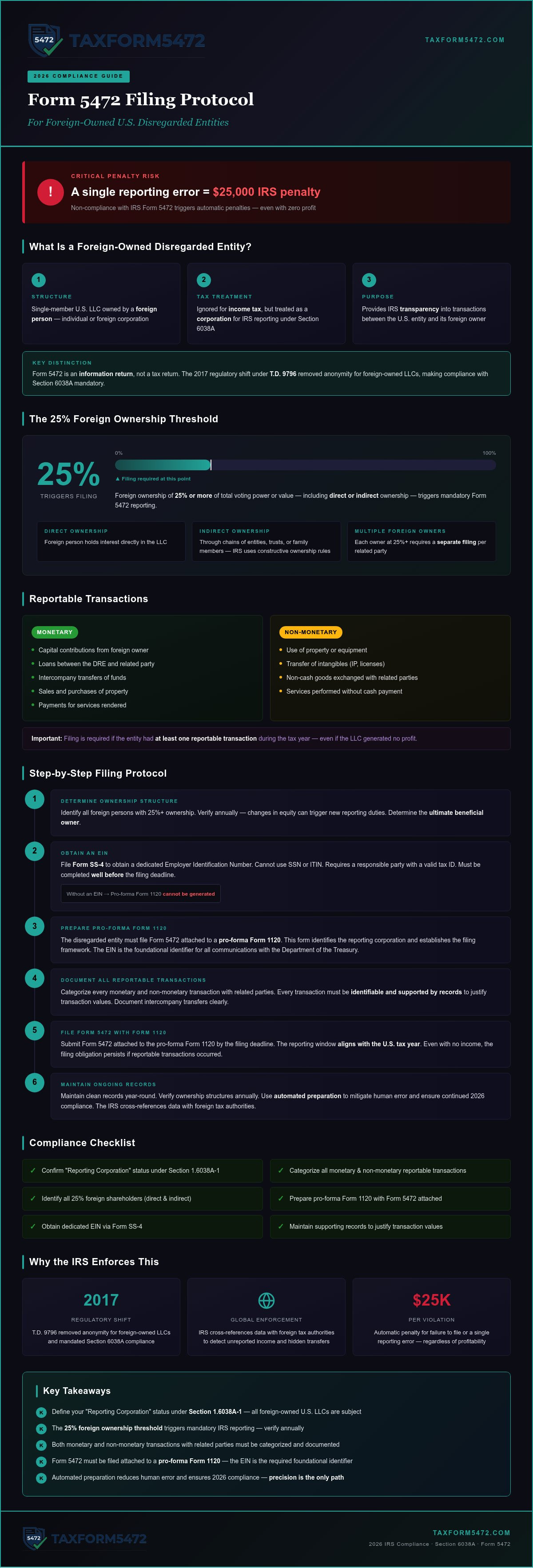
Step-by-Step Filing Protocol for Disregarded Entities
Submission requires a specific composite packet. It's not a standalone process. The IRS mandates that the disregarded entity form 5472 be attached to a pro-forma Form 1120. This documentation must be filed by mail or fax unless you're using an authorized electronic provider. Every related party transaction identified in previous sections requires its own separate Form 5472. If your LLC has transactions with three different related parties, you must submit three copies of the form. The signature must come from an authorized officer or the foreign owner. Unsigned forms are considered invalid. Invalid forms lead to non-compliance penalties. Documentation is your only defense.
The Pro-Forma Form 1120 Requirement
Form 1120 serves as a carrier for the information return. For a DRE, this is a pro-forma filing. It doesn't report corporate income tax. Fill only the header information. This includes the legal name, address, and EIN of the LLC. You must check the box for "Foreign-owned" in the specific ownership section. Leave lines 1 through 31 blank. Don't report gross receipts or expenses on this form. The IRS uses this document solely to identify the reporting entity. Including financial data on these lines is a common error. It can lead to misclassification. The entity remains disregarded for income tax; it's only a corporation for Section 6038A reporting purposes.
Deadlines and Extension Protocols
The standard filing deadline is April 15, 2026. This applies to calendar-year entities. If your entity uses a fiscal year, the deadline is the 15th day of the fourth month following the close of the tax year. Timely submission is critical. The IRS doesn't offer grace periods for the $25,000 penalty. If you can't meet the deadline, file Form 7004. This grants an automatic six-month extension. The extension applies to the filing time, not the payment of any taxes owed by the owner personally. For more details on managing this timeline, see the IRS Form 5472 filing guide. Using an extension provides necessary time for data verification.
Precision in the submission packet is non-negotiable. One missing attachment can invalidate the entire filing. Ensure all Form 5472s are physically attached to the Form 1120 before mailing. Check for the correct IRS service center address. These addresses change based on the entity's location. To ensure your packet meets all technical standards, use our automated preparation protocol. This tool generates the complete, ready-to-file PDF based on current 2026 requirements. It eliminates the risk of blank-line errors. It secures your compliance status instantly.
Streamlining Compliance with Automated Preparation
Manual filing is a high-risk activity. For the 2026 cycle, the IRS maintains a strict liability stance on information returns. A single missing field or an incorrect code on a disregarded entity form 5472 triggers an automatic $25,000 penalty. Automation is the only logical safeguard for foreign owners. It replaces human variability with algorithmic precision. This shift ensures that every technical requirement of Section 6038A is satisfied before submission. It's a professional protocol for a digital environment. Efficiency is the priority.
Mitigating the $25,000 Non-Compliance Penalty
The financial consequences of non-compliance are immediate and severe. The IRS doesn't require proof of intent to levy a penalty. Incomplete or late filings are sufficient grounds for enforcement. Using automated Form 5472 preparation eliminates these risks by validating data in real-time. The protocol checks for the presence of a valid EIN, related party details, and specific reportable transaction codes. It prevents the generation of a pro-forma Form 1120 if essential data is missing. This systemic check acts as a critical layer of defense against administrative oversight and technical errors that often bypass manual review.
Digital Submission Efficiency
Traditional CPA interactions are often slow and unnecessarily expensive. Manual back-and-forth communication increases the likelihood of data entry errors and missed deadlines. SaaS platforms offer a streamlined digital interface that guides the user through the requirements. You input data once. The system generates the compliant packet instantly. The TaxForm5472 platform is built for this specific utility. It prioritizes speed and accuracy over traditional consulting models. Users receive immediate confirmation and a ready-to-file document. This efficiency allows foreign owners to manage their U.S. obligations from any global location without the overhead of high-cost professional fees.
Digital record-keeping is the final component of a robust compliance strategy. The IRS can request documentation years after a filing. Maintaining a secure digital archive of every disregarded entity form 5472 ensures you're prepared for any future IRS audit. Automated systems store these records securely in the cloud. They provide a clear, organized audit trail of how transaction values were determined and reported. This level of organization is difficult to maintain with paper-based systems or fragmented email threads. It's a professional necessity for modern international business operations. Focus on the workflow. Secure the entity. Move forward with confidence in your 2026 filing status.
Securing Your 2026 Compliance Status
Compliance is a rigid protocol. Foreign owners must identify all reportable transactions and submit precise documentation. The $25,000 non-compliance penalty remains a critical financial risk. Proper filing of the disregarded entity form 5472 ensures your entity remains in good standing with the IRS. This guide established the pro-forma Form 1120 requirements and the 25% ownership threshold. Automation is the standard for accuracy. It eliminates the variables of manual entry. Our platform provides an automated preparation protocol with a Section 6038A compliant interface. This global service is available worldwide. Secure your status and avoid administrative delays. Maintaining digital records is essential for future audit defense. The IRS expects total transparency. Precise data entry is your best protection against enforcement actions. Every transaction must be documented and verified for the 2026 tax year. Use our streamlined digital interface to manage your filing efficiently. Prepare and File Form 5472 Online to meet your 2026 obligations. Your compliance is now manageable and secure.
Frequently Asked Questions
Does a single-member LLC owned by a non-resident alien need to file Form 5472?
Yes. A single-member LLC owned by a non-resident alien is a reporting corporation. This status requires the submission of a disregarded entity form 5472 if any reportable transactions occurred. The IRS treats these entities as corporations solely for reporting purposes. This applies even if the entity has no U.S. source income. Compliance is mandatory to maintain the LLC's standing. Failure to file triggers significant financial penalties.
What is the penalty for not filing Form 5472 for a disregarded entity?
The standard penalty is $25,000 per violation. This fine applies to late filings, incomplete data, or failure to maintain records. If the IRS notifies the entity of a failure and compliance isn't met within 90 days, additional penalties accrue. These can reach $25,000 for every 30-day period. There is no maximum limit for these secondary fines. Accuracy and timeliness are the only ways to avoid these costs.
Can a disregarded entity file Form 5472 without an EIN?
No. A disregarded entity cannot file without a valid Employer Identification Number. The IRS uses the EIN to track the entity specifically for Section 6038A compliance. You cannot use a personal Social Security Number or an ITIN in place of an EIN for the LLC. Obtaining an EIN is a prerequisite for generating the pro-forma Form 1120. Without this identifier, the IRS cannot process the disregarded entity form 5472 submission.
What is a pro-forma Form 1120 and why is it required for DREs?
A pro-forma Form 1120 is a corporate tax return used solely as a cover page. It doesn't report income or calculate taxes for the DRE. You only complete the identification section and check the foreign-owned box. The IRS requires this because DREs are technically treated as corporations for information reporting. It provides the administrative structure needed to attach and process the mandatory Form 5472.
Are there any exemptions for disregarded entities from filing Form 5472?
Exemptions are extremely limited. A DRE might be exempt if it had zero reportable transactions with related parties during the tax year. Small dollar amounts don't trigger an exemption. Even "zero-dollar" non-monetary exchanges require disclosure. If the foreign owner files a consolidated U.S. tax return that includes the DRE's data, a separate filing might not be necessary. Always verify your specific transaction history before assuming an exemption applies.
How do I report a capital contribution on Form 5472?
Capital contributions are reported as transactions with a related party. You must disclose the total value of cash or property injected into the LLC by the foreign owner. These are typically categorized in Part V of the form. Detailed records must support the valuation of any non-cash assets. Accurate reporting of these movements is vital for transparency. The IRS monitors these transfers to ensure proper tax treatment and to prevent illegal profit shifting.
When is the filing deadline for Form 5472 in 2026?
For calendar year entities, the deadline is April 15, 2026. This date aligns with the standard U.S. corporate tax filing window. If your LLC operates on a fiscal year, the deadline is the 15th day of the fourth month after the year ends. You can request a six-month extension by filing Form 7004 before the original due date. An extension avoids the $25,000 late-filing penalty but requires timely submission of the extension request.
Is an ITIN required for the foreign owner to file Form 5472?
An ITIN is not strictly required for the foreign owner. The IRS allows the use of a Foreign Tax Identifying Number (FTIN) issued by the owner's home country. You must provide this FTIN on the form if a U.S. tax ID isn't available. However, the LLC itself must have an EIN. The owner's personal tax ID status doesn't change the entity's reporting obligation. Providing a valid FTIN ensures the IRS can identify the related party.