
A single oversight on your federal tax return triggers a $25,000 IRS penalty. For non-US owners, the delaware llc form 5472 requirements are mandatory. This applies even to inactive entities. It's easy to confuse Delaware's $300 annual franchise tax with federal reporting obligations. These are separate systems. One is state-level. The other is federal. IRS instructions are dense. Reporting thresholds are low. You likely feel the pressure of maintaining compliance while managing complex cross-border transactions. Mistakes are expensive.
This guide provides a precise breakdown of your 2026 federal mandates. You will learn which transactions require reporting. We explain the role of pro-forma Form 1120. We outline the steps to confirm your specific obligations. We also identify efficient filing methods to streamline your workflow. Stay compliant. Protect your assets. Avoid the $25,000 fine. Everything you need for the 2026 tax year is here. Follow these steps to keep your Delaware LLC in good standing with the IRS.
Key Takeaways
- Identify "Reporting Corporation" status for Delaware entities with 25% or more foreign ownership.
- Master the delaware llc form 5472 requirements to prevent the $25,000 federal non-compliance penalty.
- Execute the mandatory filing protocol involving both the Pro Forma Form 1120 and Form 5472.
- Leverage automated preparation platforms to eliminate manual entry errors and ensure Section 1.6038A-1 compliance.
Understanding the Federal Mandate for Delaware LLCs
Foreign-owned Delaware LLCs are not just state entities. They are federal Reporting Corporations under Section 6038A. This classification is mandatory for any entity with 25% or more foreign ownership. It captures direct and indirect interests. Most international founders choose the single-member LLC structure. These are Disregarded Entities (DEs). For compliance purposes, the IRS treats these DEs as domestic corporations. This shift in status triggers specific Form 5472 Overview obligations. You must recognize that state-level privacy does not override federal transparency mandates.
The delaware llc form 5472 requirements apply regardless of revenue. Even a dormant LLC may have a filing obligation. The requirement is triggered by a single reportable transaction during the tax year. These transactions include capital injections, loans, or expense reimbursements. If you move money between yourself and the business, the IRS requires a record. Compliance is a strict administrative necessity. It isn't tied to your tax liability but to information transparency.
The Reporting Corporation Definition
A Reporting Corporation is any US entity with significant foreign backing. The IRS defines "significant" as a 25% foreign shareholder interest. This includes direct ownership or control through a chain of entities. Single-member LLCs are the most common reporting entities. While they are "disregarded" for income tax, they are "regarded" for information reporting. This distinction is vital. It means your Delaware LLC must obtain an EIN and file federal forms even if it pays no US tax. Ownership tracking is the first step in your compliance strategy.
Section 6038A Compliance Standards
Section 6038A serves as the statutory foundation for Form 5472. It establishes rigorous record-keeping standards. The objective is clear. The IRS wants a trail of transactions between US entities and foreign related parties. You must maintain books that justify the reported values of all exchanges. This documentation must be available for IRS inspection upon request. Standard business receipts and bank statements are often insufficient. You need a structured ledger. Precise records prevent the $25,000 non-compliance penalty. Compliance is about proof. Without a paper trail, your filing is vulnerable to audit challenges. Keep your records updated monthly to ensure accuracy.
- Ownership: 25% or higher foreign stake.
- Entity Type: Includes Disregarded Entities (DEs).
- Trigger: Any reportable transaction.
- Penalty: $25,000 for failure to file or maintain records.
Core Requirements: Reporting Entities and Related Parties
Identifying "Foreign Related Parties" is your first compliance step. This identification dictates the total number of forms you must file. A Delaware LLC often has multiple related parties. Each requires a separate submission. The Official IRS Form 5472 Information details these complex relationships. Understanding these delaware llc form 5472 requirements prevents filing gaps. Missing a single party leads to immediate penalties. Accuracy is mandatory.
Defining the Foreign Related Party
A foreign related party includes any 25% foreign shareholder. It also covers individuals or entities related to that shareholder. Attribution rules apply. This means indirect ownership through family members or holding companies counts toward the threshold. You must look through layers of ownership. If a foreign parent company owns a holding company that owns the Delaware LLC, the parent is a related party. Do not assume a simple structure exempts you. Every entity in the chain requires review. One form per party. No exceptions.
Common Reportable Transactions for Delaware LLCs
Reportable transactions include both monetary and non-monetary exchanges. There is no "de minimis" exception for foreign-owned disregarded entities. The reporting threshold is $0.00. Even a small transaction triggers the requirement. Common examples for Delaware entities include:
- Capital contributions: Initial startup funding or subsequent cash injections from the owner.
- Distributions: Any cash or property transferred from the LLC to the foreign owner.
- Loans: Intercompany lending, including interest-free arrangements or formal notes.
- Expense payments: The owner paying US business bills using a personal foreign bank account.
Many founders overlook expense payments. Paying for a US domain or state filing fee from a personal account is a reportable transaction. It's a capital contribution. Failure to report these events results in a minimum $25,000 penalty per form. This penalty is per year. It applies even if no tax is due. To ensure accuracy, use automated IRS Form 5472 preparation to catch these small but critical data points. Precision is your only defense against IRS scrutiny.
The IRS does not offer leniency for small mistakes. The $25,000 penalty is the floor, not the ceiling. If the IRS notifies you of a failure to file, and you don't correct it within 90 days, additional $25,000 penalties accrue every 30 days. This makes the delaware llc form 5472 requirements the highest-risk component of your annual compliance. Proactive identification of every related party and every transaction is the only way to safeguard your business. Do not wait for an audit to verify your records.
Delaware vs. Wyoming: Foreign Owner Tax Reporting Comparison
Federal compliance is uniform. The state of incorporation does not change federal disclosure laws. Whether you choose Delaware or Wyoming, the IRS Form 5472 Requirements remain constant. Both states house "Reporting Corporations" under Section 6038A. The primary differences are administrative and financial at the state level. Founders often mistake state-level privacy for federal exemption. This is a costly error. Your federal reporting burden exists regardless of your state-level benefits.
Delaware remains the standard for venture capital and institutional investment. Its Court of Chancery provides a sophisticated legal environment for complex business disputes. However, this prestige comes with a flat $300 annual franchise tax for LLCs. Wyoming is the primary alternative for cost-sensitive founders. It offers lower state fees and robust asset protection statutes. Choosing one over the other impacts your state-level budget, but your federal reporting burden is the same. The delaware llc form 5472 requirements apply to any foreign-owned LLC formed in either jurisdiction.
State-Level Filing Obligations
Delaware requires an annual franchise tax. For LLCs, this is a flat $300 due by June 1 every year. Late payments incur a mandatory $200 penalty. Interest also accrues at 1.5% per month. Unlike corporations, Delaware LLCs don't file a formal annual report. They only pay the tax to remain in good standing. This simplicity is a trade-off for the higher cost. Failure to pay leads to the LLC being "voided" by the state.
Wyoming requires a formal annual report. The filing fee starts at $60. It's based on the value of assets located within the state boundaries. For most digital businesses, assets in Wyoming are zero. This keeps the fee at the minimum. The deadline is the first day of the anniversary month of formation. Both states require a registered agent. These fees typically range from $50 to $300 annually depending on the provider you select.
Privacy and Disclosure Differences
Delaware is a leader in corporate privacy. Member and manager names aren't listed on the Certificate of Formation. This creates a barrier against public data scrapers and private litigants. Wyoming offers similar anonymity. It also has no state-level income tax for foreign owners. These features make both states attractive for international founders seeking a professional US presence without public exposure.
Federal impact is the critical factor. State-level privacy doesn't override federal mandates. The IRS ignores state-level anonymity. You must disclose the "Ultimate Beneficial Owner" on federal forms. State privacy protects you from the public, not the Department of the Treasury. Failure to reconcile state-level privacy expectations with federal transparency leads to the $25,000 penalty. You must maintain internal records that match your federal filings. Privacy is a shield against third parties, not a pass on the delaware llc form 5472 requirements.
Filing Protocol: Pro Forma 1120 and Form 5472
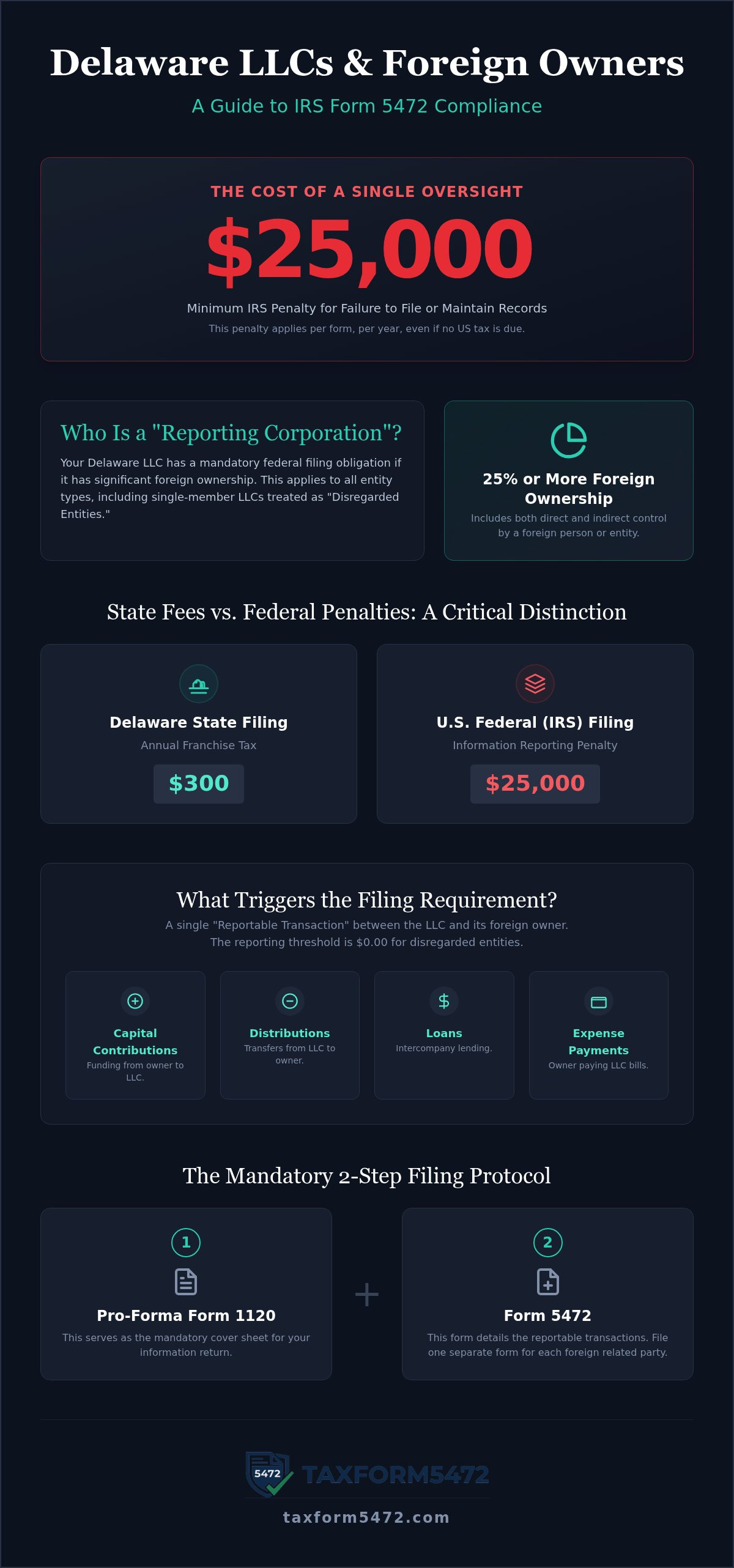
Compliance follows a rigid four-step sequence. First, obtain an Employer Identification Number (EIN). You can't file without this identifier. Second, prepare the "Pro Forma" Form 1120. This document acts as a mandatory cover sheet. Third, complete a separate Form 5472 for every foreign related party involved in reportable transactions. Fourth, assemble the packet and submit it to the IRS. Precision at each stage is required to satisfy delaware llc form 5472 requirements. Errors lead to immediate rejection or costly penalties.
Completing the Pro Forma 1120
The Pro Forma 1120 is a modified version of the standard corporate return. You must write "Foreign-owned U.S. DE" across the top of page 1. This identifies the entity as a disregarded entity for informational purposes. Provide only basic entity data. This includes the legal name, address, and EIN. Leave all income and deduction lines blank. Enter zeros where necessary. Don't report business expenses here. This form is a navigational tool for the IRS, not a tax calculation. For a deeper look at these technicalities, see the Foreign Owned LLC Form 5472: 2026 Compliance Reference. Accuracy in these headers is vital for processing.
Deadlines and Submission Methods
The standard deadline for the 2026 tax year is April 15, 2027. This matches the US corporate filing schedule. If you need more time, file Form 7004 by the original deadline. This provides an automatic six-month extension to October 15, 2027. Missing the deadline triggers the $25,000 penalty immediately. There's no grace period for informational returns. Plan your submission early to avoid administrative bottlenecks.
Submission methods are limited. Foreign-owned disregarded entities can't e-file. You must submit the Pro Forma 1120 and Form 5472 by mail or fax. The IRS maintains specific addresses for these filings. Using the wrong office delays processing. Faxing is often preferred for speed and confirmation. Confirm the current IRS fax numbers before sending. If mailing, use a service with tracking. Proof of mailing is your only defense against claims of non-receipt. Ensure your delaware llc form 5472 requirements are met with verifiable documentation.
Manual assembly is risky. A missing page or incorrect header leads to non-compliance. You can automate your IRS Form 5472 preparation to ensure every form is correctly formatted and sequenced. Digital tools eliminate the guesswork of manual IRS instructions. Focus on your business while software handles the administrative burden.
Automated Compliance for Delaware Entities
Manual filing of the Pro Forma 1120 and Form 5472 is inherently inefficient. It significantly increases the risk of Section 1.6038A-1 errors. These technical mistakes are the primary trigger for the $25,000 penalty. Automated platforms eliminate manual entry errors by standardizing the input process. They ensure every field, from the entity address to the reportable transaction codes, matches IRS expectations. Digital preparation is 80% faster than traditional CPA routes. It removes the administrative friction of document sharing and physical signatures. Security remains a non-negotiable priority. Modern systems employ enterprise-grade encrypted data handling. This protects sensitive foreign owner information from unauthorized access. You maintain total control over your compliance data.
Benefits of Digital Form 5472 Preparation
Real-time validation is the core technical advantage of automation. The system performs instant checks on your EIN and transaction categorization. This ensures immediate accuracy before the form is finalized. It prevents the submission of incomplete or logically inconsistent forms. Cost-effectiveness is a significant operational factor. Flat-fee pricing models provide absolute budget certainty. This stands in sharp contrast to the unpredictable hourly rates of traditional tax professionals. You also build a secure digital archive. This archive stores past filings and supporting documentation for future IRS audits. Organized, accessible records are your primary defense against federal scrutiny. For broader context on corporate mandates, review the Foreign Owned US Corporation Tax: 2026 Compliance Guide. Digital tools simplify the complex delaware llc form 5472 requirements into a streamlined workflow.
Next Steps for Delaware Owners
Immediate action is required for the 2026 tax year. Audit your 2025 and 2026 ledger entries for any related-party activity. This includes capital injections, owner distributions, and personal payments of business expenses. Confirm your EIN is active and matches IRS records exactly. Even minor discrepancies in the entity name or address lead to filing rejections. Once your internal data is verified, use taxform5472.com to secure your 2026 filing. Don't risk a $25,000 penalty on manual entry errors or missed deadlines. Automation provides the technical precision required for international compliance. It's the high-efficiency alternative to outdated manual methods. Your delaware llc form 5472 requirements are satisfied with speed and accuracy. Compliance is a binary status. Automation ensures you stay on the right side of the threshold.
Securing Your 2026 Delaware Compliance
Federal transparency is a non-negotiable mandate. Your Delaware LLC is a Reporting Corporation under Section 6038A. State-level privacy does not shield you from IRS disclosure rules. A single reportable transaction triggers the filing obligation. Failure to act results in a $25,000 minimum penalty per form. This risk is entirely avoidable with the right protocol. You must reconcile your state-level records with federal transparency expectations to maintain good standing.
Maintain precise records of every related-party exchange. Meeting the delaware llc form 5472 requirements involves a specific sequence of Pro Forma 1120 and Form 5472 submissions. Manual entry is inefficient and prone to technical errors. Digital preparation ensures accuracy, security, and speed. It is the utilitarian choice for international founders focused on operational efficiency and risk mitigation.
Mitigate your penalty risk today. Leverage our IRS-compliant digital preparation platform to streamline your workflow. Automate your Delaware LLC Form 5472 filing here. Professional tools provide the quiet confidence required for global business operations. Stay compliant and keep your focus on growth.
Frequently Asked Questions
Is Form 5472 required if my Delaware LLC had no income?
Yes. Reporting is triggered by reportable transactions, not business income. If the foreign owner paid for the LLC formation or injected any capital, a filing is required. Even dormant entities often have transactions like registered agent fees paid by the owner from personal funds. These are considered capital contributions. No income does not equal no filing. You must evaluate every movement of value to ensure compliance with delaware llc form 5472 requirements.
What is the penalty for not filing Form 5472 for a Delaware LLC?
The minimum penalty is $25,000 per form, per year. This fine applies to late, incomplete, or missing filings. If the IRS notifies you of a failure and you don't comply within 90 days, additional $25,000 penalties accrue every 30 days. There is no maximum ceiling for these recurring fines. Compliance is financially critical for every foreign owner. Precise digital preparation helps mitigate this significant financial risk through automated validation checks.
Does a Delaware LLC need a US bank account to file Form 5472?
No. A US bank account is not a prerequisite for federal informational filing. However, transactions often occur through the owner's foreign accounts. If you pay US business expenses from an overseas personal account, it's a reportable transaction. You must report these movements regardless of the bank's geographic location. The IRS focus remains on the relationship and the transfer of value. Geography does not exempt you from the delaware llc form 5472 requirements.
Can I file Form 5472 online for my Delaware entity?
Generally, no. Foreign-owned US disregarded entities cannot e-file the required Pro Forma 1120 and Form 5472 packet. You must submit these documents via mail or fax to the specific IRS address designated for foreign-owned entities. Automated platforms can prepare the documents for you with high precision. However, the final submission remains a manual physical process. Standard corporate e-filing systems don't support this specific informational return for disregarded entities.
What counts as a reportable transaction for a single-member LLC?
Any exchange of value between the LLC and its foreign owner is reportable. Common examples include initial capital contributions, loans, interest payments, and owner distributions. It also includes non-monetary transactions like the use of property or equipment. Even the owner paying the $300 Delaware franchise tax from a personal account is a reportable event. There's no minimum dollar threshold for these disclosures. Every cent moved between the owner and entity requires reporting.
How do I get an EIN for my foreign-owned Delaware LLC?
You must submit Form SS-4 to the IRS. Foreign owners without a US Social Security Number or ITIN must apply via fax or mail. You cannot use the online EIN application without a US taxpayer ID. The process typically takes several weeks for foreign applicants. An EIN is a mandatory requirement for completing your federal informational filings. You should secure this identifier immediately after forming your Delaware entity to avoid administrative delays.
Do I need to file Form 5472 every year?
You must file every year a reportable transaction occurs. For most active Delaware LLCs, this is an annual requirement. Transactions like paying the annual franchise tax or receiving a distribution trigger the mandate. If the entity is truly dormant with zero transactions between the owner and the LLC, a filing might not be necessary. However, most entities have at least one reportable event annually. Consult your ledger to confirm your specific annual filing status.
What is a Pro Forma Form 1120?
It's a modified version of the US Corporation Income Tax Return. Foreign-owned disregarded entities use it as a mandatory cover sheet for Form 5472. You only complete basic entity information at the top and write "Foreign-owned U.S. DE" on page one. All financial lines for income and deductions remain blank. It serves as a vehicle to deliver the informational data in Form 5472 to the IRS. Accuracy in this document is essential for processing.