

A single clerical error on an informational return triggers an automatic $25,000 penalty. Manual entry is no longer a viable strategy for foreign-owned U.S. corporations. Securing your status requires precise form 5472 electronic filing through Modernized e-File protocols. This is a technical requirement. It's not a digital option. Data integrity depends on direct transmission and automated validation.
IRS e-file systems are complex. Many international owners lack a U.S. tax professional. They struggle with rigid transmission standards and software hurdles. It's stressful to face massive fines due to simple submission errors. You need a system that ensures accuracy. It must work without the high overhead of traditional accounting firms. Efficiency is the priority. Professional results require professional tools.
This guide simplifies your digital submission. Master the technical requirements for 2026 compliance. Learn to automate the preparation process. We'll review transmission protocols, validation steps, and methods for securing immediate proof of filing. Expect a streamlined path to total compliance. Minimize your time investment. Focus on your business while the technical protocols handle the IRS requirements. Results are the only metric.
Key Takeaways
- Understand Modernized e-File (MeF) protocols required for mandatory 2026 IRS compliance.
- Identify technical requirements for consolidating Form 5472 within the primary Form 1120 digital package.
- Optimize your form 5472 electronic filing to eliminate the high error rates of manual paper submissions.
- Execute a rigorous preparation checklist to verify corporate identity and reportable transaction data.
- Leverage automated validation tools to secure immediate proof of filing and mitigate penalty risks.
IRS Form 5472 Electronic Filing: Mandatory Standards for 2026
Direct digital submission via the Modernized e-File (MeF) system defines form 5472 electronic filing. It replaces traditional paper methods for foreign-owned U.S. corporations and foreign-owned disregarded entities. Digital precision is now a baseline requirement. The IRS uses these electronic records to track reportable transactions between U.S. companies and their foreign related parties. Manual filing introduces human error. Digital filing eliminates it. Speed is a secondary benefit. Compliance is the primary objective. Precise data entry is the only way to satisfy 2026 standards.
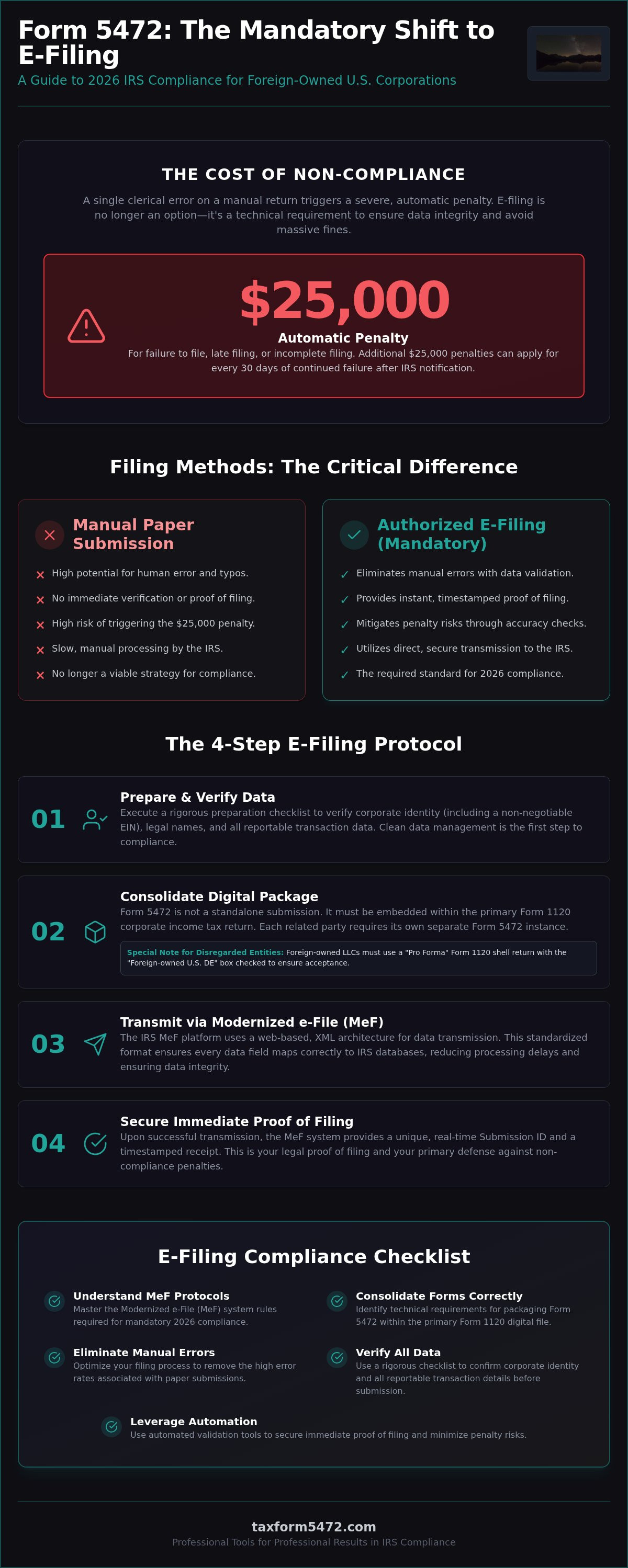
Proof of timely submission is critical. Paper filings often lack immediate verification. Electronic filing provides a timestamped receipt. This record is your defense against the $25,000 non-compliance penalty. The IRS applies this fine for failure to file, late filing, or incomplete filing. Accuracy matters. The margin for error is zero. If the failure continues for more than 90 days after IRS notification, additional $25,000 penalties apply every 30 days. Mandatory e-filing thresholds apply to any corporation required to file Form 1120. If you file the parent return digitally, the IRS Form 5472 must follow the same digital protocol.
The Role of Section 6038A in Digital Reporting
Section 6038A establishes the statutory authority for these reporting requirements. It mandates that foreign-owned U.S. corporations maintain specific records. Digital reporting enhances IRS data matching capabilities across international borders. It allows the agency to cross-reference transactions with foreign tax jurisdictions instantly. You must maintain electronic records that support your digital entries for the duration of the statute of limitations. These files must be accessible and organized. Digital compliance starts with clean data management. It ends with a successful transmission.
Modernized e-File (MeF) System Overview
The IRS MeF platform utilizes a web-based architecture. It relies on XML (Extensible Markup Language) for data transmission. This format ensures that every data field maps correctly to IRS databases. It's a standardized language for tax compliance. When you submit through this system, you receive a unique Submission ID in real time. This ID is your legal proof of receipt. It confirms the IRS accepted the transmission. XML-based filing reduces processing delays significantly. It ensures your corporate data remains intact from entry to submission. This system is the engine of modern tax reporting.
The Mechanics of Digital Submission: Form 1120 and 5472
Successful form 5472 electronic filing requires understanding its status as a mandatory attachment. It's not a standalone submission. You must embed it within the primary corporate income tax return, Form 1120. This creates a consolidated digital package. The IRS MeF system expects this specific hierarchy. The XML schema defines exactly where the Form 5472 data sits within the 1120 structure. Each related party requires its own separate Form 5472 instance. The system aggregates these into a single transmission for processing.
Data validation rules act as gatekeepers. They check for missing EINs or incorrect legal names before the IRS receives the file. An Employer Identification Number (EIN) is non-negotiable for digital filing. Digital systems use the EIN as the primary key. If the EIN doesn't match IRS records, the entire package fails. Refer to the Official IRS Instructions for Form 5472 for specific field requirements. Modern software checks for logical errors. It verifies that total reportable transactions on Part IV match the summarized data. This prevents the penalties associated with incomplete returns. Digital precision is mandatory.
Pro Forma 1120 for Disregarded Entities
Foreign-owned LLCs often operate as disregarded entities. They don't file a full income tax return. However, electronic filing requires a "Pro Forma" Form 1120. This is a shell return. You must complete the name, address, and EIN sections. Leave financial items blank if they don't apply. Ensure the "Foreign-owned U.S. DE" box is checked. This tells the IRS to expect the Form 5472. Common rejection codes often stem from missing this checkbox. Without this flag, the MeF system may reject the filing as an incomplete 1120. Precision in these shell fields ensures acceptance.
Digital Signature Requirements
Authentication is the final step. You must use a Practitioner PIN or Form 8879-CORP. This authorizes the digital transmission. Form 8879-CORP acts as the electronic equivalent of a physical signature. It links the corporate officer to the digital file. Foreign shareholders or officers must provide written authorization. Maintain these digital records for at least three years. They serve as your audit defense. Using an automated preparation tool simplifies this professional form 5472 electronic filing workflow. It ensures all authorization forms align with the electronic submission. Efficiency depends on these integrated digital signatures.
Comparing Filing Methods: Paper vs. Authorized e-File Providers
Filing method selection dictates your corporate risk profile. Manual submission is a high-risk strategy. Digital transmission is a controlled, professional process. Paper returns require physical sorting and manual data entry by IRS personnel. This creates multi-month delays. In contrast, form 5472 electronic filing bypasses the mailroom entirely. Data moves directly from the authorized provider to IRS servers. Processing occurs in days. Efficiency is the primary benefit of digital adoption.
Error rates vary significantly between methods. Manual entry is prone to failure. IRS staff must transcribe data from physical forms. A single typo in an EIN or transaction amount triggers an immediate rejection or penalty notice. Automated validation catches these discrepancies before the IRS receives the file. Modern systems check data against the Official IRS Form 5472 Instructions during the entry phase. This ensures mathematical accuracy and field completion before transmission. Precision is automated.
Audit trails provide legal protection. Certified mail receipts only prove a package reached an IRS facility. They don't verify the accuracy or completeness of the contents. Digital timestamps generate a unique Submission ID. This ID confirms the exact data accepted by the system. It creates a robust audit trail for foreign-owned entities. The cost-benefit analysis is clear. A $25,000 penalty for non-compliance makes manual errors unsustainable. Automated software is a strategic investment in risk mitigation. It prevents catastrophic fines through technical accuracy.
The Risks of Manual Paper Filing
IRS backlogs remain a persistent threat to international entities. Paper returns often sit in processing centers for months without acknowledgment. Proving "reasonable cause" for a late filing is nearly impossible without a digital receipt. Manual transcription errors by IRS staff are outside your control. Yet, these errors affect your compliance status. Paper filing is a legacy liability that introduces unnecessary variables into your tax workflow.
Efficiency of Authorized e-File Platforms
Authorized platforms offer immediate validation against IRS business rules. They utilize direct API connections for secure, high-speed transmission. This infrastructure ensures higher acceptance rates and faster processing cycles. Automated archiving of submitted documentation simplifies future audits. It keeps your corporate records organized and accessible at all times. Form 5472 electronic filing through specialized platforms is the required standard for professional 2026 compliance. Results are the focus.
Preparation Checklist for Successful Electronic Transmission
Data readiness determines the success of your form 5472 electronic filing. Incomplete records cause instant rejection. Start with the basics. Verify the U.S. reporting corporation's legal name and EIN against the original SS-4 confirmation letter. Even a minor spacing difference leads to validation failure. Next, confirm the ownership structure. You must identify every foreign shareholder holding at least 25% of the total voting power or value. This threshold triggers the filing requirement. Accuracy at this stage prevents the $25,000 non-compliance penalty mentioned earlier.
- Entity Verification: Confirm the EIN and legal address match IRS records exactly.
- Ownership Audit: Identify all 25% foreign shareholders using constructive ownership rules.
- Transaction Ledger: Compile all monetary and non-monetary exchanges with related parties.
- Foreign TINs: Secure tax identification numbers for all foreign related entities.
Verify the 25% ownership threshold by calculating both voting power and total equity value. The IRS applies constructive ownership rules. You must consider shares held by family members or related entities. It's a technical calculation. Errors here lead to underreporting. Precision is your only defense against automated IRS flags. Clean data is the foundation of digital compliance.
Identifying Reportable Transactions
Reportable transactions are the core of the filing. You must categorize all monetary and non-monetary exchanges. This includes sales and purchases of inventory, rents, and royalties. Interest payments on intercompany loans must be disclosed. Commissions and insurance premiums also require reporting. Non-monetary transactions are equally critical. Services provided without cash payment still require disclosure. Ensure your accounting ledger matches your digital entries exactly. Consistency is the standard for IRS data matching. Digital precision starts with clean bookkeeping. It ends with an error-free transmission.
Related Party Documentation
Related party data requires granular detail. You need the full legal name, physical address, and country of organization for each entity. IRS validation systems reject generic P.O. Box entries in many foreign jurisdictions. Use the specific tax identification number (TIN) for each foreign shareholder. If a corporation has multiple 25% foreign owners, you must prepare distinct Form 5472 instances for each. These consolidate into your single electronic submission. Use a professional preparation tool to organize multiple related parties efficiently. It ensures every address and TIN meets MeF transmission standards. Automation handles the technical complexity of form 5472 electronic filing for consolidated entities.
Automated Compliance: Using taxform5472.com for Instant Filing
Professional form 5472 electronic filing requires a dedicated technical interface. The taxform5472.com platform delivers this through an automated SaaS environment. We've engineered the system specifically for foreign-owned U.S. corporations and LLCs. Manual data entry by third-party firms is slow and prone to clerical errors. Our automation engine processes raw financial data into compliant XML structures in seconds. This removes the administrative burden from international business owners. You maintain control of your data. The platform handles the technical transmission.
Validation is the core of our technical protocol. The system performs instant error-checking against the latest 2026 IRS business rules. It analyzes every field for consistency. Missing foreign tax IDs or mismatched entity names trigger immediate alerts. This proactive validation ensures your filing meets Modernized e-File (MeF) standards before it reaches the IRS. Direct electronic submission follows a successful check. The connection to the IRS gateway is secure and encrypted. You receive a timestamped Submission ID as your legal proof of filing. All records remain accessible in your digital archive.
The taxform5472.com Advantage
Our interface is strictly utilitarian. It's a precision tool for rapid compliance. We avoid complex menus and marketing narratives. The design is anticipatory. It flags potential filing errors during the data entry phase. This saves hours of troubleshooting after a rejection. Efficiency is the priority. The platform provides a streamlined path for international owners who lack a U.S. tax professional. It's a results-oriented utility for modern business.
Next Steps for 2026 Compliance
Compliance is a continuous process. Start by gathering your 2025 fiscal year records. You must organize your reportable transaction ledgers and shareholder data identified in previous sections. Securing your status early mitigates the risk of the $25,000 non-compliance penalty. Automation makes this possible with minimal time investment. Finalize your filing now to ensure total 2026 compliance.
- Log in to the automated preparation tool to begin the process.
- Enter the reporting corporation's EIN and legal name exactly as recorded by the IRS.
- Detail the 25% foreign shareholders and their respective jurisdictions.
- Input the monetary totals for all reportable transactions from your ledger.
- Run the automated validation engine to confirm data integrity.
- Submit the completed package directly to the IRS gateway for immediate processing.
Securing Your 2026 Compliance Status
IRS standards for 2026 require absolute technical precision. Manual paper filing introduces unacceptable risks for foreign-owned entities. You've learned that form 5472 electronic filing through the Modernized e-File (MeF) system is the only way to secure immediate proof of submission and avoid the $25,000 penalty. Success depends on a rigorous preparation checklist and clean data validation. Legacy methods are no longer compatible with modern regulatory demands.
Automation replaces the slow, error-prone cycles of manual data entry. Our platform provides a streamlined digital interface specialized for international ownership compliance. It's a utilitarian tool designed for efficiency and results. You gain access to an automated preparation and filing tool that flags errors before transmission. This ensures your corporate status remains secure and your time is protected. The transition to digital reporting is a technical shift. It requires a modern approach to tax administration. Secure your standing with the IRS today.
Start your automated Form 5472 filing now. Precision is the baseline. Efficiency is the outcome. Your compliance is ready for the digital era.
Frequently Asked Questions
Can I file Form 5472 electronically without a US Social Security Number?
Yes. You don't need a US Social Security Number to file. Foreign shareholders use an Individual Taxpayer Identification Number (ITIN) or their foreign tax identification number. The reporting corporation itself uses its Employer Identification Number (EIN). Digital systems validate the foreign shareholder's identity using name and address data. ITINs are preferred but not mandatory for all foreign related parties.
What happens if my Form 5472 electronic filing is rejected by the IRS?
Correct the identified error and resubmit the transmission immediately. The IRS MeF system provides specific error codes for every rejection. These codes pinpoint the exact field causing the failure. You must resolve these discrepancies to avoid the $25,000 penalty. Timely resubmission is critical. Digital systems allow for instant correction and re-filing within the submission window. Accuracy is the priority.
How do I get a digital receipt for my Form 5472 submission?
Secure your Submission ID immediately after the IRS accepts the file. This 20-digit alphanumeric code acts as your official digital receipt. It confirms the exact timestamp and content of the transmission. Professional form 5472 electronic filing platforms archive this ID automatically. You should download and store the formal acknowledgment file for your corporate records. This is your primary audit defense.
Is electronic filing mandatory for foreign-owned disregarded entities?
Yes. Foreign-owned disregarded entities must file Form 5472 and a pro forma Form 1120. If the entity is required to file any part of its tax return electronically, the Form 5472 must follow that protocol. Mandatory e-filing thresholds apply to corporations filing more than 10 returns of any type. Most modern entities opt for digital submission to ensure accuracy and speed.
How long does the IRS take to process an electronically filed Form 5472?
Processing occurs in real time or within 24 to 48 hours. The MeF system validates the XML schema almost instantly. Once accepted, the data enters the IRS database immediately. This is significantly faster than the multi-month backlog associated with paper returns. Form 5472 electronic filing removes the delays of manual mail sorting and transcription. You receive confirmation of acceptance shortly after submission.
Can I use standard tax software for Form 5472 electronic filing?
Most standard consumer software doesn't support the pro forma 1120 requirements for foreign-owned LLCs. You need specialized software designed for international corporate compliance. Standard packages often lack the specific XML tags required for foreign related party disclosures. Specialized platforms ensure the consolidated filing package meets all technical MeF standards. Professional tools prioritize these complex international requirements. Results-oriented software is essential.
What are the technical requirements for attaching Form 5472 to Form 1120?
Form 5472 must be embedded as an XML attachment within the Form 1120 transmission. The IRS MeF system requires a specific hierarchy where the 5472 data sits inside the parent return. Each related party requires a separate XML instance. All instances must validate against the current IRS schema. Software handles this nesting automatically. Manual attachments or PDF uploads are generally not acceptable for structured data reporting.
Do I need an EIN to file Form 5472 online?
Yes. An Employer Identification Number (EIN) is mandatory for the US reporting corporation. You can't initiate a digital transmission without a valid EIN. The IRS uses the EIN as the primary identifier for the reporting entity. If you don't have an EIN, you must obtain one before attempting any online filing. This number is the foundation of your digital tax identity. It's a non-negotiable requirement.